A Primer on Primary Balance

After two days of hearings on Capitol Hill and reading scores of articles, commentaries, and blogposts about the President’s Budget, there seems to be some confusion about a key accomplishment of this plan: putting the Budget into primary balance by the middle of the decade.

“Primary balance” does not mean that a budget is balanced. It is a technical term that describes something that is actually quite easy to understand. For a moment, put national finances aside and think about the finances of a family.

Imagine a family – already living beyond its means -- where one of the parents is laid off at the same time that the roof of their house needs repair and they are hit by unexpected health expenses. With less money coming in and more money needed to go out, they are forced to charge more and more on their credit card. The result is that they sink deeper in to debt.

The first thing that this family would need to do on the way to getting their finances in order is to stop charging new items onto their credit card. Once they do that, the income they have coming in would be enough to cover their current household expenses. Of course, they would still have the overhang of the debts they incurred, and those debts would grow as the interest payments did. But, the rate at which their debts would grow would slow. They would have reached an important milestone toward being fiscally sound.

While the federal budget is enormously more complex, it works in a similar way. In the years leading up to the Obama Administration, the government was not living within its means, notably, taking on two large tax cuts and a new prescription drug benefit for Medicare without paying for it. Once the economic crisis hit, revenues plummeted just as outlays – including automatic stabilizers such as unemployment insurance and one-time emergency measures needed to jump-start the economy – increased. As a result, our deficits – already large – grew even larger, reaching 10.9 percent of the economy this year.

Like our hypothetical family, what we need to do now that a recovery is underway is to get to the point where our current spending on programs is no longer adding to our debts by increasing the principal that we owe. The 2012 Budget does that: it includes more than $1 trillion in deficit reduction – two-thirds from lower spending -- and puts the nation on a path toward fiscal sustainability.  

Specifically, by the middle of the decade, we will be able to pay our current bills and remain in primary balance for the remainder of the decade (for those of you so inclined, go to this table in the Budget and look at the last line on page 176). This does not mean that the federal government is debt-free. It means that the government will be in a place where it is paying for all of its programs—in other words, where spending on government programs will not be adding to our debt, and debt is growing no faster than the economy. Just as no longer charging new purchases to a credit card is a crucial first step for a family to start living within its means, reaching primary balance is an important first step for a nation on the road back from high deficits. That is why one of the charges to the Fiscal Commission was to find a path to primary balance because policymakers on both sides of the aisle saw how important reaching this milestone was.

Reaching primary balance will mean implementing the most deficit reduction since the end of World War II as we go from our current historic deficit of more than 10 percent of GDP to around 3 percent of GDP, the level at which we will reach primary balance and be paying for the government’s programs.

To be sure, reaching this milestone is not enough. The debt is still there, and it is still accumulating interest—just like a credit card bill. And we are going to have to start paying that debt down too. That is why the President has called this budget a down payment, because we will still have work to do to pay down the debt and address our long-term fiscal challenges.

Doing that work will take all sides being clear about our goals, finding areas of agreement, and then exploring where we can work together. The Administration is committed to doing that because what we need now is not more partisanship, but more problem-solving.


Jack Lew is the Director of the Office of Management and Budget.

West Wing Week: "Goodbye, Gibbs"

February 18, 2011 | 4:26 | Public Domain

This week, President Obama released his federal budget, and emphasized the need to make tough choices, taking responsibility for our deficits while investing in education, to prepare our children to be competitive in the global economy and win the future. He also responded to the Egypt Crisis, met some Boy Scouts, and honored some great Americans.

Download mp4 (145.4MB)

West Wing Week: "Goodbye, Gibbs"

Welcome to the West Wing Week, your guide to everything that's happening at 1600 Pennsylvania Avenue. This week, President Obama released his federal budget, discussing the need to take responsibility for our deficits while investing in education, to prepare our children to be competitive in the global economy and win the future. He also responded to the situation in Egypt, chatted with some Boy Scouts, and honored some of our greatest Americans.

Find out more about the topics covered in this West Wing Week

Friday, February 11, 2011:

Monday, February 14, 2011:

Tuesday, February 15, 2011:

Wednesday, February 16, 2011:

Arun Chaudhary is the official White House videographer

Advise the Advisor: Austan Goolsbee and Small Business

February 16, 2011 | 2:13 | Public Domain

Advise the Advisor is a new program to help senior staff at the White House stay connected to the American people. In this edition, CEA Chairman Austan Goolsbee asks for your input on key issues that affect small businesses and entrepreneurs. Visit WhiteHouse.Gov/Advise to submit your feedback.

Download mp4 (24.7MB)

A Budget that Meets Two Goals

On Monday, the Administration released the President’s Budget for Fiscal Year 2012.  It’s a Budget that meets two goals: it makes tough but necessary cuts that put our nation on a sustainable fiscal path.  And it’s a budget that invests wisely to ensure economic opportunity for working Americans.

As the President said Monday, this is a budget designed to help America win the future by out-innovating, out-educating, and out-building our global competition.  But in order to afford those investments, the government needs to start living within our means.  So we’re proposing over $1 trillion in deficit reduction, of which two thirds comes from spending cuts.

Yet we cannot abandon the needs of working families at this point in our economic recovery.  Yes, our cuts have involved tough choices, and they will require sacrifices from many Americans.  But there’s also a lot in this budget to help middle-class families get back to work, afford college, to protect them at work, and strengthen their retirement.

A few examples:

President Obama on Deficits and Corporate Tax Reform

Read the Transcript  |  Download Video: mp4 (581MB) | mp3 (56MB)

Yesterday, President Obama traveled to Parkville Middle School and Center for Technology to unveil his budget proposal for 2012 and explain some of the tough choices we have to make so we can afford to invest in our future. During a news conference today, the President spoke about how the federal government, like American families, must consider all areas of the budget in order to live within its means while still investing in the future:  

The President Unveils a Budget to Win the Future for Our Kids

Ed. Note: Learn more about the President's Budget from the OMB site or watch OMB Director Jack Lew's White House White Board.

Read the Transcript  |  Download Video: mp4 (169MB) | mp3 (16MB)

The budget going through Congress can often come off as boring process, one too mired in details and political back-and-forth to be worth following.  But the President traveled to Parkville Middle School and Center for Technology in Baltimore to unveil his budget plan this morning in a reflection of the fact that in the tough choices we face as a nation, our kids' futures are at stake.  That's why the President's Budget would get our deficits under control, but it's also why he stands by investments in education, and it has a lot to do with why he supports investments in building a 21st Century infrastructure and fostering American innovation -- in short, a budget to win the future:

White House White Board: OMB Director Jack Lew on the President's Budget

Ed. Note: Learn more about the President's Budget from the OMB site or watch the President discuss the Budget during a visit to Parkville Middle School and Center for Technology in Baltimore.

In this White House White Board, Jack Lew, Director of the Office of Management and Budget, explains how the President's Budget will help the government live within its means, while still investing in America's future. Look for much more detail here at WhiteHouse.gov Monday afternoon.

Viewing this video requires Adobe Flash Player 8 or higher. Download the free player.

Weekly Address: "It's Time Washington Acted as Responsibly as Our Families Do"

The President previews his budget, explaining that it will help the government live within its means, while still investing to make sure America wins the future. 

Read the Transcript  |  Download Video: mp4 (146MB) | mp3 (4MB)

Weekly Wrap Up: Rebuilding America's Infrastructure for the 21st Century

A quick look at the week of February 7, 2011:

President Obama Meets Workers in Michigan

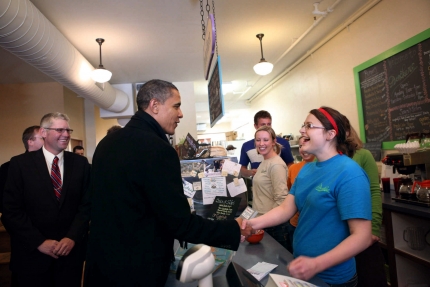
President Barack Obama greets the employees during a stop at Donkers candy store and restaurant in Marquette, Mich., February 10, 2011. (Official White House Photo by Samantha Appleton)

Quote: "America has always used the building of our infrastructure networks to take our economy forward and to build out American industry. The Wireless Initiative is going to bring that to the 21st Century. It's going to take it to the next level, because that's the American way."--Austan Goolsbee, chairman of the Council of Economic Advisers, explaining the National Wireless Initiative on the White Board.

Advise the Advisor: Your direct line to senior staff at the White House kicks off with a new video with Senior Advisor David Plouffe.

Open for Suggestions: The Consumer Financial Protection Bureau wants to hear from you. Check out the new ConsumerFinance.govshare your suggestions for the bureau and watch video responses.

Out-Building: This week, the President puts forward plans to build up the nation's infrastructure, investing in things like high speed rail, and expanding broadband access so all of America's families will be equipped to win the future: