

Latest News
Celebrating the One Year Anniversary of the Tribal Law and Order Act
Posted by on July 27, 2011 at 2:34 PM EST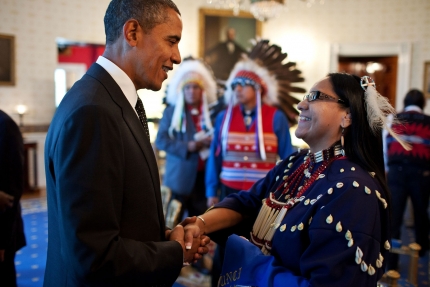
President Barack Obama greets Lisa Marie Iyotte in the Blue Room of the White House prior to signing the Tribal Law and Order bill signing ceremony, July 29, 2010. (Official White House Photo by Pete Souza)
This week marks the one-year anniversary of the enactment of the Tribal Law and Order Act (TLOA), a comprehensive law that is improving the federal government’s ability to work with Indian tribes in the investigation and prosecution of crime impacting tribal communities. President Obama was proud to sign the TLOA, as it fills key gaps in our criminal justice system that for far too long were not addressed.
Lisa Iyotte, a Lakota woman, a survivor, shared her personal story of her brutal rape that occurred in her home on a reservation as her young daughters watched. The man who raped her was never prosecuted for his crimes against her. During her introduction of President Obama at the TLOA signing ceremony, she said, “if the Tribal Law and Order Act had existed 16 years ago, my story would be very different.” As President Obama put it, “when one in three Native American women will be raped in their lifetimes, that is an assault on our national conscience; it is an affront to our shared humanity; it is something that we cannot allow to continue.”
TLOA helps us better address public safety in tribal communities. Specifically, TLOA gives tribes greater sentencing authority, improves defendant’s rights, establishes new guidelines and training for officers handling domestic violence and sex crimes, strengthens services to victims, helps combat alcohol and drug abuse and helps at-risk youth, expands recruitment and retention of Bureau of Indian Affairs and tribal officers and gives them better access to criminal databases.
An Important Speech for the Hispanic Community
Posted by on July 27, 2011 at 1:19 PM ESTThis week, the President went to the National Council of La Raza's annual conference luncheon in Washington, DC. There he discussed how the success of the Latino community is intrinsically tied to the success of our country, telling an audience of more than 2,000 that "the American family is only as strong as the Latino community." He highlighted the many promises we've kept; victories we have won working together in order to make sure America remains a place where opportunity is open to all who work for it. As the President outlined:
"We've cut taxes for middle class workers, small businesses, and low-income families. We’ve won credit card reform and financial reform, protections for consumers and folks who use payday lenders or send remittances home from being exploited or ripped off. We’ve worked to secure health care for 4 million children, including the children of legal immigrants, and we are implementing health reform for all who have been abused by insurance companies, and all who fear going broke if they get sick – big victories for a Latino community that suffers from lack of health insurance more than any other.
The President also addressed the "unfinished business" we still have before us. The President noted:
We know the recent recession has hit Latino families especially hard. We must continue our work on job creation to make sure everyone who wants a job can find one; to make sure paychecks actually cover the bills; to make sure families don’t have to choose between buying groceries and buying medicine; between sending their kids to college and being able to retire. My number one priority, every day, is to figure out how we can get businesses to hire and create jobs with decent wages. And in the short-term, there are some things we should do right away. I want to extend the tax relief we put in place for middle-class families, so that folks have more money in their paychecks. I want to cut red tape that keeps entrepreneurs from turning new ideas into thriving businesses. I want to sign trade deals so our businesses can sell more goods made in America to the rest of the world. And the hundreds of thousands of construction workers who lost their jobs when the housing bubble burst – I want to put them back to work building our roads and bridges and airports. There is work to be done. There are workers ready to do it. Bipartisan proposals for all of this would already be law if Congress would just send them to my desk. And I’d appreciate it if you’d all help me convince them to do it. Let’s get it done.
Taking a Chance with Solar Energy
Posted by on July 27, 2011 at 12:13 PM ESTIn the winter of 2007, Ella Jenness was like many Americans. She was looking for a job.
After four months of unemployment, she joined a company with just six workers in a field almost entirely new to her. Most of her experience was in real estate, and this was a solar energy production firm. It was “a new challenge,” Jenness said.
Today, that small company, Martifer Solar USA, has grown. The California-based business now has offices in Colorado and Connecticut. Martifer Solar will sub-contract out about 15,000 man-hours of labor. And the number of employees has jumped rather markedly – 983 percent, or 53 others to be precise.
Learn more about Economy, Energy and EnvironmentA Better Understanding of Employee Benefits for an Increasingly Diverse American Workforce
Posted by on July 26, 2011 at 5:13 PM ESTEd. Note: Cross-posted from (Work in Progerss)
Last year, I wrote in “Sometimes, It Takes An Interpretation” that by making a clarification to the Family and Medical Leave Act, originally passed in 1993, we are taking into better consideration the changing nature of America’s households and workers. Our clarification then means that today, a same-sex partner who shares in parenting, or an aunt who steps in for a mother called to active military duty, can take unpaid leave to ensure the care for a child at home.
Today, we take another great step in better understanding the resources and benefits available to America’s workforce.
For the first time, in order to better understand the benefits available to an increasingly diverse American workforce, this year’s National Compensation Survey from the Bureau of Labor Statistics includes information on domestic partner benefits, providing a better, fuller picture of employee benefits in workplaces across our nation.
The report shows that while 71% of all workers in private industry have access to health care plans, only about 1 in 4 such workers have access to a health care plan they can use to cover their same-sex or opposite-sex domestic partner.
High wage earners and union workers are significantly more likely to have access to benefits for a domestic partner, while only a small percentage of low wage-earners, non-union workers and part-time workers have access to these benefits.
Learn more about Health CareThe Arts Play a Significant Role in High Academic Performance
Posted by on July 26, 2011 at 4:23 PM ESTEd. Note: Champions of Change is a weekly initiative to highlight Americans who are making an impact in their communities and helping our country rise to meet the many challenges of the 21st century.
This past week, I had the privilege of participating in what I consider a “lifetime experience” in Washington, DC. I began Tuesday, July 19, by meeting with a group of exceptional educators from across the United States who are strong advocates of integrating arts into the curriculum. Through my affiliation with the National Association of Elementary School Principals (NAESP), I have had the opportunity to meet with colleagues from other geographical areas; however, I have never been provided with an occasion to collaborate with fellow educators from other areas of the United States who share a passion for arts education. As the principal of a school in a small town in south Alabama, sitting with a superintendent from a large district in Maryland, along with directors of highly successful programs in Detroit, Chicago, Cleveland, Dallas, Oklahoma City, and the South Bronx was truly incredible. The group quickly realized that our differences in geographical locations, backgrounds, and dialect were minor. On the other hand, our common dedication toward providing schools richly immersed in the arts quickly connected us into a cohesive group.
Following our meeting with fellow educators, we were introduced to a group of actors who strongly advocate providing arts education in schools. As members of the Creative Coalition, Tim Daly (coalition president), Omar Epps, Patricia Arquette, Rachel Leigh Cook, and Minnie Driver joined our group of educators for a guided tour of the East Wing of the White House. Initial feeling of inhibitions from meeting famous individuals immediately disappeared because of their friendliness and warmth. Once given a briefing by a secret service officer, our phenomenal White House tour began. In moments, our group jelled as we took advantage of every possible photo opportunity – photos of White House memorabilia and photos with celebrities!
Learn more about EducationEmpowering Small Business
Posted by on July 26, 2011 at 3:00 PM EST“The dairy business is getting tougher and tougher over the years,” Grant Kohler said, but he still looks forward to opening his small, family-run business, Heber Valley Artisan Cheese. Despite the tough economic conditions, Grant thinks his business, which will have a new creamery and an online operation that is rare in the dairy industry, has tremendous potential.
Heber Valley Artisan Cheese is not a typical small business. With more than 90 years of history and deep immigrant roots that spanned four generations and counting, its story epitomizes the American dream. When Albert Kohler, Grant’s grandfather, bought the Canyon View Farm in 1929, he had no idea whether his farm would survive the challenges of the Great Depression. What he did have was a tough work ethnic, an entrepreneurial spirit and the cheese making skills that he inherited from his father, who emigrated from Switzerland.

The Kohler family in the mountains of Heber Valley, home to Heber Valley Artisan Cheese. (Photo by Grant Kohler). (by Grant Kohler)
Learn more about EconomyClosing the Achievement Gap with Arts Programming
Posted by on July 26, 2011 at 11:02 AM ESTEd. Note: Champions of Change is a weekly initiative to highlight Americans who are making an impact in their communities and helping our country rise to meet the many challenges of the 21st century.
Tuesday, July 19th, 2011, was an exciting day for our school. It was an opportunity for me to participate with the White House staff and other arts education advocates in a discussion about how to continue to make arts an important part of our core curriculum. The pressure on schools to make budgetary cuts coupled with the increased stress of testing make arts programming during and after school often the first area that is cut. Sadly it disproportionately affects our neediest districts, especially those in the South Bronx. We wanted to be part of this discussion because we felt we can contribute several solutions that have worked well with our students. We believe that by transforming schools to become Arts Powered Schools, schools can become activist centers that use the arts to build a community of learners.
What is an Arts Powered School?
The Center for Arts Education, who developed the concept of Arts Powered Schools, believes as we do that all schools can be arts powered schools if they use the tools and resources of the community to help transform any school into a center of arts learning.
In New York City’s Community School District 7, we had a literacy rate of 23% in grades 3-8 in 2010. That means only about a quarter of students are reading proficiently and on or above grade-level. We believe that we need to change the culture of reading of our community by using the culture of the community as an asset to address summer learning loss. Partnering with the Multicultural Music Group, Yale Black Alumni Association, local teaching artists, teachers and principals, we offer students two hours of music instruction and two hours of visual arts instruction to inspire students to attend academic instruction that focuses on building reading stamina and a love for reading. This initiative is a three week summer program we call the "Summer Bridge Arts Institute." This program engages students in reading while developing students’ acumen through culturally relevant art. By developing great artists we know we can make great readers!
TRIO Advocates Visit the White House
Posted by on July 26, 2011 at 11:01 AM ESTLast week, 15 young leaders from around the country came to the White House to meet with the Office of Public Engagement and Domestic Policy Council staff about TRIO, a set of federally funded opportunity programs. Among the leaders in attendance were youth mentors, recent college graduates, and graduate students who came to discuss the impacts and future of the program.
TRIO opportunity programs support students from disadvantaged backgrounds in their pursuit of a college degree and a successful career. Over 850,000 low income, first generation, and disabled students are able to participate in the programs from 6th grade through their college graduation. With more than 2,800 programs nationally, TRIO is the largest discretionary program in the U.S. Department of Education.
Upward Bound, just one of the many TRIO opportunities, helps youth prepare for higher education. Participants receive instruction in literature, composition, mathematics, and science on college campuses after school, on Saturdays and during the summer. Another program, Talent Search, helps first generation students whose family annual income is less than $33,075 better understand educational opportunities and options. The program provides participants with information about college admissions requirements, scholarships and various student financial aid programs.
Our country’s future depends on programs like these to ensure all Americans have an ability to not only attend school but also to succeed and find support in communities during their entire educational experience.
The young leaders came to the White House to discuss their experiences with TRIO, and explain why recent cuts to the program are hurting the students nationwide. They told their own success stories, and discussed how continued cuts will endanger the ability of future students to benefit as they did from these important services.
One advocate said that TRIO programs allowed them to graduate high school, go to college, and find a successful career. Without the support systems and mentorship provided by the program, she said she would never have been able to graduate high school and would have never considered college an option. Today, she is a successful post graduate who is working to better the lives of younger students in her community.
Another advocate underscored the importance of the TRIO program by saying “it’s not that I used to be a McNair Scholar, it is that I will always be a McNair Scholar.” She explained that the programs helped her get through high school and college because of the support systems in place through TRIO. Beyond that, her time in TRIO encouraged her to continue to work with students still in the programs to provide them with a positive example of what these programs can help them achieve.
TRIO is a cornerstone of President Obama’s goal of having the highest proportion of students graduating from college in the world by 2020. As we continue to move forward, it is vitally important that these programs remain a priority and students across the country are given an opportunity to succeed in school.
Isaiah Nelson is an Intern in the Office of Public Engagement
Learn more about Education
- &lsaquo previous
- …
- 211
- 212
- 213
- 214
- 215
- 216
- 217
- 218
- 219
- …
- next &rsaquo
Twitter