

Latest News
First-Ever White House Hispanic Policy Conference: Why Hispanics are Critical to Winning the Future
Posted by on July 14, 2011 at 2:37 PM ESTThe success of our nation and the success of the Hispanic community are one and the same and our ability to win the future—to out innovate, out educate and out build our competitors—will depend greatly on the success of the Hispanic community.
It’s undeniable. At more than 54 million strong, the most recent census numbers show that the Hispanic community is no longer found in a handful of states, but in every state across the country. As the largest and fastest growing minority group in the U.S. it is critical to the future of our nation—our economy, our education system—that the Hispanic community thrives.
Over the last two days the White House Office of Public Engagement and the White House Initiative on Educational Excellence for Hispanics partnered to host the first ever White House Hispanic Policy Conference. 160 Hispanic leaders from 25 states, D.C. and Puerto Rico joined over 100 Administration officials to discuss the President's agenda and its impact on the Hispanic community and more importantly, to strategize together on how we best move forward together to improve outcomes and access for the Hispanic community.
The purposes of the policy conference were three-fold:
- Relationship Building—Connecting national leaders to key Administration decision makers.
- Obama Administration 101—Ensuring folks gained a deeper understanding of the multifaceted ways this Administration’s agenda connects to the Hispanic community.
- Working Together—Allowing participants to connect with each other and Administration officials to address how we improve access and outcomes for our community.
To make sure both days were valuable to the national Hispanic leaders present, we organized the conference differently than the formats used in the past.
On the first day—Obama 101—held at the White House, we focused on informal, interactive, small group conversations driven by Hispanic leaders, not Administration officials. No lectures. No PowerPoint presentations. No talking points. Just the opportunity for Hispanic leaders to meet, talk, and initiate relationships with senior Administration officials—more than 35 Administration officials participated from 19 White House Offices and Cabinet agencies (and we had to turn away many more officials because of time limitations!)
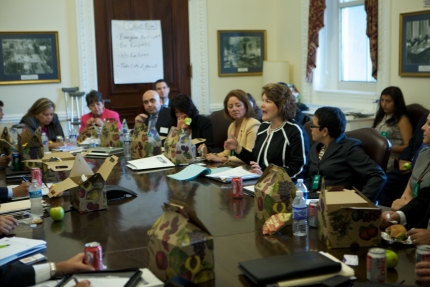
Judy Canales, Rural Business Administration and Ramona Romero, General Counsel, U.S. Department of Agriculture, discuss the department’s agenda and the Hispanic community. (Photo by Nilsa Ruiz)
Learn more about100+ Roundtables E-Book Launched
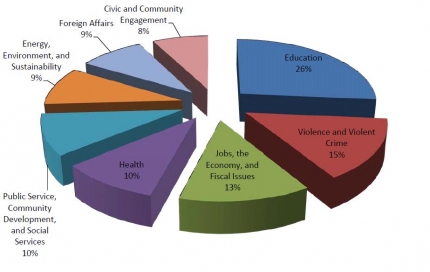
Posted by on July 14, 2011 at 1:40 PM ESTAcross the country, through President Obama’s Roundtable Initiative for Young Americans, 384 youth roundtables were held with a wide range of your peers in 46 states, the District of Columbia, and Guam. As the initiative wrapped up at the end of May, President Obama and White House staff began to follow-up, with the launch of “How to Make Change,” an ongoing summer program that connects young people to the issues they cared about most during the roundtables. What exactly were those issues, how did they rank amongst all of the roundtables, and where around the country were these conversations held?
Click here (PDF) to download the e-book, review the summary, and read feedback that young people gave to us. We hope this can offer some guidance on connecting you with other young people around the country that are engaged on issues too. Check it out!
Download the PDF e-book summarizing the 100+ Youth Roundtables
 Learn more about Additional Issues
President Obama Calls Young Leaders
Posted by on July 14, 2011 at 1:00 PM ESTYesterday afternoon, President Obama called three young leaders to thank them for the work they did on a range of topics from youth civic engagement and interfaith issues to roundtables with Young Americans, and summits on youth entrepreneurship & employment. The President wanted to let Reshma Saujani, Erik Kamrath, and Haris Tarin know what a big difference the work that they, and scores of other young people like them make every day when they participate in community engagement and help solve major issues that affect all Americans.
The President spoke with Reshma on her partnership with young business owners and advocates around our #1 priority - employment and entrepreneurship – in this case youth employment. He connected with Haris on his work with interfaith communities and the American Muslim community in assuring that no American slips through the cracks and that young Americans of all backgrounds feel connected and engaged in the work of our nation, and he spoke with Erik on the issues of student aid, the Dream Act, and youth jobs that were discussed at the roundtables he hosted.
President Obama also talked with them about ways in which the Administration will be taking their feedback, and that of young Americans of all backgrounds and opinions seriously as we continue to move forward.
Get engaged and stay in touch with us: Whitehouse.gov/YoungAmericans
Cleaning Up Schools, Taking Care of Our Space
Posted by on July 14, 2011 at 10:53 AM ESTEd. Note: Champions of Change is a weekly initiative to highlight Americans who are making an impact in their communities and helping our country rise to meet the many challenges of the 21st century.
I applied to be on Grades of Green’s Kids’ Advisory Board because they are working to inspire kids to be green and I wanted to be a part of it. They nominated me for the Champions of Change award because of the work I have done at my school, American Martyrs. I was so excited when they called and told me I had been named a “Champion of Change.”
As a Champion of Change, on July 8th I was part of a video conference from the White House situation room with kids from all over the country who have implemented environmental changes just like I have. Seeing and hearing all the great activities they have organized (including mine) showed me that us kids really can make a difference. After the videoconference I was honored and learned some new activities which I will try to put in place at my school.
I became involved in ecology because I am worried about what is happening to our planet. I believe we all have a responsibility to take care of our space. It is not up to our parents, or others to pick up after us. I wanted to get others to help me clean up our school so I ran for the position of safety and ecology and I won. After being elected I began making our school green. The first activity I organized was a drive to recycle gently used school supplies. I thought of this idea because I know at the end of the school year everyone just throws their old school supplies away. Filling my garage with pens, pencils, crayons, old notebooks, etc. I sorted it with some help from my friends and we gave the supplies to a less fortunate school in Watts. The smiles on their faces made it all worthwhile and we were keeping it out of the landfill.
Learn more about , Energy and EnvironmentInspiring Students To Environmental Literacy
Posted by on July 13, 2011 at 1:01 PM ESTEd. Note: Champions of Change is a weekly initiative to highlight Americans who are making an impact in their communities and helping our country rise to meet the many challenges of the 21st century.
When I was honored last Friday as a Champion of Change and participated in the subsequent video conference event with the other honorees, it became clear to me that the White House Administration and fellow youth around the nation have a commitment to environmental literacy. This essential commitment will engrain environmental consciousness into the next generation of decision makers.
During the summer of my freshman year of high school, I was a volunteer docent at "Cool Globes," an environmental exhibit at the California Science Center, providing tours and engaging public elementary schools students visiting on field trips. While volunteering, I noticed that the majority of students visiting the exhibit had difficulty answering what I thought to be basic questions, such as "Why is it important to protect our environment" or "Why is recycling good for the environment?"
I quickly understood my community's need for environmental education in public elementary schools and decided to create The GreenTeens, a program to increase students' understanding, inspire them to take action, and empower them to lead their communities toward green citizenship.
Learn more about Energy and EnvironmentYoung Leaders Taking Charge in Environmental Sustainability
Posted by on July 12, 2011 at 4:54 PM ESTEd. Note: Champions of Change is a weekly initiative to highlight Americans who are making an impact in their communities and helping our country rise to meet the many challenges of the 21st century.
All across the country, young people are taking initiative in their schools and communities to teach others about the importance of environmental stewardship, energy conservation, and reducing waste. This past Friday, the White House honored a group of young leaders who have taken it upon themselves to do just that – educate and change their communities. These young people have taken the initiative to help green their schools and to inform other people, adults and youth alike, about the importance of living a more sustainable life. From teens teaching school-children about environmental issues, to primary school kids starting school gardens and encouraging kids to bring trash-free lunches, these Champions of Change are not only inspiring the adults around them by greening their schools, but they are making sustainability something ‘cool’ and interesting to the kids in their classes and communities.
I was fortunate enough to meet with these young leaders over a video chat from the Situation Room, and to hear their stories, successes, and struggles first hand. The strength of America’s clean energy future depends on the dedication and innovation of our future leaders, and after spending time with these outstanding individuals, I’m encouraged that this generation is taking it upon themselves to make changes that will help and sustain our world.
Please visit the Champions of Change website to learn more about these young people and their work. We hope these Champions and their causes will inspire and energize you, no matter what your age, to educate yourself about sustainability, and to work to make a difference in your own communities.
Ashley Baia is Associate Director of the Office of Public Engagement
How Kids Can Do Something to Protect the Earth
Posted by on July 12, 2011 at 1:42 PM ESTEd. Note: Champions of Change is a weekly initiative to highlight Americans who are making an impact in their communities and helping our country rise to meet the many challenges of the 21st century.
I am Grace Cortese, and I am 10 years old. You might think I’m too young to make a difference in the environment. The reason I don’t believe that is because of my science teacher, Jillian Esby. She cares a lot about the environment and she teaches us that there are a million ways we can help if we pay attention and are willing to change our habits. Even the little things can add up, like turning out the light when you leave a room, or using both sides of the paper. Now my whole school is doing things to help protect the earth.
My school has a composter for our lunch leftovers, a waste-free lunch program, recycle bins all over campus and a book swap. Our school made a carpool program to reduce the number of cars on campus, and we have a “Walk to School” day once a year. We also did a really cool thing to eliminate paper napkins and disposable water bottles. Each classroom has a party pack with cloth napkins, plastic cups and plates and we use those for all the class parties and events. My science teacher Mrs. Esby has a “Teenie Greenies” club at lunch and she teaches a class in “up-cycling” after school. Last year, we planted a fruit orchard on campus. We will give the fruit to the local food bank. My school does a lot to help others, too. We collect canned food for the Westside Food Bank and we fix meals for the homeless. Last year we collected 17,720 pounds of food and fixed 285 meals. In second grade, we “adopt a beach” through Heal the Bay and we do beach clean-ups. I learned a lot about the disgusting things that end up in the ocean, like cigarette butts and plastic bags. Last year at school, we had a read-a-thon to raise money for malaria nets in Malawi, Africa for a place called. G.A.I.A. I called my friends, grandparents, aunts and uncles and I raised $2,000! That is enough for 200 bed nets, and I feel really happy that I helped keep kids in Africa safe from malaria.
Winning The Future for Native American Youth
Posted by on July 11, 2011 at 12:28 PM ESTOn Sunday, the White House Office of Public Engagement launched the Native American Youth Challenge program. In a video message, President Obama announced the challenge at the 2011 UNITY Youth Conference, calling for young American Indian and Alaska Native leaders to submit their stories of leadership and service in their communities. The stories submitted will be considered and evaluated based on ademonstrated record of service to one’s tribe, nation, village, or community. Young leaders who have sought to improve their communities are encouraged to submit stories in one or more of the following areas:
- Education, Mentorship or Afterschool Programs;
- Sports, Nutrition or Let’s Move! in Indian Country;
- Substance and Alcohol Abuse Prevention;
- Health and Wellness, including Youth Suicide Prevention;
- Building Healthy Relationships and Peer Relationships;
- Cultural Preservation and Native Languages;
- Anti-Bullying and Personal Empowerment;
- Self Expression through Arts and Crafts;
- Emerging Leadership in Government Service; and
- Economic and Community Development
As a part of the challenge, a handful of exceptional Native youth community leaders will be invited to the White House this fall in conjunction with the activities of Native American heritage month. Submissions should include a description of the leadership initiatives or community programs; the number of people involved or effected; key examples of success; and explanations of the barriers or challenges and how they were overcome. Simply put, we hope to hear from Native American Youth to learn about how you are working to overcome the challenges facing your communities – send us your stories!
One great example of how young people are overcoming the challenges facing Indian Country is by taking part in the First Lady’s initiative, Let’s Move! in Indian Country. Today, the White House Summer South Lawn Series hosted a lacrosse event for approximately 80 Native American youth from the Menominee Nation, the Eastern Band of Cherokee Indians, Native Lifelines of Baltimore, as well as local youth from Annapolis and D.C. The groups played and learned about Lacrosse with some of the best players in the game, while also learning about the origins of the game and cultural traditions from members of the Onondaga Nation. Let’s Move! in Indian Country strives to bring together federal agencies, communities, nonprofits, corporate partners and tribes to end the epidemic of childhood obesity in Indian Country within a generation.
Charles Galbraith is the Associate Director of the White House Office of Intergovernmental Affairs and Public Engagement
Learn more about Civil Rights
- &lsaquo previous
- …
- 215
- 216
- 217
- 218
- 219
- 220
- 221
- 222
- 223
- …
- next &rsaquo
Twitter