

Latest News
Collaborating with Tribes through the White House Rural Council
Posted by on July 1, 2011 at 10:55 AM ESTOn June 9th, President Obama signed an Executive Order establishing the first White House Rural Council. While rural communities face challenges, they also present economic potential. The Council will address these challenges, build on the Administration’s rural economic strategy, and improve the implementation of that strategy.
The Council, chaired by Secretary of Agriculture Tom Vilsack, was established to focus on policy initiatives for Rural Americans and will coordinate to increase the effectiveness of federal engagement with tribal governments. According to the 2010 U.S. Decennial Census, 42.6 percent of all Native Americans live in rural areas. In addition, some reservations face unemployment rates of up to 80 percent. The Council will work across federal agencies to address these challenges and promote economic prosperity and quality of life in Indian Country and across rural America. The Council will work to break down silos and find areas for better collaboration and improved flexibility in government programs and will work closely with state, local and tribal governments, non-profits, and the private sector to leverage federal support.
Plans are already underway for the Council to address ways to expand access to capital in rural communities, including an examination of the unique challenges facing Indian Country in increasing the flow of credit to Indian reservations. Economic development and job creation in Indian Country—and in all other sectors of the U.S. economy—depend on access to capital. When credit-worthy business owners can easily borrow to finance business start-up and expansion, the economy thrives. One thing we hear from tribal leaders, however, is that borrowing money for business development in Indian Country is difficult. The reasons range from difficulties in using tribal land as collateral, to the small number of lending institutions serving Indian Country, to lenders’ perceptions that lending to tribal members or tribal governments is risky.
Learn more about RuralTransforming the Global Lighting Industry
Posted by on June 29, 2011 at 11:04 AM ESTEd. Note: Champions of Change is a weekly initiative to highlight Americans who are making an impact in their communities and helping our country rise to meet the many challenges of the 21st century.
Earlier this year, I was honored to be recognized as a Champion of Change and to join in a White House roundtable discussion with leaders in the Science and Technology community. The invitation to join in the discussion gave me the chance to share how Lighting Science Group, the LED lighting company that I founded in 2004, benefits from the expertise of scientists and engineers who have joined us from NASA Kennedy Space Center. Our advances in the field of LED lighting, which produces high quality light using about 80% less electricity than traditional lighting, would not have been possible without the contributions of these talented and dedicated men and women working alongside our engineering, lighting and manufacturing professionals.
In our conversations, we focused on what each of us are doing and what more can be done to further develop our technology-based industries while also contributing to job creation and quality of life in our communities. Our most significant insight was the virtuous cycle generated when centers of technical excellence create a center of gravity, attracting the commercial, educational and human resources required for new employment and business success. Kennedy Space Center has the technical resources, the facilities, the local educational infrastructure and the heritage to emerge as one such center. By creating a nucleus of technologies with the potential to transform large segments of our economy or create whole new industries, these centers of gravity are critically important to America’s continued competitiveness.
Learn more about TechnologyPushing Past Boundaries with Florida's Space Coast
Posted by on June 28, 2011 at 5:21 PM ESTEd. Note: Champions of Change is a weekly initiative to highlight Americans who are making an impact in their communities and helping our country rise to meet the many challenges of the 21st century.
“Change is the law of life. And those who look only to the past or present are certain to miss the future.”
—John F. KennedyCourage and hard work have served as hallmarks of America’s space program since the earliest days of NASA. As the Shuttle Program nears completion, opportunities emerge in the face of certain change. The Space Coast must embrace the many changes that are occurring and leverage the resulting opportunities.
Recently, I participated in a discussion with leading thinkers from Florida’s Space Coast regarding the next chapter for our community, state and nation. I strongly believe there is a great opportunity for Space Coast to not only secure its own economic vitality but also create significant value for the entire country. The Space Coast has one the most technically capable engineering and technician workforces in the world. This workforce presents a powerful resource for companies that are developing new technologies and pushing past established boundaries. I am very pleased that NASA and local leadership are working hard to both support and create technology development/manufacturing opportunities for this talented workforce.
Rivian Automotive is building on the creative thinking and diligent hard work that have guided the space program to its unparalleled achievement. Taking a clean sheet approach, Rivian is reinventing the way automobiles are designed, manufactured and sold. Rivian has developed platform, manufacturing and powertrain technologies that enable affordable, ultra-efficient vehicles that do not require compromises in performance or style.
Learn more about Innovations, TechnologyPioneering New Frontiers in Technology and Innovation
Posted by on June 28, 2011 at 5:19 PM ESTEd. Note: Champions of Change is a weekly initiative to highlight Americans who are making an impact in their communities and helping our country rise to meet the many challenges of the 21st century.
Earlier this year, I had the privilege of traveling to Florida’s ‘Space Coast,’ home of Cape Canaveral and the legendary Kennedy Space Center, to meet with industry and business leaders whose work is at the cutting edge of space exploration and technology. I was there as part of the Administration’s Champions of Change Series, to highlight the work people are doing every day to win the future through innovation and education.
I had a very lively discussion with nearly 20 area residents about their work. These are visionary leaders both within the government and the private sector who are working to tap the exceptional skills and resources of the Space Coast to ensure the area’s economy continues to prosper and diversify, as NASA ends the Space Shuttle program and proceeds with efforts to develop new crew transportation and space exploration systems. We discussed creative, hands-on learning programs for young students inspired by NASA’s missions. We met business owners who are transforming technology and capabilities developed for the Shuttle program into good jobs for Florida workers. We met an entrepreneur who is hiring former NASA engineers and trying to revolutionize how we build cars in America. We met NASA contractors and private launch companies, who all are doing incredible work to adapt and grow their businesses in an uncertain environment.
We also heard really good ideas about how government and industry can work together to utilize the immense brain-power, and unique capabilities and infrastructure that exists across the I-4 corridor to spur further development and growth of this important economy.
If my one hour conversation with one room of people is any indication of the creativity and potential of the space industry to continue to pioneer new frontiers in technology and innovation, I can’t wait to see what they’ll come up with next.
Carlos Monje is Special Assistant to the President and Chief of Staff of the White House Domestic Policy Council.
Learn more about TechnologyA Historic Step Toward True Trust Reform
Posted by on June 28, 2011 at 10:55 AM ESTEd. Note: WhiteHouse.gov just launched a new page dedicated to the Native American community, view it here.
An historic court action on June 20 signaled the beginning of a new era in the U.S. Government’s relations with American Indian communities.
By approving the $3.4 billion settlement of the Cobell v. Salazar lawsuit, U.S. Senior District Judge Thomas F. Hogan paved the way for payments to as many as a half a million American Indians to resolve their class-action litigation regarding the federal government’s management of their individual trust accounts and assets.
A fund of $1.5 billion will be used to compensate class members for their claims regarding potential mismanagement of their trust funds and assets and historical accounting. The agreement also establishes a $1.9 billion fund for the voluntary buy-back and consolidation of fractionated land interests, which have been proliferating through succeeding generations. The program, to be administered by the Department of the Interior, provides individual American Indians an opportunity to obtain cash payments for small divided land interests and free up the “fractionated” land for the benefit of tribal communities. The settlement also provides for a Indian Education Scholarship Fund of up to $60 million for the benefit of American Indians and Alaska Natives.
Learn more about Civil RightsA New Webpage for the Native American Community
Posted by on June 28, 2011 at 10:43 AM ESTThe White House is pleased to announce the launch of “Winning the Future: President Obama and the Native American Community.” This webpage is meant to serve as another tool to help Indian Country navigate the federal government and learn about how the President’s Agenda is helping to win the future for Native Americans.
Since his first day in office, President Obama has worked to strengthen the government-to-government relationship between the United States and tribal governments in order to improve the quality of life for all Native Americans. Working with tribal leaders through meaningful consultation, the Administration and Indian Country have made significant progress in several areas. We made sure the Recovery Act included many job-creating investments for Indian Country. Our health care reform permanently authorized the Indian Health Care Improvement Act, and the President signed into law the Tribal Law and Order Act, which will help fight crime in Indian Country. Furthermore, the Administration finally settled the longstanding legal claims in the Cobell litigation and the lawsuit brought by Native American Farmers against the United States Department of Agriculture. To mark the launch of this webpage, we are highlighting a guest blog post by Interior Secretary Ken Salazar on the recent court approval of the historic settlement in the Cobell lawsuit, “A Historic Step Towards True Trust Reform.”
All of these accomplishments have provided more opportunity and security for Native Americans, but they are just part of our ongoing effort to create stronger tribal communities throughout Indian Country. This new webpage is designed to be a centralized forum to share information about those ongoing efforts, while continuing to improve our government-to-government relationship.
Learn more about Additional IssuesBroadband and the Latino Community: Let's Keep the Momentum Going!
Posted by on June 27, 2011 at 10:11 AM ESTYesterday I was happy to participate in a panel discussion about broadband at the National Association of Latino Elected and Appointed Officials (NALEO) annual conference in San Antonio. NALEO members recognize that broadband Internet is one of the tools necessary to help their communities thrive in today's economy. In fact, I think that any conference focused on building stronger communities should include a discussion of broadband - it's a critical ingredient for job creation, economic growth, and improving education, health care, and public safety.
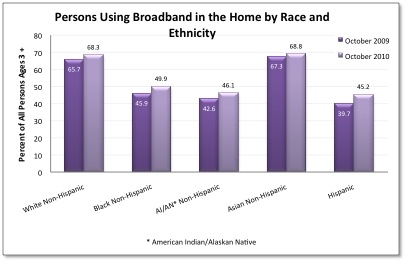
I talked about challenges and opportunities. NTIA's data show that although 90-95 percent of Americans live in areas with access to broadband, only 68 percent of households subscribe to the service. In fact, more than 28 percent of Americans do not use the Internet in any location, which means they are cut off from countless educational and job opportunities.
The issue is even greater for Latinos. While the Internet subscribership rate for Hispanics increased by five percentage points last year, it is still only 45 percent. Even after adjusting for socioeconomic factors like income and education, Latinos still significantly lag the national rate in broadband adoption.
Our research shows that those who lack broadband at home most commonly cite lack of interest or need as the primary reason. Interestingly, while those are certainly factors for Hispanic non-adopters, they most often cite affordability as the primary reason. So there is no single solution to bridging the digital divide.
But the good news is that NTIA, and others in the Obama administration, are working on many fronts to expand broadband access and adoption, including efforts targeted to Hispanics and other communities where broadband is underutilized, such as rural Americans, seniors, people with disabilities, and other minorities.
For example, NTIA's broadband grants program - a $4 billion Recovery Act investment in high-speed Internet infrastructure, public computer centers, and broadband adoption initiatives - is bringing more Latinos online and providing training in the skills needed for today's jobs. I also asked attendees to help us build awareness of www.DigitalLiteracy.gov, a website we launched recently to increase computer and Internet skills in America. The site contains a range of tools for teaching and learning digital literacy, and it provides a central location for practitioners to share materials and best practices. Anyone can suggest additional resources for the website, and I encouraged more content targeted to the Hispanic community.
I appreciate NALEO's focus on broadband. To everyone working on empowering Latino communities: let's keep this momentum going!
Guest blog by Ms. Anna M. Gomez Deputy Assistant Secretary for Communications and Information
and Deputy Administrator, National Telecommunications and Information Administration (NTIA)
U.S. Department of Commerce.Learn more about Technology, Additional IssuesMarking Progress for LGBT Americans in Foreign Affairs
Posted by on June 24, 2011 at 6:22 PM EST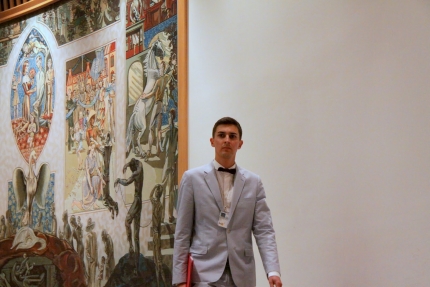
Curtis Ried, an advisor to Ambassador Susan Rice, leaves the chamber of the UN Security Council (USUN Image)
Editor’s note: Click here for Ambassador Rice’s full remarks to Gays and Lesbians in Foreign Affairs Agencies (GLIFAA). On Monday, June 27, at 10:25 a.m., Secretary of State Hillary Rodham Clinton will deliver remarks to GLIFAA in the Dean Acheson Auditorium at the Department of State. They will be carried live at www.state.gov.
Life at the State Department has changed immeasurably for lesbian, gay, bisexual and transgender (LGBT) employees since the founding of Gays and Lesbians in Foreign Affairs Agencies (GLIFAA) in 1992. As a member of GLIFAA and a Foreign Service Officer, I deeply appreciate the dedication of the Obama Administration to ensuring that LGBT members of the Foreign Service enjoy many more equal benefits for our partners and families than was the case until just a few years ago. On a broader level, the central role this Administration has given to the promotion of human rights for LGBT persons around the world is a tremendous source of pride for me and for my fellow LGBT colleagues.
GLIFAA was thus particularly honored to host Ambassador Susan Rice at a commemoration of LGBT Pride Month on Friday in Washington, DC. Standing before nearly 80 employees of the Department of State and NGO representatives who work on LGBT issues, Ambassador Rice spoke passionately about the work of the U.S. Mission to the United Nations to strengthen the LGBT community’s basic human rights worldwide. Crucially, she marked the June 17 passage of a historic Human Rights Council resolution dedicated to advancing the fundamental human rights of LGBT persons – the first such resolution ever to pass a vote by a UN body. Ambassador Rice said:
When the U.S. delegation voted yes in Geneva, we reaffirmed a basic American promise: to fight discrimination in any guise and to embrace diversity in every form. The Obama Administration is proud to work to make that promise real. We’ve taken historic strides to advance LGBT equality and to strengthen LGBT families and communities.
Learn more about Civil Rights
- &lsaquo previous
- …
- 217
- 218
- 219
- 220
- 221
- 222
- 223
- 224
- 225
- …
- next &rsaquo
Twitter