Energy and Environment Latest News
Cool Roofs: An Easy Upgrade
Posted by on December 14, 2010 at 4:09 PM ESTEd. Note: Cross-posted from the Energy Blog.
Check out Google Earth – the ‘view from above’ of your favorite American city. And look at the roofs of the office buildings, warehouses, shopping centers, and even the homes. Most of them are probably pretty dark in color – and this means they heat up a lot when the weather is warm – up to 50 degrees hotter than light roofs. All of those dark roofs mean that as a nation we’re using a lot more air conditioning than we need to. At least a billion dollars a year in extra power bills, in fact. And when you combine hot roofs with dark roads and parking lots, we get the ‘urban heat island’ effect: cities tend to be 2-5 degrees hotter than less urban areas just because of all the dark surfaces.
But there’s something we can do about it: changing to a ‘cool roof.’ The Department of Energy just did this in our Washington, DC headquarters. It was time to replace our roof anyway, so for no extra cost we went to a ‘cool’ white material. And we’re hoping others follow this lead.
Here's a video of Secretary Chu giving his thoughts on our new cool roof:
Viewing this video requires Adobe Flash Player 8 or higher. Download the free player.Learn more about Energy and EnvironmentBoosting Exports of Renewable Energy and Energy Efficiency Technology
Posted by on December 14, 2010 at 2:13 PM ESTFrom the earliest days of the Obama administration, we have been working to promote innovation and competitiveness in high-growth sectors like renewable energy and energy efficiency (RE&EE). President Obama’s Recovery Act, for instance, made the single largest investment in clean energy in our nation’s history. Over $90 billion was invested through the Recovery Act to promote everything from advanced wind turbines and solar panels to new battery technologies and the modernization of our electricity grid.
Thanks to these investments and the ingenuity of U.S. businesses, America is on track to meet the president’s goal of doubling the country’s installed capacity of renewable energy technologies by 2012
But spurring domestic clean energy innovation to meet America’s needs is only half of the picture.
Empowering U.S. business to create and deliver those new technologies to energy-hungry foreign markets is the other.
Open for Questions: Environmental Justice with CEQ Chair Nancy Sutley and EPA Administrator Lisa Jackson
Posted by on December 14, 2010 at 2:09 PM ESTThis Wednesday, December 15, 2010, the Obama Administration is hosting the first White House Forum on Environmental Justice to build on our commitment to ensuring that overburdened and low-income communities have the opportunity to enjoy the health and economic benefits of a clean environment. At lunch, U.S. Environmental Protection Agency Administrator Lisa P. Jackson and I will host a live Facebook chat to answer your questions about the Obama Administration’s work to create a healthy and sustainable environment for all Americans.
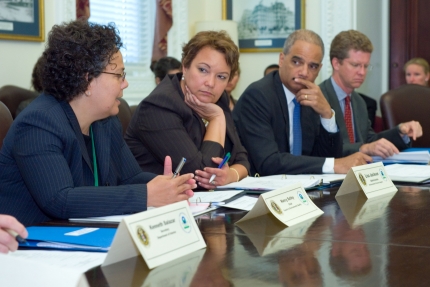
CEQ Chair Nancy Sutley, EPA Administrator Lisa Jackson, Attorney General Eric Holder, and HUD Secretary Shaun Donovan discuss environmental justice issues in September.
Tune in on Wednesday, December 15th at 12:50PM EST to participate in the discussion live at whitehouse.gov/live. To submit your questions on Facebook, sign on to http://apps.facebook.com/ObamaWhiteHouselive/. Also, watch the White House Forum live all day, beginning at 10am, at www.whitehouse.gov/live.
Nancy Sutley is Chair of the White House Council on Environmental Quality
Learn more about Energy and EnvironmentA Global Focus on Climate Change
Posted by on December 14, 2010 at 2:01 PM ESTClimate change is one of the greatest environmental and public health challenges we face in the modern world. Confronting it will demand global collaboration and prompt difficult decisions. Last week, I joined Secretaries Chu and Vilsack at the 16th session of the Conference of the Parties (COP-16) to the United Nations Framework Convention on Climate Change.
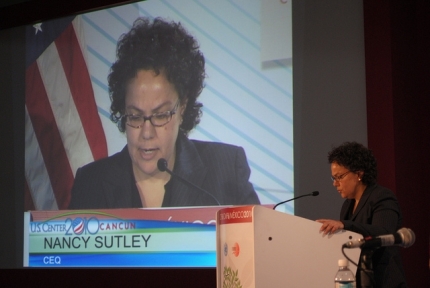
CEQ Chair Sutley addresses the U.S. Center at COP-16 in Cancun, Mexico, on December 8, 2010 (Courtesy of U.S. Department of State)
President Obama has made it clear that the United States must take bold action to address the growing threat of global warming, to reduce our dependence on finite resources such as oil, and to create clean energy jobs and technologies. This Administration has taken unprecedented steps to address these problems –we have made major investments in clean energy through the Recovery Act and we have moved toward tough new fuel economy standards for cars and light trucks, among a range of other actions.
This Administration recognizes that the Federal Government cannot advocate change with any credibility unless we are willing to take action ourselves. U.S. Special Envoy for Climate Change and head of the U.S. delegation Todd Stern focused on securing a balanced package of decisions building on the progress made in Copenhagen last year. I hosted side events to highlight leadership in focusing on the Federal Government’s role in reducing greenhouse gas emissions and preparing the U.S. to adapt to the impacts of climate change.
The Federal Government is the single largest energy consumer in the U.S. economy, racking up an energy bill of more than $24 billion in 2008 alone. President Obama signed an Executive Order last year directing Federal Agencies to slash their greenhouse gas emissions and meet sustainability goals to help us grow a clean energy economy and save taxpayer dollars.
The U.S. Government is one of the first national governments or large corporations to tackle this challenge to measure, report, and reduce our greenhouse gas pollution from indirect sources (such as employee commuting). Our commitment to leading by example is about more than net reductions in greenhouse gases. We are also building up a body of knowledge and experience among Federal officials who are involved in setting and implementing national policies aimed at achieving our clean energy goals. And through pilot programs with some of our 600,000 vendors and contractors, we are working to design ways to support businesses that share these sustainability goals.
Sharing our leadership at home in Federal sustainability with an audience of international leaders is an important way to highlight our commitment to dealing with climate change. President Obama’s Executive Order allows us to leverage the Federal Government’s influence to benefit all Americans, support a job-producing clean energy economy, protect our environment, and help prop up the health and prosperity of the United States and the world.
A special note of congratulations and thanks to Ambassador Stern and the U.S. Negotiations team for helping to forge agreements at Cancun that will make measureable progress in reducing global greenhouse gas pollution.
Nancy Sutley is Chair of the White House Council on Environmental Quality
Learn more about Energy and EnvironmentCelebrating EPA's 40th Anniversary
Posted by on December 6, 2010 at 7:09 PM ESTLast week marked a major milestone for the U.S. Environmental Protection Agency (EPA) as it turned 40 years old on December 2, 2010. On Thursday, I joined EPA Administrator Lisa P. Jackson and other Obama Administration officials in wishing the agency "Happy Birthday" after four decades of work to protect the health of the environment and all Americans. We launched the event by reading President Obama's Proclamation on the 40th Anniversary of the Environmental Protection Agency, which called on the EPA and other Federal Agencies to continue their legacies of responsible stewardship and to advance environmental quality in the face of new challenges, including global climate change.
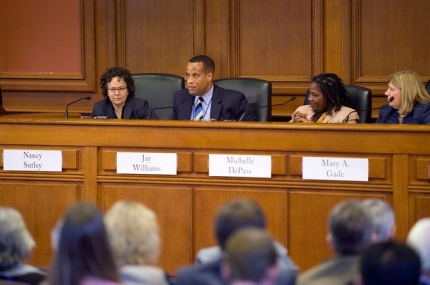
Chair Sutley, Youngstown, Ohio Mayor Jay Williams, EPA Assistant Administrator Michelle DePass, and Former EPA Regional Administrator Mary Gade participate in the EPA @ 40 conference. (Photo by Eric Vance, US EPA)
On Friday, I joined other environmental leaders at Harvard University for its conference: "EPA @ 40: Protecting the Environment and Our Communities." I had the opportunity to lead a panel on "Global Problems and Local Solutions," which included a dynamic discussion on EPA's history of success in working with state and local governments and communities to safeguard the health of our environment. EPA's 40 years of leadership have fostered cleaner communities, promoted the health of children, and helped build a stronger America. The Obama Administration is committed to continuing this proud legacy, and to leaving a clean and healthy country for future generations.
Nancy Sutley is Chair of the White House Council on Environmental Quality
Learn more about Energy and EnvironmentArctic National Wildlife Refuge Turns 50
Posted by on December 6, 2010 at 6:31 PM EST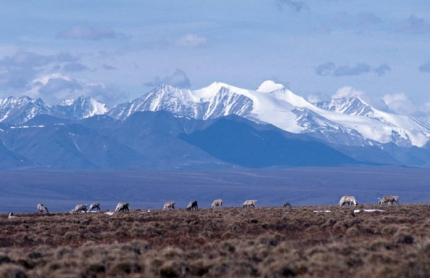
Caribou in the Arctic Refuge coastal plain, with the Brooks Range mountains in the background to the south. (by U.S. Fish and Wildlife Service)
Today, I join with the President, Secretary of the Interior Ken Salazar, and countless Americans to celebrate the 50th anniversary of the establishment of the Arctic National Wildlife Refuge. Few places in America retain the natural beauty of the Refuge, which protects a broad swath of northeast Alaska and its shoreline.
The Arctic National Wildlife Refuge has a long bipartisan history. Following the efforts of countless conservationists, in 1960 President Eisenhower signed an executive order to establish the Arctic National Wildlife Range “for the purpose of preserving unique wildlife, wilderness and recreational values” and followed many years of efforts by conservationists to protect our wild lands. These conservationists, including Olaus and Margaret Murie, sought to protect this unique American landscape. In 1980, under President Carter’s leadership, the area was renamed the Arctic National Wildlife Refuge and expanded to further recognize and protect the variety of wildlife found in the area.
Learn more about Energy and Environment
- &lsaquo previous
- …
- 147
- 148
- 149
- 150
- 151
- 152
- 153
- 154
- 155
- …
- next &rsaquo
Related Videos
-
 May 09, 2014 8:21 AM
Inside the White House: Solar Panels
-
 September 01, 2016 8:25 PM
President Obama Delivers a Statement to the Press
White House Blogs
- The White House Blog
- Middle Class Task Force
- Council of Economic Advisers
- Council on Environmental Quality
- Council on Women and Girls
- Office of Intergovernmental Affairs
- Office of Management and Budget
- Office of Public Engagement
- Office of Science & Tech Policy
- Office of Urban Affairs
- Open Government
- Faith and Neighborhood Partnerships
- Social Innovation and Civic Participation
- US Trade Representative
- Office National Drug Control Policy