Energy and Environment Latest News
EPA@40: Healthier Families, Cleaner Communities, A Stronger America
Posted by on December 3, 2010 at 3:13 PM ESTYesterday the EPA commemorated its 40th anniversary. It was a time to reflect on the many ways EPA has protected the air we breathe, safeguarded the water that flows into our homes, and cared for the land where we build our communities and grow our food.
Many Americans may not remember what life was like before EPA opened its doors. Los Angeles was known as the smog capital of the world, and in 1969 - six months before the EPA’s founding - Cleveland’s Cuyahoga River actually caught fire because of pollution.
Today, when we pour a glass of water, we can be confident it is free of pollution. We can breathe easier knowing that our cars are not releasing harmful lead pollution into the air. When we buy an apple at the grocery store, we are assured it will not carry the dustings of extremely dangerous pesticides.
Learn more about Energy and EnvironmentWhat You Missed: Tuesday Talk with Secretary Steven Chu
Posted by on December 2, 2010 at 4:29 PM ESTIn Tuesday Talks this week, Department of Energy Secretary Steven Chu answered your questions from WhiteHouse.gov and Facebook in a live video chat. Secretary Chu recently delivered a speech calling on the United States to sharply accelerate innovations in clean energy -- citing China and other countries' recent advances in clean technology as a critical "Sputnik Moment" for the U.S.
Watch the chat to learn what you can do to save more energy at home and about the initiatives that the Department of Energy is undertaking to promote a sustainable energy economy. You can check out the full video of the chat or use the links below to jump directly to the questions you're interested in.
Learn more about Energy and EnvironmentTuesday Talks: Building A Clean Energy Economy with Energy Secretary Chu
Posted by on November 29, 2010 at 2:21 PM ESTEd. Note: This live event has concluded. Check back for the video.
In Tuesday Talks this week, Department of Energy Secretary Steven Chu is answering your questions in a live video chat. Secretary Chu recently delivered a speech calling on the United States to sharply accelerate innovations in clean energy -- citing China and other countries' recent advances in clean technology as a critical "Sputnik Moment" for the U.S. Now, it’s your chance to ask the Secretary your questions on building a clean energy economy.
Join us for a talk with Secretary Chu on Tuesday, November 30th at 1:15 p.m. EST.
Here's how you can participate in advance:
Here’s how you can join live:
- Join the discussion live through the White House Facebook application
- Watch the chat through WhiteHouse.gov/live
Learn more about Energy and EnvironmentPCAST Energy Report Released Today
Posted by on November 29, 2010 at 9:31 AM ESTA new report released today by the President’s Council of Advisors on Science and Technology (PCAST) provides specific and practical recommendations on how the Nation can transform its current carbon-based economy into a safer, more sustainable, and economically advantageous energy ecosystem.
It calls for significant changes in the way the Federal government coordinates the complex job of fulfilling America’s energy needs across multiple agencies and programs—changes that promise to increase economic competitiveness, enhance environmental stewardship, and strengthen national security. The report also calls for significantly increasing Federal investments in energy-related research and development and suggests new revenue options that could support the development of more efficient energy technologies.
Report to the President on Accelerating the Pace of Change in Energy Technologies Through an Integrated Federal Energy Policy (pdf) calls upon the Federal government to craft a government-wide Federal energy policy and update it regularly with strategic Quadrennial Reviews similar to those produced regularly by the Department of Defense. It recommends realistic approaches to increasing the Nation’s inveastment in clean-energy technologies by about $10 billion per year. And it calls for a review of current legislative energy subsidies and incentives—including preferred tax treatment and trade restrictions—with the goal of better aligning them with evolving priorities as specified in the Quadrennial Energy Review.
The report got quick support from the American Energy Innovation Council (AEIC)—a group of America’s top business executives including Bill Gates, chairman and former chief executive of Microsoft; Norm Augustine, former chairman of Lockheed Martin; Ursula Burns, chairman and chief executive of Xerox; John Doerr, partner at Kleiner Perkins; Chad Holliday, chairman of Bank of America and former CEO of DuPont; Jeff Immelt, chief executive of GE; and Tim Solso, chairman and chief executive of Cummins. In a letter released this morning, AEIC chairman Chad Holliday wrote:
“The overarching transformation in the national energy innovation system that PCAST deems necessary is consistent with the urgent recommendations put forward by AEIC earlier this year. In PCAST’s important new study, a comprehensive energy strategy is suggested along with significantly increased public investments in energy technology innovation. … Enactment of these recommendations would be a critically important step toward creating a cleaner, more secure energy system for the American people.”
Learn more about Energy and Environment, TechnologyBuilding the Clean Energy Economy
Posted by on November 23, 2010 at 10:01 AM ESTSince taking office, President Obama and his Administration have taken unprecedented steps to build a clean energy economy in this country. You may have already read about the events and announcements across the Administration in October on this front. I wanted to highlight a few items from the last couple of weeks:
- Helping Middle Class Families Save on Energy Bills. As part of our efforts to remove barriers standing in the way of a strong and sustainable home energy-efficiency industry, the Vice President announced several new agency initiatives that will help middle-class families save money on their energy bills.
- Helping Farmers and Small Businesses Reduce Energy Costs. Secretary of Agriculture Tom Vilsack announced $30 million in loans and grants that will generate and save energy for our nation's farmers and rural small businesses for decades to come. The loans and grants will go to more than 500 farmers, ranchers, and rural businesses for renewable energy and energy efficiency projects across the country. In each case, the projects announced will cut energy costs by 25 to 65 percent, amounting to an estimated 2.9 million kilowatt hours of energy saved. Among other things, this funding will help replace outdated equipment, such as inefficient grain dryers, support energy production from anaerobic digesters, insulate buildings, and allow recipients to incorporate renewable energy technologies into their operations.
- Large Scale Solar Power on Public Lands. Secretary of the Interior Ken Salazar approved a large-scale solar energy project on U.S. public lands in Nevada – a 500-megawatt facility that will provide electricity to about 150,000 homes and create 1,300 construction jobs and up to 200 permanent operation jobs. Since early October, the Secretary has approved a total of eight large-scale solar energy projects that combined will generate 3,500 megawatts to power more than 1 million homes and create 6,000 construction jobs and 700 permanent plant operations jobs.
- Cars that Will Run on Compressed Natural Gas. Secretary of Energy Steven Chu announced an offer of a nearly $50 million conditional loan commitment that will support the development of the six-passenger MV-1, a factory-built wheelchair accessible vehicle that will run on compressed natural gas. The Vehicle Production Group estimates that the project is expected to create over 900 jobs and that it will produce approximately 22,650 vehicles per year when at full capacity.
- Greening the Federal Supply Chain. General Services Administrator Martha Johnson and White House Council on Environmental Quality Chair Nancy Sutley recently announced a collaboration between the federal government and vendors and suppliers to create a greener and more efficient supply chain.
- Modernizing Our Electric Grid and Powering Electric Cars. Cathy Zoi, the Assistant Secretary for Energy Efficiency and Renewable Energy at the Department of Energy, took part in a ribbon cutting at the first public curbside electric vehicle charging station here in the nation’s capital. The Department of Energy also awarded $19 million, as part of a public-private investment of more than $30 million, for five projects to increase reliability, efficiency and security of our nation’s electric grid.
Learn more about Energy and EnvironmentCanoeing on the Anacostia
Posted by on November 19, 2010 at 7:01 PM ESTThis week, I had the opportunity to explore a part of the Washington, DC area that is sometimes overlooked. I joined Wilderness Inquiry, a Minneapolis-based organization, and partners from other Federal agencies and local organizations to experience the Anacostia River by canoe. We left the Kenilworth Playing Fields bright and early Thursday morning, on a perfect November day. In addition to the beautiful fall colors and smooth water, we saw great blue heron and beaver as we paddled up the river and crossed the Maryland state line.
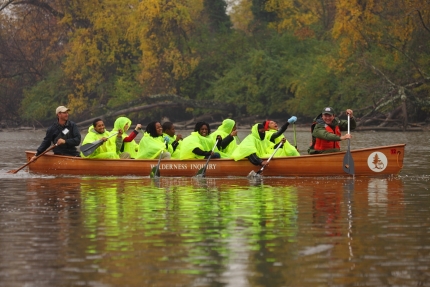
Local kids canoe on the Anacostia. (Photo by Keith Hyde, US Army Corps of Engineers)
Wilderness Inquiry is one of many organizations across the country that works to introduce urban youth to the outdoors. During their time in Washington, DC they have been taking local kids canoeing on the Anacostia, as part of their goal of expanding their model to 20 cities. Wilderness Inquiry works with Federal, state, and local partners to create a successful program in their community in Minnesota. These types of partnerships can help build a local constituency to conserve waterways, wildlife, and landscapes at the community level. Here at the White House Council on Environmental Quality, we are working on President Obama’s America’s Great Outdoors Initiative to promote and support innovative community-level efforts to conserve outdoor spaces and to reconnect Americans to the outdoors. The President has made it clear that one of his priorities is to engage young people, especially those who live in our Nation’s cities, and to find ways to get them outdoors to experience our unique natural heritage.
Jack Shapiro is the Deputy Associate Director for Policy Outreach at the White House Council on Environmental Quality
Learn more about Energy and Environment
- &lsaquo previous
- …
- 148
- 149
- 150
- 151
- 152
- 153
- 154
- 155
- 156
- …
- next &rsaquo
Related Videos
-
 May 09, 2014 8:21 AM
Inside the White House: Solar Panels
-
 September 01, 2016 8:25 PM
President Obama Delivers a Statement to the Press
White House Blogs
- The White House Blog
- Middle Class Task Force
- Council of Economic Advisers
- Council on Environmental Quality
- Council on Women and Girls
- Office of Intergovernmental Affairs
- Office of Management and Budget
- Office of Public Engagement
- Office of Science & Tech Policy
- Office of Urban Affairs
- Open Government
- Faith and Neighborhood Partnerships
- Social Innovation and Civic Participation
- US Trade Representative
- Office National Drug Control Policy