Health Care Blog
Cracking Down on Insurance Companies, Protecting Consumers
Posted by on January 12, 2012 at 1:00 PM ESTThe health care law gives us new tools to protect consumers who are looking for health insurance. One of those tools is “rate review”. For the first time ever, in every state, insurance companies are required to publicly justify their actions if they want to raise rates by 10 percent or more. These increases are then reviewed by independent experts to decide whether they are reasonable – providing unprecedented transparency and easy-to-understand information about why insurers want to raise your rates. Thanks to health reform, if your insurance company wants to hit your wallet with a major increase, they have to tell you why. And if you don’t like what they have to say, you can take your business elsewhere.
Today, we’re using this tool to protect consumers and crack down on unreasonably high rate increases. We’re announcing that Trustmark Life Insurance Company has unreasonably raised health insurance premiums in: Alabama, Arizona, Pennsylvania, Virginia, and Wyoming – which would affect nearly 10,000 residents across these five states.
In each instance, Trustmark raised rates by 13 percent or more over the last year. For small businesses in Alabama and Arizona, when combined with other rate hikes made over the last 12 months, rates have increased by 27.2 percent and 18.1 percent, respectively. You can view more information about these rates here.
These increases are unreasonable and it’s time for Trustmark to immediately rescind the rates, issue refunds to consumers or publicly explain their refusal to do so.
Learn more about Economy, Health CareHealth Care Conference Calls Changing Lives, Engaging Thousands
Posted by on January 11, 2012 at 2:55 PM ESTFor people like Sam, the HHS Partnership Center’s conference calls on the health care reform law, have helped connect them to affordable, quality health care coverage despite unemployment and a major pre-existing condition. In May, Sam was unemployed, could not afford health insurance and then experienced a massive heart attack. He survived his heart attack but now has a significant pre-existing condition that insurance companies either refuse to cover or cover at a very high cost.
Sam was on one of the interactive conference calls sponsored by the U.S. Health and Human Services Center for Faith-Based and Neighborhood Partnerships where he learned about the Pre-Existing Condition Insurance Plan, PCIP. He learned that he was eligible for affordable health care coverage that will cover all of his medical needs, including his pre-existing cardiac care. He went to http://www.pcip.gov for more information and now has the health care coverage he needs.
in 2012, the Center for Faith-Based and Neighborhood Partnerships will continue its series of interactive conference calls for faith and community leaders explaining the benefits and provisions of the new health care law. Over 800 people registered for a call on the Affordable Care Act and Behavioral Health. The call was so popular, it is being held again in early February. To date, more than 5,000 faith and community leaders have participated in the HHS Partnership Center’s conference call series.
You can join the calls too! To register for these calls, click on the links below. Please join us so that you can share the new health care information with members of your congregation and community!
Lines are opened for questions at the end of every call, giving listeners calling in from across the United States a unique opportunity to interact directly with HHS staff and ask questions they may have about the Affordable Care Act.
On January 19, the Center will also host a live, interactive tour of HealthCare.gov. The tour will highlight the site’s many resources to help people take control of their health, access affordable health care coverage in their communities, and understand how the law is being implemented in different states.
To learn more about future interactive conference calls on the Affordable Care Act, sign up for the HHS Partnership Center newsletter at www.hhs.gov/partnerships.
In January and February, conference calls will take place on:
January 19, 3:00 pm EST–Tour of HealthCare.gov
January 24, 2:00 pm EST– ACA 101 (in Spanish)
January 31, 12:30 pm EST– ACA 101
February 2, 12:30 pm EST– ACA and Behavioral Health
February 28, 2:00 pm EST– ACA 101 (in Spanish)
Learn more about Health CareLowering Health Care Cost Growth to Get More Value for Consumers
Posted by on January 9, 2012 at 4:00 PM ESTToday, we got some good news when the official statistics for health care spending were released. The new statistics from the Office of the Actuary at the Centers for Medicare & Medicaid Services show that health care spending growth in 2009 and 2010 decreased to record lows.
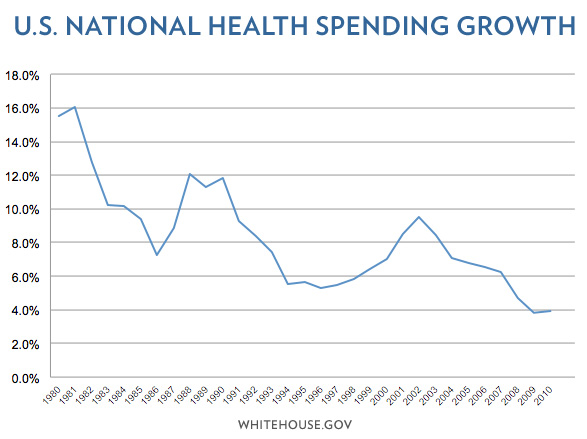
The Affordable Care Act was signed into law by President Obama on March 23, 2010. These numbers do not take into account all of the cost saving provisions in the Affordable Care Act that are still being implemented. But they do show why the Affordable Care Act is so important. And we’re confident the law will continue to help hold down cost growth in the years ahead. Here are some important facts to remember if you’re looking at the new stats:
Learn more about Economy, Health CareAmerica’s Ideas to Support Entrepreneurship in Education, Energy, and Health Care
Posted by on January 6, 2012 at 9:56 AM ESTIn December, the Obama Administration announced the Startup America Policy Challenge to identify high-impact ideas to support entrepreneurship in areas of national interest: education, energy, and health care.
To kick off the challenge, Secretary Arne Duncan (Department of Education), Secretary Steven Chu (Department of Energy), and Secretary Kathleen Sebelius (Department of Health and Human Services) each asked the American public for ideas about how the U.S. government can break down barriers to entrepreneurship and enable the use of clean energy, digital learning, and health information technologies.
On Quora, a public question and answer website, I asked the America people to respond to these specific questions:
- In the U.S. education system, what can the government do to best enable the use of new learning technologies?
- In the U.S. energy system, what can the government do to best enable the use of new clean energy technologies?
- In the U.S. healthcare system, what can the government do to best enable the use of new health information technologies?
The response has been thoughtful, wide ranging, and inspiring.
- On the subject of learning technologies, respondents had ideas to increase the flexibility of existing funds, spread best practices of what works, and improve basic infrastructure. And a number of respondents provided feedback about reducing bureaucracy and empowering teachers.
- On the subject of clean energy technologies, respondents had ideas on how the US Government could support consumer awareness of clean energy, be an anchor customer, and invest in research and development. Respondents also suggested including negative externality costs into the price of fossil fuels, and were adamant that government not pick a “winning technology.”
- On the subject of health care IT, respondents proposed ideas to promote interoperability standards, ensure a greater focus on the end user experience, share industry best practices, and measure the impact of specific technologies.
This is just a sampling of the great dialogue and answers – please feel free to vote on which ideas resonate with you and/or provide your own feedback. In the White House and in the Agencies, we are reading your responses.
To sharpen the dialogue a bit further and solicit additional input, I posted follow-up questions on Quora about specific barriers that customers face:
- Learning Technologies: Parents and teachers – what’s your biggest barrier to educating your kids that technology could solve? How important is the ability to access your child’s assessment data in electronic form?
- Clean Energy: Building and business owners – what’s your biggest barrier to using clean energy in your building or business? How important is the ability to access your building energy usage data in electronic form?
- Health IT: Doctors and patients – what’s your biggest barrier to using information technology to improve health outcomes? How important is the ability to share or receive your health records data in electronic form?
We look forward to hearing your feedback – so please keep it coming!
Aneesh Chopra is U.S. Chief Technology Officer
In Case You Missed It: 2.5 Million More Young Adults Now Have Health Insurance
Posted by on January 3, 2012 at 4:26 PM ESTWe are thrilled to report that the CDC released data last month showing that 2.5 million more young adults now have health insurance coverage thanks to health reform. In September 2010, an Affordable Care Act policy went into effect allowing young adults to stay on their parents' insurance plans through age 26.
“Thanks to the Affordable Care Act, 2.5 million more young adults don’t have to live with the fear and uncertainty of going without health insurance,” said Secretary Kathleen Sebelius. “Moms and dads around the country can breathe a little easier knowing their children are covered.” Check out this HHS press release for more details.
“The data announced today show that, because of the health care law, there is a continued and consistent pattern of improved health coverage among young adults,” said Sherry Glied, Ph.D., HHS Assistant Secretary for Planning and Evaluation. “The Affordable Care Act has helped literally millions of young adults get the health insurance they need so they can begin their careers with the peace of mind that they’re covered.” You can find out more here on this CDC fact sheet.
Learn more about Health Care2011 Year in Review: Eight Ways the Health Care Law Helps You
Posted by on December 28, 2011 at 12:06 PM ESTAs we ring in the New Year, we also want to take a minute to reflect on the progress we made in 2011. I’m proud to say that we had a very productive year for protecting the health of all Americans, especially those who are least able to help themselves. From strengthening Medicare to expanding access to preventive services to holding insurance companies accountable – young adults, families, and seniors have begun to see benefits from the health care law that took effect in 2010.
Here are eight important ways that you or your family might have benefited from the health law in 2011:
Making Sure More Americans Have Health Coverage – 2.5 million more young adults have health insurance coverage thanks to a provision in the health law allowing young adults to remain on their parents’ health insurance until age 26. This means more young adults in this country can now go on and live their lives with less worry about visiting their doctor when they get sick, or facing catastrophic medical bills if they are in an accident.
Families around the country are benefitting from this part of the law, including families like the Houghs, whose daughter Natalie was diagnosed with a rare heart condition after suffering cardiac arrest at school. Her condition requires a lifetime of medication and care. Now, thanks to the health care law, Natalie can stay on her family’s plan and has started college. And by the time she turns 26 it will be illegal for a plan to deny coverage to anyone, regardless of their health, and Natalie will have access to a choice of quality, affordable health plans.
Shedding Light on Insurance Companies – Prior to the Affordable Care Act, insurance companies in too many states were able to raise their rates without explaining their actions. But now, insurers who want to hike their rates by 10%or more have to explain and justify those increases in writing. Experts will scrutinize those explanations and, in many cases, can tell the insurer to reduce their price.
As a result of this law, over the last year, 42 states, the District of Columbia and the five U.S. territories have stiffened their oversight of proposed health insurance rate increases. And results are beginning to come in. For example, Connecticut’s Insurance Department rejected a 20% rate hike by one insurer. And Oregon chopped the rate increase by one of its largest insurers almost in half, saving money for 60,000 people.
Giving You More Value for Your Dollar – A new consumer protection took effect in 2011 called the 80 / 20 rule. It makes sure that at least 80%of your premium dollars are being spent on health care and improving your care – not on advertising and executive salaries. If your insurer fails this test, you get a rebate, starting this summer. This rule makes sure that you get your money’s worth from your health insurance company.
Learn more about Health Care
- &lsaquo previous
- …
- 97
- 98
- 99
- 100
- 101
- 102
- 103
- 104
- 105
- …
- next &rsaquo
From the Press Office
Related Videos
-
 December 13, 2016 5:04 PM
Signing Ceremony for the 21st Century Cures Act
-
 December 10, 2016 5:00 AM
Weekly Address: It’s Time to Get Covered on the Health Insurance Marketplace