Health Care Blog
Getting to Zero on World AIDS Day
Posted by on December 1, 2011 at 3:02 PM ESTWatch President Obama's full remarks here.
President Obama today marked World AIDS Day, speaking at an event called "The Beginning of the End of AIDS" where he outlined the progress that has been made in the global fight against the pandemic:
Because we invested in anti-retroviral treatment, people who would have died, some of whom are here today, are living full and vibrant lives. Because we developed new tools, more and more mothers are giving birth to children free from this disease. And because of a persistent focus on awareness, the global rate of new infections and deaths is declining. So make no mistake, we are going to win this fight.
AIDS has claimed 30 million lives over the past three decades, and while the rate of new infections is going down in many countries, the President acknowledged that it is not declining in America:
The infection rate here has been holding steady for over a decade. There are communities in this country being devastated, still, by this disease.
When new infections among young black gay men increase by nearly 50 percent in 3 years, we need to do more to show them that their lives matter. When Latinos are dying sooner than other groups, and when black women feel forgotten, even though they account for most of the new cases among women, then we’ve got to do more.
So this fight is not over. Not for the 1.2 million Americans who are living with HIV right now. Not for the Americans who are infected every day. This fight is not over for them, it’s not over for their families, and as a consequence, it can’t be over for anybody in this room -- and it certainly isn’t over for your President.
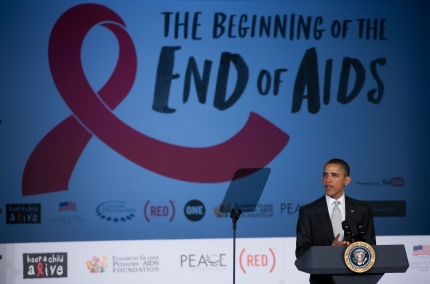
President Barack Obama delivers remarks on World Aid's Day event at George Washington University in Washington, Dec. 1, 2011. (Official White House Photo by Lawrence Jackson)
The President announced that he is directing $50 million in increased funding for domestic HIV/AIDS treatment and care -- an additional $15 million for the Ryan White program for HIV medical clinics across the country. and an additional $35 million for state AIDS Drug Assistance Programs. He also pledged that America will continue to be a leader in the global fight against the pandemic:
Now, as we go forward, we’ve got to keep refining our strategy so that we’re saving as many lives as possible. We need to listen when the scientific community focuses on prevention. That’s why, as a matter of policy, we’re now investing in what works -- from medical procedures to promoting healthy behavior.
And that’s why we’re setting a goal of providing anti-retroviral drugs to more than 1.5 million HIV-positive pregnant women over the next two years so that they have the chance to give birth to HIV-free babies.
We’re not going to stop there. We know that treatment is also prevention. And today, we’re setting a new target of helping 6 million people get treatment by the end of 2013. That’s 2 million more people than our original goal.
Today’s event was sponsored by the ONE and (Red) campaigns and also featured remarks from Presidents George W. Bush and Bill Clinton, via satellite.

Musician Bono, center, listens as President Barack Obama delivers remarks at a World AIDS Day event at George Washington University in Washington, D.C., Dec. 1, 2011. (Official White House Photo by Pete Souza)
Learn more about , Foreign Policy, Health CareAmerican Leadership to Reach an AIDS-Free Generation
Posted by on December 1, 2011 at 12:35 PM ESTToday President Obama was part of a very special World AIDS Day event. It is a day for solemn observance, to remember all those who have been lost to this disease over 30 years, and those still living with HIV today.
Yet today’s event was a joyous occasion as well, as it celebrated all those who have done – and are doing – so much to respond to HIV/AIDS. Despite all the challenges, the history of this virus is also one of remarkable people coming together to make a difference.
The PEPFAR program – a program created by one president and handed off to another - has benefited from widespread support, and today’s event demonstrated American unity in this fight. The ONE Campaign and Product (RED), who have done so much to get people involved, were our hosts. President Obama was joined by President George W. Bush and President Clinton, each of whom played key roles in the AIDS fight while in office and continue their efforts today. Bono and Alicia Keys represented the artistic community that has been so important in the response, while Kay Warren represented the commitment of people of faith. Senator Marco Rubio and Representative Barbara Lee represented both the critical role of Congress in this effort and the power of bipartisanship of our work. The African leadership that has played such a vital role was exemplified by Dr. Patricia Nkansah-Asamoah of Ghana and Florence Ngobeni of South Africa. And last but by no means least, many of the advocates and practitioners from the AIDS and global health communities were in attendance, making clear the fact that every individual’s contribution makes a difference.
As President Obama said in his remarks and his World AIDS Day Proclamation, scientific advances have provided us with a unique opportunity for dramatic gains in the global response to HIV/AIDS. The concept of ‘combination prevention,’ through which we rely on multiple prevention interventions tailored to needs in the countries where we work, is at the center of this effort. The President outlined plans to expand our combination prevention work, including prevention of mother-to-child transmission, voluntary medical male circumcision, and condoms.
Learn more about , Foreign Policy, Health CareTips for Congregations and Communities on World AIDS Day Activities
Posted by on December 1, 2011 at 12:34 PM ESTRight now, we are experiencing a domestic epidemic that demands a renewed commitment, increased public attention, and leadership…To accomplish these goals we must undertake a more coordinated national response to the epidemic. The Federal Government can’t do this alone, nor should it. Success will require the commitment of governments at all levels, businesses, faith communities, philanthropy, the scientific and medical communities, educational institutions, people living with HIV, and others…
– President Barack Obama
On the occasion of World AIDS Day 2011, we invite faith-based and community organizations across the United States to consider how you might engage your members–or share with others your best practices- today and throughout the year to support those with HIV/AIDS and help achieve an AIDS-free generation.
Our nation’s churches, temples, mosques, synagogues and community organizations are uniquely positioned to contribute to the national effort to reverse the course of the HIV epidemic in America. Reaching our goals of ending stigma against AIDS; making sure everyone who is HIV+, knows it; getting everyone who needs it treatment; and all the other goals the President put forth in the National HIV/AIDS Strategy require everyone to work together. These are not the kinds of goals government can achieve alone!
For World AIDS Day 2011, the Obama Administration is promoting the theme “Leading with Science, Uniting for Action.” The theme reflects the Federal government's commitment to move toward the goal of an AIDS-free generation, both in the U.S. and around the world.
Making an AIDS-free America will depend on the American people!
There are many options for faith communities interested in joining in the observation of World AIDS Day 2011. We know communities who have held meetings to remind people to be tested. Some have offered testing. Others hold support groups for people with HIV. The truth is, anything you do to increase awareness has the potential to keep someone HIV-free, and to connect people with HIV to early treatment. As each community has unique needs, we invite you to be engaged in what ever way you feel is the most beneficial and respectful.
-
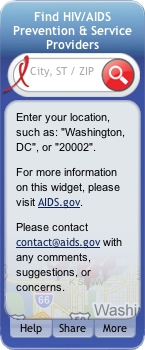
Encourage congregants to learn their HIV status so that, if infected, they can take advantage of life-saving treatments. Such efforts will help identify some of the more than 230,000 Americans living with HIV who are unaware of their infection. Early diagnosis is essential to enhancing and extending the lives of those with HIV. It also reduces the likelihood that one will infect others. You can also help individuals find HIV testing and other services near you by using the HIV/AIDS Prevention & Service Providers Locator (shown below). Simply enter a Zip Code and a list of HIV testing sites and other HIV-related services is returned, complete with a map to help figure out how to get there. Does your organization have a website or blog? Embed this widget in your blog so that readers can always locate these services via your site.
-
Work to reduce stigma and discrimination against people living with HIV/AIDS.The ongoing stigma associated with HIV disease—and the behaviors that can lead to infection—continue to interfere with our efforts, as a nation, to end this illness. Fear of discrimination causes some Americans to avoid learning their HIV status, disclosing their status, or accessing needed medical care or other supportive services. Faith leaders are especially well positioned to deliver messages of understanding and non-judgmental support that can serve as constructive examples to others in the community.
- Plan a local event.The World AIDS Day event planning guide can help you get started. You can customize and use these World AIDS Day posters and add the World AIDS Day logo to your websites. Help your congregants learn about HIV by sharing these fact sheets. Join the World AIDS Day conversation on Twitter: use the hashtag #WAD2011 to find and share local events. Learn about additional World AIDS Day resources. There are also other Awareness days that might be appropriate for your congregation.
To see some quick facts about HIV/AIDS in the United States click here: White House Office of HIV/AIDS Policy. Here are just a few:
HIV/AIDS is a crisis in the United States:- Over one million people are currently living with HIV/AIDS in the U.S.;
- It is estimated that every 9 ½ minutes someone in the U.S is infected with HIV/AIDS;
- Of those infected, approximately 21 percent (one in five) are unaware of their infection;
- America's poorest urban neighborhoods HIV prevalence was more than 4 times the national average.
- In the United States most new HIV infections occur among African American young people, ages 13-19 accounting for 68% of new AIDS cases among teens in the U.S.
For more ideas on how faith communities can initiate, or enhance existing, HIV/AIDS activities or programs, please read:
- United in Battling HIV/AIDS: A Guide to Understanding How Faith Communities Can Make a Difference (from the National Alliance of State and Territorial AIDS Directors)
- Partnerships for the Common Good: A Partnership Guide for Faith-Based and Neighborhood Organizations (from the White House Office for Faith-based and Neighborhood Partnerships, p. 32)
- Also, read more about efforts of the Centers for Faith-based and Neighborhood Partnerships to support the National HIV/AIDS Strategy.

December 1, 2011.
Alexia Kelley serves as Deputy Director of The White House Office of Faith-based and Neighborhood Partnerships.
Learn more about Health Care-
From the Archives: President Obama Says, "Get Tested"
Posted by on December 1, 2011 at 11:19 AM ESTWatch President Obama's remarks on National HIV Testing Day here.
Today is World AIDS Day. In the United States, roughly 1.2 million Americans are living with HIV and about 50,000 become newly infected each year. Since the beginning of the epidemic 30 years ago, more than 600,000 Americans have lost their lives to HIV and AIDS. Today, there are more than 200,000 Americans living with HIV who don’t know it. Regular testing is important: If people know they are HIV positive, they can take steps to protect themselves and their partners, and live longer and healthier lives.
During a visit to Kenya in 2006, then-Senator Barack Obama and his wife Michelle highlighted the importance of testing for HIV by getting tested themselves at a local clinic.
Learn more about Foreign Policy, Health CareOpen for Questions: The Beginning of the End of AIDS
Posted by on November 30, 2011 at 3:01 PM ESTTomorrow is World AIDS Day, and President Obama will be marking the occasion by speaking at ONE Campaign and (RED)’s Beginning of the End of AIDS event at George Washington University. You can watch the whole event live on YouTube.com/TheONECampaign.
Later in the day, Gayle Smith, Special Assistant to the President and Senior Director for Development and Democracy at the White House, and Ambassador Eric Goosby, U.S. Global AIDS Coordinator, will be taking your questions on the global AIDS epidemic and what the Obama Administration is doing to bring it to an end.
- What: Open for Questions: The Beginning of the End of AIDS
- Who: Gayle Smith, Special Assistant to the President and Senior Director for Development and Democracy at the White House, and Ambassador Eric Goosby, U.S. Global AIDS Coordinator
- When: Thursday, December 1 at 2:30 p.m. EST
- Where: Watch live at WhiteHouse.gov/live and submit your questions via Facebook, Twitter using the hashtag #WHChat or our webform.
Learn more about Health CareWe Can’t Wait: New Steps Encourage Doctors and Hospitals to Use Health IT to Lower Costs, Improve Quality, Create Jobs
Posted by on November 30, 2011 at 1:08 PM ESTWhen doctors and hospitals use health information technology (IT), patients get better care and we can all save money. This results in less paperwork for billing, medical records, and prescribing; easier coordination of care among doctors, nurses, and pharmacists in hospitals and outpatient settings; and better reporting on quality of care. Thanks to President Obama’s leadership, the number of physicians using this important technology to help patients get better care and save money has more than doubled, from 17 percent to 34 percent, since 2008. And we can’t wait to do more.
Today, Secretary Sebelius announced that we are making it easier for doctors and other health professionals to adopt health IT and receive incentive payments that were made available under the Health Information Technology for Economic and Clinical Health (HITECH) Act. At the same time, we remain vigilant in ensuring your health data remains private, confidential and secure.
Here’s how it works:
- The HITECH Act offers doctors and hospitals the opportunity to earn financial incentives from Medicare and Medicaid if they show that they have adopted health IT and are using it to make a meaningful difference in patient care.
- Under the current rules, providers who adopt health IT this year, and register through the end of February, must meet new standards for using health IT in 2013. If they do not adopt health IT until 2012, they don’t have to meet the new standards until 2014, and are still eligible for the same amount of incentive payment.
- To spur greater innovation and improvement, Secretary Sebelius announced that she intends to adjust the deadline for meeting the new standards for providers that start this year to 2014, removing the disincentive for providers to adopt and use health IT right away.
- &lsaquo previous
- …
- 101
- 102
- 103
- 104
- 105
- 106
- 107
- 108
- 109
- …
- next &rsaquo
From the Press Office
Related Videos
-
 December 13, 2016 5:04 PM
Signing Ceremony for the 21st Century Cures Act
-
 December 10, 2016 5:00 AM
Weekly Address: It’s Time to Get Covered on the Health Insurance Marketplace