Health Care Blog
Taking Your Questions About Tobacco Cessation and Prevention
Posted by on November 16, 2011 at 3:13 PM ESTTomorrow marks the American Cancer Society’s 36th Great American Smokeout – a day when we encourage smokers to make a plan to quit. The good news is that over the last four decades the number of smokers has been cut in half. However, we’re still seeing tobacco take its toll on too many people, including our youth.
About 46 million Americans still smoke cigarettes, killing an estimated 443,000 people each year. And each day, approximately 4,000 young people smoke their first cigarette
President Obama and his Administration are committed to stopping kids from using tobacco and we are taking steps to help adults quit.
In honor of the Great American Smokeout, HHS Secretary Kathleen Sebelius is sitting down with iVillage’s Kelly Wallace for a live web chat. During the chat, they will talk about how to make a plan to quit and what the Obama Administration is doing to prevent kids from starting in the first place.
The chat will take place on Thursday, November 17th from 12:45 p.m. to 1:15 p.m. EST. To watch live, go to iVillage.com/livechat or www.hhs.gov/live. You can submit a question in advance here, or ask a question during the chat on iVillage’s Twitter or Facebook page.
We hope you’ll join the conversation on how to help Americans to kick the habit, and stop young people before they start.
Read more:
Learn more about , Health CareThe Campaign to Cut Waste is Saving Billions
Posted by on November 15, 2011 at 1:33 PM EST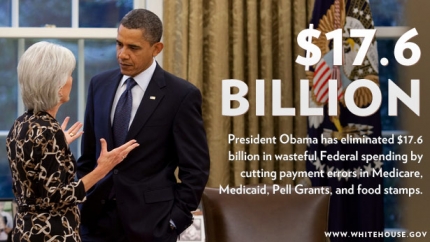
Nearly two years ago, President Obama signed an executive order to begin an aggressive campaign against government waste -- and directed federal agencies to prevent $50 billion in improper payments by the end of 2012.
In 2011 alone, this campaign netted $17.6 billion in savings by cutting payment errors for programs like Medicare, Medicaid, Pell Grants, and food stamps.
When the President issued the order, his goal was to see the error rate drop from 5.42 percent to 4.2 percent. Today, we're able to project that, by 2012, the rate will drop all the way to 3.8 percent.
President Obama has asked Congress for aggressive new tools to help the federal government save even more money -- as much as $160 billion over the next decade. But because we can't wait for lawmakers to build on this progress, the Obama administration is moving forward with additional steps to find savings.
The Department of Health and Human Services will soon launch four new pilot programs to reduce the error rate further and cut Medicare and Medicaid waste and fraud. And Jack Lew, the Director of the Office of Management and Budget, just directed federal agencies to step up their oversight of contractors and grant recipients in order to eliminate waste and fraud.
For more information on the work to reduce payment errors, visit paymentaccuracy.gov.
Learn more about Fiscal Responsibility, Health CareWe Can’t Wait: Jumpstarting Innovation in Health Care, Reducing Costs
Posted by on November 14, 2011 at 12:45 PM ESTEd. note: Cross-posted from HealthCare.gov.
Health care costs remain a significant drain on the budgets of families, businesses, and federal and state governments. The health reform law, the Affordable Care Act, made significant strides in making Medicare more affordable and insurance companies more accountable. Congress is considering other ways to build on this progress, but we can’t wait to do more to help make our health care system more affordable.
In that spirit, the Obama Administration recently launched the Health Care Innovation Challenge. Made possible by the Affordable Care Act, this initiative will invest up to $1 billion in the best projects that doctors, hospitals, and other innovators propose to deliver high-quality medical care and save money. Projects that win this competition will use health care dollars more wisely, help create jobs, and help professionals improve the work they do for patients.
Innovation doesn’t happen in a vacuum and usually doesn’t start in Washington — we need the vision and experience of people who are already proving that our health care providers can and do provide better care and better health at lower cost. So we want to hear from you. Send us your innovative ideas and solutions, and submit a proposal outlining your vision for helping us transform the health care system. We’ll sort through these proposals and help put the best ones into practice.
If your proposal has strong evidence that it can start quickly, reduce costs, and improve health care, you can qualify for approximately $1 million to $30 million in an upfront investment. Priority is given to proposals that retrain workers and support job creation. You can find a fact sheet and the Funding Opportunity Announcement on our Healthcare Innovation Challenge Web page.
We’ll work with a wide variety of public and private organizations, including providers, payers, local governments, community and faith-based organizations, and other innovators whose compelling ideas can improve health care for patients. We are also looking for projects that help patients with the greatest health care needs, projects that can be up and running soon, and projects that rapidly hire, train, and deploy health care workers.
For example, the Health Care Innovation Challenge could support the use of personal and home care aides to help the elderly stay in their homes or expanding the use of community-based paramedics to provide basic services to individuals in rural communities.
Different communities have different needs and circumstances—some require unique, locally driven innovations. With the Health Care Innovation Challenge, we hope to give providers even more opportunities to make our health care system even stronger.
We look forward to hearing your ideas on how to make this happen. For more information, you can also visit http://innovations.cms.gov/.
Learn more about Health CareSupreme Court Announces It Will Hear Challenges to the Affordable Care Act
Posted by on November 14, 2011 at 12:10 PM ESTThe Supreme Court announced today that it would consider the legal challenges to President Obama’s historic health care reform law, the Affordable Care Act.
Earlier this year, the Obama Administration asked the Supreme Court to hear the case against the Affordable Care Act in order to put the challenges to rest and continue moving forward with implementing the law, which will lower the cost of health care for all Americans while ensuring more people are able to access the care they need.
The Affordable Care Act will:
- Reduce the deficit by more than a trillion dollars over the next decade due to decreased spending on health care
- Expand health care coverage to 32 million people who didn’t have it before
- Allow more than 1 million young people to stay on their parent’s health care plans until their 26th birthday
- End abusive insurance practices such as denying treatment for pre-existing conditions, dropping people from plans when they get sick, and implementing annual and lifetime limits on care
- Strengthen Medicare to help better protect our seniors
“We know the Affordable Care Act is constitutional and are confident the Supreme Court will agree,” White House Communications Director Dan Pfeiffer said.
Learn more about Health CareProtecting Our Nation’s Youth
Posted by on November 10, 2011 at 11:00 AM ESTEd note: This blog was cross-posted from the White House Blog.
For many kids, their first cigarette leads to a lifetime of addiction, and for many, serious disease. With 20 percent of U.S. high school students smoking, keeping tobacco out of the hands of minors can have a huge impact on our nation’s health now and in the future. That’s why President Obama and his Administration are committed to doing all we can to stop kids from smoking.
We took an important step toward achieving that goal when the Food and Drug Administration issued more than 1,200 warning letters to retailers for selling tobacco to kids. The letters come after we conducted more than 27,500 inspections nationwide. Most retail store owners follow the law and don’t sell cigarettes to kids, but we’re reminding those who don’t that they have a responsibility to follow the law and that there are serious consequences if they fail to do so.
You can search our database of inspection reports for tobacco retailers by name and location to see how your community checks out. You can also take the pledge to protect our nation’s children by supporting retailers who follow the law and do not sell cigarettes and smokeless tobacco products to youth. Let your local establishments know you appreciate their efforts to protect our kids.
These kinds of activities are just a part of our campaign to stop children from smoking. President Obama was proud to sign the Family Smoking Prevention and Tobacco Control Act which gives us new tools to help stop young people from smoking before they start. Those tools include graphic warning labels that make the danger of smoking abundantly clear. Big tobacco companies are trying to stand in the way of these commonsense measures to protect our kids, but we’re confident their attempts will ultimately fail.
We know our campaign against tobacco is a ‘winnable battle’. It is a public health challenge where the strategies to address it are proven and in-hand. We have the science. Under President Obama, we have the leadership and commitment. And now, more than ever, we have the laws and policies that will allow us to protect the health of our nation’s kids.
Kathleen Sebelius is the Secretary of Health and Human Services.
Learn more about , Health CareOur Children Can’t Wait: New Regulations Increase Accountability and Boost Quality in Head Start
Posted by on November 8, 2011 at 4:04 PM EST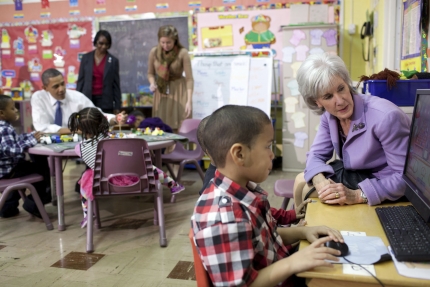
President Barack Obama and Health and Human Services Secretary Kathleen Sebelius, right, talk with students while visiting a classroom at the Yeadon Regional Head Start Center in Yeadon, Pa., Nov. 8, 2011. (Official White House Photo by Pete Souza)
We know that the first years of our children’s lives are critical. That’s when the most rapid development happens in their brains and when they pick up the social, emotional, and academic skills that will help them succeed. When children get what they need during these early years, it can lay the foundation for success in school and through every stage of their lives.
President Obama and HHS’s announcement today of historic reforms to the Head Start program will help to ensure that all children in Head Start are attending top-notch programs that will help them reach their full potential. The Department of Health and Human Services will implement new rules that will – for the first time in the program’s history– require all Head Start grantees that fail to meet a new set of rigorous quality benchmarks to compete for continued federal funding.
Under the new rules, programs that fall short of quality benchmarks will have to compete. We will put out a notice to all early education providers in their communities: If you can do better, you’ll get the Head Start funding. And after the initial round of reviews, Head Start providers will continue to be evaluated every five years to make sure they’re maintaining a high standard of performance.
The best Head Start programs do much more than teach kids their ABCs. They help children develop the self-control and critical thinking they need to become successful learners. They connect kids with essential health services like immunizations that they may otherwise go without. They get moms and dads engaged in their children’s education. They put kids on a path to opportunity.
This rule is a key part of the President’s broader agenda to strengthen Head Start. In the last two years, we’ve also improved training for Head Start providers, provided mentors for programs that want to improve, and created 20 Centers of Excellence that are models for the rest of the Head Start community. Combined with this new system of evaluation and competition, Head Start providers today have more tools and more incentives to improve than ever before in the program’s history.
In a world where the jobs follow the best trained workers, America’s capacity to lead the world will depend on our success in educating all of our children, including those most at risk for falling behind. The early years are critical to that success. This Administration will continue to work to make sure our children can grow up with the tools and experience they need to compete.
Today’s Head Start children are tomorrow’s workforce. Today we are taking a historic step toward making sure all children in Head Start get the top notch early education they need to succeed.
Learn more about Education, Health Care
- &lsaquo previous
- …
- 103
- 104
- 105
- 106
- 107
- 108
- 109
- 110
- 111
- …
- next &rsaquo
From the Press Office
Related Videos
-
 December 13, 2016 5:04 PM
Signing Ceremony for the 21st Century Cures Act
-
 December 10, 2016 5:00 AM
Weekly Address: It’s Time to Get Covered on the Health Insurance Marketplace