Health Care Blog
By the Numbers: 141,000
Posted by on November 29, 2011 at 5:05 PM EST
Illegal sales of counterfeit DVDs cost the U.S. economy 141,000 jobs and $20.5 billion each year. Money from the sales of pirated music and movies often helps fuel drug trafficking and gang crime. Together, these facts make theft of intellectual property far from a victimless crime.
Today, the Department of Justice and the National Crime Prevention Council launched a public awareness campaign to make sure people know the facts. Eighty percent of Americans believe it’s illegal to knowingly purchase counterfeit or pirated goods, but do it any way. And nearly 60 percent believe they won’t get caught. The truth is that buying a pirated album or movie doesn’t just hurt stores or movie studios or musicians or actors. It affects everyone involved in the production of that CD or DVD, from the ideas to the production to the processing, including artists, writers, technicians, janitors, caterers, and others.
The campaign launched today targets all types of intellectual property theft, including goods like purses and sunglasses, medications, movies, and music, and aims to raise awareness that buying these items is a serious crime.
Bargain Hunters Be Wary
Posted by on November 29, 2011 at 4:04 PM ESTAs Americans kick off the holiday shopping season, it's a good time to remember the importance of making responsible purchases and rejecting counterfeits that pose a threat to American jobs, safety and health. Today I joined Attorney General Eric Holder and other Administration officials at the White House to announce progress we’ve made cracking down on intellectual property theft crimes, and to launch a public awareness campaign to combat the purchase and sale of counterfeit and pirated products.
As President Obama has said, in order to win the future in the global economy America must out innovate our competitors. Intellectual property theft undermines our nation's innovators and entrepreneurs. The new campaign will educate the public about the full range of intellectual property crimes we confront, from counterfeit consumer goods and fake pharmaceuticals laced with potentially dangerous substances to illegal downloads, while highlighting the potential threat these crimes pose to economic prosperity and public safety. The campaign will include a television PSA, materials delivered through social media, and radio, web, and print ads.
The Administration has been proactive on multiple fronts in order to increase intellectual property enforcement. We have increased law enforcement efficiency, advocated for legislative reform, informed the public about the negative impacts of intellectual property theft, and engaged the private sector to foster cooperation and create voluntary solutions through productive conversations. Today’s announcement marks an important milestone in the Administration’s ongoing efforts to curb intellectual property theft that harms the economy, undermines job creation, undermines innovation, and jeopardizes the health and safety of American consumers.
At the event, Attorney General Holder and I were joined by Acting Deputy Secretary of Commerce Rebecca Blank, who discussed the ways in which counterfeit goods impact the everyday lives of American families. Director of Immigration and Customs Enforcement John Morton was also in attendance to discuss ongoing Administration law enforcement efforts concerning counterfeit goods and intellectual property crimes. And Ann Harkins, National Crime Prevention Council President and CEO, was on hand to unveil the products of the campaign that will help build awareness about the harm caused by counterfeit goods and engage the public in stopping intellectual property theft.
For more information about the campaign, visit: http://www.ncpc.org/getreal.
Millions of Seniors Saving Money on Prescription Drugs, Thanks to the Affordable Care Act
Posted by on November 28, 2011 at 2:51 PM ESTOver the weekend, a report by the Associated Press detailed how the Affordable Care Act is dramatically reducing drug costs for seniors who hit the prescription drug coverage gap known as the donut hole. This year, seniors are benefiting from a 50 percent discount on brand-name drugs in the donut hole. And the discount and other provisions in the law are saving money for seniors. As the AP reported:
The average beneficiary who falls into the coverage gap would have spent $1,504 this year on prescriptions. But thanks to discounts and other provisions in President Barack Obama's health care overhaul law, that cost fell to $901, according to Medicare's Office of the Actuary, which handles economic estimates.
So far this year, more than 2.2 million people with Medicare have saved more than $1.2 billion on their prescriptions. The Associated Press spoke with two of them:
For retired elementary school teacher Carolyn Friedman, it meant she didn't need a loan to pay for drugs that keep her epilepsy under control.
"What a change for the better," said Friedman, 71, of Sunrise, Fla. "This year it was easier to pay my bills, whereas last year I had to borrow money to pay for my medications when I was in the doughnut hole."
…
Joan Gibbs thought her pharmacy had made a mistake. Her total cost for a brand-name painkiller in the doughnut hole came out lower than her co-payment earlier in the year, at a time her plan was picking up most of the tab.
"I reluctantly called the insurance company," said Gibbs, 54, who lives near Cleveland. "If they had made a mistake, I knew they would catch it sooner or later. I was very surprised that it turned out to be such a good discount."
Gibbs is on Medicare because of an auto-immune disorder and other medical problems that left her unable to work.
Thanks to the Affordable Care Act, seniors will receive bigger discounts in the years ahead. By 2020, the donut hole will be closed completely.
And even if you don’t hit the donut hole, there’s still good news for beneficiaries with Medicare Part D. Prescription drug premiums will not rise next year, and thanks to health reform, seniors can get preventive services like mammograms and other cancer screenings for free.
Nancy-Ann DeParle is the Assistant to the President and Deputy Chief of Staff
Learn more about Health CareBy the Numbers: 443,000
Posted by on November 17, 2011 at 5:22 PM EST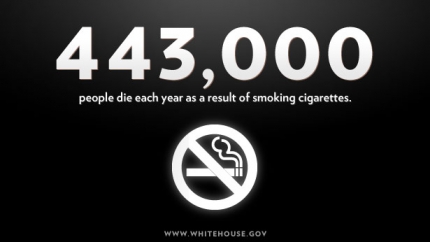
An estimated 443,000 people in the United States die each year due to cigarettes. Although we've known about the harmful effects of tobacco for many decades now, about 46 million Americans still smoke cigarettes. Worse still, one in five kids smokes cigarettes by the time they leave high school.
Today, on the 36th Great American Smokeout, President Obama--a former smoker himself--is urging smokers to quit. And his Administration is committed to stopping kids from using tobacco.
Tobacco use is the leading cause of preventable death and disease, not just in the United States, but around the world. Quitting now reduces risk of cancer, heart and lung disease, and stroke among other illnesses.
To get help quitting or learn more about resources available to help you or someone you know quit, visit the American Cancer Society or SmokeFree.gov.
Learn more about Health CareFrom the Archives: Establishing Equal Hospital Visitation Rights
Posted by on November 17, 2011 at 3:28 PM ESTNovember 17, 2010 was a big day for anyone ever denied access to a sick spouse, partner, or loved one due to discrimination.
On that day, the Centers for Medicare and Medicaid Services announced that all patients in hospitals receiving Medicare and Medicaid funding must be allowed to decide who they want to be at their bedside when they are sick—regardless of race, color, national origin, religion, sex, sexual orientation, gender identity, or disability.
President Obama asked Health and Human Services that visitation rules be amended the previous April:
There are few moments in our lives that call for greater compassion and companionship than when a loved one is admitted to the hospital. In these hours of need and moments of pain and anxiety, all of us would hope to have a hand to hold, a shoulder on which to lean -- a loved one to be there for us, as we would be there for them.
Yet every day, all across America, patients are denied the kindnesses and caring of a loved one at their sides -- whether in a sudden medical emergency or a prolonged hospital stay. Often, a widow or widower with no children is denied the support and comfort of a good friend. Members of religious orders are sometimes unable to choose someone other than an immediate family member to visit them and make medical decisions on their behalf. Also uniquely affected are gay and lesbian Americans who are often barred from the bedsides of the partners with whom they may have spent decades of their lives -- unable to be there for the person they love, and unable to act as a legal surrogate if their partner is incapacitated.
For all of these Americans, the failure to have their wishes respected concerning who may visit them or make medical decisions on their behalf has real consequences. It means that doctors and nurses do not always have the best information about patients' medications and medical histories and that friends and certain family members are unable to serve as intermediaries to help communicate patients' needs. It means that a stressful and at times terrifying experience for patients is senselessly compounded by indignity and unfairness. And it means that all too often, people are made to suffer or even to pass away alone, denied the comfort of companionship in their final moments while a loved one is left worrying and pacing down the hall.
Learn more about Civil Rights, Health CarePresident Obama: Congratulations to Everyone Taking Part in Today's Great American Smokeout
Posted by on November 17, 2011 at 6:00 AM ESTToday, Americans from across the country are making plans to quit smoking as part of the American Cancer Society’s Great American Smokeout. And this morning, we released a video from President Obama congratulating everyone who is participating in this important event and underscoring our Administration’s commitment to fighting tobacco use:
Watch President Obama's full remarks here.
President Obama and his Administration are committed to doing all we can to stop kids from smoking and reducing the number of Americans who smoke. And for those of you who are making the commitment to quit, you are not alone and we have resources to help you succeed. You can visit HHS.gov today to connect with a smoking cessation expert via IM or phone, use the online step-by-step quit guide, or sign up for SmokefreeTXT a texted based smoking cessation program. And under the Affordable Care Act insurance companies are required to cover recommended preventive services, including tobacco cessation counseling without charging you an extra penny out of your own pocket.
We are also continuing our efforts to protect young people from starting smoking in the first place.
President Obama was proud to sign the Family Smoking Prevention and Tobacco Control Act which gives us new tools to help young people stop smoking before they start. New prevention efforts include addressing marketing practices aimed at children like banning fruit and candy flavored cigarettes and working with states to keep tobacco out of the hands of kids by increasing enforcement at the retail level. And the law calls for graphic warning labels that make the danger of smoking abundantly clear. Big tobacco companies are trying to stand in the way of these commonsense measures to protect our kids, but we’re confident their attempts will ultimately fail.
Sadly, we’ve seen too many friends, families and communities suffer needlessly, and suffer tremendously, from tobacco-related death, disease and disability. We have a clear path to ending the tobacco epidemic and it is a battle we can – and must - win. The prosperity and health of our country depends on it.
Join me today at 12:45p ET as I talk with iVillage reporter, Kelly Wallace, for a live web chat about tobacco cessation and prevention. To watch live, go to iVillage.com or www.hhs.gov/live. You can submit a question in advance here, or ask a question live during the chat on iVillage’s Twitter or Facebook page.
Learn more about Health Care
- &lsaquo previous
- …
- 102
- 103
- 104
- 105
- 106
- 107
- 108
- 109
- 110
- …
- next &rsaquo
From the Press Office
Related Videos
-
 December 13, 2016 5:04 PM
Signing Ceremony for the 21st Century Cures Act
-
 December 10, 2016 5:00 AM
Weekly Address: It’s Time to Get Covered on the Health Insurance Marketplace