Health Care Blog
Reducing Health Care Costs – More Good News
Posted by on December 15, 2011 at 3:05 PM ESTYesterday, we received two more pieces of good news about our work to bring down the cost of health care. Thanks to the Affordable Care Act and the Obama Administration’s work to fight fraud, we’re delivering real savings for businesses and families and fighting criminals who steal from the health care system. We are also making it easier for small businesses to insure their workers.
Record High Number of Health Care Fraud Prosecutions
The Obama Administration is committed to fighting health care fraud and a new independent report shows just how serious we are about cracking down on criminals. The independent Syracuse University Transactional Records Access Clearinghouse examined data from the Justice Department and reported:
“Federal health care fraud prosecutions reached an historic high last year. During the twelve months of fiscal year 2011, the government reported 1,235 new health care fraud prosecutions -- the largest number reported since separate tracking of this offense began twenty years ago. This number is up 68.9% over the past fiscal year when the number of criminal prosecutions totaled 731.”
Health care fraud is a crime and when fraudsters steal from the health care system, we all pay the price in the form of higher health care costs. This news builds on the Vice President’s announcement earlier this week on a new Medicare initiative to crack down on fraudulent prescriptions for drugs like OxyContin. And the record number of prosecutions is yet another sign that President Obama’s team is serious about fighting fraud and it sends a strong message to anyone who would think about committing these crimes.
Relief for Families and Small Businesses
Our second piece of good news came when we learned that Highmark Blue Cross Blue Shield will provide more than 4,200 small businesses in West Virginia with rebates worth an average of $2,500 per business.
Highmark is providing the rebates because of a new rule in the Affordable Care Act. Under the law, if insurance companies don’t spend at least 80 percent of your premium dollar on medical care and quality rather than advertising, overhead and bonuses for executives, they have to provide you a rebate for those excessive profits.
When Highmark determined they wouldn’t meet the standard, they cut their premiums, giving consumers some welcome health care cost relief. We expect more consumers across the country to benefit from this provision of the law in the weeks and months ahead.
The Bottom Line
President Obama is committed to controlling health care costs and the latest news shows his work is making a difference.
Nancy-Ann DeParle is the Assistant to the President and Deputy Chief of Staff
Learn more about Health CareProviding Protections for In-Home Care Workers
Posted by on December 15, 2011 at 11:49 AM ESTEd. note: This is cross-posted from Work in Progress, the Official Blog of the Department of Labor
In-home care service is a high growth industry, and it’s projected to grow by 50 percent between 2008 and 2018. In-home caregivers are an essential component of the health care system and will only become more important, as an increased number of patients turn to them for more affordable assistance with medical care as well as everyday tasks and household chores.
Many homecare providers earn less than the minimum wage and no overtime for these vital services. In 2007, then-Senator Obama spent a day with professional homecare worker Pauline Beck, assisting with her daily tasks and observing firsthand the unique challenges of in-home care (watch the video). He was impressed by Pauline’s dedication, and determined to assist her and others in her profession.
Today, Pauline joined me and President Obama as he announced a proposal from the U.S. Department of Labor to revise the Fair Labor Standards Act rules that would ensure fair pay for approximately 1.8 million workers who provide in-home care services for the elderly and infirm. This new rule would ensure that these hardworking professionals who provide valuable services to American families would receive the protections of minimum wage and overtime pay that nearly every employee in the United States already receives under the FLSA.
Many of these workers are the primary breadwinners for their families. Of the roughly 2 million workers who will be affected by this rule, more than 92 percent are women, nearly 50 percent are minorities, and nearly 40 percent rely on public benefits such as Medicaid and food stamps. According to the Bureau of Labor Statistics, home health care aides earn about $21,000 a year and many lack health insurance. That is unacceptable.
The proposed regulation would also ensure that employers who have been treating these workers fairly are no longer at a competitive disadvantage. Leveling the playing field for both workers and employers is a fundamental principle of the FLSA.
Learn more about Economy, Health CareWe Can't Wait: Meet the Home Healthcare Worker Who Inspired the President
Posted by on December 15, 2011 at 9:45 AM ESTToday Pauline Beck will be at the White House to watch as President Obama announces proposed changes to the Fair Labor Standards Act (FLSA) that will affect home healthcare workers like herself. Today's event has special significance for Pauline, because it was the day then-Senator Obama spent "in her shoes" that informed him of the important work these Americans do and the need to level the playing field so they are fairly compensated for their efforts. Take a minute to watch the video and learn her story.
Dynamic Dialogue and Shared Experience at Miami Summit
Posted by on December 14, 2011 at 2:46 PM ESTEd. Note: Cross-posted from the Department of Education.
More than 200 Latino leaders convened earlier this month in Miami for the White House’s Hispanic Community Action Summit at Miami-Dade College (MDC), a fitting venue for the forum as the nation’s largest community college and one renowned for graduating the largest numbers of both Latino and minority youths.
Eduardo Padrón, MDC president and chair of the President’s Advisory Commission on Educational Excellence for Hispanics, welcomed business and civic leaders, administrators, educators and students to the daylong session. Padron emphasized the link between America’s economic progress and that of Hispanics, and that, as the fastest-growing community in the U.S., Hispanics must be better prepared to succeed both academically and economically if America is to compete globally.
Jose Rico, the new Executive Director of the White House Initiative on Educational Excellence for Hispanics, and Julie Rodriguez, Associate Director of the White House Office of Public Engagement, provided a concise overview of the status of employment, housing, immigration, education, and health care. These presentations provided an excellent foundation for the roundtable discussions that ensued throughout the day.
New Data: Thanks to Health Reform, 2.5 Million More Young Adults Have Health Insurance
Posted by on December 14, 2011 at 2:03 PM ESTHistorically, young adults making the transition from school to work have been substantially more likely than any other demographic group to go without health insurance. In today’s labor market, it can be particularly tough for young workers to find jobs that provide health benefits.
A new policy enacted as part of the Affordable Care Act is designed to make it easier for younger Americans to obtain and maintain health insurance. The policy, which took effect in 2010, allows young adults to stay on their parents’ health insurance plan up until they turn age 26. Prior to the Act, dependent children were typically dropped from their parents’ coverage when they turned 18 or graduated from college.
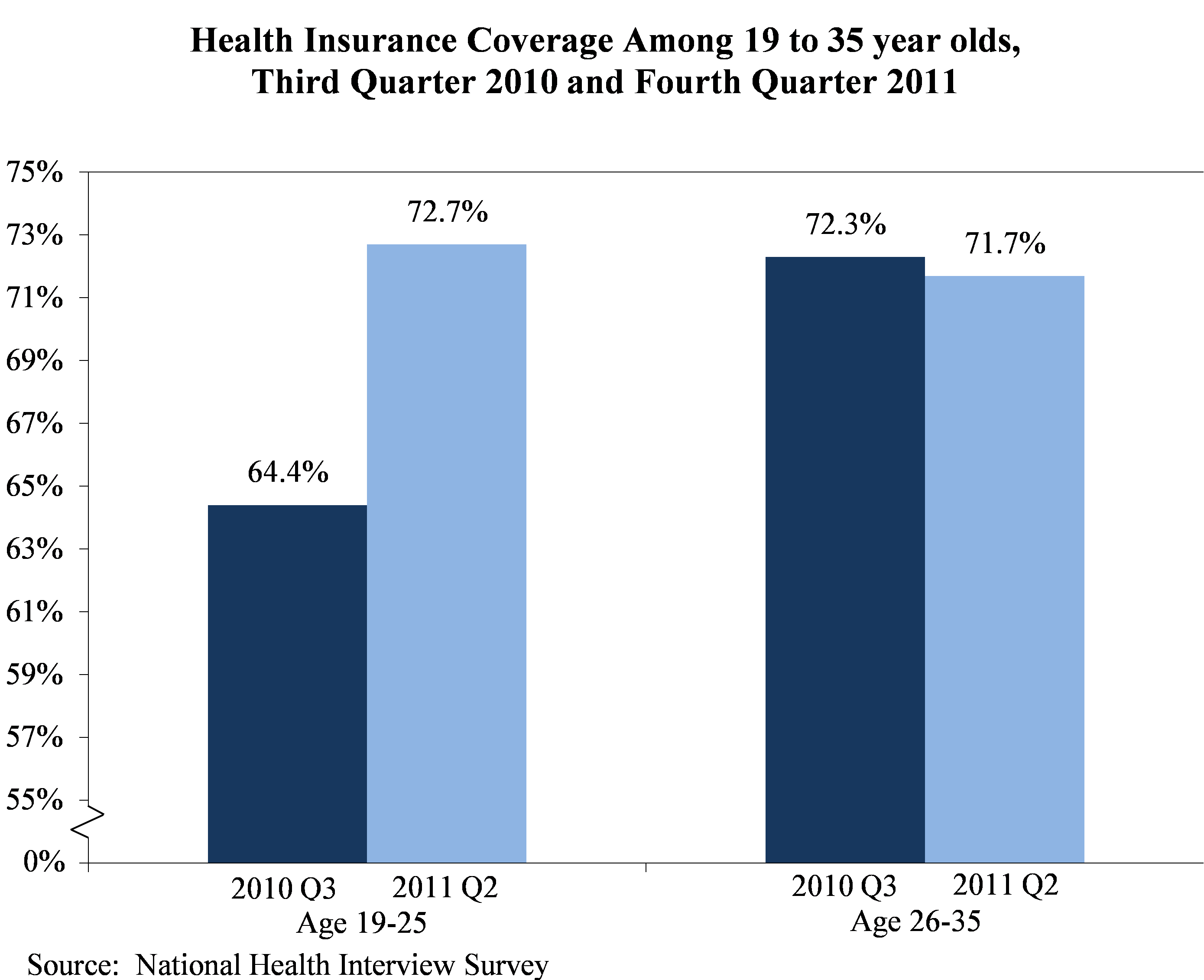 Today, the CDC released new data that indicate that this provision of the law is already making a difference. New results from the National Health Interview Survey show that, from September 2010, when this part of the law took effect, to June 2011, the percentage of 19 to 25 year olds with health insurance coverage increased by more than 8 percentage points, from 64.4 percent to 72.7 percent. This translates to roughly 2.5 million young adults gaining coverage.
A closer look at the NHIS data makes it clear that the Affordable Care Act is responsible for this good news. First, the coverage gains were accounted for entirely by an increase in private insurance coverage. There has been no statistically significant change in the percentage of 19 to 25 year olds covered by public health insurance since September 2010. Second, as shown in the graph, the percent of young adults between the ages of 26 and 35 with health insurance coverage stayed roughly constant over the same time period. This slightly older cohort can be seen as a plausible “control group” because its members faced similar economic conditions as 19 to 25 year olds but are generally not eligible for dependent coverage through their parents’ insurance.
Learn more about Health Care2.5 Million More Young Adults Have Coverage Thanks to Health Law
Posted by on December 14, 2011 at 9:56 AM ESTAs a parent, nothing gives us more peace of mind than knowing that our children can pursue their dreams without unfair limitations. This is why I’m excited to announce that millions more young adults in America now have health insurance coverage thanks to the health care law – enabling them to pursue their goals without worrying about what will happen if they get sick.
The provision in the law allowing young adults to remain on their parents’ health insurance until age 26 has resulted in 2.5 million young people gaining coverage, according to analysis based on new data released today by the National Center for Health Statistics.
Families around the country are benefitting from this part of the law, including families like the Houghs, whose daughter Natalie was diagnosed with a rare heart condition after suffering a cardiac arrest at school. Her condition requires a lifetime of medication and care. There was a day when this diagnosis would mean insurance companies would either not cover Natalie or would offer her unaffordable plans. It would mean that Natalie and her family would have to keep paying, or face the unimaginable alternative.
Now, thanks to the health care law, Natalie can stay on her family’s plan and has started college. And, by the time she turns 26, it will be illegal for a plan to deny coverage to anyone, regardless of their health and Natalie will have access to quality, affordable care.
Today’s news is more evidence of the good things the health care law is doing for young people and their families. More young adults in this country can now go on and live their lives with less worry about visiting their doctor when they get sick, or incurring catastrophic medical bills if they are in an accident. And for us parents, this lets us breathe a sigh of relief.
Kathleen Sebelius is the Secretary of Health and Human Services
Learn more about Health Care
- &lsaquo previous
- …
- 99
- 100
- 101
- 102
- 103
- 104
- 105
- 106
- 107
- …
- next &rsaquo
From the Press Office
Related Videos
-
 December 13, 2016 5:04 PM
Signing Ceremony for the 21st Century Cures Act
-
 December 10, 2016 5:00 AM
Weekly Address: It’s Time to Get Covered on the Health Insurance Marketplace