Health Care Blog
Nine States Receive Grants to Invest in Early Learning Programs
Posted by on December 19, 2011 at 5:45 PM EST
Secretary of Education Arne Duncan speaks in South Court Auditorium. To his right are Secretary of Health and Human Services Kathleen Sebelius, University of Chicago Professor James Heckman, Erickson Institute Professor Barbara Bowman, HHS Deputy Assistant Secretary for Early Childhood Development Linda Smith, and Jacqueline Jones, Senior Advisor at the Department of Education.
Last week, the White House announced that nine states-- California, Delaware, Maryland, Massachusetts, Minnesota, North Carolina, Ohio, Rhode Island, and Washington--would receive grants to invest in high-quality early learning and development programs through the $500 million Race to the Top-Early Learning Challenge.
To apply for the grants, the Departments of Education and Health and Human Services asked states to create plans for early education programs that would give children from low-income families the strong foundation they need to be successful once they start school. Thirty-five states, Puerto Rico, and the District of Columbia applied for grants, and these nine were chosen based on the quality of their applications, and the funds available. Domestic Policy Council Director Melody Barnes, U.S. Secretary of Education Arne Duncan and U.S. Secretary of Health and Human Services Kathleen Sebelius announced the grantees at an early learning event at the White House last Friday.
President Obama had previously asked Congress to authorize a permanent Early Learning Challenge Fund as part of his budget. Unfortunately, Congress did not act on that proposal, so the Administration took action to ensure this program was funded this year through Race to the Top, because our kids only get one shot at a top-notch education and they cannot afford to wait.
The grants will support the nine states as they work toward closing the school readiness gap and developing new approaches to raising the bar across early learning programs, including Head Start, public pre-K, childcare, and private preschools. States will work toward creating standards, improving training and support for teachers and educators, and building evaluation systems into their early learning programs.
Learn more about Race to the Top.
Learn more about Education, Health CareWeekly Wrap Up: "Welcome Home"
Posted by on December 16, 2011 at 5:02 PM ESTWatch West Wing Week here.
What happened this week on WhiteHouse.gov:
Fort Bragg After nearly nine years of sacrifice, the Iraq war has come to an end. The President and First Lady traveled to Fort Bragg in North Carolina on Wednesday to welcome home the troops and thank them — and their families — for their enormous sacrifices and achievements. “For all the disagreements that we face, you remind us that there is something bigger than our differences. Something that makes us one nation. And one people…I could not be prouder of you. America could not be prouder of you.” To see more milestones from the Iraq War, from President Obama’s very first day in office through the work his Administration has done to support our heroes as they return home, check out our new timeline.
Iraq Visit On Monday, the President welcomed Iraqi Prime Minister Nouri al-Maliki. The two leaders held talks on the removal of U.S. military forces from Iraq and on efforts to start a new chapter in partnership between the two nations. “This is a season of homecomings. Military families across America families are being reunited for the holidays. In the coming days, the last American soldiers will cross the border out of Iraq—with honor and with their heads held high.”
Fair Labor As a part of the ‘We Can’t Wait’ campaign, the President announced his support to extend overtime pay protections and a guaranteed minimum wage for home healthcare workers. This effort will raise wages for people like Pauline Beck, a homecare worker who inspired then-Senator Obama in 2007. Currently, many in-home care providers earn less than the minimum wage and no overtime for their vital services to assist those who need it most. “We are going to make sure that over a million men and women in one of the fastest-growing professions in the country don’t slip through the cracks. We’re going to make sure that companies who do right by their workers aren’t undercut by companies who don’t. We’re going to do what’s fair, and we’re going to do what’s right.”
Still Ticking In 15 days, middle class taxes will increase if Congress does not take action to extend the payroll tax cut. Deputy Director of the National Economic Council Brian Deese explains in a White Board discussion how President Obama’s payroll tax cut helps families, business, and the economy – and why it’s so important for Congress to act and extend the tax cut for 2012.
Breaking Down Barriers to Health IT through Entrepreneurship
Posted by on December 16, 2011 at 4:19 PM ESTWhen this Administration took office, President Obama made historic efforts to promote and cultivate a culture of innovation across government. We’ve seen the first-ever Open Government plan and launching of initiatives that harness the creativity of the American people to help solve our toughest problems.
At the Department of Health and Human Services, we’re looking at new ways to collaborate with innovators who seek to deliver better health and health care at lower cost. Healthcare technology, particularly health IT, is a particular area where a great deal of innovation is taking place – leading to the creation of new jobs in Health IT.
As part of the Administration’s Startup America campaign to promote entrepreneurship, we’ve hosted events targeting entrepreneurs, investors and senior administration officials to come up with new opportunities around health care innovations. We’ve also encouraged new and creative ways of thinking through various prizes and challenge efforts to create new tools and applications to support better health and health care.
By the Numbers: 2.5 Million
Posted by on December 16, 2011 at 1:42 PM EST
Earlier this week, the CDC released new data that shows an additional 2.5 million young adults now have health insurance as a result of the Affordable Care Act.
Before President Obama’s historic health care reform law was passed, young people were generally dropped from their parents plan when they turned 18 or left college. Obtaining coverage through an individual plan could be cost-prohibitive for young adults, especially those with pre-existing conditions, so many went without health insurance altogether.
The Affordable Care Act includes a provision that allows young adults to stay on their parent’s health insurance until their 26th birthday. When that provision went into effect in September of 2010, about 64 percent of 19 to 25 year olds had health insurance. By June of 2011, that number jumped to nearly 73 percent.
What’s more, the most significant provisions of the Affordable Care Act won’t go into effect until 2014. When they do, an estimated 30 million previously uninsured Americans will have access to coverage.
For more information:
- Read about how the Obama Administration is reducing health care fraud, and making it easier for small businesses to insure their workers
- Read about how the Affordable Care Act has already saved seniors and people with disabilities $1.5 billion on their prescription drugs
- Read about how the Obama Administration is making it easier for doctors and other health professionals to adopt health IT to reduce paperwork and better coordinate high-quality patient care
Learn more about Health CareBy the Numbers: $21,000
Posted by on December 15, 2011 at 3:44 PM EST
Today President Obama announced a proposal that would ensure fair pay for the 1.79 million workers who provide critical in-home care services for the elderly and infirm. Because of the way the Fair Labor Standards Act is written, these workers are classified as “companions” and therefore exempt from minimum wage and overtime requirements, despite the fact many of them work up to 70 hours a week. The average salary for full-time, in-home care workers is just $21,000 a year.
When the exemption was established in 1974, it was meant to apply to casual babysitters and companions, not workers whose vocation was in-home care service. Now, as our population ages, the need for professional in-home care services is greater than ever. These workers should be paid fairly for their hard work and long hours and today’s proposed legislation changes would ensure that they are.
Approximately 92 percent of these workers are women, and a large number of them are their family’s breadwinners. Close to 40 percent rely on public benefits such as Medicaid and food stamps to make ends meet. Today’s proposed rule would expand minimum wage and overtime protections by ensuring that all home care workers employed by third parties, like staffing agencies, will receive protections along with workers who are privately employed.
For more information:
- Learn the story of Pauline Beck, a home care worker then-Senator Obama spent a day working alongside when he was a candidate for this office. Beck was at the White House today when President Obama announced the new proposal, fulfilling a promise he made to her and other home care workers back in 2007.
Ensuring Fair Pay for Homecare Workers
Posted by on December 15, 2011 at 3:15 PM EST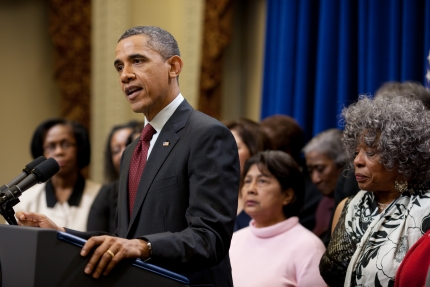
President Barack Obama delivers remarks on new minimum wage/overtime protections for in-home care workers at a “We Can’t Wait” event in the Eisenhower Executive Office Building of the White House, Dec. 15, 2011. Among the workers joining the President was Pauline Beck, right, a home care worker from California who, in 2007, was shadowed by then Senator Obama as part of an event called “Walk a Day in My Shoes.” (Official White House Photo by Pete Souza)
Four years ago, President Obama spent the day with Pauline Beck, a home health care worker. He followed her throughout her day -- as she got up at 5:00 in the morning to care for an 86-year-old amputee. He saw first-hand the demands of her work.
Their business is a growing industry -- one of the fastest in America. As the population of this country gets older, more Americans are turning to people like Pauline Beck to help make sure they have the care they need. And as the President said this morning, "As the homecare business has changed over the years, the law hasn’t changed to keep up." In the eyes of the law, homecare workers fall into the same category as a teenaged babysitter.
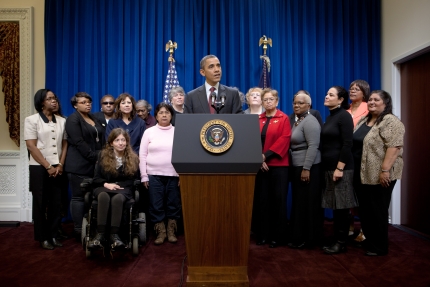
President Barack Obama delivers remarks on new minimum wage/overtime protections for in-home care workers at a “We Can’t Wait” event in Room 430 of the Eisenhower Executive Office Building of the White House, Dec. 15, 2011. Attendees include: Labor Secretary Hilda Solis, Karen Kulp, President & CEO Home Care Associates; and home care workers: Pauline Beck, Thelma Reta, Iterra Blackshear, Tracy Dudzinski, Manuela Butler, Elma Wauneetta Phillips, Bertie Caraway, Margaret Glover, Elva Munoz, Michelle Wise, Olive Nanette Lyons, April Jones-Britt, Martha Cobos, and Gilda Brown; and home care employers: Sascha M. Bittner and Robin L. Shaffert. (Official White House Photo by Lawrence Jackson)
So today, the President did something to help homecare workers like Pauline Beck. He announced his support of a law to extend overtime pay protections and a guaranteed minimum wage to those who do this work:
We are going to make sure that over a million men and women in one of the fastest-growing professions in the country don’t slip through the cracks. We’re going to make sure that companies who do right by their workers aren’t undercut by companies who don’t. We’re going to do what’s fair, and we’re going to do what’s right.
Watch President Obama's full remarks here.
Learn more about Economy, Health Care
- &lsaquo previous
- …
- 98
- 99
- 100
- 101
- 102
- 103
- 104
- 105
- 106
- …
- next &rsaquo
From the Press Office
Related Videos
-
 December 13, 2016 5:04 PM
Signing Ceremony for the 21st Century Cures Act
-
 December 10, 2016 5:00 AM
Weekly Address: It’s Time to Get Covered on the Health Insurance Marketplace