Health Care Blog
Calling All Innovators – Health Care Innovation Challenge Open for Great Ideas
Posted by on December 7, 2011 at 10:27 AM ESTRecently, the Department of Health and Human Services, through the Affordable Care Act, launched the Health Care Innovation Challenge, which will award $1 billion in grants to applicants who will implement the most compelling new ideas to deliver better health and improved care at lower costs to people enrolled in Medicare, Medicaid and the Children’s Health Insurance Program (CHIP)—particularly those with the greatest health care needs.
The Challenge is a signature initiative of the Center for Medicare and Medicaid Innovation, and promises to catalyze new approaches that support health care delivery transformation. It offers an unprecedented opportunity for innovators and entrepreneurs who have been working tirelessly on new care improvement models but have often faced great difficulty bringing them to the patients who need them in today’s reimbursement environment. This Challenge will help us by:
- Identifying new ways of paying for health care that improve care at reduced cost and can be scaled nationally by CMS and the Department of Health and Human Services.
- Engaging a wide variety of innovators to help come up with new and promising ideas. Interested parties of all types are welcome to apply. Doctors, nurses and other care providers, hospitals, health systems, payers, technology entrepreneurs and other private sector organizations, faith-based organizations, local governments, and public-private partnerships are some of the professionals and organizations we expect to apply. In addition, certain organizations may apply as conveners to assemble and coordinate groups of participants.
- Helping to create jobs. The Challenge gives priority to applicants that identify opportunities for job creation. By rewarding public sharing and rapid deployment of such ideas, the Challenge will boost our ability to deliver on the promise of health care delivery innovation. We also believe that by attracting top talent to the health care sector and identifying pathways for innovators to build rewarding careers in this industry, we will both solidify our position as the world’s most competitive healthcare workforce and also help strengthen the foundation for better health for our citizens well into the future.
- Encouraging “enhanced infrastructure” to support more effective system-wide function. In this context, we hope this Innovation Challenge will serve as a call to action for technology and data innovators to team with care innovators to propose solutions that can be implemented with speed and have the capacity to scale.
- Promising smart answers fast. We need your “letters of intent” by December 19th, 2011, with full applications by January 27th, 2012. Winners will be awarded by March 2012 with three-year grants ranging from $1 million to $30 million.
Some of the greatest transformations American healthcare has seen have come from sources outside its traditional boundaries — for example, health care has borrowed widely from the automotive, aerospace, and defense industries to innovate. So please share this post far and wide to innovative thinkers in every corner of American industry – even to those who haven’t yet actively engaged in the health care delivery sector. There’s never been a better time to innovate in health care – as more and more of the information required to power innovations that safeguard and improve health becomes available and accessible, and as the health care system begins to reward providers for keeping patients healthy and delivering value, not just volume. Answer the Health Care Innovation Challenge, and play your part in improving the nation’s health care system by proposing new ideas that deliver better health and improved care at lower costs to people with Medicare, Medicaid and CHIP.
As Open Enrollment Ends, People with Medicare Save $1.5 Billion on Prescriptions
Posted by on December 6, 2011 at 9:42 AM ESTIf you’ve had a Medicare Advantage or Prescription Drug Plan for a few years, you’ll know that December is the end of Medicare Open Enrollment. This year, the last day for you to choose new Medicare health or prescription drug coverage for 2012 is December 7, earlier than it’s been in previous years.
December 7 is tomorrow. But you still have until midnight tomorrow if you want to make a change to your medical or prescription drug coverage.
And as you are reviewing your plan, remember that Medicare is only getting stronger. New data released today shows how millions of seniors have gotten cheaper prescription drugs and free preventive services, all thanks to the President’s health reform law.
Thanks to the Affordable Care Act, the Medicare prescription drug coverage gap known as the donut hole is starting to close. Through the end of October, 2.65 million people with Medicare have received discounts on brand name drugs in the donut hole. These discounts have saved seniors and people with disabilities a total of $1.5 billion on prescriptions – averaging about $569 per person. For State-by-State information on the number of people who are benefiting from this discount in 2011, visit this page.
Over the coming years, the Affordable Care Act will help close the coverage gap completely. Each year from now to 2020, you’ll pay less for brand name and generic drugs in the coverage gap. And in 2020, the coverage gap will be eliminated and the donut hole will be closed for good.
In addition to cheaper prescription drugs, the Affordable Care Act also made preventive services available to people with Medicare for free. Preventive care helps people stay healthy and live longer lives. Through the end of November nearly 24.2 million people with Medicare have received one or more free preventive services, including Medicare’s new free Annual Wellness Visit. For State-by-State information on the numbers of people who are utilizing preventive services in 2011, visit this page.
Learn more about Health CarePresident Obama Meets with Tribal Leaders
Posted by on December 5, 2011 at 5:46 PM ESTOn December 2, 2011, following the 2011 White House Tribal Nations Conference, President Obama met with a small and regionally diverse group of tribal leaders from across Indian Country. Also participating in the meeting were Secretary of the Interior Ken Salazar, Secretary of Health and Human Services Kathleen Sebelius, Secretary of Education Arne Duncan, and Associate Attorney General Thomas Perrelli.
The tribal leaders in attendance had the opportunity to directly engage with the President on a leader-to-leader, government-to-government basis. They spoke about economic issues affecting their reservations and proposed some innovative solutions for developing sustainable economies focusing on building solar and wind projects, reducing regulatory burdens, expanding broadband and leveraging private sector investment, among others. Also discussed was the Executive Order on Improving American Indian and Alaska Native Educational Opportunities and Strengthening Tribal Colleges and Universities, which the President signed earlier in the day to improve education opportunities for Native American youth across the country.
The twelve tribal leaders that participated in the meeting were Fawn Sharpe, President, Quinault Indian Nation; Diane Enos, President, Salt River Pima-Maricopa Indian Community; Steve Ortiz, Chairman, Prairie Band Potawatomi Nation; Jefferson Keel, Lt. Governor, Chickasaw Nation; Nelson Cordova, Governor, Pueblo of Taos; George Edwardson, President, Inupiat Community of Arctic Slope; Ben Shelly, President, Navajo Nation; Richard Milanovich, Chairman, Agua Caliente Band of Cahuilla Indians; Colley Billie, Chairman, Miccosukee Indian Tribe; Tracy “Ching” King, President, Fort Belknap Indian Community; Rodney Bordeaux, President, Rosebud Sioux Tribe; and Erma Vizenor, Chairwoman, White Earth Band of Chippewa.
This meeting took place after a week of White House events that focused on strengthening the government-to-government relationship between the United States and Tribal Nations and building on the progress made during the 2009 and 2010 White House Tribal Nations Conferences. In addition to the President’s meeting, the White House hosted a series of Regional briefings and listening sessions for tribal leaders, highlighted 11 Native American youth as Champions of Change, released a White House Tribal Nations Conference Progress Report and at the Tribal Nations Conference the President spoke to representatives from the 565 federally recognized Indian tribes.
Learn more about , Economy, Education, Energy and Environment, Health Care, Taxes, Additional IssuesWest Wing Week: 12/2/11 or "Bo Meets Bo."
Posted by on December 2, 2011 at 12:00 AM ESTThis week, as the President urged Republicans to join a Democratic effort to prevent a thousand dollar tax increase on the typical American family, the White House got spruced up for the holidays. The President also hosted the EU Summit, the Dutch Prime Minister, and announced a new commitment to fighting AIDS in America and around the world. He also lit the National Christmas Tree. That's November 25th to December 1st, or "Bo Meets Bo."
Watch West Wing Week here.
By the Numbers: $335
Posted by on December 1, 2011 at 6:17 PM EST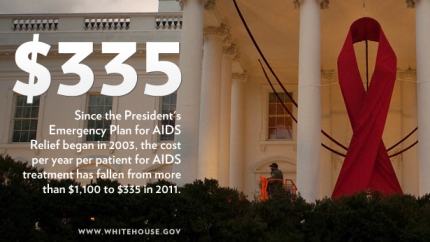 Learn more about Health Care
More Good News for Medicare
Posted by on December 1, 2011 at 4:50 PM ESTEarlier this week, I highlighted a new story from the Associated Press indicating that seniors who hit the prescription drug coverage gap known as the donut hole will save an average of $600 this year alone.
Today, we got more good news for people with Medicare. Released today, a new report from the Government Accountability Office requested by Senators Baucus and Harkin finds that more seniors are enrolling in Medicare Advantage and that premiums are going down. The report examined changes in the Medicare Advantage program between 2010 and 2011. Here are a few of the highlights:
Access to Medicare Advantage Remains Strong, with more people enrolled in Medicare Advantage this year:
“Enrollment in the MA plans GAO analyzed increased by about 6 percent--from 7.9 million to 8.4 million beneficiaries--from April 2010 through April 2011.”
Medicare Advantage premiums are going down:
“The average monthly premium for beneficiaries in MA plans decreased from $28 in 2010 to $24 in 2011, about a 14 percent reduction.”
President Obama is committed to making Medicare stronger and today’s report is another sign that the Affordable Care Act is working for America’s seniors. In addition to lower premiums, seniors can get free preventive services like mammograms and other cancer screenings and a free annual wellness visit. And in the years ahead, the prescription drug coverage gap known as the donut hole will be eliminated.
You can learn more about Medicare and the Affordable Care Act at www.healthcare.gov. And click here to read the full report from the GAO, entitled MEDICARE ADVANTAGE: Enrollment Increased from 2010 to 2011 While Premiums Decreased and Benefit Packages Were Stable.
Nancy-Ann DeParle is the Assistant to the President and Deputy Chief of Staff
Learn more about Health Care
- &lsaquo previous
- …
- 100
- 101
- 102
- 103
- 104
- 105
- 106
- 107
- 108
- …
- next &rsaquo
From the Press Office
Related Videos
-
 December 13, 2016 5:04 PM
Signing Ceremony for the 21st Century Cures Act
-
 December 10, 2016 5:00 AM
Weekly Address: It’s Time to Get Covered on the Health Insurance Marketplace