Health Care Blog
Announcing the Winners of the Apps Against Abuse Technology Challenge
Posted by on November 1, 2011 at 1:22 PM ESTLast July, I wrote about a new and innovative effort to help address sexual assault and dating violence. While women of any age can be targets of this kind of abuse, young women aged 16-24, experience the highest rates of rape and sexual assault, and 1 in 5 will be a victim of sexual assault during college. Many of these assaults occur when the offender, often an acquaintance, has targeted and isolated a young woman in vulnerable circumstances. Moreover, sixty percent of college students who have been in an abusive relationship say no one helped them.
Working with the Office of the Vice President and the White House Office of Science and Technology, we launched the Apps Against Abuse technology challenge – calling on software innovators to harness the power of mobile technology to help prevent dating violence and abuse by keeping young adults connected to trusted friends and providing easy access to important resources for help including local police and abuse hotlines.
Today, we are pleased to announce the winners of the challenge: “Circle of 6” and “On Watch.” Prototypes of the two winning applications were selected from a pool of over 30 entries submitted to Challenge.gov.
Vice President Biden applauded the winning applications earlier today during a conference call with hundreds of college and university officials to discuss ongoing efforts to help better prevent and respond to sexual assault and violence on campuses across the country. He encouraged the college and university leaders to make students on their campuses aware of the applications when they become available for download in 2012.
Why Cancer Patients Can't Wait: "It Can Mean the Difference Between Curing Your Cancer and Not"
Posted by on October 31, 2011 at 7:00 PM ESTWatch Jay Cuetara, a cancer patient and advocate for drug shortage reform, speak about President Obama's executive action to reduce prescription drug shortages in America here.
President Obama today signed an executive order that directs the FDA to step up work to reduce the drug shortages and protect consumers. Jay Cuetara know just how important this is: in August, the center where he was receiving chemotherapy ran out of the drug being used to treat his cancer, which "can mean the difference between curing your cancer and not," the San Francisco man explained.
The President's action means that drug companies will be required to let the FDA know earlier about the potential for drug shortages so that they can respond successfully. If we find out that prices are being driven up because shortages are being made worse by manipulations of companies or distributors, agencies will be empowered to stop those practices. And the FDA and the Department of Justice will be investigating any kinds of abuses that would lead to drug shortages.
As the President said today, we can't wait for action. "We'll still be calling on Congress to pass a bipartisan bill that will provide additional tools to the FDA and others that can make a difference. But until they act, we will go ahead and move."
Update: Check out a video from Bonnie Frawley, a pharmacy manager from Boston, who talks about what the President’s order will mean for hospitals.
Learn more about Health CareBy the Numbers: 650 Percent
Posted by on October 31, 2011 at 4:46 PM EST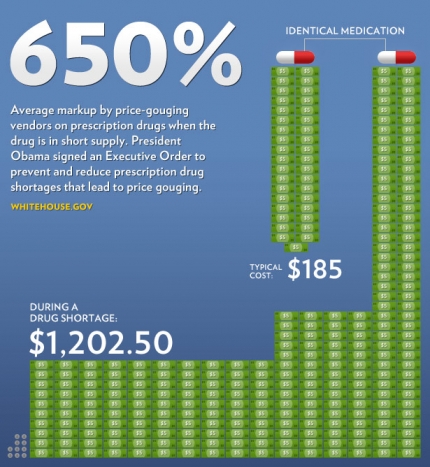
The number of prescription drug shortages tripled between 2005 and 2010. Besides having serious consequences for people's health and well-being, drug shortages drive vendors to charge outragous prices for drugs that are normally affordable when in stock. One report found that price-gouging vendors mark up prices on drugs in short supply by 650 percent, on average.
Another report about these “grey market vendors”—companies that inflate prices of drugs running in short supply—found that a leukemia drug whose typical contract price is about $12 per vial was being sold at $990 per vial. At the extreme, a drug used to treat high blood pressure that was normally priced at $25.90 was being sold at $1,200 due to a drug shortage.
Only a very small number of drugs are affected by such shortages, but for many patients, changing medications may be the difference between getting healthier and getting sicker. Drugs affected by shortages include cancer treatments, anesthesia drugs, and other medications that are critical to the treatment and prevention of serious diseases and life-threatening conditions.
Today, President Obama signed an Executive Order that will help prevent shortages that lead to this type of price gouging. The order directs the Food and Drug Administration to expand reporting about situations that might lead to drug shortages, and also to work with the Department of Justice to investigate illegal price gouging.
Learn more about Economy, Health CareWhy We Can’t Wait: Taking Action to Reduce Prescription Drug Shortages
Posted by on October 31, 2011 at 1:30 PM EST
President Barack Obama talks with the media before signing an Executive Order directing the Food and Drug Administration (FDA) to take action to help further prevent and reduce prescription drug shortages, protect consumers and prevent price gouging, in the Oval Office, Oct. 31, 2011. From left: pharmacy manager Bonnie Frawley from Brigham and Women's Hospital in Boston, Mass.; Health and Human Services Secretary Kathleen Sebelius; cancer patient Jay Cuetara from San Francisco, Calif.; and FDA Commissioner Peggy Hamburg. (Official White House Photo by Pete Souza)
Sometimes the most important component of a patient’s treatment is the type of medication they receive and the consistency at which they receive it. For some Americans, a change in their treatment regimen or a substitution of a medication can seriously threaten their ability to get better.
Between 2005 and 2010, the number of prescription drug shortages nearly tripled. While the FDA successfully prevented 137 drug shortages between January 1, 2010 and September 26, 2011, prescription drug shortages continue to threaten the health and safety of the American people. Today, too many people are waiting for their prescription to become available. Some are forced to switch from the medication they prefer, while others go without their medicine altogether. In some cases, drug shortages can even force people to stop a course of treatment before it finishes.
We cannot control the factors that cause these drug shortages. But we are committed to doing our part to counteract them. Which is why President Obama signed an Executive Order today that will lead to earlier FDA notification of any impending shortages for certain prescription drugs. Early notification can help prevent a shortage from becoming a crisis by allowing hospitals, doctors and manufacturers to take action to ensure medications remain available.
In addition, the President’s Executive Order will call on FDA to work with the Justice Department to examine whether “gray market” profiteers are responding to potential drug shortages either by hoarding medications or charging exorbitant prices. In recent months, we’ve heard reports of enormous markups such as a blood pressure medicine usually priced at $26 being sold for $1,200. And under this Executive Order, the Justice Department will watch the market closely to make sure companies are not exploiting drug shortages to raise their profits at the expense of patients.
Learn more about Health CareFor the Win: Hope and Soap
Posted by on October 28, 2011 at 4:49 PM ESTFor the Win is a guest blog series featuring the remarkable initiatives that young Americans are advancing to win the future for their communities. Each week we highlight a new young person and learn about their inspiring work through their own words. Submit your story to appear in the For the Win guest blog series.
Maren Johnson, 16, is a junior at Watertown High School in Watertown, S.D. She is the Global Soap Project’s student ambassador and a member of the 2011 PARADE All-America High School Service Team, an award recognizing outstanding young service leaders presented by PARADE Magazine in partnership with generationOn, the global youth service enterprise of Points of Light.
Nearly 50 fifth and sixth grade students at Immaculate Conception school in my hometown of Watertown, S.D., were shocked recently when they saw simulated germs on their classmates’ hands light up under a special ultra-violet light as part of a Global Handwashing Day activity. Global Handwashing Day, celebrated this year on October 15, is an annual day to raise awareness about the benefits of handwashing with soap and support a global culture of handwashing.
Studies show that hand washing with soap is the most effective way to reduce disease that causes more than 3.5 million children to die before they reach five. While it is extremely important to raise awareness and create better hand washing habits, I have engaged more than 500 people in solving another critical problem: millions of people simply cannot afford soap, or do not have access to it.
That’s why a little over a year ago I recruited six hotels in Watertown to begin collecting their used bars of soap so that I could help recycle them through the Global Soap Project in Atlanta, Ga. My network has grown to more than 160 hotels in four states and Canada and I’ve collected more than 6,000 pounds of used soap. Recently, about 100 hotels with more than 7,000 hotel rooms in the Black Hills of South Dakota indicated they intend to join our effort.
First Lady Michelle Obama on Making a Difference in Cities with Food Deserts
Posted by on October 25, 2011 at 6:25 PM EST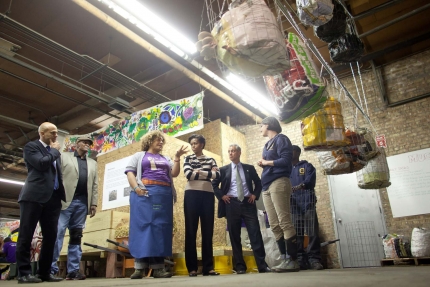
First Lady Michelle Obama learns about growing mushroom chandeliers from Erika Allen, National Outreach Director for Growing Power, during a tour of Iron Street Farm in Chicago, Ill., Oct. 25, 2011. Sam Kass, White House Assistant Chef and Senior Policy Advisor for Healthy Food Initiatives, left, and Chicago Mayor Rahm Emanuel toured the seven-acre urban farm with Mrs. Obama. October 25, 2011. (Official White House Photo by Lawrence Jackson)
For too many American families, serving healthy food as part of a regular diet isn’t actually an option. That’s because, in many communities across the country, there is no place to purchase any groceries, much less fresh fruits and vegetables. These neighborhoods are known as food deserts, and in recent years, as economic difficulties caused grocery stores to shut their doors or consolidate locations, they have been proliferating.
Eliminating these food deserts and making sure parents in every part of the country have access to fresh produce and healthy choices is a primary goal of Let’s Move, and today First Lady Michelle Obama was in Chicago where she challenged attendees at the Mayor’s Summit on Food Deserts to look for ways to attract grocery stores and other businesses selling fresh produce to their communities.
Studies have shown that people who live in communities with greater access to supermarkets, they eat more fresh fruits and vegetables – surprise. And that can have a real impact on the health of our families.
I mean, truly, we all grew up in communities with grandmothers who cooked two, three vegetables that you had to eat. There was no ifs, ands or buts about it. But that’s because many of our grandparents, they had community gardens; there was the vegetable man that came around. There were many other resources that allowed them to have access. So it’s not that people don't know or don't want to do the right thing; they just have to have access to the foods that they know will make their families healthier.
Learn more about , Health Care, Working Families
- &lsaquo previous
- …
- 105
- 106
- 107
- 108
- 109
- 110
- 111
- 112
- 113
- …
- next &rsaquo
From the Press Office
Related Videos
-
 December 13, 2016 5:04 PM
Signing Ceremony for the 21st Century Cures Act
-
 December 10, 2016 5:00 AM
Weekly Address: It’s Time to Get Covered on the Health Insurance Marketplace