Students Present Ideas for Better Buildings

President Obama has called for an all-of-the-above energy strategy, and one way we can prepare for the future is to engage students in creating energy solutions for the future. Recently, students from across the country came to the White House to present their ideas for energy efficient buildings. University teams—led by their respective energy club—tackled cases that focus on a number of the most common, most stubborn barriers to energy efficiency in both the private sector and in state and local settings. The students came from a variety of academic programs, including engineering, real estate, business/management, and policy.

The cases use real scenarios, information, and data provided by Better Buildings Challenge Partners and others in the commercial buildings industry. Students presented on two city policy scenarios and two private real estate scenarios, answering questions such as, "What is the best mechanism to significantly move the energy efficiency market?" Their creative and innovative solutions addressed policy, finance, business and real estate challenges.

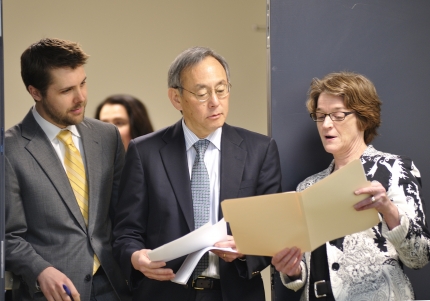
Discussing Winners

Reviewing student ideas, from left: Brian Deese, Deputy Director of the National Economic Council; Energy Secretary Chu; and Kathleen Hogan, Deputy Assistant Secretary for Energy Efficiency.

This forum provides the next generation of engineers, entrepreneurs and policymakers with skills and experience to start careers in clean energy and generates creative solutions to real-world problems to be used as models by businesses and other organizations across the marketplace.

The event supported the Better Buildings Challenge, a national energy efficiency leadership initiative and a core element of President Obama's plan to make commercial buildings 20 percent more energy efficient by 2020. In addition to supporting significant energy reduction, the Better Buildings Challenge is focused on finding solutions to persistent barriers to energy efficiency that have limited the energy efficiency market.

Energy Secretary Steven Chu announced the winners of the competition and congratulated them for their efforts to tackle some of the most common and stubborn barriers to improving energy efficiency.

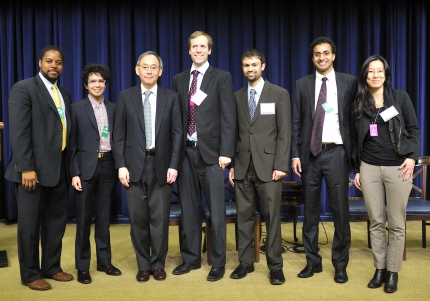
Secretary Chu with Winners

Energy Secretary Steven Chu (3rd from left) pictured with the student team from Massachusetts Institute of Technology, one of the winning teams.

Participating Universities:
Babson College
Carnegie Mellon University
Columbia University
Dartmouth College
Duke University
The George Washington University
Georgetown University
Georgia Institute of Technology
Harvard University
Massachusetts Institute of Technology
Texas A&M University
Tufts University
University of California, Berkeley
University of California, Irvine
University of Colorado, Denver
University of Michigan, Ann Arbor
University of Southern California
Vanderbilt University
Yale University

Read more on the President's Better Buildings Initiative.

Maria Vargas is Director of the Better Buildings Challenge at the U.S. Department of Energy

Reducing Greenhouse Gas Pollution: Protecting Communities and Strengthening the Economy

In January 2010, President Obama announced that the Federal Government would reduce the greenhouse gas (GHG) emissions from its operations by 28 percent by 2020. In his announcement the President remarked, “As the largest energy consumer in the United States, we have a responsibility to American citizens to reduce our energy use and become more efficient.”

This goal wasn’t just about improving the operations of government, but about living up to the Federal Government’s responsibility to all Americans to improve our economy and environment. In meeting this pollution reduction target, the Government will help American taxpayers avoid up to $11 billion in energy costs.

In line with this effort, the Council on Environment Quality (CEQ) is releasing revised GHG emissions accounting guidance for Federal agencies. The draft proposes revisions to guidance released in October 2010, which established Government-wide requirements for measuring and reporting GHG emissions associated with Federal agency operations. As agencies learn from their experience implementing the initial guidance, we are applying this knowledge in our continual quest to make Federal emissions reporting as accurate as possible. 

As part of our Open Government initiative at CEQ, we are giving the public an opportunity to review this guidance and provide us with feedback. CEQ will review all public comments submitted in the next 30 days before finalizing the updated guidance.

We look forward to hearing from all of you as we continue to work toward the President’s goal to lower costs, reduce pollution, and transition to a cleaner, all-of-the-above energy strategy.

You can read the revised GHG plan and share your ideas here.

Nancy Sutley is Chair of the White House Council on Environmental Quality

A New Leader in Protecting our Oceans and Coasts

This week marks my first as Director of the National Ocean Council (NOC) Office, a role in which I'm tremendously honored to serve on behalf of the American people. Since its inception, the NOC has evolved into an engine for advancing stewardship of our ocean, coasts, and Great Lakes—resources that contribute not just to our Nation's economy, but also to our environmental health and overall public wellbeing. The task before the Council—to advance the sustainable use of our ocean, coastal, and Great Lakes resources under President Obama's National Ocean Policy—could not be more important.

The NOC has already made significant progress. In January 2012, the National Ocean Council released a strong, scientifically robust draft Implementation Plan to carry out the National Ocean Policy. The draft Plan reflects feedback from hundreds of stakeholders and members of the public. Additional comments being received and incorporated now will help us improve and develop the final Plan.

I am looking forward to building on this progress by applying 22 years of experience in the resource management field, with a focus on coastal management issues and public involvement that culminated in leading the development of an ocean management plan for the Commonwealth of Massachusetts. I am also looking forward to working with the members and staff of the NOC and the agencies who are working hard to ensure healthy oceans. The expertise and capability of those directly supporting the NOC is extraordinary. But we can't do it alone. That's why collaborating and communicating with our partners and the public—including industries, environmental groups, states, tribes, communities, academia, and others—will remain a top priority for the Council as we move ahead.

Again, it's an honor to be aboard.

Deerin Babb-Brott is Director of the National Ocean Council Office

Built to Last: Energy and the Environment in the Southwest

Editor's Note: This blog introduces readers to Neal R. Armstrong, Director of the Center for Interface Science: Solar Electric Materials at The University of Arizona.

CEQ Chair Nancy Sutley recently visited the University of Arizona (UA) to tour one of the nation’s hubs for energy research, the Center for Interface Science: Solar Electric Materials (CISSEM), and to discuss sustainability with leading researchers, administrators, and students. The visit followed President Obama’s State of the Union Address last month, in which he laid out a blueprint for an American economy that is “built to last,” including a strong focus on clean energy.

CISSEM is one of 46 Energy Frontiers Research Centers created under the American Recovery and Reinvestment Act of 2009. These centers are focused on transformative innovations in renewable energy production that will reduce our dependence on foreign oil and protect our environment.  Appropriate to Arizona’s photon-rich landscape, UA’s center is at the cutting edge of the effort to create solar cells that are economically competitive with fossil fuels. Such cells must be both relatively inexpensive to manufacture and efficient at converting sunlight into electricity.

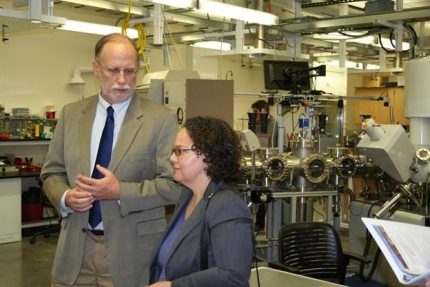
Chair Sutley tours UA

Chair Sutley tours UA’s Energy Frontiers Research Center with Director Neal Armstrong. (Photo Credit: University of Arizona)

After visiting CISSEM’s laboratories, Chair Sutley was briefed on UA’s own sustainability efforts by Senior Associate Vice President for Business Affairs Bob Smith. In the Southwest, water management is a critical priority, and UA is conserving through efforts including waterless urinals, reclaimed water irrigation, water harvesting, xeriscaping, and irrigation scheduling. The University is also actively reducing energy consumption by installing photovoltaic and solar thermal panels on a number of campus buildings, lighting retrofits, combined heat and power plants, HVAC scheduling, high-efficiency boilers, smart thermostats, and more. 

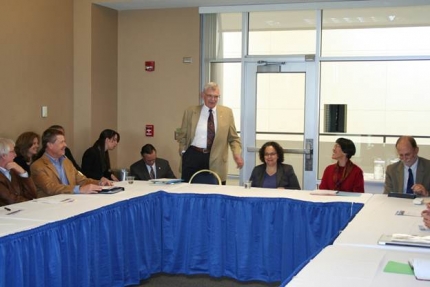
Chair Sutley wrapped up her visit to the University of Arizona at a sustainability roundtable with UA scientists, administrators, and students, moderated by UA Provost Jacquelyn Mok. In her opening remarks, the Chair noted several of the challenges facing federal policymakers: How do we best take advantage of the information technology revolution? How do we think about federal assets in the face of a changing planet so that we can provide actionable information to local and regional managers? And, how do we change from a stovepipe mindset to bring a systems approach to managing natural resources and energy systems? Steered by Executive Dean Joaquin Ruiz, a focus on water echoed throughout the discussion, since water is a critical variable in all natural resource issues including energy production. The discussion ended with an impassioned plea from undergraduate Noelle Espinosa for continued federal support of our nation’s universities that foster innovative programs such as CISSEM and help lay the groundwork for a prosperous, sustainable future for America.

UA President introduces Chair Sutley

UA President Gene Sander introduces Chair Sutley to the sustainability roundtable. (Photo Credit: University of Arizona)

Neal R. Armstrong is Director of the Center for Interface Science: Solar Electric Materials at The University of Arizona

Praise for the National Ocean Policy Implementation Plan

Today, the National Ocean Council released a draft National Ocean Policy Implementation Plan for public comment, laying out an action plan for addressing the most critical challenges facing ocean, coastal, and Great Lakes resources. Here's what others have to say about the plan:

Jim Lanard, President, Offshore Wind Development Coalition

“We support the National Ocean Policy and believe that it can help bring clarity to the management of our oceans and advance the growth of the offshore wind industry. A National Ocean Policy will result in the protection of marine ecosystems and will ensure the orderly and economically - and environmentally-sustainable development of ocean resources, in a manner that respects and minimizes conflicts with existing users.”

Bill Ruckelshaus, Co-chair, Joint Ocean Commission Initiative

“The Joint Ocean Commission Initiative Leadership Council applauds release of the National Ocean Policy Implementation Strategy. This is a crucial step toward realizing a policy that will benefit not only the health of our oceans and coasts but our economy, our environment, and our nation’s security. We look forward to continued collaboration with the National Ocean Council in support of timely and effective implementation of the National Ocean Policy.”

Rick Bellavance, Owner and Operator, Priority Fishing Charters, Rhode Island

“Our ocean is critical to Rhode Island’s economy and way of life. We need all government agencies to work with fishermen and everyone else who uses the ocean to create a comprehensive plan that allows us to tackle big problems like climate change and ocean acidification while protecting and sustainably growing our coastal economies. Today’s announcement lays out a plan to do just that.”

Richard Nelson, Lobsterman, Friendship, Maine

“A healthy ocean is the foundation of New England’s coastal economy. We need to get everyone to the table—the government, scientists and people like me who make a living out there—and we need to make a comprehensive plan for the ocean so that new businesses like renewable ocean energy can develop while ensuring that existing industries like fishing can grow and flourish into the future.”

Molly McCammon, Executive Director, Alaska Ocean Observing System

“The National Ocean Policy and the draft implementation plan really highlight the important role our oceans play in the nation’s economy and global environment. I am especially pleased that the plan recognizes the importance of ocean observations, making data publicly available, and especially focusing on the issues facing the Arctic region.”

Tricia K. Jedele, Director, Conservation Law Foundation’s Rhode Island Office

“The implementation plan announced today gives us new approaches and tools for tackling the many challenges facing our ocean. This is a great opportunity for everyone who works or plays on Rhode Island Sound to work together to improve the health of our ocean ecosystems, clean up our beaches, and strengthen the economies of our coastal communities.”

Jack Clarke, Director of Public Policy & Government Relations, Massachusetts Audubon Society

“Mass Audubon supports the Obama administration’s initiative in planning for and managing America’s ocean waters. This is an important and necessary step as we work together to provide for our oceans’ environmental, economic and national security functions. We look forward to partnering with the federal agencies focusing on ocean management planning in the New England region.”

Berl Hartman, the New England Chapter Director of Environmental Entrepreneurs (E2)

“E2 welcomes the National Ocean Policy draft implementation plan as a major milestone to protect the health of our valuable ocean ecosystems and bolster our coastal economies. Our oceans and Great Lakes are incredible engines of economic development and jobs. Today’s draft plan moves us towards a coherent, coordinated policy that sets national priorities and provides data for better decisions.”

Rep. Ed Markey, Ranking Member of the House Natural Resources Committee

“President Obama's ocean plans provide a framework for coastal communities to address some of the most pressing challenges to ensure healthy oceans, coasts and Great Lakes for present and future generations. Right now our oceans and Great Lakes are as active as they are vast, teeming with competition to fish, ship goods, train our Naval forces, harness wind energy, and conserve vital species and recreation locations. This plan will strengthen regional efforts to promote efficiency and collaboration in sharing these resources.”

The National Ocean Council invites your input to inform development of the final Implementation Plan.

Michael Weiss is Acting Director of the National Ocean Council

At Treasury, Green is Our Favorite Color – But We'll Take (LEED) Gold!

Editor’s Note: This blog was cross-posted from the U.S. Department of the Treasury Blog.

When you think about a “green” building, you probably don’t picture a centuries-old National Historic Landmark that’s lined with columns and made of thousands of tons of granite.

Well, maybe that’s about to change. I'm pleased to announce that the Treasury Building – which dates back to the 19th century and is located right next door to the White House – received Leadership in Energy and Environmental Design (LEED) Gold certification from the U.S. Green Building Council (USGBC) at a ceremony today in our historic Grant Room.

According to the USGBC, the Treasury Building is believed to be the oldest building in the world to receive LEED certification. The fact that the home of much our nation’s financial history has achieved this distinction for environmental leadership really adds new meaning to the term ‘green’ building.

LEED is a leading international standard for the design, construction, and operation of high-performance green buildings. The Treasury Building received its LEED Gold certification based on a number of green construction and operation features, including:

•Increasing the use of natural day lighting to reduce energy consumption;
•Establishing sustainable cleaning and landscape programs;
•Developing and implementing advanced control and management of the heating ventilation and air conditioning (HVAC) systems;
•Conducting waste stream audits to benchmark recycling programs and identify opportunities to maximize material conservation;
•Creating a green procurement program for materials, equipment and services purchased
•Increasing occupant space utilization;
•Augmenting alternate transportation means; and
•Establishing enhanced utility metering for improved systems management

These improvements are paying big dividends. Not just for the environment, but also for the Department’s bottom line – because going green saves green for taxpayers. Project results, which are producing an estimated $3.5 million in energy and lease cost savings annually, include:

•A 43 percent decrease in the use of potable water
•A 7 percent decrease in electrical usage
•A 53 percent decrease in the use of steam
•The addition of 164 additional workstations within the building

The fact that we’ve been able to achieve those types of results is particularly significant given the unique historical and architectural features of the Treasury Building.

The Treasury Building is more than two city blocks long and was constructed over a period of 33 years between 1836 and 1869. The east and center wings – which comprise the oldest portion of the structure – were designed by Robert Mills, architect of the Washington Monument, and were built between 1836 to 1842. It’s the third-oldest federal building in Washington D.C., after the White House and the U.S. Capitol, and was named a National Historic Landmark in 1972.

We’re proud of the improvements we’ve made around the Treasury Building – both big and small – to help reduce our environmental footprint and save taxpayer dollars. They’re part of a broader Administration-wide effort, which includes President Obama’s recent $2 billion commitment to energy upgrades of federal buildings using long term energy savings to pay for up-front costs, at no cost to taxpayers.

But Treasury’s environmental initiatives represent just a few of the steps we’ve taken to cut waste and improve efficiency.

•We’re continuing to transition to electronic payments for federal beneficiaries and retirees, which will save more than $500 million over the first five years. That also has a significant environmental benefit by converting approximately 135 million paper check payments to electronic payments per year.
•Last week, Vice President Biden and Secretary Geithner announced that the United States Mint is suspending production of surplus Presidential $1 Coins for circulation, which will save at least $50 million annually over the next several years.
•The Department’s work to increase e-filing of tax returns will save more than $100 million over five years.
•A set of projects we’re implementing to consolidate IT services will save an estimated $125 million over five years.
•Earlier this year, Treasury received “green” ratings across-the-board on its energy and sustainability scorecard from the Office of Management and Budget and White House Council on Environmental Quality.

Of course, we’re not satisfied with those initiatives alone. And, moving forward, we’ll continue to work to identify additional ways to save money for taxpayers and improve our Department’s environmental efficiency. (As you might be able to tell, we’re pretty competitive when it comes to our environmental sustainability efforts here at Treasury.)

For now, though, receiving LEED GOLD certification is a certainly welcome achievement and represents the culmination of a lot of hard work by a number of dedicated public servants here at the Department.

At Treasury, green is our favorite color – but we’ll take gold!

Dan Tangherlini is Assistant Secretary for Management, Chief Financial Officer, Chief Performance Officer, and Director of the Office of Small and Disadvantaged Business Utilization at the U.S. Department of the Treasury.

The Role of Women in Combating Climate Change

Editor's Note: Ambassador Melanne Verveer is U.S. Ambassador-at-Large for Global Women's Issues

Last week I traveled to Durban, South Africa to participate in the Conference of the Parties to the United Nations Framework Convention on Climate Change to highlight the critical and largely untapped potential of women to combat climate change. Studies have shown that it is often women who are on the frontlines of, and suffer disproportionately from, the impacts of climate change. This is certainly important. But we must remember that women are also a powerful force for finding solutions to climate change across the board, including in areas such as agriculture, sustainable forest management, and energy access. 

Agriculture, which accounts for approximately 14 percent of global greenhouse gas emissions and is a sector that can be particularly sensitive to climate variability and change, is one key area where women can play a major role. A recent FAO report shows that women, in many places, are the main producers of the world's staple crops, particularly in developing countries and regions likely to be adversely affected by climate change impacts.  However, globally, only a small minority of women farmers have access to land tenure. This is a problem for many reasons – including that it limits women's potential to combat climate change. Studies have shown that women with the right to property are significantly more capable of investing in climate-smart agricultural productivity; we have a lot of work to do to unlock women's potential in this area. 

Women also have untapped potential for increasing energy access, which directly relates to climate change. For example, nearly 3 billion people globally still rely on traditional cookstoves and open fires to prepare food for their families. In most instances, women are responsible for cooking – not to mention also spending many hours per week collecting fuel, which often puts women at risk of gender based violence. The resulting smoke exposure causes an estimated two million premature deaths annually, with women and young children the most affected. Cookstoves also impact the climate through emissions of greenhouse gases and short-lived particles such as black carbon. Engaging women is critical to tackling this problem. As we work to build a global market for clean cookstoves, integrating women into the cookstoves supply chain will help increase clean cookstove adoption rates while also creating new economic development opportunities. And as Secretary Clinton has noted, women create a multiplier effect in local communities because they disproportionately spend more of their earned income on food, healthcare, home improvement, and schooling.   

The United States recognizes the power of women's potential in these areas and many others, and is investing in major initiatives including Feed the Future and the Global Alliance for Clean Cookstoves, where women's role in generating transformative change is front and center.  

I went to Durban to highlight the critical role of women in combating climate change. While there, I worked with U.S. negotiators on the Durban texts and participated in public engagement events. Our efforts to build on the gender equality and women's empowerment language in the Cancun agreements are reflected in several crucial institutional developments, including language on gender balance related to the composition of the board of the new Green Climate Fund, the Standing Committee, and the Adaptation Committee. We also worked to reflect gender considerations in the mission of the Climate Technology Center and Network. USAID Assistant Administrator Eric Postel and I solicited input during a meeting with leading non-governmental organizations working on gender and climate issues, and I hosted a high-level side event at the U.S. Center focused on unlocking women's potential to combat climate change. The level of enthusiasm among my fellow panelists and the audience at the event was inspirational. 

We made progress in Durban, but we can't stop here. To achieve the future we all seek, we must do more. As the late Wangari Maathai, founder of the Green Belt Movement and ground-breaking advocate on women and the environment said, "We must not tire, we must not give up, we must persist." The future of not only women, but our planet, depends on it.

Ambassador Melanne Verveer is U.S. Ambassador-at-Large for Global Women's Issues

Lending Federal Support as Communities Prepare for Impacts of Climate Change

Last week the Administration released a report that outlines how the Federal Government is expanding and strengthening the Nation's capacity to better understand, prepare for, and respond to the risks associated with climate change. From the Federal Government's perspective, adapting to the impacts of a changing climate is simply responsible risk management. Working together, communities and the Federal Government can reduce long-term risks and costs, including from projected increases in extreme weather events.

Here's what others have to say about the importance of this interagency work to build resilience and protect people, property and economies across the country:

Mayor Mark Mallory, Cincinnati, OH
"Climate scientists tell us that Cincinnati will experience more frequent and more severe storms as a result of climate change. More frequent and more severe summer heat waves are expected as well. The Cincinnati region is just beginning to identify the things that we will need to do to be prepared for these weather changes. Just like cities plan for natural disasters or outbreaks of the flu, we need to prepare for the effects of climate change."

Aaron N Durnbaugh, Climate Adaptation Coordinator, City of Chicago
"As a local government working to prepare our city, citizens and natural resources for a changing climate, the City of Chicago is encouraged to see the coordinated federal climate action presented in the 2011 progress report. The federal efforts supporting cities including building local resilience and making climate science accessible, will create the resilient, healthy and prosperous City envisioned by the Chicago Climate Action Plan and, in turn, the resilient nation envisioned by the Interagency Climate Change Adaptation Task Force."

Mark Tercek, President and CEO, Nature Conservancy
"We commend the Administration's Climate Change Adaptation Task Force on continued progress toward preparing our nation for coping with the impacts of climate change. We're pleased that the Administration continues to emphasize the essential role natural systems play in protecting Americans from climate impacts. As just one example, our barrier islands and floodplains have protected America's communities from storms for millennia and we need to ensure they continue to do so."

Laura Spanjian, Sustainability Director, City of Houston
"The City of Houston is beginning to implement adaptation strategies and tools to address the impacts and risks associated with climate changes that affect Houston's water resources and coastal zones, among other systems. Sustained funding from federal agencies will help cities employ proactive measures, instead of only short-term reactive measures that are detrimental to human livelihood, as well as being cost-prohibitive."

Brian Holland, Director of Climate Programs, ICLEI – Local Governments for Sustainability USA
"The Council on Environmental Quality's Progress Report on Adaptation demonstrates the success achieved by federal agencies in building resilience in partnership with local communities. In working with our 550 local government members in the US, ICLEI has clearly identified a need for local-federal climate collaboration and has seen critical federal resources in action. This report lays the groundwork for continued partnership with the cities and counties that are on the front lines of extreme weather events and climate resilience."

J. Wayne Leonard, CEO, Entergy Corporation
"A meaningful discussion on climate change cannot stop at mitigation. The solutions must also include adapting to and resilience against its most negative consequences. Today's report recognizes that the livelihoods of people living in coastal communities, the sustainability of rich natural resources that support our economy and the security of residential, commercial and industrial assets are at great risk if we don't devise and implement plans to protect against, and recover from, the adverse effects associated with climate change."

Bennett Freeman, Vice President for Sustainability and Research, Calvert Investments
"Investing in climate preparations can create American jobs at home and spur exports abroad. We support efforts by the Administration to prepare for and respond to climate change impacts in vulnerable communities." 

Jim Taft, Executive Director, Association of State Drinking Water Administrators
"ASDWA appreciates the efforts of the Interagency Climate Change Adaptation Task Force in developing this Action Plan. We believe the six principal recommendations of the Action Plan (along with the various supporting actions) are sound and appropriate. In particular, the call for the compilation of the best available data/information, coupled with use of appropriate decision-making tools will be of considerable benefit to drinking water utilities as they consider meeting both the quantity and quality challenges posed by a changing climate. We also support the holistic approach to this challenge under the banner of integrated water resources management (e.g., promoting both efficient use of currently available water resources as well as careful consideration of future water resources). The Action Plan should prove beneficial to both drinking water utilities and state drinking water programs as they consider their future roles and actions."

Paul Fleming, Manager, Climate & Sustainability Group, Seattle Public Utilities
"Identifying, assessing and managing the risks and opportunities associated with climate change is not just about understanding the physical impacts of climate change, but also the managerial, technical and policy implications. From strengthening data observation systems, to calling for stronger coordination between federal and local governments to promoting flexible decision making, the National Action Plan reflects the multi-dimensional nature of the intersection between climate change and water."

Ken Kirk, Executive Director, National Association of Clean Water Agencies
"Climate change will affect water more than any other resource, and NACWA commends CEQ for recognizing the challenges facing wastewater utilities in adapting to and in mitigating the impacts of climate change. NACWA is especially pleased that CEQ recognizes the importance of integrated water resources management for managing these impacts, and the need for improved data to enable utilities to make better long-term decisions in the face of climate change. With utilities facing huge financial challenges as a result of the economic downturn, studies that help in planning for the additional costs and investment that climate change will necessitate are particularly helpful."

Susan Ruffo is Deputy Director for Climate Change Adaptation at the White House Council on Environmental Quality
Taking Action to Protect our Nation from Climate Change Impacts

Across the United States and the world, climate change is already affecting communities, livelihoods, and the environment.  We must understand and adapt to a changing climate, including more frequent extreme weather events such as heat waves, drought and floods, and continued sea level rise.  Taking action now to manage climate risks can be viewed as an insurance policy for the Nation's future health and economic prosperity.  The Federal Government will work in partnership with states and local communities to help make our nation more resilient and prepared to address the challenges and opportunities that will arise from a changing climate.

By considering how climate change may affect people, businesses, and communities, as well as its own services, operations, and assets, the Federal Government will be in a better position to promote economic growth and enhance our security.  Working with diverse stakeholders, Federal agencies are preparing for a range of climate and extreme weather impacts that put people, property, local economies, and ecosystems at risk.

To highlight these actions, today we are releasing a new report that outlines the Federal Government's progress in expanding and strengthening the Nation's capacity to better understand, prepare for, and respond to extreme events and other climate change impacts.  This report, produced by the Interagency Climate Change Adaptation Task Force, provides an update on actions in key areas of Federal adaptation, including: building resilience in local communities, safeguarding critical natural resources such as freshwater, and providing accessible climate information and tools to help decision-makers manage climate risks. 

Click here to read the full 2011 report.

Based in part on numerous listening sessions and public outreach events with a wide range of stakeholders, "Federal Actions for a Climate Resilient Nation: Progress Report of the Interagency Climate Change Adaptation Task Force," highlights the progress toward implementing those recommendations.  This report follows the Task Force's October 2010 Progress Report to the President that recommended the Federal Government strengthen the Nation's capacity to better understand and manage climate-related risks.

The 2010 Progress Report identified freshwater resources as a priority area for greater attention.  On June 2, 2011, the Council on Environmental Quality (CEQ) released a draft "National Action Plan: Priorities for Managing Freshwater Resources in a Changing Climate," for public review and comment. Today, CEQ also announced the final Action Plan that responds to public input.  This final Plan will be the foundation for Federal agency efforts to manage freshwater resources as the climate changes.  It is designed to help freshwater resource managers assure adequate water supplies, safeguard water quality and aquatic ecosystems, and protect human life, health and property.

Click here to read the full Managing Freshwater Action Plan.

The Obama Administration remains committed to protecting the Nation from the critical impacts of climate change.  Responding to demand from local, state, and Tribal governments and communities, the Task Force will focus in coming years on reducing the Nation's vulnerability to extreme weather and climate events; enhancing regional coordination among Federal and non-Federal actors; strengthening and leveraging non-Federal partnerships; and implementing Federal agency adaptation planning.  The Task Force will provide an update on Federal adaptation progress in March 2014, following the release of the 2013 National Climate Assessment Synthesis Report.

Nancy Sutley is Chair of the White House Council on Environmental Quality
Dr. Jane Lubchenco is Under Secretary of Commerce for Oceans and Atmosphere and Administrator of the National Oceanic and Atmospheric Administration

Dr. Steve Fetter is Principal Assistant Director of Environment for the White House Office of Science and Technology Policy

Instructions for Implementing Sustainable Locations for Federal Facilities

The purpose of Executive Order 13514 is to establish an integrated strategy toward sustainability in the Federal Government, including efforts to operate high performance sustainable buildings in sustainable locations and to strengthen the vitality and livability of the communities for Federal agencies. Section 2(f) of the Executive Order directs agencies to "advance regional and local integrated planning by...participating in regional transportation planning and recognizing existing community transportation infrastructure; ...ensuring that planning for new Federal facilities or new leases includes consideration of sites that are pedestrian friendly, near existing employment centers, and accessible to public transit, and emphasizes existing central cities and (rural) town centers." 

Section 5(b) of E.O. 13514 directs the Chair of CEQ to issue instructions to implement the Executive Order. On September 15, 2011 CEQ issued Instructions for Implementing Sustainable Locations for Federal facilities. The Instructions ensure that agencies make responsible choices in the siting of Federal facilities, both owned and leased, striking the appropriate balance among cost, security and sustainability, while meeting agency mission need and ensuring competition.

Click here to read the Instructions.