Investing in Advanced Biofuels to Create Jobs

Yesterday, President Obama announced that our Departments will jointly invest $510 million over the next three years to develop the domestic capacity for advanced biofuels.  The funds will be leveraged with at least a one-to-one private industry match to construct or retrofit advanced biofuel plants to produce drop-in aviation and marine biofuels that will power our military’s ships and aircraft and our commercial transportation fleet.  For the first time, our Departments’ efforts have been put behind a single project to help create the new energy future and new energy economy set out in the President’s Blueprint for a Secure Energy Future (pdf) issued this March.

As the President said yesterday at the White House Rural Economic Forum in Iowa, “We're going to do more to speed the development of next-generation biofuels, and we’re going to promote renewable energy and conservation.”

Tom Vilsack is Secretary of Agriculture and Ray Mabus is Secretary of the Navy.

Taking a Chance with Solar Energy

In the winter of 2007, Ella Jenness was like many Americans. She was looking for a job.

After four months of unemployment, she joined a company with just six workers in a field almost entirely new to her. Most of her experience was in real estate, and this was a solar energy production firm. It was “a new challenge,” Jenness said.

Today, that small company, Martifer Solar USA, has grown. The California-based business now has offices in Colorado and Connecticut. Martifer Solar will sub-contract out about 15,000 man-hours of labor. And the number of employees has jumped rather markedly – 983 percent, or 53 others to be precise.

Energy Information Helps Save Money and the Planet

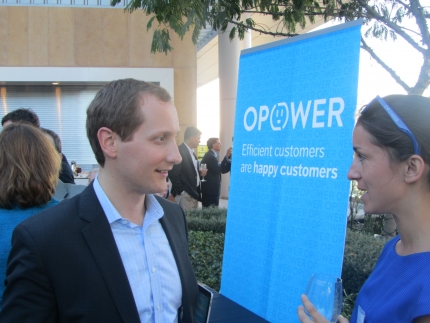
While the U.S. is known around the world for innovative companies like Google and Facebook, there is a new vanguard of American companies creating and exporting clean energy technologies,” said Jim Kapsis.  His company, OPower, an information-enabled energy efficiency company, is one of them. Opower is transforming the relationship between consumers and how they use energy in their homes.  According to Kapsis, Opower is on track to save households more than $100 million next year and enough energy to take the equivalent of more than 100,000 households off the grid.

OPower

OPower provides 10 million U.S. households with home energy information and has clients in 25 states. (by OPower)

Founded in 2007 by two college buddies, the company started out with a simple idea: utility bills are too difficult to understand.   The friends, co-founders, Dan Yates and Alex Laskey, bet that if people had better information about their energy usage, they would use less of it, save money, and improve the environment.  “It was an innovative business idea, but given the complexity of the energy market, they weren’t sure at first that it was going to work,” said Kapsis.  By working with utility companies to deliver better information to their customers, OPower not only helps people understand how they are consuming energy, but how they are doing relative to other similar homes in their neighborhood. By coupling this context with personalized energy saving advice, Opower is giving households the tools to make more informed choices about their energy use.

Cleaning Up Schools, Taking Care of Our Space

Ed. Note: Champions of Change is a weekly initiative to highlight Americans who are making an impact in their communities and helping our country rise to meet the many challenges of the 21st century.

I applied to be on Grades of Green’s Kids’ Advisory Board because they are working to inspire kids to be green and I wanted to be a part of it. They nominated me for the Champions of Change award because of the work I have done at my school, American Martyrs. I was so excited when they called and told me I had been named a “Champion of Change.”

As a Champion of Change, on July 8th I was part of a video conference from the White House situation room with kids from all over the country who have implemented environmental changes just like I have.  Seeing and hearing all the great activities they have organized (including mine) showed me that us kids really can make a difference. After the videoconference I was honored and learned some new activities which I will try to put in place at my school. 

I became involved in ecology because I am worried about what is happening to our planet. I believe we all have a responsibility to take care of our space. It is not up to our parents, or others to pick up after us. I wanted to get others to help me clean up our school so I ran for the position of safety and ecology and I won. After being elected I began making our school green. The first activity I organized was a drive to recycle gently used school supplies. I thought of this idea because I know at the end of the school year everyone just throws their old school supplies away. Filling my garage with pens, pencils, crayons, old notebooks, etc. I sorted it with some help from my friends and we gave the supplies to a less fortunate school in Watts. The smiles on their faces made it all worthwhile and we were keeping it out of the landfill. 

How Kids Can Do Something to Protect the Earth

Ed. Note: Champions of Change is a weekly initiative to highlight Americans who are making an impact in their communities and helping our country rise to meet the many challenges of the 21st century.

I am Grace Cortese, and I am 10 years old. You might think I’m too young to make a difference in the environment. The reason I don’t believe that is because of my science teacher, Jillian Esby. She cares a lot about the environment and she teaches us that there are a million ways we can help if we pay attention and are willing to change our habits. Even the little things can add up, like turning out the light when you leave a room, or using both sides of the paper. Now my whole school is doing things to help protect the earth.

My school has a composter for our lunch leftovers, a waste-free lunch program, recycle bins all over campus and a book swap. Our school made a carpool program to reduce the number of cars on campus, and we have a “Walk to School” day once a year. We also did a really cool thing to eliminate paper napkins and disposable water bottles. Each classroom has a party pack with cloth napkins, plastic cups and plates and we use those for all the class parties and events. My science teacher Mrs. Esby has a “Teenie Greenies” club at lunch and she teaches a class in “up-cycling” after school. Last year, we planted a fruit orchard on campus. We will give the fruit to the local food bank. My school does a lot to help others, too. We collect canned food for the Westside Food Bank and we fix meals for the homeless. Last year we collected 17,720 pounds of food and fixed 285 meals. In second grade, we “adopt a beach” through Heal the Bay and we do beach clean-ups. I learned a lot about the disgusting things that end up in the ocean, like cigarette butts and plastic bags. Last year at school, we had a read-a-thon to raise money for malaria nets in Malawi, Africa for a place called. G.A.I.A. I called my friends, grandparents, aunts and uncles and I raised $2,000! That is enough for 200 bed nets, and I feel really happy that I helped keep kids in Africa safe from malaria.

Our Energy Independence: Join the Live Chat Wednesday, 6/29, 2 pm EDT

Editor's Note:  This has been cross-posted from the EnergyBlog at Energy.gov

As many of us hit the road to celebrate America's independence this upcoming 4th of July weekend, we must once again confront the reality of our country's economy, environment and security dependence on foreign oil.

On Wednesday, June 29th, at 2:00 pm ET, please join Dr. Arun Majumdar at Energy.gov for a frank, two-way discussion about the investments the federal government is making in innovative research and technology today that will move us off of foreign oil and toward the clean energy infrastructure of the future.

Watch the video invitation to the online chat with Dr. Arun Majumdar here.

Ginny Simmons is a new media specialist with the Office of Public Affairs
Related Topics: Energy and Environment

Can Energy Efficiency Help You Get a Job?

Back in February, President Obama asked the Council on Jobs and Competitiveness to help lead the Better Buildings Initiative to make American businesses more competitive by saving them about $40 billion per year in energy costs. The first question the Jobs Council asked, of course, was exactly how many jobs we were talking about here?

As of today, the Political Economy Research Institute (PERI) of the University of Massachusetts at Amherst released an independent study projecting that the Better Buildings Initiative would create more than 114,000 jobs – half of which would come from a new tax credit for building energy upgrades that the President proposed to Congress in his 2012 budget. That would mean new jobs for people like contractors, sheet metal workers, engineers, and architects.

Creating new jobs in building energy upgrades means we also need to develop new skills.

Yesterday, I visited North Carolina Central University just prior to the Jobs Council meeting to talk about how they’re building skills for America’s future.

Technical universities and community colleges are critical to developing new building industry professionals to take advantage of the opportunities that the Better Buildings Challenge will create. That’s why the National Institute of Standards and Technology, working with the Department of Energy, will announce a new competitive grant program for technical and community colleges later this summer – fulfilling President Obama’s commitment to launch a Commercial Building Technology Extension Partnership.

To sustain this momentum, we also need to address how energy upgrades can improve the value of a building. A better building will cut your utility bills, but energy performance isn’t consistently factored into how buildings are appraised even though it’s an appropriate consideration under existing national standards. That’s because the information and tools that appraisers need aren’t readily available. That’s why the Department of Energy and The Appraisal Foundation – the Congressionally authorized source of appraisal standards and appraiser qualifications in the United States – have launched a collaboration to make sure that appraisers have what they need to make energy performance a recognized aspect of how buildings are appraised.

Developing the market for building energy upgrades is more about silver buckshot than a silver bullet. It’s steady, systematic progress like this – working in partnership with business – that will attract the investment and create the jobs that will put America’s building industry to work making American businesses more efficient and competitive.

Penny Pritzker is a Member of the President’s Council on Jobs and Competitiveness

Unleashing Rooftop Solar Energy through More Efficient Government

Ed. Note: Cross posted from the Energy Blog.

Across the country, the race is on to drive down the cost of solar energy. And a new challenge through the U.S. Department of Energy’s SunShot Initiative could help slash the costs even faster.

We are challenging cities and counties to compete nationwide to cut the red tape that can push up the price tags on solar energy projects.

One of the highest hurdles for would-be investors in residential and small commercial solar energy installations is navigating the differing and expensive administrative processes required to get their solar panels from the drawing board to the rooftop.

Solar panels on the roof of the Department of Energy Forrestal Building

Solar panels on the roof of the Department of Energy Forrestal Building. Photo provided by the Department of Energy.

June 1: Official Start of the Hurricane Season

This has been cross posted from the U.S. Department of Homeland Security FEMA Blog

It’s June 1, which means it is the official start of Hurricane season. With hurricane season officially here, we wanted to share a video from Administrator Fugate:

Watch FEMA Administrator Fugate's full remarks here.

You can do your part by making sure you and your loved ones are prepared by having an emergency plan and kit. Talk with your friends and neighbors and encourage them to do the same. And you can also take steps to get prepared for a hurricane at your workplace, so talk with your human resources manager about steps you can take.

Last week was Hurricane Awareness Week and we wrote a series of blog posts to illustrate the importance of being informed about the many hazards of severe tropical weather. Here there are again if you didn’t have a chance to read them:

Visit www.ready.gov/hurricanes to get prepared and embed our widget on your website to help us get the word out:

This widget is no longer available.

Related Topics: Energy and Environment

America’s Home Energy Education Challenge

[Ed. Note: This has been cross posted from Energy.gov.]

Let’s be honest. Many of us probably had trouble paying attention one or two times in middle school science class. While the occasional frog dissection and "potato-volt" experiments were cool, not all of us got up in the morning, scarfed down Cocoa Puffs and got geeked about test tubes and chlorophyll. And that’s not to discredit the great teachers out there, but as they all know (and as Ms. Ives, my 7th grade teacher knew quite well), sometimes the 12-year-old mind just has WAY more important things to think about.

It can be quite a feat coming up with new and exciting ways to engage our young folk when it comes to energy and science, but the Department of Energy and the National Science Teachers Association have put together a new challenge to ignite that spark.

America’s Home Energy Education Challenge is designed to harness the imagination and enthusiasm of America’s students to encourage home energy efficiency.

“Energy efficiency is all about helping families save money by saving energy,” said Secretary Chu. “America’s Home Energy Education Challenge leverages the passion and curiosity of students to encourage families across the country to reduce energy waste in their homes while inspiring the next generation of American’s energy leaders.”

Geared specifically towards students in grades 3-8, teams of participating teachers and students will compete this fall to reduce energy waste in their homes by recording their energy consumption data for three months. Then, that data will be compared to energy usage data from the same time period a year ago. These teams will collectively challenge other teams in their community, and then compete regionally and even nationally to see who are the best energy savings champions.

Another cool part of the challenge is the new Energy Fitness Award. Modeled after the famous President’s Physical Fitness award, the Energy Fitness Award challenges students to improve their knowledge of energy use in buildings, to learn more about the energy they use, and to design and develop energy plans.

Registration is open now for school principals and teachers until September 30, 2011. From September through December, energy data will be measured, and the awards will be announced in January 2012.

So Moms and Dads out there – get ready for a new kind of school science project, one that will get the kids psyched about science and save you money by saving energy at home.

You can get info on prizes, regional breakdowns, grading criteria, and learn much more American’s Home Energy Education Challenge at HomeEnergyChallenge.org.

Andy Oare is a New Media Strategist with the Office of Public Affairs at the U.S. Department of Energy
Related Topics: Energy and Environment