White House CEQ Chair Sutley to Join U.S. Senator Cardin for a Panel Discussion on Clean Water

EXECUTIVE OFFICE OF THE PRESIDENT
COUNCIL ON ENVIRONMENTAL QUALITY
WASHINGTON, D.C. 20503


FOR IMMEDIATE RELEASE: 

January 12, 2011


White House CEQ Chair Sutley to Join U.S. Senator Cardin for a Panel Discussion on Clean Water


WASHINGTON, D.C. – White House Council on Environmental Quality Chair Nancy Sutley will join U.S. Senator Benjamin L. Cardin (D-MD) for a panel discussion entitled, "Taking Responsibility for Clean Water" this Thursday, January 13, 2011 in College Park, Maryland.  Chair Sutley will headline the dialogue among national and local officials regarding S. 3481, authored by Senator Cardin and signed into law by President Obama last week, which clarifies the Federal Government's responsibility to pay reasonable service charges to a State or local government to address stormwater pollution from Federal properties.  She will discuss the Obama Administration’s commitment to ensuring clean water, restoring the health of the Chesapeake Bay, and promoting sustainability within Federal Government operations.

WHO:             Nancy Sutley, Chair, White House Council on Environmental Quality
                        U.S. Senator Benjamin L. Cardin

WHAT:           "Taking Responsibility for Clean Water" Remarks and Panel Discussion

WHEN:           Thursday, January 13, 2011 at 10:00 AM (EST)

WHERE:         College Park City Hall, Council Chambers
                         4500 Knox Road
                         College Park, MD 20740

###

Obama Administration Convenes Environmental Leaders at Historic White House Environmental Justice Forum Featuring Five Cabinet Secretaries

EXECUTIVE OFFICE OF THE PRESIDENT
COUNCIL ON ENVIRONMENTAL QUALITY
WASHINGTON, D.C. 20503


FOR IMMEDIATE RELEASE:                                                                             

December 15, 201


Obama Administration Convenes Environmental Leaders at Historic White House Environmental Justice Forum Featuring Five Cabinet Secretaries


WASHINGTON, DC – Five Cabinet Secretaries and senior officials from a wide range of Federal agencies and offices participated in the first White House Forum on Environmental Justice today, illustrating the Obama Administration’s commitment to ensuring all Americans have strong Federal protection from environmental and health hazards. 


More than 100 environmental justice leaders from across the country attended the day-long event, which featured White House Council on Environmental Quality Chair Nancy Sutley, EPA Administrator Lisa P. Jackson, Attorney General Eric Holder, Secretary of the Interior Ken Salazar, Secretary of Labor Hilda Solis, Secretary of Health and Human Services Kathleen Sebelius, and Secretary of Homeland Security Janet Napolitano. 


"Low-income and minority communities often shoulder an unacceptable amount of pollution in this country, diminishing their economic potential and threatening the health of millions of American families," said Nancy Sutley, Chair of the White House Council on Environmental Quality. "The White House Forum underlines the commitment across the Administration to integrating environmental justice into the missions of Federal agencies, and ensuring this really is a country of equal opportunity for all."


"This administration has taken unprecedented steps to ensure that environmental protection reaches every community.  We want to put an end to the days when public health and economic potential are harmed by disproportionate exposure to pollution," EPA Administrator Lisa P. Jackson said.  "Our continued success relies on close collaboration with our federal partners and strong input from the groups and individuals engaged at the community level.  This meeting is an important way to advance all of those goals."


"For decades, our nation’s environmental problems and threats have been heaped disproportionately on America’s most vulnerable communities. This is unacceptable, and it is unconscionable. But through the aggressive enforcement of federal environmental laws in every community, I believe we can and must change the status quo and ensure environmental justice for all Americans," said Attorney General Eric Holder.


"The Obama administration is committed to making environmental justice a central part of our everyday decision-making process," Secretary of the Interior Ken Salazar said. "Today’s forum speaks to our high-level engagement in strengthening communities that are too often left out and left behind.”


"The Administration’s focus on environmental justice includes the opening of substantive opportunities to the 21st century green economy for our minority and low-income communities," said Secretary of Labor Hilda L. Solis.  "Fostering and leveraging the tremendous untapped human resources that exist across the nation is the smart and right thing to do.  After all, it is possible to do well while doing good.  Together, we can ensure the U.S. economy is both more reflective of our diversity and more robust in the face of global competitiveness."


"We understand that people's health is determined not just by what happens in their doctor's office but also by their environment -- where you live, work, go to school, and play, what you eat and drink, the air you breathe, and how you get around. We are committed to collaborating across the government to put the environment at the center of our health agenda," said Secretary Sebelius.


"The Department of Energy is committed to environmental justice and to promoting healthy communities for all Americans," said Energy Secretary Steven Chu. "The Obama Administration is investing in clean energy to not only improve the environment, but to strengthen the economy, save families money and create jobs in all communities."


The Forum highlighted initiatives underway across the Federal Government that affect environmental justice communities.  Discussions centered on the Obama Administration’s commitment to ensuring that communities overburdened by pollution – particularly minority, low-income and indigenous communities – have the opportunity to enjoy the health and economic benefits of a clean environment.  The Forum also provided an opportunity for environmental justice and community leaders and officials from state, local and tribal governments to engage in a conversation with Administration officials about environmental justice.   These leaders offered their vision for healthier and more sustainable communities during panel discussions throughout the day. 


Panels focused on:

  • How investments in the clean energy economy are expanding green job opportunities in environmental justice communities and beyond.
  • How existing legal authorities are being used to more fully engage communities that have been left out and left behind.
  • How the Federal Government is addressing environmental and health disparities in communities throughout the country.
  • How low-income communities can work with Federal, state and local governments to prepare for the environmental and health impacts of climate change.

On September 22, 2010, Administrator Jackson and Chair Sutley reconvened the Interagency Working Group on Environmental Justice for the first time in more than a decade.  At a White House meeting attended by five Cabinet members, the Administration recommitted to advancing the mandate of Executive Order 12898, "Federal Actions to Address Environmental Justice in Minority Populations and Low-Income Populations," which states that each agency, with the law as its guide, should make environmental justice part of its mission.

For more information on the Interagency Working Group on Environmental Justice, visit:  http://www.epa.gov/environmentaljustice/interagency/index.html

###

Obama Administration to Host Press Conference Call to Announce Federal Asian Carp Efforts Today at 1:00 PM (EST)

EXECUTIVE OFFICE OF THE PRESIDENT
COUNCIL ON ENVIRONMENTAL QUALITY
WASHINGTON, D.C. 20503


FOR IMMEDIATE RELEASE:                                                                             

December 16, 201


Obama Administration to Host Press Conference Call to Announce Federal Asian Carp Efforts Today at 1:00 PM (EST)


WASHINGTON, DC – John Goss, Asian Carp Director at the White House Council on Environmental Quality, with representatives from other federal agencies will hold a conference call with reporters today, December 16, 2010 at 1:00 PM (EST) to make an announcement on collaborative Asian carp efforts under a newly-updated Asian Carp Control Strategy Framework (Framework).


Goss chairs the Asian Carp Regional Coordinating Committee (ACRCC), a team of Federal, state and local agencies working together to prevent Asian carp from establishing self-sustaining populations in the Great Lakes.  The Framework, released by the Obama Administration in February 2010 and updated in May, unifies Federal, state and local action in an unparalleled effort to combat invasive species.


WHO:        John Goss, Asian Carp Director, White House Council on Environmental Quality
                   Cameron Davis, Senior Advisor to the Administrator (Great Lakes), U.S. Environmental Protection Agency
                   Jane Lyder, Deputy Assistant Secretary for Fish and Wildlife and Parks, U.S. Department of the Interior
                   Charlie Wooley, Deputy Regional Director for the Midwest Region, U.S. Fish & Wildlife Service
                   Leon Carl, Regional Executive, Midwest Area, U.S. Geological Survey
                   Ernest Drott, Great Lakes and Asian Carp Program Manager, U.S. Army Corps of Engineers
                   Arnab Raychaudhuri, Special Assistant, Office of the Assistant Secretary of the Army for Civil Works
                   Rear Admiral Michael Parks, District Commander, U.S. Coast Guard District Nine


WHAT:       Conference call with reporters


WHEN:      Thursday, December 16, 2010 at 1:00 PM (EST)


RSVP:        To receive dial-in information, please RSVP to press@ceq.eop.gov

###

Obama Administration Releases 2011 Asian Carp Control Strategy Framework

EXECUTIVE OFFICE OF THE PRESIDENT
COUNCIL ON ENVIRONMENTAL QUALITY
WASHINGTON, D.C. 20503


FOR IMMEDIATE RELEASE:                                                                             

December 16, 201


Obama Administration Releases 2011 Asian Carp Control Strategy Framework

WASHINGTON – The Obama Administration today announced a series of new measures to protect the Great Lakes from Asian carp, building on the unprecedented proactive plan to prevent this invasive species from developing self-sustaining populations in the Great Lakes that the Administration established in February 2010.


The 2011 Asian Carp Control Strategy Framework adds 13 new initiatives to the comprehensive effort to combat Asian carp, including expanding eDNA testing capacity and developing cutting-edge biological controls and monitoring technology, among other measures. 


The original Framework, created in February 2010 and updated in May, established the Asian Carp Regional Coordinating Committee (ACRCC), consisting of state and municipal agencies, the U.S. Army Corps of Engineers, the U.S. Fish and Wildlife Service, the U.S. Geological Survey, the U.S. Environmental Protection Agency, and the U.S. Coast Guard to synchronize the  response to Asian carp. 

 
"The Obama Administration has taken an aggressive, unprecedented approach to protect our Great Lakes and the communities and economies that depend on them from the threat of Asian carp," said John Goss, Asian Carp Director for the White House Council on Environmental Quality. "This Framework builds on the successes we accomplished in 2010 by leveraging our cross-government, regional coordination on immediate preventative actions and multi-tiered strategies for the longer term."


"Thanks to the Great Lakes Restoration Initiative established by President Obama and strongly supported by Congress, we can take important steps to protect these vital waters," said Cameron Davis, Senior Advisor to the Administrator (Great Lakes), U.S. Environmental Protection Agency . "We are working to maintain this ecosystem, which represents the nation’s largest source of fresh surface water and is the cornerstone of local jobs and the regional economy."


“The Army Corps of Engineers continues its commitment to protect the Great Lakes from Asian carp.  Our achievements in 2010 demonstrate the success of this integrated framework, of working together to keep the carp out of this treasured ecosystem. Our success further motivates us to accomplish new initiatives in 2011," said Jo-Ellen Darcy, Assistant Secretary of the Army for Civil Works.


"From a biological standpoint we face a great challenge protecting the Great Lakes ecosystems and fisheries from invasion by the Asian carp," said Tom Strickland, Assistant Secretary for Fish and Wildlife and Parks at the Department of the Interior."The U.S. Fish and Wildlife Service and the U.S. Geological Survey are working on the ground as part of an Administration-wide intensive comprehensive strategy to stop the spread of Asian carp. This effort is unprecedented and is a major priority for the Department of the Interior."


The original Asian Carp Control Strategy Framework included 32 Federally-funded initiatives, all of which have been completed or are underway.  The 2011 Asian Carp Control Strategy Framework now includes 45 short- and long-term initiatives in an aggressive, multi-tiered strategy to combat Asian carp.


Key accomplishments in 2010 in response to the Asian Carp threat include:


  • Enhanced the fish barrier system to include strengthened electric barriers, physical barricades to stop carp migration during floods, and closed off smaller waterway connections to the Great Lakes.
  • Constructed a third electric fish barrier in the Chicago Waterway for extra protection in the primary path of concern for carp migration into Lake Michigan.
  • Established Asiancarp.org to provide up-to-date information about Asian Carp efforts. 
  • Utilized emergency authority provided through Section 126 of Energy and Water Development Act of 2010 to block flood waters from the Des Plaines River with a 13-mile fish barrier and a permanent block in the Illinois and Michigan Canal to keep Asian carp from crossing into the Chicago Waterway.
  • Installed a 1,500 foot fish barrier fence at Eagle Marsh, near Fort Wayne, IN, once considered an alternate pathway of greatest concern, to block advancement of Asian carp from the Wabash to the Maumee and Lake Erie. 
  • Identified 18 other potential pathways at risk across all the Great Lakes states for the potential transfer of aquatic invasive species between the Great Lakes and Mississippi River Basins.
  • Began implementing the Asian Carp Prevention and Control Act following the President’s signing of the bill on December 14, 2010.  This legislation prohibits live bighead carp from being shipped or imported into the United States.
  • Coordinated Federal agencies to deploy larger field crews to conduct electro shock and netting operations, and increased eDNA testing capacity to 220 samples a week.
  • Increased collaboration across all levels of government by integrating the Great Lakes states into the Asian Carp Regional Coordinating Committee and our Asian Carp Control Strategy Framework actions.

New projects in the 2011 Framework include:

  • Validation of eDNA as an effective tool for monitoring and tracking Asian Carp through analysis and refinement of the eDNA processes to determine the number and distribution of positive detections of Asian carp. 
  • Development of eDNA genetic markers to more accurately and efficiently detect Asian carp concentrations.
  • Expansion the USFWS lab in LaCrosse, WI to increase capacity of eDNA testing in all of the Great Lakes.
  • Development of alternate trap and net designs for Asian carp.
  • Development of rapid genetic-based methods to detect Asian carp to allow for faster results than eDNA.
  • Evaluation of the affect of removing Asian carp food sources by reducing phosphorus and nitrogen from waste water treatment plant discharges into the CAWS/Upper Illinois Watershed.
  • Assessment of the impact of steel hulled barges on the electric barriers.
  • Evaluation of a permanent separation between the Wabash-Maumee watersheds.

Key ongoing projects include:

  • Continuation of the Great Lakes and Mississippi River Interbasin Study (GLMRIS), including study of aquatic nuisance species controls and hydrologic separation of the basins.
  • Development of permanent blockages for aquatic invasive species pathways throughout the Great Lakes states.
  • Evaluation of electric barrier effectiveness through fish tagging and by utilizing Didson cameras.
  • Deployment of an enhanced, more efficient system to monitor, sample and capture Asian carp. 
  • Enforcement of carp inspections at bait shops, fish processors, fish markets and retail food establishments.
  • Enabling American commercial fisherman to develop markets for Asian carp, reducing Asian carp population in the Illinois River and creating jobs.
  • Public engagement through outreach and enforcement.
  • Collaboration with stakeholders groups, commercial fishermen, industry and recreational boaters to mitigate the damage Asian carp inflict upon waterway users.
  • Investment of Great Lakes Restoration Initiative funds in research and development of long term fish management strategies for Asian carp, eDNA sampling, and habitability assessments.
  • Improvement of hydro gun techniques to herd or eradicate and test as a barrier when locks are opened.
  • Development of biological interference to reduce Asian carp breeding.
  • Establishment and continual updating of www.asiancarp.org as a comprehensive source for information about Asian carp activities. 

For more information or to read the 2011 Asian Carp Control Strategy Framework, visit: www.asiancarp.org.

###

A Global Focus on Climate Change

Climate change is one of the greatest environmental and public health challenges we face in the modern world.  Confronting it will demand global collaboration and prompt difficult decisions.  Last week, I joined Secretaries Chu and Vilsack at the 16th session of the Conference of the Parties (COP-16) to the United Nations Framework Convention on Climate Change. 

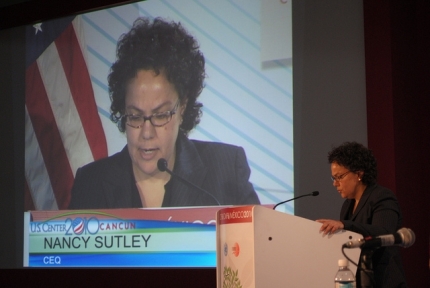
Nancy in Cancun

CEQ Chair Sutley addresses the U.S. Center at COP-16 in Cancun, Mexico, on December 8, 2010 (Courtesy of U.S. Department of State)

President Obama has made it clear that the United States must take bold action to address the growing threat of global warming, to reduce our dependence on finite resources such as oil, and to create clean energy jobs and technologies.  This Administration has taken unprecedented steps to address these problems –we have made major investments in clean energy through the Recovery Act and we have moved toward tough new fuel economy standards for cars and light trucks, among a range of other actions.

This Administration recognizes that the Federal Government cannot advocate change with any credibility unless we are willing to take action ourselves.  U.S. Special Envoy for Climate Change and head of the U.S. delegation Todd Stern focused on securing a balanced package of decisions building on the progress made in Copenhagen last year.  I hosted side events to highlight leadership in focusing on the Federal Government’s role in reducing greenhouse gas emissions and preparing the U.S. to adapt to the impacts of climate change.

The Federal Government is the single largest energy consumer in the U.S. economy, racking up an energy bill of more than $24 billion in 2008 alone.   President Obama signed an Executive Order last year directing Federal Agencies to slash their greenhouse gas emissions and meet sustainability goals to help us grow a clean energy economy and save taxpayer dollars. 

The U.S. Government is one of the first national governments or large corporations to tackle this challenge to measure, report, and reduce our greenhouse gas pollution from indirect sources (such as employee commuting).  Our commitment to leading by example is about more than net reductions in greenhouse gases.  We are also building up a body of knowledge and experience among Federal officials who are involved in setting and implementing national policies aimed at achieving our clean energy goals.  And through pilot programs with some of our 600,000 vendors and contractors, we are working to design ways to support businesses that share these sustainability goals.

Sharing our leadership at home in Federal sustainability with an audience of international leaders is an important way to highlight our commitment to dealing with climate change.  President Obama’s Executive Order allows us to leverage the Federal Government’s influence to benefit all Americans, support a job-producing clean energy economy, protect our environment, and help prop up the health and prosperity of the United States and the world.

A special note of congratulations and thanks to Ambassador Stern and the U.S. Negotiations team for helping to forge agreements at Cancun that will make measureable progress in reducing global greenhouse gas pollution.

Nancy Sutley is Chair of the White House Council on Environmental Quality

White House CEQ Chair to Lead U.S. Climate Change Adaptation and Sustainability Side Events at COP-16 in Cancun

EXECUTIVE OFFICE OF THE PRESIDENT
COUNCIL ON ENVIRONMENTAL QUALITY
WASHINGTON, D.C. 20503


FOR IMMEDIATE RELEASE:                                                                             

December 6, 2010


White House CEQ Chair to Lead U.S. Climate Change Adaptation and Sustainability Side Events at COP-16 in Cancun


WASHINGTON, DC – White House Council on Environmental Quality (CEQ) Chair Nancy Sutley will travel to Cancun, Mexico this week to represent the United States and lead side events at the United Nations Framework Convention on Climate Change’s 16th Conference of the Parties (COP-16).  On December 8, 2010, she will lead a side event on "Moving Forward with Climate Change Adaptation in the United States," focusing on the Obama Administration's actions to expand and strengthen the United States’ capacity to prepare for and respond to the risks associated with climate change.  On December 9, 2010, Chair Sutley will lead a side event on "GreenGov: The Role of the U.S. Federal Government Operations in Reducing GHG Pollution," where she will discuss President Obama's Executive Order on Federal Leadership in Environmental, Energy and Economic Performance. 


WHO:              Nancy Sutley, Chair, White House Council on Environmental Quality


WHAT:            "Moving Forward with Climate Change Adaptation in the United States" Side Event
Remarks and Panel Discussion at COP-16


WHEN:            Wednesday, December 8, 2010 at 1:30 PM (CST)


WHERE:          Cancun, Mexico

-----------------------------------------------------------------------------------------------------------

WHO:              Nancy Sutley, Chair, White House Council on Environmental Quality

WHAT:            "GreenGov: The Role of the U.S. Federal Government Operations in Reducing GHG
Pollution" Side Event Remarks and Panel Discussion at COP-16

WHEN:            Thursday, December 9, 2010 at 11:45 AM (CST)

WHERE:          Cancun, Mexico
 

###

Celebrating EPA's 40th Anniversary

Last week marked a major milestone for the U.S. Environmental Protection Agency (EPA) as it turned 40 years old on December 2, 2010.  On Thursday, I joined EPA Administrator Lisa P. Jackson and other Obama Administration officials in wishing the agency "Happy Birthday" after four decades of work to protect the health of the environment and all Americans.  We launched the event by reading President Obama's Proclamation on the 40th Anniversary of the Environmental Protection Agency, which called on the EPA and other Federal Agencies to continue their legacies of responsible stewardship and to advance environmental quality in the face of new challenges, including global climate change. 

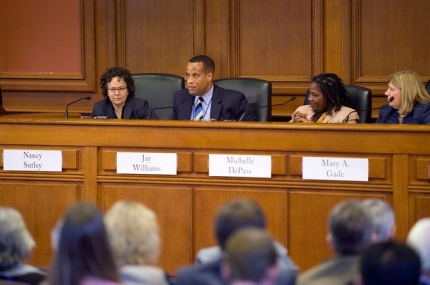
EPA at 40

Chair Sutley, Youngstown, Ohio Mayor Jay Williams, EPA Assistant Administrator Michelle DePass, and Former EPA Regional Administrator Mary Gade participate in the EPA @ 40 conference. (Photo by Eric Vance, US EPA)

On Friday, I joined other environmental leaders at Harvard University for its conference: "EPA @ 40: Protecting the Environment and Our Communities."  I had the opportunity to lead a panel on "Global Problems and Local Solutions," which included a dynamic discussion on EPA's history of success in working with state and local governments and communities to safeguard the health of our environment.   EPA's 40 years of leadership have fostered cleaner communities, promoted the health of children, and helped build a stronger America.   The Obama Administration is committed to continuing this proud legacy, and to leaving a clean and healthy country for future generations.  

Nancy Sutley is Chair of the White House Council on Environmental Quality

White House CEQ Chair Sutley to Headline Discussion at Harvard University's EPA at 40 Conference

EXECUTIVE OFFICE OF THE PRESIDENT
COUNCIL ON ENVIRONMENTAL QUALITY
WASHINGTON, D.C. 20503


FOR IMMEDIATE RELEASE:                                                                             

December 1, 201


White House CEQ Chair Sutley to Headline Discussion at Harvard University's EPA at 40 Conference


WASHINGTON, DC – White House Council on Environmental Quality Chair Nancy Sutley will headline a panel entitled, "Global Problems, Local Solutions" this Friday, December 3, 2010 at Harvard University's conference celebrating the 40th anniversary of the Environmental Protection Agency.  The day-long conference, "The EPA @ 40: Protecting the Environment & Our Communities," will focus on EPA's environmental legacy.  Chair Sutley will lead off a dialogue with co-panelists including current and former officials from all levels of government, highlighting EPA’s achievements in working with state and local governments and communities.


WHO:           Nancy Sutley, Chair, White House Council on Environmental Quality


WHAT:        "Global Problems, Local Solutions" Remarks and Panel Discussion at Harvard University's "The EPA @ 40: Protecting the Environment & Our Communities" Conference


WHEN:        Friday, December 3, 2010 at 10:30 AM to 11:45 AM (EST)


WHERE:     Ames Courtroom, Austin Hall
                     Harvard Law School
                     1515 Massachusetts Avenue
                     Cambridge, MA 02138

###


White House Council on Environmental Quality Statement Regarding Environmental Reviews for Recovery Act Funded Projects

EXECUTIVE OFFICE OF THE PRESIDENT
COUNCIL ON ENVIRONMENTAL QUALITY
WASHINGTON, D.C. 20503


FOR IMMEDIATE RELEASE:                                                                             

November 29, 2010   


White House Council on Environmental Quality Statement
Regarding Environmental Reviews for Recovery Act Funded Projects

WASHINGTON –  Sahar Wali, White House Council on Environmental Quality Spokeswoman, issued the following statement today regarding environmental reviews for Recovery Act funded projects: 

"Every project funded by the Recovery Act is covered by environmental reviews.  Under the National Environmental Policy Act (NEPA), Federal agencies are required to analyze their actions, including Recovery Act programs, to determine whether or not they could have significant environmental effects.

"Agencies may identify activities – such as routine facility maintenance, or installing batteries at an existing wind farm – that do not individually or cumulatively have a significant effect on the human environment as eligible for a categorical exclusion, meaning the project does not need to undergo detailed environmental analysis in an environmental assessment or an environmental impact statement.  Categorical exclusions do not 'exempt' agencies from NEPA compliance; in fact, they serve as an effective method for NEPA analysis by allowing Federal Agencies to focus their more intensive environmental reviews and resources on actions that could have significant impacts."

###

President Signs America Recycles Day Proclamation


FOR IMMEDIATE RELEASE:                                                                             

November 16, 2010                                                                                                                      


President Signs America Recycles Day Proclamation

Proclamation, new task force focus on electronic waste

WASHINGTON – Yesterday, on America Recycles Day, President Obama signed a proclamation celebrating the strides the country has made in recycling generally, while also highlighting the need for greater attention to addressing electronic waste (e-waste).  Last week, the Council on Environmental Quality (CEQ), the Environmental Protection Agency (EPA), and the General Services Administration (GSA) formed a task force, under the Executive Order on Federal Sustainability, charged with helping the federal government lead by example in responsibly managing used electronics.

Electronic waste from old cell phones, computers and other devices often contains toxic chemicals and heavy metals.  Most of this waste is landfilled, which creates potential health and environmental hazards throughout the U.S., and a significant part of the rest is shipped to developing countries that lack the capacity to manage these wastes safely, threatening the health and environment of those communities.  Reusing and recycling e-waste reduces the risks from these hazards and also provides opportunities to reduce the carbon footprint and conserve valuable natural resources.

"Used electronics represent the fastest growing segment of local solid waste in our country. Far too many used electronics end up in landfills or are exported to nations where there is little capacity for safe management.  Rather than benefitting from the reuse and recycling of valuable components, we see increased exposure to the toxic chemicals and other harmful substances in electronic devices," said EPA Administrator Lisa P. Jackson.  "EPA has made the handling of used electronics and e-waste one of our top priorities, and through this task force the U.S. can become the world leader in sustainable electronics management.  There are cost-effective and potentially profitable methods to better manage these materials and prevent health and environmental threats at home and around the world."

"The Federal Government has a responsibility to ensure that its own waste is properly managed and recycled," said Nancy Sutley, Chair of the White House Council on Environmental Quality. "Identifying opportunities to reuse the valuable resources contained in most disposed electronic devices is an important part of our obligation to protect human health and the environment."

"Already one of the largest consumers of electronics, we plan to make the Federal Government the most responsible," said GSA Administrator Martha Johnson.  "Not only will we reduce the federal government’s footprint, we will model behavior for private consumers and use our position in the marketplace to drive the development of sustainable electronics and recycling solutions."

The interagency task force, co-chaired by EPA, GSA, and CEQ, will develop a national strategy for responsible electronics stewardship, including improvements to federal procedures for managing electronic products. This strategy will also include steps to ensure electronics containing hazardous materials collected for recycling and disposal are not exported to developing nations that lack the capacity to manage the recovery and disposal of these products in ways that safeguard human health and the environment.

On October 11, EPA Administrator Lisa P. Jackson visited the town of Guiyu in Guandong Province, China.  Guiyu is noteworthy for its large electronic waste recycling industry.  Administrator Jackson saw firsthand some of the approaches being used to recycle and reuse discarded electronics and appliances and discussed remaining challenges and opportunities for collaboration.

Reusing or recycling electronics helps the environment by reducing our carbon footprint and conserving resources.  Electronic equipment contains valuable materials, such as precious metals and rare earth minerals, which can be recycled.  Recycling these components conserves materials, prevents air and water pollution, and reduces greenhouse gas emissions that occur during extraction, manufacturing and processing.  For example, for every 1 million cell phones recycled, 75 pounds of gold, 772 pounds of silver, 33 pounds of palladium, and more than 35,000 pounds of copper can be recovered.

Electronics and other products are usually created from raw materials that are extracted from the Earth, transported and processed, distributed, consumed, reused or recycled, and ultimately disposed.  Each of these stages creates impacts on the environment, which are unsustainable with limited natural resources.  By making smarter choices, consuming less, and reusing and recycling, everyone can contribute to a healthier and more sustainable environment.  Also, by promoting responsible electronics stewardship, green jobs can be created and a vibrant American reuse, recycling and refurbishing industry can be built. 

The presidential proclamation is a time to think about creating a sustainable environment by being responsible consumers.  By reusing, recycling, and being smarter in the amounts and types of materials used, people can save energy, conserve fewer natural resources, and reduce greenhouse gas emissions.

The president’s proclamation: http://www.epa.gov/epawaste/conserve/rrr/2010recycles.prc.rel.pdf

More information on the Interagency Task Force on E-waste Management:  http://www.epa.gov/osw/conserve/materials/ecycling/

More information on reducing, reusing and recycling:  http://www.epa.gov/wastes/conserve/rrr/


R378
Note: If a link above doesn't work, please copy and paste the URL into a browser. 
View all news releases related to trash and recycling