Leading by Example Toward a Sustainable Future

As part of our commitment to lead by example, yesterday, Federal agencies released Strategic Sustainability Performance Plans that outline how they will achieve the environmental, economic and energy goals called for by President Obama.  This is the first time agencies have developed and submitted Sustainability Plans, now available here.

In the President's 2009 Executive Order on Federal Leadership in Environmental, Energy and Economic Performance, he asked agencies to develop, implement and annually update a plan that prioritizes sustainability actions based on a positive return on investment for the American taxpayer.  The goal is to meet energy, water, and waste reduction targets that will save taxpayer dollars, create clean energy jobs, and reduce pollution.

Federal agencies of all sizes came up with a range of sustainability actions that align with their individual missions and responsibilities.  At the Department of Defense, for example, the Air Force has a plan to certify all of its aircraft to operate with a 50 percent alternative fuel blend by 2011. And at the Department of Transportation, they've established an awards program to highlight and promote intra-agency best practices in waste prevention, recycling, and green procurement.

The Federal Government has an obligation to lead by example toward a sustainable future.  Today we took another step in the right direction.

Nancy Sutley is Chair of the White House Council on Environmental Quality
 

Federal Agency Strategic Sustainability Performance Plans

Under Executive Order 13514, Federal agencies are required to develop, implement and annually update a plan that prioritizes actions based on a positive return on investment for the American taxpayer and to meet GHG emissions, energy, water, and waste reduction targets.

Agencies released their fourth annual Sustainability Plans in October 2013. In these updated plans, agencies discuss highlights and challenges from the previous year, and, based on these results, how they will refine their strategies, expand on successes, and plan new initiatives to meet the Executive Order goals.

Click here to view individual agency Strategic Sustainability Performance Plans.


West Wing Week: "Dispatches from the Gulf"

 Welcome to a special Gulf Coast episode of West Wing Week. We spent this week traveling through communities on America’s Gulf Coast to give you a special behind the scenes look at the federal government’s historic and unprecedented effort to contain and clean up after the Deepwater BP oil spill.

Join responders as they skim sheen off the ocean and respond to oiled wildlife. Stop by a town hall with Navy Secretary Ray Mabus, as he hears the concerns of locals. Join engineers as they pump mud into the well itself, creating a more permanent seal and much more.

Find more video, photos, and information on the events featured in this episode below:

Tuesday, August 3, 2010

Wednesday, August 4, 2010


Arun Chaudhary is the official White House videographer 

Obama Administration Officials to Convene Public Outreach Meeting of the Interagency Climate Change Adaptation Task Force in Denver, July 19, 2010

EXECUTIVE OFFICE OF THE PRESIDENT
COUNCIL ON ENVIRONMENTAL QUALITY
WASHINGTON, D.C. 20503


FOR IMMEDIATE RELEASE:
July 15, 2010
 
Obama Administration Officials to Convene Public Outreach Meeting of the Interagency Climate Change Adaptation Task Force in Denver, July 19, 2010
 
Denver, CO – Obama Administration officials will hold a public outreach meeting of the Interagency Climate Change Adaptation Task Force in Denver, Colorado on July 19, 2010. The meeting provides an opportunity for senior members of the Obama Administration to hear local and regional ideas, questions and concerns about climate change impacts, including impacts to agriculture, and to describe Federal planning efforts already underway.
 
In 2009, the White House Council on Environmental Quality (CEQ), the Office of Science and Technology Policy (OSTP), and the National Oceanic and Atmospheric Administration (NOAA) initiated the Interagency Climate Change Adaptation Task Force, which includes representatives from more than 20 Federal Agencies. When President Obama signed the Executive Order on Federal Leadership in Environmental, Energy, and Economic Performance, on October 5, 2009, he called on the Task Force to develop, within one year, Federal recommendations for reducing vulnerability to climate change impacts both domestically and internationally. An interim progress report was released in March 2010 and can be viewed online at http://obamawhitehouse.archives.gov/administration/eop/ceq/initiatives/adaptation.
 
WHO:                     Shere Abbott, Associate Director for Environment, Office of Science and Technology Policy, Executive Office of the President
Harris Sherman, Undersecretary for Natural Resources and Environment, United States Department of Agriculture
William Hohenstein, Director of Global Change Program Office, United States Department of Agriculture
 
WHAT:                  Interagency Climate Change Adaptation Task Force Public
                               Meeting and Press Conference
 
WHEN:                 Monday, July 19, 2:00 – 5:00 p.m. public meeting. Media
                              availability will be at 1:30 p.m.
 
WHERE:                Colorado Room, Doubletree Hotel Denver, 3203 Quebec Street,
                               Denver, CO
 
###


Open for Questions: Sustainable Communities

July 15, 2010 | 56:25 | Public Domain

Special Assistant to the President Derek Douglas moderates a discussion on the Sustainable Communities Partnership with Shelly Poticha from the Department of Housing and Urban Development, Beth Osborne from the Department of Transportation, and Tim Torma from the Environmental Protection Agency.

Download mp4 (539MB) | mp3 (52MB)

American Jobs Making Advanced Batteries

July 15, 2010 | 56:25 | Public Domain

President Obama talks about how investing in clean energy can help move the economy forward and create new American jobs as he visits the site of an advanced battery plant in Holland, MI.

Download mp4 (130MB) | mp3 (13MB)

Read the Transcript

Remarks by the President in Holland, Michigan on Investing in Clean Energy

Compact Power, Inc.
Holland, Michigan

1:36 P.M. EDT

THE PRESIDENT:  Hello, everybody.  Thank you so much.  Thank you.  Everybody, please have a seat, have a seat.

Before I get started, first of all, let me thank your fine young mayor.  Mr. Mayor, it is wonderful to see you, and I am partial to daughters, as I know you are, and I hope at some point I get a chance to meet yours.  But thank you for the great work that you’ve done.

Somebody who I think is one of the best governors in the country, Jennifer Granholm -- please give her another round of applause.  (Applause.)  Jennifer has been relentless about bringing manufacturing -- 21st century manufacturing here to Michigan.  And this is just an example of the kinds of projects she’s been working on for so long.  I’m very grateful for the presence of the chairman of LG Chem, Bon-Moo Koo.  Thank you very much for your presence here today, as well as the CEO and vice chairman, Peter Bahn-Suk Kim.  Thank you very much.  Please give them a big round of applause.  (Applause.)

And I want to acknowledge your congressman -- Pete Hoekstra is here in the audience.  Please give him a round of applause.  (Applause.)

Now, it is wonderful to be here in Holland, and I am especially to be here as Compact Power breaks ground on this site.  This is about more than just building a new factory.  It’s about building a better future for this city, for this state, and for this country.

Now, I want to say what everyone here in Holland and everybody here in Michigan knows too well, which is that these have been some pretty tough times.  A brutal recession came on top of what was already a lost decade for the middle class, especially for manufacturing towns here in the Midwest.  Even before this recession cost so many jobs, incomes had been flat, jobs were moving overseas, while the price of everything from health care to college tuitions were skyrocketing.

It was a decade in which it seemed like the values that built this country were turned upside-down.  Folks who were working hard and honestly every day to meet their responsibilities were running in place or falling behind while high-flying financial speculators who were cutting corners were rewarded with lavish bonuses and benefits.

It got even worse when the financial crisis sent our economy into a freefall and cost 8 million Americans their jobs.  Michigan was hit harder than anywhere else.  An on top of this recession, you were also rocked by the near collapse of the domestic auto industry.

It was in the middle of this crisis that my administration walked through the door.  And we had a number of difficult decisions that we had to make and make quickly.  Some, including shoring up U.S. automakers, weren’t real popular, as you will recall.  But with millions of jobs at stake, with the future of so many families and businesses on the line, we acted to prevent the country from slipping into an even deeper crisis.

And that’s why, when my administration began, we cut taxes for small business owners and for 95 percent of working families here in Michigan and across the country.  We extended unemployment insurance to help folks get through these storms.  And through small business loans, a focus on research and development and investments in high-tech, fast-growing sectors like clean energy, we’ve aimed to grow our economy by harnessing the innovative spirit of the American people.

Because we did, shovels will soon be moving earth and trucks will soon be pouring concrete where we are standing.  Because of a grant to this company, a grant that’s leveraging more than 150 million private dollars, as many as 300 people will be put to work doing construction and another 300 will eventually be hired to operate this plant when it’s fully up and running.  And this is going to lead to growth at local businesses like parts suppliers and restaurants.  It will be a boost to the economy of the entire region. 

Now, this is the ninth advanced battery plant to begin construction because of our economic plan.  These plants will put thousands of people to work.  This includes folks who were working at a couple of facilities being built in Michigan by another battery technology company called A123.  And in every case, we’ve been guided by a simple idea -- government can’t generate the jobs or growth we need by itself, but what government can do is lay the foundation for small businesses to expand and to hire, for entrepreneurs to open up shop and test new products, for workers to get the training they need for the jobs of the 21st century, and for families to achieve some semblance of economic security. 

So our goal has never been to create a government program, but rather to unleash private sector growth.  And we are seeing results.  There are 4.5 million unemployed workers already hired whose employers are eligible for a payroll tax exemption, a tax break that I signed into law earlier this year. 

Just yesterday, the Council of Economic Advisers put out a detailed report and it showed that for things like tax credits that go to advanced energy manufacturing or loan guarantees for small businesses or financing for infrastructure projects, we’re leveraging nearly three private dollars for every public dollar that’s spent.  That’s an incredible bang for our buck.  By making critical seed money available, we’ve attracted more than $280 billion in investment from private companies and others, which will mean new jobs and brighter futures for families in Holland and in communities across the country.

And by the way, these aren’t just any jobs.  These are jobs in the industries of the future.  Just a few years ago, American businesses manufactured only 2 percent of the world’s advanced batteries for electric and hybrid vehicles -- 2 percent.  But because of what’s happening in places like this, in just five years we’ll have up to 40 percent of the world’s capacity -- 40 percent.  (Applause.)  So for years you’ve been hearing about manufacturing jobs disappearing overseas.  You are leading the way in showing how manufacturing jobs are coming right back here to the United States of America.  (Applause.)   

For example, the workers at this plant, already slated to produce batteries for the new Chevy Volt, learned the other day that they’re also going to be supplying batteries for the new electric Ford Focus as soon as this operation gears up.  That means that by 2012, the batteries will be manufactured here in Holland, Michigan.  So when you buy one of these vehicles, the battery could be stamped “Made in America” -– just like the car.  (Applause.)   

And here’s another benefit.  Because of advances in the manufacture of these batteries, their costs are expected to come down by nearly 70 percent in the next few years.  That’s going to make electric and hybrid cars and trucks more affordable for more Americans.  And that not only means more jobs but it also means we’re going to be less dependent on foreign oil.

So taken together, these are the efforts that are going to create jobs and help build a stronger economy in the long run.  And I want to express my appreciation to the Michigan leaders, not only here but in Congress, who supported the economic plan that made this possible.

As a result of the steps that we took, an economy that was shrinking is now growing.  We were bleeding jobs at a rate of 750,000 per month the January that I was sworn in.  Now the economy is adding private sector jobs and has been for six straight months. 

Now, this doesn’t mean that we’re out of the woods -– not by a long shot.  But it does mean that there are small business owners who’ve been able to get the loans they need to hire a few more people.  It means there are salespeople with a few more dollars in their pockets because customers are buying again.  It means there are innovators and entrepreneurs finally able to take a chance on a new idea.  And it means there are construction workers heading to the jobsite each day –- just like some of the folks who are here today -– because our country is slowly coming back from this vicious recession. 

The progress we’ve made so far is not nearly enough to undo the enormous damage that this recession caused.  And I’ve said since the first day I took office, it’s going to take time to reverse the toll of the deepest downturn in a generation.  I won’t be satisfied as long as even one person who needs a job and wants to work can’t find one.

But what I’m absolutely clear about and what this plant will prove is that we are headed in the right direction, and that the surest way out of the storms we’ve been in is to keep moving forward and not go backwards. 

There are some folks who want to go back –- who think that we should return to the policies that helped to lead to this recession.  Some of them made the political calculation that it’s better to obstruct than to lend a hand.  They said no to tax cuts, they said no to small business loans, they said no to clean energy projects.  Now, it doesn’t stop them from being at ribbon-cuttings -- (laughter) -- but that’s okay.  I just want to make sure that everybody understands that this country would not be better off if this plant hadn’t gotten built and if the clean energy package that made it possible wasn’t in place.  (Applause.) 

And when you head out to any of the two dozen battery technology plants coming online that are going to be able to be stamped “Made in America” on their products, I want folks who have been pushing against these economic policies to explain to these workers why it would be better for these things to be manufactured in other countries, or why the solar plants and wind turbines and biodiesel refineries that are being built shouldn’t have happened. 

Most workers and most entrepreneurs understand we’re not in the clear yet.  But they understand we’re headed in the right direction.  There’s something about America that no matter what the trials are, what the tribulations are, we stay optimistic and we keep going forward.  And we know if we work hard enough and we’re determined enough, if we try as hard as we can and if we’re willing to experiment, and if things don’t work we put them aside, but we keep on going -- that sooner or later we’re going to see a brighter day.  And we’re going to pass on a better America to our children and our grandchildren.

That’s been our history.  That’s the legacy that we inherit.  So to everybody in Holland, I want you to understand these have been a tough few years, but we have been through tough times before, and at our best we’ve risen to the challenges we face by tapping the drive and the talent and the ingenuity that has always been at the heart of America’s success.

And that’s what’s happening all across America as we speak.  That’s not only how we’re going to emerge from this period of turmoil; that’s how we’re going to actually come out stronger than we were before.

So to all of you who have been part of this project, thank you.  This is a symbol of where Michigan is going, this is a symbol of where Holland is going, this is a symbol of where America is going.

God bless you.  And God bless the United States of America.  (Applause.) 

END
1:50 P.M. EDT

Close Transcript

Testimony of Nancy Sutley, Chair of the Council on Environmental Quality Before the U.S. Senate Committee on Energy and Natural Resources, Subcommittee on Water and Power

EXECUTIVE OFFICE OF THE PRESIDENT
COUNCIL ON ENVIRONMENTAL QUALITY
WASHINGTON, D.C. 20503


FOR IMMEDIATE RELEASE:                                                                             

July 14, 2010                                                                                                                      


Testimony of Nancy Sutley, Chair of the Council on Environmental Quality Before the U.S. Senate Committee on Energy and Natural Resources, Subcommittee on Water and Power


WASHINGTON, DC – White House Council on Environmental Quality Chair Nancy Sutley testified today before the U.S. Senate Committee on Energy and Natural Resources, Subcommittee on Water and Power.  The hearing was focused on the Federal response to the discovery of the aquatic invasive species Asian carp in Lake Calumet, Illinois.  The text of the written testimony submitted to the Subcommittee is below:


Thank you Chairwoman Stabenow and Ranking Member Brownback for holding this hearing.

Invasive species pose serious threats to our ecosystems.  The Great Lakes in particular have been devastated by invaders such as the sea lamprey, zebra mussel and the round goby.  The Great Lakes now face perhaps their most significant invasive species threat yet from Asian carp.  This time, however, we have an opportunity to prevent the environmental and economic harm that this invasive species could cause, and are working urgently to do so.


The Obama Administration is executing a robust, coordinated and proactive Asian Carp Control Strategy Framework (Framework), developed in February and updated in May 2010 by the U.S. Army Corps of Engineers (USACE), Environmental Protection Agency (EPA), U.S. Fish and Wildlife Service (FWS), U.S. Geological Survey (USGS), the U.S. Coast Guard (USCG), and the Great Lakes Fisheries Commission (GLFC) in cooperation with state and local agencies. This Framework unifies Federal, state and local actions to combat invasive species with a multi-tiered defense of the Great Lakes from Asian carp while longer-term biological controls are developed.  Since I last testified before this Committee in February, the Administration has updated the Framework and has accomplished or is on track to meet the milestones it laid out.


The goal of the Administration’s strategy of 32 short- and long-term actions is to prevent Asian carp from establishing self-sustaining populations in the Great Lakes.  In the near term, the Framework focuses on keeping Asian carp out of the Chicago Area Waterway System (CAWS) and Great Lakes, and on removal of Asian carp in the CAWS. Measures to accomplish this include environmental DNA (eDNA) monitoring, contract commercial fishing, and conventional techniques such as electrofishing and netting.


As part of the Framework, Federal and Illinois State officials have been conducting intensive fishing operations to locate Asian carp along the CAWS since February 17, 2010.  On May 25, the Asian Carp Regional Coordinating Committee (ACRCC) completed a week-long sampling and data collection operation on the Little Calumet River in South Chicago that utilized rotenone, a fish toxicant. This operation yielded more than 130,000 pounds of fish, including more than 40 species. No bighead or silver Asian carp were found among them.


On June 22, as you are aware, routine sampling under the Framework led to the discovery of a live bighead Asian carp above the electric barrier system for the first time. The aggressive Framework the Administration has in place allowed us to both identify and capture Asian carp in the waterway and to respond quickly and in a coordinated manner to intensify actions to detect and capture any additional Asian carp, if present.  The ACRCC’s member agencies and contractors immediately increased sampling in Lake Calumet, where the Bighead carp was discovered, and the surrounding area. To date, no additional Asian carp have been found.


We believe that the capture of this live carp as part of our monitoring plan shows that the Framework is working.  The plan assumes that a small number of Asian carp may exist in the CAWS, and was designed to pinpoint and remove them.  You will hear more today from John Rogner of the Illinois Department of Natural Resources about our actions undertaken in the CAWS since February and the immediate increase in actions taken in Lake Calumet once the carp was captured there.  The Illinois DNR has worked seamlessly with FWS and other Federal partners to implement monitoring and control actions for Asian carp in the CAWS. 


The U.S. Army Corps of Engineers has also undertaken actions pursuant to the Framework.  In April, using authority Congress granted under Section 126 of the Energy and Water Development and Related Agencies Appropriations Act of 2010, and funding provided through the Great Lakes Restoration Initiative (GLRI), USACE awarded a multi-million dollar contract for construction of concrete and fencing between the Chicago Sanitary and Ship Canal and Des Plaines River. This is designed to prevent fish passage around the electric barrier in flooding events where the two water bodies mix.  We urge Congress to extend in time and geography the USACE’s Section 126 authority, which expires in Oct 2010 and appears to be limited only to the CAWS, so that emergency actions to battle invasive carp can continue as needed. 


In addition, construction and operation of a third electric barrier is underway and on schedule to be completed in October 2010.


All of these efforts are meant to keep the carp at bay in the short term.  However, it is biological controls such as the ones being developed by the USGS that are likely to prevent Asian carp migration over the long-term.  As Dr. Leon Carl will describe, USGS is conducting scientific research into additional methods for controlling Asian carp, including Asian carp-specific poisons, methods to disrupt spawning and egg viability, seismic technology, and assessment of Asian carp food sources and potential habitats.


In other longer-term actions, USACE is collaborating with Federal, state, regional, and local agencies and non-governmental organizations on an Inter-Basin Transfer Study to explore all options and technologies for reducing the risk of Asian carp transfer between the Great Lakes and Mississippi River basins.  This includes a comprehensive analysis of Asian carp control technologies, including physical or hydrologic separation of the Lake Michigan from the Mississippi River basin.


As the Administration indicated in February, we are committed to proactively investigating areas outside of the CAWS that may be vulnerable to Asian carp.  A new area of focus is the connection between the Wabash and Maumee Rivers near Fort Wayne, Indiana.  In flood events, the Wabash River can hydrologically connect with the Maumee River, which runs into Lake Erie, making Asian carp in this area another potential threat to the Great Lakes.  Currently USGS, FWS, USACE, and Indiana DNR are studying the area to better understand the risk and what next steps should be. We have expanded the ACRCC to include representatives from the States of Indiana and Ohio to ensure an effective and coordinated response on a larger front.  In addition, we continue to provide information to and seek input from other Great Lakes states that are not part of the ARCC.


The Administration received a letter from Chairwoman Stabenow and other Great Lakes representatives requesting we name a Federal Coordinated Response Commander for Asian carp to oversee the diverse actions underway to contain the spread of the carp in the region.  We are currently evaluating this request.


In conclusion, the Administration shares the great concern about this issue and is committed to preventing the spread of Asian carp into the Great Lakes. I would like to reiterate that our management actions to control Asian carp are robust, that Federal, state, and local agencies are effectively coordinating with each other, and that we believe we are succeeding in our aim to keep Asian Carp from establishing themselves in the Great Lakes.


In addition, I want to thank Congress for fully funding the President’s FY 2010 request for the Great Lakes Restoration Initiative, without which many of these actions would not be possible.


Thank you for the opportunity to testify today, and I look forward to your questions.”


###

Traveling Across California to Celebrate America's Great Outdoors

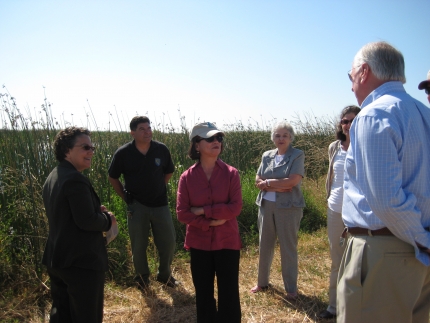
We hit the road last week to visit locations across California with a focus on the America's Great Outdoors Initiative. We began Wednesday with Congressman Thompson at Yolo Wildlife Refuge in Davis. The well over 50,000 acres refuge is the product of California residents who came together to form a local and Federal, public/private partnership in order to preserve a critical habitat for migrating birds and create a beautiful space for schoolchildren to learn about the wonders of wilderness. After spending the early morning in the refuge's wetlands, we held a successful listening session at University of California, Davis, affording us the opportunity to hear the ideas of a few hundred Northern Californians.

Yolo refuge

CEQ Chair Nancy Sutley, Yolo Wildlife Refuge Manager Dave Feliz, EPA Region IX Associate Director Jovita Pajarillo, CEQ Associate Director for Policy Outreach Amy Salzman, and U.S. Representative Mike Thompson at the Yolo Wildlife Refuge.

The White House

Office of the Press Secretary

President Obama Signs Montana Disaster Declaration

The President today declared a major disaster exists in the State of Montana and ordered Federal aid to supplement State and local recovery efforts in the area struck by severe storms and flooding beginning on June 15, 2010, and continuing.

Federal funding is available to State and eligible local governments and certain private nonprofit organizations on a cost-sharing basis for emergency work and the repair or replacement of facilities damaged by the severe storms and flooding in Hill County and the Rocky Boy’s Indian Reservation. 

Federal funding is also available on a cost-sharing basis for hazard mitigation measures for all counties and Tribes within the State.

W. Craig Fugate, Administrator, Federal Emergency Management Agency (FEMA), Department of Homeland Security, named Steven S. Ward as the Federal Coordinating Officer for Federal recovery operations in the affected area. 

FEMA said additional designations may be made at a later date if requested by the State and warranted by the results of further damage assessments.

FOR FURTHER INFORMATION CONTACT:  FEMA (202) 646-3272.

The White House

Office of the Press Secretary

Remarks by the President on the Economy at the University of Nevada, Las Vegas

University of Nevada - Las Vegas, Las Vegas, Nevada

9:33 A.M. PDT

THE PRESIDENT:  Thank you, everybody.  Thank you.  (Applause.)  Please have a seat.  Have a seat.  (Applause.)  Well, thank you, Harry.  Thanks for giving me a chance to get out of Washington.  It’s very hot there.  (Laughter.)  It’s hot here, too, but there’s a little more humidity there.  And I just love coming to Vegas.  (Applause.)  I love being here.  I mentioned last night, I'm not the only one who loves it, because I noticed that, for some reason, Air Force One is more crowded when we're coming to Vegas. (Laughter.)  Somehow I need more staff and logistical support and a couple extra Secret Service guys.  (Laughter.)

We've got some wonderful leaders here, and I just want to acknowledge them very quickly.  U.S. Representative Dina Titus is here -- (applause) -- doing a great job.  And Nevada’s Secretary of State, Ross Miller, is here.  (Applause.)  Dr. Neal Smatresk is here, and his family.  And they’re doing a great job on behalf of UNLV.  (Applause.)  And all of you are here.  (Applause.)  And I am thrilled to see you.

But I’m especially here to be with my friend and your Senator, Harry Reid.  (Applause.)  One of the first stories I heard about Harry was that he was a boxer back in the day here in Nevada.  And I was mentioning last -- she’s laughing, she’s -- oh, I can't believe it.  (Laughter.)  No, he was.  (Laughter.)  You wouldn't know that because he’s so soft-spoken.  He’s all “well, I'm Harry Reid.”  (Laughter.)  But when he first told me he was a boxer, he said, “Barack, I wasn’t the fastest, I wasn’t the hardest hitting, but I knew how to take a punch.”  (Laughter.)  He knew how to take a punch.  And Harry Reid became a pretty good boxer because he would simply outlast his opponents.  He had a stronger will.

I think that tells you something about the kind of person he is, the kind of senator he is, the kind of Senate Majority Leader he is.  He’s a fighter, and you should never bet against him.  (Applause.)  And that’s just what we need right now.  That's what Nevada needs right now.  (Applause.)  That's what Nevada needs, is somebody who’s going to fight for the people of Nevada and for the American people. 

And you know that he wasn’t born with a silver spoon in his mouth -- in Searchlight, Nevada.  So when you're going through tough times, Harry Reid has been there.  He knows what it feels like to be scraping and scrimping, and struggle to make ends meet.  And so when his home state is having a tough time, when the country is having a tough time, he knows that he’s got to be fighting on behalf of not those who are powerful, but on behalf of those who need help the most.

Now, let me tell you, when we first took office, amidst the worst economy since the Great Depression, we needed Harry’s fighting spirit -- because we had lost nearly three million jobs during the last six months of 2008.  The month I was sworn in, January 2009, we lost 750,000 jobs in that month alone.  The following month we lost 600,000 jobs.  And these were all the consequence of a decade of misguided economic policies -- a decade of stagnant wages, a decade of declining incomes, a decade of spiraling deficits.

So our first mission was to break the momentum of the deepest and most vicious recession since the Great Depression.  We had to stop the freefall and get the economy and jobs growing again.  And digging out of this mess required us taking some tough decisions, and sometimes those decisions were not popular. And Harry knew they weren’t popular.  I knew they weren’t popular.  But they were the right thing to do.

And Harry was willing to lead those fights because he knew that we had to change course; that to do nothing, to simply continue with the policies that had gotten us into this mess in the first place would mean further disaster.  And to fail to act on some of the great challenges facing the country that we had been putting off for decades would mean a lesser future for our children and our grandchildren.

Now, as a result of those tough steps that we took, we’re in a different place today than we were a year ago.  An economy that was shrinking is now growing.  We’ve gained private sector jobs for each of the past six months instead of losing them -- almost 600,000 new jobs. 

But as Harry pointed out, that’s not enough.  I don’t have to tell you that.  The unemployment rate is still unacceptably high, particularly in some states like Nevada.  And a lot of you have felt that pain personally or you’ve got somebody in your family who’s felt the pain.  Maybe you found yourself underwater on your mortgage and faced the terrible prospect of losing your home.  Maybe you’re out of work and worried about how you’re going to provide for your family.  Or maybe you’re a student at UNLV and you’re wondering if you’re going to be able to find a job when you graduate, or if you’re going to be able to pay off your student loans, or if you’re going to be able to start your career off on the right foot. 

Now, the simple truth is it took years to dig this hole; it’s going to take more time than any of us would like to climb out of it.  But the question is, number one, are we on the right track?  And the answer is, yes.  And number two, how do we accelerate the process?  How do we get the recovery to pick up more steam?  How do we fill this hole faster?

There’s a big debate in Washington right now about the role that government should play in all this.  As I said in the campaign -- and as I’ve repeated many times as President -- the greatest generator of jobs in America is our private sector.  It’s not government.  It’s our entrepreneurs and innovators who are willing to take a chance on a good idea.  It’s our businesses, large and small, who are making payroll and working with suppliers and distributing goods and services across the country and now across the world. 

The private sector, not government, is, was, and always will be the source of America’s economic success.  That’s our strength, the dynamism of our economy.  And that’s why one of the first things Harry Reid did, one of the first things we did, was cut dozens of taxes -- not raise them, cut them -- for middle class and small business people.  And we extended loan programs to put capital in the hands of startups.  And we worked to reduce the cost of health care for small businesses. 

And right now, Harry is fighting to pass additional tax breaks and loan authority to help small businesses grow and hire all across the country.  But he has also tried to look out specifically for Nevada.  He understands, for example, that tourism is so enormous an aspect of our economy, and so helped to move our trade promotion act that is going to be helping to do exactly what it says -- promote tourism -- and bring folks here to enjoy the incredible hospitality.

     The point is, our role in government, especially in difficult times like these, is to break down barriers that are standing in the way of innovation; to unleash the ingenuity that springs from our people; to give an impetus to businesses to grow and expand.  That’s not some abstract theory.  We’ve seen the results.  We’ve seen what we can do to catalyze job growth in the private sector.

     And one of the places we’ve seen it most is in the clean energy sector -- an industry that will not only produce jobs of the future but help free America from our dependence on foreign oil in the process, clean up our environment in the process, improve our national security in the process.

So let me give you an example.  Just yesterday, I took a tour of Smith Electric Vehicles in Kansas City, Missouri, on the way here.  This is a company that just hired its 50th worker, it’s on the way to hiring 50 more, and is aiming to produce 500 electric vehicles at that plant alone.  (Applause.)  And these are spiffy-looking trucks.  I mean, they are -- and they’re used by Fortune 500 companies for distribution -- PepsiCo, Frito-Lay. They’re also used for the United States military –- electric trucks with a lot of -- they’re very strong, great horsepower.

And the reason for their success is their entrepreneurial drive.  But it’s also partly because of a grant that we’re offering companies that manufacture electric vehicles and the batteries that power them. 

Because of these grants, we’re going to be going from only having 2 percent of the global capacity to make advanced batteries that go in trucks and cars, run on electricity -- we’re going to go from 2 percent of advanced battery market share to 40 percent just in the next five years -- just in the next five years.  (Applause.)  And that will create thousands of jobs across the country -- thousands of jobs across the country, not just this year, not just next year, but for decades to come.  So it’s a powerful example of how we can generate jobs and promote robust economic growth here in Nevada and all across the country by incentivizing private sector investments.

That’s what we’re working to do with the clean energy manufacturing tax credits that we enacted last year, thanks to Harry’s leadership.  Thanks to Harry’s leadership.  (Applause.)

Some people know these tax credits by the name 48c, which refers to their section in the tax code.  But here’s how these credits work.  We said to clean energy companies, if you’re willing to put up 70 percent of the capital for a worthy project, a clean energy project, we’ll put up the remaining 30 percent.  To put it another way, for every dollar we invest, we leverage two more private sector dollars.  We’re betting on the ingenuity and talent of American businesses.  (Applause.)

Now, these manufacturing tax credits are already having an extraordinary impact.  A solar panel company -- a solar power company called Amonix received a roughly $6 million tax credit for a new facility they’re building in the Las Vegas area -– a tax credit they were able to match with roughly $12 million in private capital.  That's happening right now.  And that’s just one of over -- (applause)  -- that's just one of over 180 projects that received manufacturing tax credits in over 40 states.

Now, here’s the -- the only problem we have is these credits were working so well, there aren’t enough tax credits to go around.  There are more worthy projects than there are tax credits.  When we announced the program last year, it was such a success we received 500 applications requesting over $8 billion in tax credits, but we only had $2.3 billion to invest.  In other words, we had almost four times as many worthy requests as we had tax credits.

Now, my attitude, and Harry’s attitude, is that if an American company wants to create jobs and grow, we should be there to help them do it.  So that’s why I’m urging Congress to invest $5 billion more in these kinds of clean energy manufacturing tax credits, more than doubling the amount that we made available last year.  (Applause.)  And this investment would generate nearly 40,000 jobs and $12 billion or more in private sector investment, which could trigger an additional 90,000 jobs.

Now, I’m gratified that this initiative is drawing support from members of Congress from both sides of the aisle, including Republican Senators Richard Lugar and Orrin Hatch.  Unfortunately, that kind of bipartisanship has been absent on a lot of efforts that Harry and I have taken up over the past year and a half.

We fought to keep Nevada teachers and firefighters and police officers on the job, and to extend unemployment insurance and COBRA so folks have health insurance while they’re looking for work.  We fought to stop health insurance companies from dropping your coverage on the basis of preexisting conditions, or right when you get sick, or placing lifetime limits on the amount of care that you can receive.  

We fought to eliminate wasteful subsidies that go to banks that were acting as unnecessary middlemen for guaranteed student loans from the federal government, and as a consequence, freed up tens of billions of dollars that are now going directly to students, which means more than a million students have access to financial aid that they didn't have before.  (Applause.)

And we’re now on the cusp of enacting Wall Street reforms that will empower consumers with clear and concise information that they need to make financial decisions that are best for them -- (applause) -- and to help prevent another crisis like this from ever happening again, and putting an end to some of the predatory lending and the subprime loans that had all kinds of fine print and hidden fees that have been such a burden for the economy of a state like Nevada and haven’t been fair to individual consumers in the process. 

So that’s what Harry and I fought for.  And, frankly, at every turn we’ve met opposition and obstruction from a lot of leaders across the aisle.  And that’s why I’m glad I’ve got a boxer in the Senate who is not afraid to fight for what he believes in.  (Applause.)  And Harry and I are going to keep on fighting until wages and incomes are rising, and businesses are hiring again right here in Nevada, and Americans are headed back to work again, and we’ve recovered from this recession, and we’re actually rebuilding this economy stronger than before.  (Applause.)  That’s what we’re committed to doing.  (Applause.) 

     So, Nevada, I know we’ve been through tough times.  And not all the difficult days are behind us.  There are going to be some tough times to come.  But I can promise you this:  We are headed in the right direction.  We are moving forward.  We are not going to move backwards.  (Applause.) 

And I’m absolutely confident that if we keep on moving forward, if we refuse to turn backwards, if we’re willing to show the same kind of fighting spirit as Harry Reid has shown throughout his career, then out of this storm brighter days are going to come. 

     Thank you very much, everybody.  God bless you.  (Applause.)

END
9:52 A.M. PDT