You Asked, Chu Answered

Ed. Note: Cross-posted from the Department of Energy's blog. To learn more about events happening as part of National Energy Awareness Month, check out our calendar.

Last week Secretary Chu invited you to submit your questions on home energy efficiency and the response was tremendous. We sifted through your questions and recently discussed many of them with the Secretary.

 Here are the resources that the Secretary referenced during the discussion:

While the Secretary covered a lot of ground during the course of our discussion there were some thoughtful questions that we didn’t have a chance to ask, so we decided to ask the experts at Energy Efficiency and Renewable Energy to weigh in. You can check out their responses below.

Obama Administration Officials Release Progress Report on Work of Climate Change Adaptation Task Force

EXECUTIVE OFFICE OF THE PRESIDENT
COUNCIL ON ENVIRONMENTAL QUALITY
WASHINGTON, D.C. 20503


FOR IMMEDIATE RELEASE:                                                                             
October 14, 2010      

Obama Administration Officials Release Progress Report on Work of Climate Change Adaptation Task Force

WASHINGTON – A new interagency report released today outlines recommendations to President Obama for how Federal Agency policies and programs can better prepare the United States to respond to the impacts of climate change.  The report, produced by the Interagency Climate Change Adaptation Task Force, recommends that the Federal Government implement actions to expand and strengthen the Nation’s capacity to better understand, prepare for, and respond to climate change.  The recommendations include making adaptation a standard part of agency planning and ensuring scientific information about the impacts of climate change is easily accessible.

The Interagency Climate Change Adaptation Task Force is co-chaired by the Council on Environmental Quality (CEQ), the Office of Science and Technology Policy (OSTP), and the National Oceanic and Atmospheric Administration (NOAA) and includes representatives from more than 20 Federal Agencies.  When the President signed the Executive Order on Federal Leadership in Environmental, Energy, and Economic Performance, on October 5, 2009, he called on the Task Force to develop, within one year, Federal recommendations for adapting to climate change impacts. “Progress Report of the Interagency Climate Change Adaptation Task Force,” released today, provides those recommendations, based in part on numerous listening sessions and public outreach events with a wide range of stakeholders.

“Taking action to reduce greenhouse gas emissions and avoid the effects of climate change is a priority, and we must also prepare for the inevitable effects of climate change.  Adaptation requires thoughtful, preventative actions and investments to build resilience and reduce risk,” said Nancy Sutley, Chair of the White House Council on Environmental Quality.  “The Federal Government must consider climate impacts in decision making and how it will affect our services, operations and assets throughout the country.”
 
“This report’s framework for climate adaptation moves science into practice to help the Nation cope with the impacts of climate change,” said Shere Abbott, Associate Director for Environment in the White House Office of Science and Technology Policy. “It makes plain that adaptation, and not just mitigation, is absolutely necessary if we are to avoid the worst consequences of global climate change, and it outlines a course of action that will put that part of our Nation's response on track to succeed.”

“There is a growing and urgent need for society to develop and implement science-based strategies to adapt to climate change,” said Dr. Jane Lubchenco, Under Secretary of Commerce for Oceans and Atmosphere and NOAA Administrator.  “Adaptation and resilience will require partnerships and action across all segments of society—the public sector, local to Federal government, the private sector, the nonprofit sector and individuals.  In addition, climate change impacts vary from region to region, so new approaches and preparations tailored to meet the needs and solutions for each region must also be part of our strategy.”

The Federal Government is already taking steps to build adaptive capacity and increase resilience to climate change in the United States and internationally.  In the Progress Report, the Task Force recommends that the Federal Government implement the following actions to expand and strengthen these efforts to help the Nation better understand and prepare for climate change:

  • Make adaptation a standard part of Agency planning to ensure that resources are invested wisely and services and operations remain effective in a changing climate.
  • Ensure scientific information about the impacts of climate change is easily accessible so public and private sector decision-makers can build adaptive capacity into their plans and activities.
  • Align Federal efforts to respond to climate impacts that cut across jurisdictions and missions, such as those that threaten water resources, public health, oceans and coasts, and communities. 
  • Develop a U.S. strategy to support international adaptation that leverages resources across the Federal Government to help developing countries reduce their vulnerability to climate change through programs that are consistent with the core principles and objectives of the President’s new Global Development Policy.
  • Build strong partnerships to support local, state, and tribal decision makers in improving management of places and infrastructure most likely to be affected by climate change. 

The Task Force’s work has been guided by a strategic vision of a resilient, healthy, and prosperous Nation in the face of a changing climate.  To achieve this vision, the Task Force identified a set of guiding principles that public and private decision-makers should consider in designing and implementing adaptation strategies.  They include (but are not limited to) the following:

  • Adopt Integrated Approaches:  Adaptation should be incorporated into core policies, planning, practices, and programs whenever possible.
  • Prioritize the Most Vulnerable:  Adaptation strategies should help people, places, and infrastructure that are most vulnerable to climate impacts and be designed and implemented with meaningful involvement from all parts of society.
  • Use Best-Available Science:  Adaptation should be grounded in the best-available scientific understanding of climate change risks, impacts, and vulnerabilities. 
  • Apply Risk-Management Methods and Tools:  Adaptation planning should incorporate risk-management methods and tools to help identify, assess, and prioritize options to reduce vulnerability to potential environmental, social, and economic implications of climate change.
  • Apply Ecosystem-based Approaches:  Adaptation should, where appropriate, take into account strategies to increase ecosystem resilience and protect critical ecosystem services on which humans depend, to reduce vulnerability of human and natural systems to climate change.

The Task Force will establish, by Spring 2011, a partnership committee composed of local, state, and Tribal representatives to consult with the Federal Government as it begins to implement the recommended actions.  The Office of the Federal Environmental Executive, with the advice of the Task Force’s Agency Adaptation workgroup, will develop implementing instructions within 120 days for how agencies should undertake adaptation planning.  Through this planning process, agencies will develop and implement strategic plans that identify how and where adaptation should be incorporated into their programs, policies, and regulations.

The Task Force will continue to meet over the next year as an interagency forum for discussing the Federal Government’s adaptation approach and to support and monitor the implementation of recommended actions in the Progress Report.  It will prepare another report in October 2011 that documents progress toward implementing its recommendations and provides additional recommendations for refining the Federal approach to adaptation, as appropriate.  The full report can be found at www.whitehouse.gov/ceq.

White House Council on Environmental Quality Announces GreenGov Presidential Awards

EXECUTIVE OFFICE OF THE PRESIDENT
COUNCIL ON ENVIRONMENTAL QUALITY
WASHINGTON, D.C. 20503


FOR IMMEDIATE RELEASE:                                                                             

October 7, 2010     


White House Council on Environmental Quality Announces GreenGov Presidential Awards

WASHINGTON, D.C. – The White House Council on Environmental Quality (CEQ) today announced eight Federal winners of the 2010 GreenGov Presidential Awards for exceptional efforts to promote sustainable operations at their agencies.  The winners are Federal agency teams or employees from across the country.

"President Obama asked the Federal Government to lead by example when it comes to building a sustainable future focused on clean and renewable energy," said Nancy Sutley, Chair of the White House Council on Environmental Quality.  "These winning entries, representing seven Federal agencies, are clearly leading by example in their innovative use of environmentally responsible products and technologies."

The GreenGov Presidential Awards celebrate extraordinary achievement in the pursuit of President Obama's Executive Order on Federal Leadership in Environmental, Energy and Economic Performance (Executive Order 13514).  They honor Federal civilian and military personnel, agency teams, agency projects and facilities, and agency programs that exemplify President Obama's charge to lead by example towards a clean energy economy. 

CEQ solicited award nominations and, along with a panel of judges, reviewed the nominations and recommended the 2010 award recipients to the President.  The eight winners were selected from more than 300 nominations and will be recognized at a White House reception tonight.  The winners and their outstanding achievement among the following categories are described below:

Good Neighbor Award: Nutrition and Food Services Team, Department of Veterans Affairs
Martinsburg, WV

The Department of Veterans Affairs' (VA) Martinsburg Medical Center's Nutrition and Food Services "Green Kitchen" has brought together local farmers, Federal VA staff and veterans to bring healthy, locally grown foods from veteran-owned farming businesses to the VA cafeteria.  This initiative has decreased landfill food waste by 86 percent, contributed 265 pounds of weekly food donations to a non-profit veteran’s transitional housing group, and increased collection of food waste for composting.  In addition, the project’s efficient kitchen equipment and operations have improved energy and water conservation.

Building the Future Award: Fort Belvoir Residential Communities Team, Department of Defense
Fort Belvoir, VA

Under the Army’s Residential Communities Initiative, the Army and Fort Belvoir Residential Communities LLC formed a 50-year public-private partnership to develop, rehabilitate and construct 2,106 homes on 576 acres at Fort Belvoir in Fairfax County, Virginia. The project includes a mixed-use Town Center that features solar panels, a salvaged playground, and a stormwater management system that captures and treats 90% of annual runoff from rainfall.  The Town Center has become a model for how other military installations can incorporate residential and retail space in an integrated building, reducing the development footprint and encouraging walking as an alternative to driving.

Green Dream Team Award: Interagency Working Group on Climate Change and Health Team, Department of Health and Human Services
Research Triangle Park, North Carolina
Atlanta, Georgia
Washington, DC

The Interagency Working Group on Climate Change and Health, formed in 2009, is an interdisciplinary team of experts that focuses on the impacts of climate change on the health of our nation’s people and communities.  The Working Group’s report, "A Human Health Perspective on Climate Change," provides a baseline assessment of the current state of knowledge of the health impacts of climate change and informs projections of future impacts.

Green Innovation Award: Sandia National Laboratories, Department of Energy
Albuquerque, NM

The Sandia National Laboratories Global Electric Motorcars (GEM) team has developed a solar-powered vehicle to promote an energy-efficient campus.  Three hundred and fifty solar-powered Global Electric Motorcars carts are now used as primary means of campus transportation, avoiding a projected 184,800 pounds of carbon dioxide and 700 pounds of sulfur dioxide annually.

Green Innovation Award: Barbara C. Lippiatt, National Institute of Standards and Technology, Department of Commerce
Gaithersburg, MD

Barbara Lippiatt has developed the Building for Environmental and Economic Sustainability (BEES) Program.  This software tool measures the environmental performance of building materials and bio-based products using a life-cycle assessment from manufacturing through product use, maintenance, and disposal. Her vision has resulted in a practical tool for sustainability performance measurement that is unbiased, science-based, quantitative, transparent, and comprehensive.

Lean, Clean and Green Award: Idaho National Laboratory Team, Department of Energy
Idaho Falls, ID

The Department of Energy's Idaho National Laboratory has implemented sustainable transportation programs and practices including streamlining its fleet of 115 buses and using alternative fuels.  Overall, this initiative has decreased petroleum fuel consumption by 21 percent and increased alternative fuel use by 56 percent.  Plans are also in the works to convert 75 percent of its light duty fleet to alternative-fueled vehicles and hybrids.

Lean, Clean and Green Award: National Archives Energy Team, National Archives and Records Administration
College Park, MD

The National Archives and Records Administration has successfully implemented sustainable infrastructure and operational changes at its National Archives Building II, located in College Park, Maryland.  This project is estimated to reduce annual energy use by 24 billion BTU’s, saving more than $400,000 in taxpayer money and eliminating 2,000 tons of carbon emissions.

Sustainability Hero Award: Dr. Anna Jones-Crabtree, U.S. Forest Service, U.S. Department of Agriculture
Denver, CO

Dr. Anna Jones-Crabtree of the U.S. Forest Service Rocky Mountain Region catalyzed an interagency effort in sustainable practice at the U.S. Forest Service’s facilities and fleet, and in its purchasing and waste processes.  Her projects have saved 964 billion BTUs and nearly $10.1 million in energy costs, reduced fleet miles-driven by approximately 720,000 miles, increased annual biodiesel and E-85 use by 12,800 gallons and 90,800 gallons, respectively, and saved more than 970 million gallons of water.

###

Council on Environmental Quality Issues Guidance on Federal Greenhouse Gas Accounting and Reporting

EXECUTIVE OFFICE OF THE PRESIDENT
COUNCIL ON ENVIRONMENTAL QUALITY
WASHINGTON, D.C. 20503


FOR IMMEDIATE RELEASE:                                                                             

October 6, 2010     


Council on Environmental Quality Issues Guidance on Federal Greenhouse Gas Accounting and Reporting

WASHINGTON – The White House Council on Environmental Quality (CEQ) today released Guidance on Federal Greenhouse Gas Accounting and Reporting that establishes Government-wide requirements for measuring and reporting greenhouse gas (GHG) emissions associated with Federal agency operations.

The Guidance serves as the Federal Government’s official Greenhouse Gas Protocol and will be used by Federal agencies to develop their first GHG inventories.  Federal agencies will submit GHG inventories annually beginning in January of 2011, as called for in the Executive Order on Federal Leadership in Environmental, Energy and Economic Performance (Executive Order 13514) signed by President Obama on October 5, 2009.

“For the first time, this guidance sets consistent standards and requirements for measuring and reporting the Federal Government’s greenhouse gas emissions.   Today we take an important step forward in transparency and accountability for the Federal Government’s greenhouse gas pollution.  We continue President Obama’s commitment to lead by example toward a healthy and prosperous clean energy future for America,” said Nancy Sutley, Chair of the White House Council on Environmental Quality.

The Guidance was announced by Chair Sutley at the first GreenGov Symposium, a three-day event held by CEQ from October 5-7, 2010, in Washington, D.C., that brought together a broad group of sustainability leaders to identify opportunities around greening the Federal Government. 

Earlier this year President Obama announced a Federal Government-wide target of a 28 percent reduction by 2020 in direct GHG emissions, such as those from fuels and building energy use, and a target 13 percent reduction by 2020 in indirect GHG emissions, such as those from employee commuting and landfill waste.  Combined, these two goals could result in a cumulative reduction of 101 million metric tons of CO2 emissions, equivalent to the emissions from 235 million barrels of oil.  Meeting Federal agency GHG pollution reduction targets is estimated to result in a cumulative $8 billion to $11 billion in avoided energy costs through 2020.

The Executive Order directed the Department of Energy’s Federal Energy Management Program to develop recommended Federal GHG reporting and accounting procedures, in coordination with the Environmental Protection Agency, Department of Defense, General Services Administration, Department of the Interior, Department of Commerce, and other Agencies as appropriate.  These recommendations established the foundation for the Guidance.  CEQ released draft Guidance for public review and comment on July 12, 2010.  The Draft Guidance was accompanied by a separate Draft Technical Support Document that provided detailed information on Federal inventory reporting requirements and calculation methodologies.

The Executive Order commits the Federal Government to leading by example toward a clean energy economy.  The Federal Government is the single largest energy consumer in the United States.  The Executive Order sets targets to increase energy efficiency, reduce GHG emissions, reduce fleet petroleum consumption, conserve water, reduce waste, support sustainable communities, and leverage Federal purchasing power to promote environmentally responsible products and technologies.  Actions taken pursuant to the Executive Order will save taxpayer dollars, create clean energy jobs, and reduce pollution.

###

Obama Administration Officials to Join Salt Lake City Mayor, Cisco Senior VP at Oct. 6 GreenGov Symposium

EXECUTIVE OFFICE OF THE PRESIDENT
COUNCIL ON ENVIRONMENTAL QUALITY
WASHINGTON, D.C. 20503


FOR IMMEDIATE RELEASE:                                                                             

October 4, 2010     


 Obama Administration Officials to Join Salt Lake City Mayor, Cisco Senior VP at Oct. 6 GreenGov Symposium


WASHINGTON, D.C. – The White House Council on Environmental Quality (CEQ) and the George Washington University (GW) today announced that the second day of the 2010 GreenGov Symposium will feature Ron Sims, Deputy Secretary of the U.S. Department of Housing and Urban Development, Sean Greene, Associate Administrator of the U.S. Small Business Administration, Salt Lake City Mayor Ralph Becker and Cisco Senior Vice President Laura Ipsen. CEQ Chair Nancy Sutley will deliver the opening remarks. 


The plenary session also will feature video submissions from the public to Planet Forward, a user-driven social network and Public Broadcasting television special that solicits solutions to global energy and climate challenges.  To view the Tuesday session live online, visit: www.planetforward.org.

As previously announced, the first day of the Symposium will feature keynotes from Chair Sutley, U.S. Secretary of Energy Steven Chu, U.S. Secretary of Agriculture Tom Vilsack, biomimicry author Janine Benyus and GW President Steven Knapp on October 5, 2010.  Broadcast quality video of Tuesday’s session will be available at http://bit.ly/ccd1MQ

The GreenGov Symposium is a three-day educational event that will bring together a broad group of sustainability leaders to identify opportunities around greening the Federal Government.  It will take place October 5-7 at The George Washington University in Washington, D.C., in conjunction with the one-year anniversary of the signing of the Executive Order on Federal Leadership in Environmental, Energy, and Economic Performance (13514) by President Obama. 

WHO:          Nancy Sutley, Chair, White House Council on Environmental Quality
                     Ron Sims, Deputy Secretary, U.S. Department of Housing and Urban Development
                     Sean Greene, Associate Administrator for Investment and Special Adviser for Innovation,
                     U.S. Small Business Administration
                     Ralph Becker, Mayor, Salt Lake City
                     Laura Ipsen, Senior Vice President and General Manager, Smart Grid, Cisco

WHEN:        Wednesday, October 6, 2010, at 9:00 a.m.

WHERE:     The George Washington University
                      Lisner Auditorium
                      730 21st St., NW
                      Washington, D.C. 20052

RSVP:          For more information and to register, visit: http://www.gwu.edu /greengov.  Media who wish to attend any portion of the three day event should RSVP to Emily Cain at eecain@gwu.edu or 202-994-3087.

### 

Obama Administration Announces Plans to Install New Solar Panels on the White House Residence

EXECUTIVE OFFICE OF THE PRESIDENT
COUNCIL ON ENVIRONMENTAL QUALITY
WASHINGTON, D.C. 20503


FOR IMMEDIATE RELEASE:                                                                             

October 5, 2010     


 Obama Administration Announces Plans to Install New Solar Panels on the White House Residence


WASHINGTON – U.S. Energy Secretary Steven Chu and Council of Environmental Quality (CEQ) Chair Nancy Sutley today announced plans to install solar panels and a solar hot water heater on the roof of the White House Residence. These two solar installations will be part of a Department of Energy demonstration project showing that American solar technologies are available, reliable, and ready for installation in homes throughout the country. Secretary Chu and Chair Sutley made the announcement during CEQ’s 2010 GreenGov Symposium, which is bringing together leaders from Federal, state and local governments, nonprofit and academic communities and the private sector to identify opportunities around greening the Federal Government.


"This project reflects President Obama’s strong commitment to U.S. leadership in solar energy and the jobs it will create here at home," said Secretary Chu.  "Deploying solar energy technologies across the country will help America lead the global economy for years to come."


"President Obama has said the Federal Government has to lead by example in creating opportunity and jobs in clean energy," said Nancy Sutley, Chair of the White House Council on Environmental Quality.  "By installing solar panels on arguably the most famous house in the country, his residence, the President is underscoring that commitment to lead and the promise and importance of renewable energy in the United States."

The PV system will convert sunlight directly to electricity. The solar hot water heater will have a solar collector facing the sun that will heat water for use in the White House Residence.  The Department of Energy will now begin a competitive procurement process to select the company responsible for the installations. 

By installing solar panels on their homes, consumers are able to effectively lock in the price of electricity they will pay in the years ahead, acting as an insulator against future rises in electricity prices since the systems installed in homes today are expected to last approximately thirty years. Financial incentives are also available to offset the initial costs of installing solar energy systems, including a 30 percent federal tax credit and additional state, local, and utility incentive programs to encourage the deployment of renewable energy. Visit HERE for additional information about state, local and utility rebates for solar generation throughout the country.

The deployment of solar energy and other renewable energy sources will help expand U.S. clean energy manufacturing and create new jobs for American workers. As a result of investments under the Recovery Act, the solar energy industry is growing and solar resources can now be seen in communities nationwide.  In the coming years, continued investments in innovation and cutting-edge solar technologies will help make solar energy cost-competitive with conventional electricity sources all across the country.

This announcement is made on the one-year anniversary of President Obama’s Executive Order 13514 on Leadership in Environmental, Energy, and Economic Performance, which called on the Federal Government to lead by example towards a clean energy economy and reduce, measure and report direct and indirect greenhouse gas pollution. In support of this goal, the Department of Energy also released "Procuring Solar Energy: A Guide for Federal Facility Decision Makers" to support the use of solar energy throughout the Federal Government.  The full guide is available HERE.


###

Obama Administration Launches First GreenGov Symposium, Hosted by The George Washington University

EXECUTIVE OFFICE OF THE PRESIDENT
COUNCIL ON ENVIRONMENTAL QUALITY
WASHINGTON, D.C. 20503


FOR IMMEDIATE RELEASE:                                                                             

October 5, 2010     


Obama Administration Launches First GreenGov Symposium
Hosted By The George Washington University


WASHINGTON, D.C. – The White House Council on Environmental Quality (CEQ) launched the first annual GreenGov Symposium today, a three-day event held October 5-7, 2010 and hosted by The George Washington University (GW).  More than 1,200 attendees and 200 speakers and panelists participated from across Federal, state and local governments, nonprofit and academic communities, and the private sector to identify opportunities around greening the Federal Government. 


The Symposium marks the one year anniversary of President Obama’s Executive Order 13514 on Federal Leadership in Environmental, Energy and Economic Performance.  The Executive Order commits Federal agencies to lead by example toward a clean energy economy, and sets targets to reduce greenhouse gas pollution, increase energy efficiency, reduce fleet petroleum consumption, conserve water, reduce waste, support sustainable communities, and leverage Federal purchasing power to promote environmentally-responsible products and technologies.

CEQ Chair Nancy Sutley and GW President Steven Knapp kicked off the Symposium, which also featured keynotes from U.S. Department of Energy Secretary Steven Chu, U.S. Department of Agriculture Secretary Tom Vilsack and President of The Biomimicry Institute and co-founder of the Biomimicry Guild, Janine Benyus.  

"The broad participation in the Symposium from inside and outside of government indicates how invested we all are in a sustainable future for the Federal Government, and for all Americans," said Nancy Sutley, Chair of the White House Council on Environmental Quality.  "One year ago today, President Obama signed an Executive Order that asked the Federal Government to look inward and push ourselves to operate more sustainably, and that is exactly what this Symposium is helping to accomplish."

"We are honored to play a supporting role in the federal government's effort to become a model of sustainability," GW President Steven Knapp said.  "The government has a unique capacity to develop innovations that institutions like ours will be able to emulate and that will not only improve the environment but strengthen America's economic competitiveness."

Sustainability leaders from across the country participated in the event.  The Symposium targeted a wide range of sustainability topics, including clean energy, water efficiency, climate and adaptation, sustainable buildings, greening the supply chain, and more. 

Participants shared challenges, best practices and discussed cutting-edge approaches for the future.  A total of 76 session topics including water efficiency, getting to zero waste and greening the supply chain, among others, will be covered at the Symposium over the next two days.  To view the complete workshop agenda, visit: www.whitehouse.gov/greengov/symposium.

###

Investing in the Health of the Great Lakes

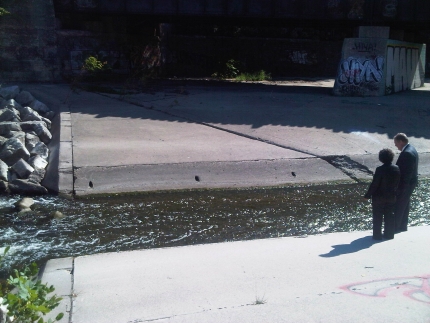
I spent Monday morning in Milwaukee touring the impressive work underway to integrate the natural environment back into water infrastructure.  Throughout the tour, I saw ways in which the Milwaukee Metropolitan Sewerage District (MMSD) is using or planning to use green infrastructure to manage and reuse stormwater, reducing pollution in the Great Lakes in a more natural way.  I was proud to announce that we are awarding MMSD a $4 million grant through the Great Lakes Restoration Initiative to continue this type of innovative and effective restoration work.

glri sutley pointing

CEQ Chair Nancy Sutley joins Milwaukee Metropolitan Sewerage District Executive Director Kevin Shafer to tour projects that will help meet GLRI restoration goals.

President Obama created the Great Lakes Restoration Initiative to target the most significant problems facing the Great Lakes, and track progress in addressing them.  Through this initiative, we have proposed the largest investment in the Great Lakes in two decades.  The grant awarded to the Milwaukee Metropolitan Sewerage District will fund projects to help meet these restoration goals. 

glri sutley by river

Chair Sutley and Executive Director Shafer view a Milwaukee Metropolitan Sewerage District project

The Great Lakes support a multi-billion dollar economy, provide drinking water for 30 million people, and help shape the culture and environment of the region.  But just like many of our nation’s ecosystems, the Great Lakes face challenges like pollution, invasive species, habitat loss and environmental degradation that threaten to erode them.  The Great Lakes Restoration Initiative calls for aggressive action to address priority areas such as cleaning up toxics and toxic hot spots, combating invasive species, protecting watersheds from polluted run-off, and restoring wetlands and other habitats.

Restoring the Great Lakes is a national priority.  Working together, we can protect this magnificent resource for the benefit of Great Lakes communities and all Americans.

Nancy Sutley is Chair of the White House Council on Environmental Quality

White House Council on Environmental Quality Chair in Milwaukee Monday to Announce Wisconsin Great Lakes Restoration Grants

EXECUTIVE OFFICE OF THE PRESIDENT
COUNCIL ON ENVIRONMENTAL QUALITY
WASHINGTON, D.C. 20503


FOR IMMEDIATE RELEASE:                                                                             

September 24, 2010     


White House Council on Environmental Quality Chair in Milwaukee Monday to Announce Wisconsin Great Lakes Restoration Grants


WASHINGTON – White House Council on Environmental Quality Chair Nancy Sutley will travel to Milwaukee on Monday to announce seven U.S. Environmental Protection Agency (EPA) Great Lakes Restoration Grants.   EPA Administrator Lisa P. Jackson announced some of the first Great Lakes Restoration Initiative competitive grants at an event in Green Bay, Wisconsin, earlier this month. 


WHO:            Nancy Sutley, Chair, White House Council on Environmental Quality

WHAT:          Announcement of Great Lakes Restoration Grants

WHEN:         Monday, September 27, 2010 at 12:00 PM

WHERE:      Milwaukee Metropolitan Sewerage District
                      260 W Seeboth St
                      Milwaukee, WI 53204


###

Obama Cabinet Secretaries and Senior Officials Join Sustainability Author and GW President to Keynote GreenGov Symposium on October 5, 2010

EXECUTIVE OFFICE OF THE PRESIDENT
COUNCIL ON ENVIRONMENTAL QUALITY
WASHINGTON, D.C. 20503


FOR IMMEDIATE RELEASE:                                                                             

September 28, 2010     


 Obama Cabinet Secretaries and Senior Officials Join Sustainability Author and GW President to Keynote GreenGov Symposium on October 5, 2010


WASHINGTON, D.C. – The White House Council on Environmental Quality (CEQ) and The George Washington University (GW) today announced that U.S. Secretary of Energy Steven Chu, U.S. Secretary of Agriculture Tom Vilsack, and biomimicry expert and author Janine Benyus will deliver opening day keynote addresses at the 2010 Green Gov Symposium on October 5, 2010.  CEQ Chair Nancy Sutley and GW President Steven Knapp also will deliver remarks at the event.

The GreenGov Symposium is a three-day event that will bring together a broad group of sustainability leaders to identify opportunities around greening the Federal Government.  It will take place October 5-7 at The George Washington University in Washington, D.C., in conjunction with the one-year anniversary of the signing of the Executive Order on Federal Leadership in Environmental, Energy, and Economic Performance (13514) by President Obama.  The Symposium will target a wide range of sustainability topics, including clean energy, water efficiency, climate and adaptation, sustainable buildings, greening the supply chain, and more. 

WHO:             Steven Chu, Secretary, U.S. Department of Energy
                        Tom Vilsack, Secretary, U.S. Department of Agriculture
                        Janine Benyus, biomimicry expert and author
                        Nancy Sutley, Chair, White House Council on Environmental Quality
                        Steven Knapp, President, The George Washington University

WHEN:          Tuesday, October 5, 2010, at 9:00 a.m.

WHERE:       The George Washington University
                       Lisner Auditorium
                       730 21st St., NW
                       Washington, D.C. 20052

RSVP:            For more information and to register, visit: http://www.gwu.edu /greengov.  Media who wish to attend any portion of the three day event, including the keynote speeches, should RSVP to Emily Cain at eecain@gwu.edu or 202-994-3087.

###