USDA’s Climate Hubs: Providing Targeted Solutions to Modern Challenges

Ed. note: This is cross-posted from the U.S. Department of Agriculture blog. See the original post here.

America’s farmers, ranchers and forest landowners face a complex and ever-changing threat in the form of a changing and shifting climate. The past three years alone have brought some of the most severe and devastating floods, droughts and fires our nation has experienced in recent history.

While no individual event can be linked to climate change, extreme weather conditions are increasingly impacting our farmers, ranchers and forest owners, to the detriment of their bottom lines, our food supply, and the future security of our farm economy.

We need a strategy that strengthens agriculture’s response to the impacts of a changing and shifting climate. Our farmers and ranchers need new and better tools to respond and prepare for the challenges of drought, heat stress, excessive moisture, longer growing seasons and changes in pest pressure.

Tom Vilsack is Secretary of the U.S. Department of Agriculture.
Related Topics: Energy and Environment

Investing in Solutions: Leaders in Finance and Climate

Editor's Note: This blog introduces readers to Alka Banerjee, Managing Director at S&P Dow Jones Indices.

This week, I participated in an event at the White House on Women Leaders in Climate Finance and Investment that highlighted the pioneering role women leaders in the finance sector are playing to mainstream climate change into finance and investment decisions.  Women around the world are often the first to feel the effects of climate and at the same time can offer unique perspectives and solutions.

I was privileged to be part of a conversation on “making climate finance work for growth,” where we discussed that a consistent global policy framework on climate change could make implementation of scalable solutions practical and possible. At S&P Dow Jones Indices, we are working to advance these solutions by creating equity indices -- tools for investment products like exchange traded funds -- which respond to consumer demand for products that help address climate change. We have created specialized indices, such as the global clean energy index, and variations of mainstream indices, such as the S&P U.S. Carbon Efficient index and the S&P/IFCI Emerging Markets Carbon Efficient index that weight companies by their carbon emissions, with higher weights going to lower emitting companies. These indices help investors choose whether to invest in companies with high carbon pollution. Over time, we have seen investor perceptions change from excluding large polluting companies from their portfolios for environmental reasons, to doing so to manage risk, to understanding that companies with progressive environmental standards are poised for more sustainable, long-term growth. We are also seeing some investors seek to completely avoid fossil fuel investment in their portfolios.

The event also included Administration officials such as Presidential advisor John Podesta, Chair of the Council on Environmental Quality Nancy Sutley, Domestic Policy Council Director for Energy and Climate Change  Dan Utech, Ambassador-at-Large for Global Women’s Issues Cathy Russell, and President and CEO of the Overseas Private Investment Corporation Elizabeth Littlefield,  who described  efforts under the President’s Climate Action Plan to make U.S. cities and states more resilient, support good clean energy and clean technology jobs, and help developing countries adapt to climate change and access renewable energy. U.S. Senator Jeanne Shaheen (NH) discussed her energy efficiency legislation, which supports investment in clean energy technologies that help to reduce carbon pollution.

The discussions revealed some key challenges and unique initiatives associated with mainstreaming climate change into finance. For example, Lindene Patton, Chief Climate Product Officer of Zurich Insurance Group, discussed the insurance industry’s role in managing climate risks and a commitment by Zurich to provide climate-smart insurance products and invest up to $1 billion in “green bonds,” which would help address climate change. Nancy Pfund, Founder and Managing Partner of DBL Investors, stated that while many private investments in green energy make good business sense and several have delivered good returns to their investors, the challenge is to attract positive attention from all sectors to the benefits of these options.

The event brought to focus the real desire to make a positive social and environmental impact through investment decisions and showed that women are playing an increasingly crucial role to make this happen.

Alka Banerjee is Managing Director at S&P Dow Jones Indices

What You Missed in We the Geeks: “Weather is Your Mood and Climate is Your Personality”

Want to get the latest updates on We the Geeks? Sign up here for email updates and share your ideas for future topics.

Summing up the distinction between short-term changes in the weather and long term climate trends in today’s "We the Geeks" Hangout, Dr. J. Marshall Shepherd, President of the American Meteorological Society, used nine simple words: "weather is your mood and climate is your personality." He later highlighted a need among scientists to correct the misperception that cold snaps disprove climate change, comparing it to the rationale: “because its night time, the sun went away.”

Those insights and more were shared at today’s "We the Geeks" Google+ Hangout on the "Polar Vortex" and Extreme Weather.

The live discussion kicked off with an explanation of the mechanics of the polar vortex phenomenon by leading National Oceanic and Atmospheric Administration Arctic Researcher Jim Overland, who said the shape of the circulating vortex of cold air—when it’s stable—is actually "just like the vortex going out of your bathtub." (You can watch a two-minute explainer video of the Polar Vortex by President Obama’s Science Advisor John P. Holdren, here).

The Polar Vortex Explained in 2 Minutes

January 08, 2014 | 2:13 | Public Domain

President Obama's Science and Technology Advisor, Dr. John Holdren, explains the polar vortex in 2 minutes—and why climate change makes extreme weather more likely going forward. Learn more at http://wh.gov/climate-change. January 8, 2014.

Download mp4 (88.9MB) | ()

We the Geeks: “Polar Vortex” and Extreme Weather

Watch today's "We the Geeks" at 2:00 p.m. ET right here, or on the White House Google+ page.


Here at the White House, while we’re beginning to thaw from this week’s bone-chilling deep freeze, our discussions about the science of weather extremes are heating up. 

We know that no single weather episode proves or disproves climate change. Climate refers to the patterns observed in the weather over time and space – in terms of averages, variations, and probabilities. But we also know that this week’s cold spell is of a type there’s reason to believe may become more frequent in a world that’s getting warmer, on average, because of greenhouse-gas pollution.

Join us this Friday, January 10th at 2:00 p.m. ET for We the Geeks: "Polar Vortex" and Extreme Weather, for a conversation with leading meteorologists, climate scientists, and weather experts about why temperatures dipped to such frigid lows this week, how weather experts turn raw data into useful forecasts, and what we know about extreme weather events in the context of a changing climate. 

Task Force on Climate Preparedness and Resilience Hosts Inaugural Meeting

State, Local and Tribal Task Force on Climate Preparedness and Resilience

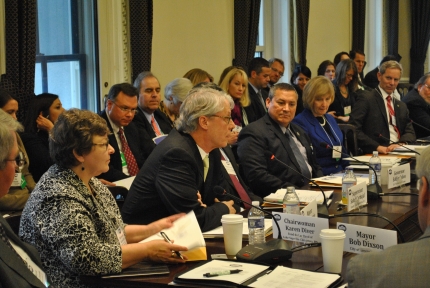
Des Moines Mayor Frank Cownie shares his climate resilience priorities in roundtable discussion with the with members of the President’s State, Local, and Tribal Leaders Task Force on Climate Preparedness and Resilience. (Photo by Office of Intergovernmental Affairs)

Last week, members of the State, Local and Tribal Leaders Task Force on Climate Preparedness and Resilience participated in their inaugural meeting at the White House. President Obama created this Task Force in his Climate Action Plan to advise the Administration on how the Federal government can support communities across the country that are dealing with the impacts of climate change. In 2012 alone, the costs of weather disasters exceeded $110 billion in the United States – including the terrible destruction caused by Hurricane Sandy. Climate change is increasing the frequency and intensity of these kinds of events – as well as the costs and public health impacts associated with them.

From Alabama to Guam, from Los Angeles to Philadelphia, state, local, and tribal leaders are on the front lines of dealing with extreme weather, sea level rise, and other impacts of climate change. This diverse group of elected officials brought their expertise and experience in building community resilience to our first meeting. Task Force members discussed ways to improve coordination to protect critical infrastructure, public resources, and emphasize pre-disaster preparedness. They also shared ideas about the types of information and tools that would be most useful in confronting the impacts of climate change.

EXECUTIVE OFFICE OF THE PRESIDENT
COUNCIL ON ENVIRONMENTAL QUALITY
WASHINGTON, D.C. 20503


FOR IMMEDIATE RELEASE:
November 5, 2013


Obama Administration Announces Winners of 2013 GreenGov Presidential Awards

WASHINGTON, D.C. – The White House Council on Environmental Quality (CEQ) today announced the fourth annual winners of the GreenGov Presidential Awards, which honor Federal civilian and military personnel as well as agency teams, facilities, and programs that have taken innovative steps to reduce energy use and carbon pollution, curb waste, and save taxpayer money in Federal agency operations.  At a White House ceremony, senior Administration officials recognized the eight award winners for exemplifying President Obama’s charge to lead by example and demonstrating extraordinary achievement in the pursuit of the President’s 2009 Executive Order on Federal Leadership in Environmental, Energy and Economic Performance (Executive Order 13514). 

"At the President’s direction, the Federal Government is moving aggressively to improve its efficiency, reduce energy use and pollution, and promote clean energy," said Nancy Sutley, Chair of the Council on Environmental Quality. "The winners of the GreenGov Presidential Awards demonstrate how Federal agencies and employees are leading by example when it comes to advancing our energy security, reducing carbon pollution, preparing for the impacts of climate change, and building stronger and healthier communities.”

President Obama’s Executive Order 13514 requires Federal agencies to improve energy efficiency, increase the use of renewable energy, and reduce greenhouse gas pollution, among other targets. To date, the Obama Administration has met that challenge by:

  • Reducing greenhouse gas pollution from Federal agency building energy use, fleets, and other direct sources by 15 percent – the equivalent of permanently removing 1.5 million cars from the road; 
  • Increasing the Federal government’s use of renewable energy to 7 percent, and setting a new goal of 20 percent renewable energy consumption by 2020, including a commitment from the Army, Navy, and Air Force to deploy a combined 3 Gigawatts of renewable energy by 2020;
  • Doubling the number of hybrid cars and truck in the Federal fleet, saving an estimated 7 million gallons of gasoline and improving the fuel efficiency of the fleet overall; and
  • Committing $2 billion to upgrade the energy efficiency of Federal buildings by using Energy Savings Performance Contracts at no up-front cost to taxpayers.

CEQ solicited nominations for the 2013 GreenGov Presidential awards from the Federal community earlier this year.  A panel of judges that included Federal and national sustainability leaders reviewed the nominations and recommended the award finalists to the President. The outstanding achievements by this year’s GreenGov Award recipients are described below:

Award Category:  Sustainability Hero

·         Individual Name: Jeanette Fiess

·         Agency: Department of Defense – U.S. Army Corps of Engineers (USACE)

Under Ms. Fiess’s leadership, the USACE Northwest Division has increased the number of employees with training in high-performance building standards by 70 percent. In 2012, Ms. Fiess led the nationwide USACE effort to update the USACE Unified Facilities Guide specifications, which lacked critical sustainability requirements. USACE Headquarters has recommended that training developed by Ms. Fiess be included as part of their national training platform in future years.

Award Category:  Green Innovation

·         Project Name: 2012 CDC Freezer Challenge

·         Agency: Department of Health and Human Services – Centers for Disease Control and Prevention (CDC)

The CDC Freezer Initiative Workgroup held a two-month Freezer Challenge competition in which professionals across the agency deployed innovative strategies to improve storage practices and reduce energy use in energy intensive laboratory freezers. The results of the Challenge will save more than $127,000 per year in operating costs and will reduce energy use by more than 320,000kWh annually, the equivalent of the yearly energy consumption of 36 family homes. 

Award Category:  Lean, Clean, and Green

·         Project Name: Alaska Marine Research Institute Goes Green

·         Agency: Department of Commerce – National Marine Fisheries Service

Scientists and engineers at the National Oceanic and Atmospheric Administration’s Ted Stevens Research Institute in Juneau, Alaska are using seawater as a heat source to replace oil-fueled heat pumps and eliminate all carbon emissions. The staff developed a system to extract heat from seawater already being pumped through the lab to support research activities. The seawater heat pump is the latest of three projects the facility has spearheaded in order to reach zero carbon emissions.

Award Category:  Good Neighbor 

·         Project Name: ORNL Good, Green, Sustainable Neighbor

·         Agency: Department of Energy (DOE) – Oak Ridge National Laboratory

The DOE Oak Ridge National Laboratory (ORNL), a leader in clean energy research, has spearheaded two recent initiatives. First, ORNL is working with the Indian River State College in Florida to create a sustainable campus, including hosting workshops that feature achievable sustainability plans and goals specific to the college. Second, ORNL is partnering with the Electric Vehicle (EV) charging project in Tennessee to install 125 electric vehicle charging stations and encourage the development of an EV charging corridor across the state.

Award Category:  Green Dream Team

·         Project Name: San Dimas Technology and Development Center Net Zero Energy/California Renewable Energy Small Tariff Excess Agreement Producer Facility

·         Agency: Department of Agriculture (USDA) – United States Forest Service (USFS)

USFS and San Dimas Technology and Development Center, along with the Department of Energy, General Services Administration, and California state energy companies, have created the first-ever USDA-USFS net zero energy facility. Retrofitting the facility and replacing inefficient energy sources will save an estimated $100,000 per year in energy costs. The net zero energy effort was completed with the installation of a 302kW photovoltaic system that is interconnected with the California electric grid.

Award Category:  Building the Future

·         Project Name: A Leader in Sustainable Practices

·         Agency: Department of Defense – United States Marine Corps

The Marine Corps Recruit Depot San Diego has reduced its energy intensity by 22 percent and has transformed 30 percent of the base’s electrical consumption to renewable energy as a result of recent sustainability projects. These projects include completing three new LEED Platinum certified buildings, installing 1.7MW of photovoltaic renewable energy generation as well as a biofuel gas pump and electric vehicle charging stations, equipping all buildings with smart electric, gas, and water meters, and hosting the first black water treatment system in the Department of Defense. These projects are estimated to save $500,000 in energy costs annually.

Award Category: Climate Champion (Two Awardees)

·         Project Name: Preparing for a Changing World

·         Agency: General Services Administration (GSA)

The GSA Climate Change Adaptation Team hosted a series of climate preparedness workshops for Federal stakeholders to review impacts of potential climate scenarios on existing mission-related infrastructure. The sessions advanced organizational readiness and ensured that climate risk to Federal agency missions are properly considered in all aspects of operational management. As a result, several Federal agencies are working with local communities to ensure effective mitigation and preparedness strategies are developed and implemented.

·         Project Name: Sea Level Rise Tool for Sandy Recovery

·         Agencies: Department of Commerce, U.S. Army Corps of Engineers, Department of Homeland Security, U.S. Global Change Research Program

A team of Federal agencies partnered together to create an interactive seal level rise mapping and calculator tool that helps city planners identify and prepare for future flood risks. This team released the tool less than a year after Hurricane Sandy, allowing state and local planners to make better informed decisions that consider the risk in location and design of redevelopment projects. The tool uses the most up-to-date scientific information by providing assessments of future risks beyond current conditions.

###

Share Your Input

June 15-July 15, 2016: RFI period to submit input on the development of the 2017 National Plan for Civil Earth Observations is now CLOSED.

  • On June 15, 2016, OSTP released a Request for Information (RFI) soliciting public input on the development of the second National Plan for Civil Earth Observations (the Plan) through the RFI. The RFI poses questions about current trends and practices in Earth observations and solicits comments regarding the 2014 National Plan for Civil Earth Observations. The public input provided in response to the RFI will inform OSTP and the U.S. Group on Earth Observations as they work with Federal agencies and other stakeholders to develop the second Plan. 
  • Comments provided in response to this RFI will be accepted until July 15, 2016.
  • Responders are encouraged to submit comments by filling out this online form, and emailing it to env_energy@ostp.eop.gov. Responders may also submit comments by:
    • Fax: (202) 456-6071. On the cover page, please state “National Plan for Civil Earth Observations, attn: Timothy Stryker”.
    • Mail: Office of Science and Technology Policy, 1650 Pennsylvania Avenue NW, Washington, DC 20504. Information submitted by postal mail should be postmarked by July 15, 2016.
  • To view the complete RFI in the Federal Register, click here.
  • For further information, contact Timothy Stryker, Director, U.S. Group on Earth Observations Program, OSTP, 202-419-5487, tstryker@ostp.eop.gov

December 9, 2015-January 15, 2016: RFI period to submit input on the United States Group on Earth Observations Draft Common Framework for Earth-Observation Data is now CLOSED.

  • On December 9, 2015, OSTP released a Request for Information (RFI) soliciting public input on the United States Group on Earth Observations Draft Common Framework for Earth-Observation Data, specifically on (1) How would adoption of this set of recommended standards by Federal agencies affect your discovery, access, and use of government Earth-observation data and data catalogs, if at all? (2) Do you agree that Common Framework-recommended statndards are current, appropriate, and valuable practices for civil Earth observation agencies withinin the Federal Government? Why or why not? (3) Do you wish to share specific examples of how the use of Common Framework-recommended standards have aided or hindered the use of government Earth-observation data or the development of products such as data portals, visualizations, or decision-support tools?
  • Comments provided in response to this RFI will be accepted until January 15, 2016.
  • Responders are encouraged to submit comments by filling out this online form. Responders may also submit comments by:
    • Fax: (202) 456-6071.
    • Mail: Office of Science and Technology Policy, 1650 Pennsylvania Avenue NW., Washington, DC 20504. Information submitted by postal mail should allow ample time for processing.
  • To view the complete RFI in the Federal Register, click here.
  • To view the Draft Common Framework for Earth-Observation data, click here (pdf).
  • To access the online form for comments, click here.

December 1, 2014 – December 31, 2014: RFI period to submit input on Microsatellite Technologies for Civil Earth Observations is now CLOSED.

  • On December 1, 2014, OSTP released a Request for Information (RFI) soliciting public input on Microsatellite Technologies for Civil Earth Observations, specifically on: (1) the current and near-term state of microsatellite technologies, and (2) whether microsatellite systsems will be capable of meeting current and future civil Earth-observing needs.
  • Comments provided in response to this RFI will be accepted until December 31, 2014. Responders are encouraged to submit comments by filling out the downloadable form. Comments may be submitted in one of three ways:
    • Email: EarthObsStudy@OSTP.gov, with "Microsatellite Technologies for Civil Earth Observations" in the subject line. Comment forms should be included as an attachment.
    • Fax: (202) 456-6071.
    • Mail: Office of Science and Technology Policy, 1650 Pennsylvania Avenue NW., Washington, DC 20504. Information submitted by postal mail should allow ample time for processing.
  • To view the complete RFI in the Federal Register, click here.
  • To download the comment form, click here (PDF).

October 23, 2014 – November 26, 2014: Request for public comment period period to submit input on the National Science and Technology Council Subcommittee on Forensic Science report on achieving latent fingerprint interoperability is now CLOSED.

  • On October 23, 2014, OSTP released a Request for Public Comment soliciting public input on the draft report entitled Achieving Latent Fingerprint Interoperability in the United States. This report evolved out of the work of the National Science and Technology Council’s Subcommittee on Forensic Science (SoFS), established in 2010 to assess the challenges of and opportunities for implementing recommendations made by the National Research Council (NRC) in its 2009 report, Strengthening Forensic Science in the United States: A Path Forward. Among its recommendations, the NRC called on the Federal Government to launch a “broad-based effort to achieve nationwide fingerprint data interoperability.” In response to this recommendation, the SoFS chartered the Automated Fingerprint Identification Systems (AFIS) Interoperability Task Force to coordinate the development of a strategic plan for achieving this goal.  Achieving Interoperability for Latent Fingerprint Identification in the United States describes the current state of latent interoperability among AFIS and identifies a series of actions that can be taken by Federal agencies to implement the standards needed to achieve interoperability, develop an overarching national connectivity strategy and infrastructure, and support State and local agencies in building connections across jurisdictions. 
  • The full Request for Public Comment can be found here.
  • The full draft report: Achieving Latent Fingerprint Interoperability in the United States can be found here (PDF).
  • Comments received in response to the request can be found here (PDF).

March 18, 2014 - April 14, 2014: Request for Information: Interagency Funding for Research and Engineering Projects Conducted by Federal Researchers is now CLOSED.

March 4, 2014 - April 4, 2014Request for Information soliciting public input on how ‘big data’ will affect how Americans live and work, and the implications of collecting, analyzing and using such data for privacy, the economy, and public policy is now CLOSED.

  • On March 4, 2014, OSTP issued a Request For Information soliciting public input on how ‘big data’ will affect how Americans live and work, and the implications of collecting, analyzing and using such data for privacy, the economy, and public policy. The comment period is now CLOSED.  Comments received by OSTP during the comment period can be found here. To view a specific RFI response within the document, click the hyperlink under its number. 

February 18, 2014 - March 20, 2014: RFI comment period to submit input on ways to provide greater incentives to Federal agencies to relinquish spectrum for wireless broadband or other innovative commercial uses is now CLOSED.

  • On February 18, 2014, OSTP released a Request for Information (RFI) soliciting public input on ways to provide greater incentives to Federal agencies to relinquish spectrum for wireless broadband or other innovative commercial uses. Below are the public comments received by OSTP during the comment period. The Request for Information follows last year’s Presidential Memorandum, Expanding America's Leadership in Wireless Innovation, which aims to promote more efficient use of spectrum by Federal agencies. Among other things, the memorandum directs the Spectrum Policy Team to make recommendations to the President on approaches that could give agencies greater incentive to share or relinquish spectrum, while protecting the mission capabilities of existing and future systems that rely on spectrum use.The full Request for Information can be found here and the new report from the Science and Technology Policy Institute can be found here.
  • Comments on the questions in the RFI were accepted through March 20, 2014. Received comments are presented together, in alphabetical order per the electronic filename of the submission, here.

January 14, 2014 - March 7, 2014Request for Information soliciting public input to inform policy developments related to high-impact learning technologies is now CLOSED

  • On January 13, 2014, OSTP issued a Request for Information (RFI) soliciting public input to inform its policy developments related to high-impact learning technologies and how such policies will affect the design and implementation of “pull mechanisms” for technologies that aim to improve a given learning outcome. The public comment period was open from January 14, 2014 to March 7, 2014.  The comment period is now CLOSED. Comments received by OSTP during the comment period can be found here. The RFI response document begins with a table of contents that shows the names of the organizations that commented and at what page their comment begins. 

November 12, 2013 - December 6, 2013: RFI comment period to submit input related to development of a National Plan for Civil Earth Observations is now CLOSED. Comments on the RFI were accepted through December 6, 2013 and can be found here.

Join a White House Google+ Hangout with Energy Secretary Moniz & EPA Administrator McCarthy Moderated by Grist

Update: Unfortunately, due to a scheduling conflict, the Google+ Hangout with Secretary Moniz and Administrator McCarthy has been cancelled. 

Less than three months ago, President Obama delivered an address at Georgetown University that underscored the moral obligation we have to leave our children a planet that’s not polluted or damaged. The President issued a Climate Action Plan for his second term that laid out commonsense steps to reduce carbon pollution and address the effects of climate change both here and across the globe.

Today, the Administration issued a Climate Action Plan progress report detailing important implementation milestones on everything from cutting carbon pollution, preparing the United States for the impacts of climate change and ways we are leading global efforts to reduce global greenhouse gas emissions, advance international negotiations and promoting new actions to promote energy efficiency. Check out highlights from our progress since the President announced the Climate Action Plan.

Want to know more about President Obama's Climate Action Plan? Join us Monday, September 23rd at 12:15 p.m. EDT for a White House Google+ Hangout with Energy Secretary Ernest Moniz and Environmental Protection Agency (EPA) Administrator Gina McCarthy, and moderated by Lisa Hymas, Senior Editor of Grist.org.

Nominate a White House Champion of Change: Veterans on the Front Lines of Advancing Clean Energy and Climate Security

In answering our nation’s call to service, America’s veterans understand the challenges of energy availability and the threats of a changing climate on the safety and effectiveness of our troops and our national security. From the dangers and logistical challenges of transporting vital energy supplies, to concerns of natural resource scarcity, these heroes have been on the front lines dealing with the security implications of a changing climate.

Upon returning home from service, many veterans of Iraq and Afghanistan have continued to serve, using their specialized skills and experiences to advance energy efficiency and renewable energy, make communities more resilient to the effects of climate change, and improve our nation’s energy security. In his Climate Action Plan, the President emphasized that failing to address climate change will threaten millions of people around the world and increase security risks. Improving preparedness and promoting energy independence helps strengthen national security and makes our troops and communities safer.

In early October, which the President designated “Energy Action Month”, the White House will recognize “Champions of Change” – Iraq and Afghanistan veterans who are leading communities to prepare for the impacts of climate change and transition to a clean energy economy. We need your help to identify these veterans and recognize their extraordinary efforts. Champions may be veterans who are:

  • Entrepreneurs working to implement technologies or techniques for clean energy, energy efficiency, or other new approaches to combat climate change
  • Professionals working to make military bases, cities, or other communities resilient to extreme weather or sea level rise
  • Businesspeople finding solutions that make communities energy independent and create jobs in clean energy

Help us recognize veterans who are leading and educating their communities on solutions to combat climate change. Click here to nominate a Champion of Change today! After following the link, select "Veterans in Clean Energy and Climate Security" as your nomination category. Please submit nominations by 5:00 PM on Wednesday, September 4th. We look forward to hearing from you!

Rohan Patel is the Associate Director for Public Engagement at the Council on Environmental Quality