The White House

Office of the Press Secretary

Presidential Memorandum -- Withdrawal of Certain Areas of the United States Outer Continental Shelf from Leasing Disposition

MEMORANDUM FOR THE SECRETARY OF THE INTERIOR 

SUBJECT: Withdrawal of Certain Areas of the United States Outer Continental Shelf from Leasing Disposition

Consistent with principles of responsible public stewardship entrusted to this office, with due consideration of the importance of Bristol Bay and the North Aleutian Basin Planning Area to subsistence use by Alaska Natives, wildlife, wildlife habitat, and sustainable commercial and recreational fisheries, and to ensure that the unique resources of Bristol Bay remain available for future generations, I hereby revoke my memorandum of March 31, 2010 (Withdrawal of Certain Areas of the United States Outer Continental Shelf from Leasing Disposition), and direct as follows:

Under the authority granted to me in section 12(a) of the Outer Continental Shelf Lands Act, 43 U.S.C. 1341(a), I hereby withdraw from disposition by leasing for a time period without specific expiration the area of the Outer Continental Shelf currently designated by the Bureau of Ocean Energy Management as the North Aleutian Basin Planning Area (Area), including Bristol Bay, offshore Alaska. This withdrawal prevents consideration of this Area for any oil or gas leasing for purposes of exploration, development, or production.

Nothing in this withdrawal affects the rights under existing leases in this Area.

BARACK OBAMA

New Recommendations to End Pirate Fishing and Seafood Fraud

Photo of seafood vendor

Seafood fraud can happen at any point in the supply chain, undermining law-abiding fishers and misleading consumers. (Photo credit: NOAA)

America’s fisheries drive coastal economies and put food on the tables of families across the country. Unfortunately, the twin global issues of illegal, unreported, and unregulated (IUU) fishing and seafood fraud undermine the economic and environmental sustainability of fisheries and fish stocks.

Global losses attributable to IUU fishing are estimated at $10 billion to $23 billion annually. Pirate fishing vessels take in fish without regard to the sustainability of ocean ecosystems. Not required to file trip plans or carry transponders, the ships roam the oceans in the shadows and become vectors for human, drug, and arms trafficking. Black-market fishing distorts legal markets and displaces law-abiding fishermen, ultimately serving as a drag on the global economy. These challenges can be compounded by seafood fraud — the mislabeling, misbranding, or falsification of product origins — which can occur at any point in the supply chain.

Today, the federal task force on combatting IUU fishing and seafood fraud released its final recommendations to tackle these complex challenges. President Obama announced the creation of the task force at the State Department’s Our Ocean conference in June, and for the last six months, under the leadership of NOAA Administrator Kathy Sullivan and Under Secretary of State Cathy Novelli, representatives from 14 agencies have come together to answer the President’s call to action.

John Podesta is Counselor to President Barack Obama. Mike Boots leads the White House Council on Environmental Quality.
Related Topics: Energy and Environment

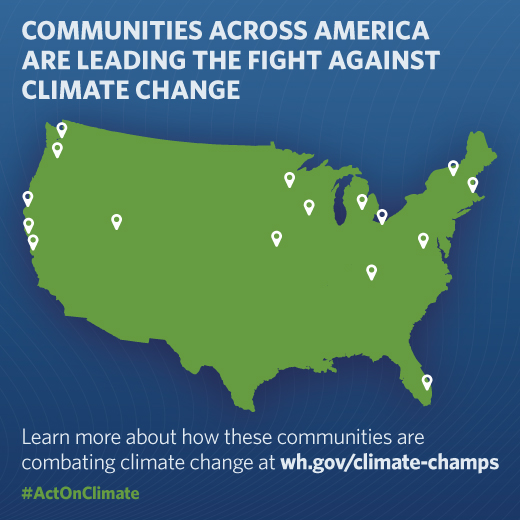
Announcing the First Class of Climate Action Champions

Deep, persistent drought. Longer, fiercer wildfire seasons. High tides flooding downtowns. Severe storms wreaking havoc. This is the picture from the front lines of climate change — in communities across America.

And as they face these immediate climate crises, cities, towns, counties, and tribes of every size and in every region of the country have stepped up to be part of the solution: identifying their vulnerabilities, cutting carbon pollution, creating jobs by investing in clean energy and energy efficiency, and finding innovative solutions to make their communities and infrastructure more resilient to climate extremes.

Today, in recognition of their strong commitment to the fight against climate change, the Obama administration is naming 16 of these communities as the first class of Climate Action Champions.

Click here for the full list of Climate Action Champions.

John Podesta is Counselor to President Barack Obama.

America Is an Arctic Nation

Arctic glacier (1)

Climate change is bringing longer, hotter summers to the Arctic, and driving glaciers to retreat. (U.S. Department of State)

There are only eight countries in the world whose territory above the Arctic Circle grants them the honored title of “Arctic Nation.” The United States is one.

The human story in the Arctic is defined by the intense and arduous relationship between people and the environment. Arctic residents know not just how to survive, but how to thrive in some of the harshest conditions on earth. Theirs is a story of adaptation and survival.

Today, however, climate change is transforming this already challenging region at an unprecedented pace. Temperatures in the Arctic are rising at twice the rate of the rest of the world on average. And though the region seems remote to most Americans, other parts of our country are also being impacted by Arctic climate change. The entire country experienced abnormal weather as the result of a storm that passed through the Bering Sea in Alaska earlier this month. Melting glaciers and land-based ice sheets are contributing to rising sea levels. The future of America is inextricably linked to the future of the Arctic.

Electric Vehicles Help Drive Climate Action

Yesterday at the White House, Energy Secretary Ernie Moniz and I got to see American innovation in action, as Pacific Gas & Electric demonstrated their new plug-in hybrid bucket truck — a utility vehicle with emissions nearly 80% lower than a conventional truck.

Not only does PG&E’s plug-in hybrid utility vehicle run cleaner, it provides up to 120 kW of exportable power — meaning that the trucks can actually be used to shorten or end power outages by plugging their reserves into the grid.

This is the kind of innovation we need to take action on climate change — reducing emissions on the one hand and finding creative ways to boost community resilience on the other.

Related Topics: Energy and Environment

#AskDrH: The President's Science Advisor Is Answering Your Questions on Climate Change

Watch on YouTube

Got questions about climate change? Ask the President's science advisor.

Dr. John P. Holdren, Director of the White House Office of Science and Technology Policy, wants to answer any questions that you have about climate change -- what it means, how bad it actually is, and what we can do to fight it.

Starting today, ask Dr. Holdren your questions on Facebook, Twitter, Instagram, or Vine using the hashtag #AskDrH -- and he'll answer some of them on camera.

Related Topics: Energy and Environment

The U.S. and China Just Announced Important New Actions to Reduce Carbon Pollution

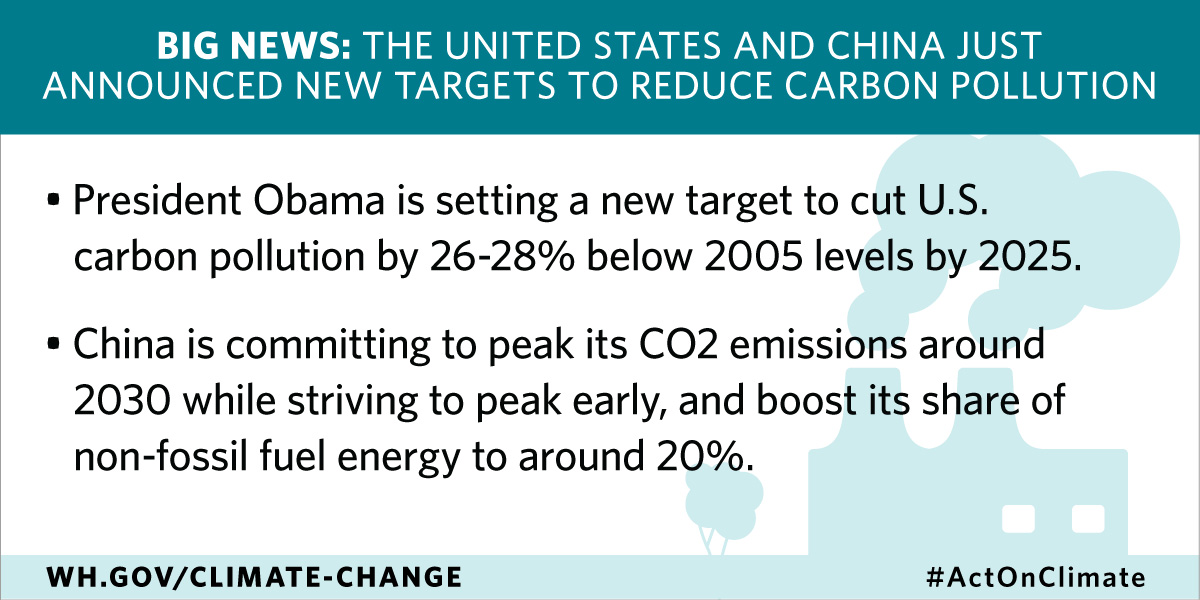
Today in Beijing, President Obama and Chinese President Xi Jinping made history by jointly announcing the United States’ and China’s respective targets for reducing the greenhouse gas emissions driving climate change in the post-2020 period.

This announcement is a unique development in the U.S.-China relationship. The world’s two largest economies, energy consumers, and carbon emitters are reaching across traditional divides and working together to demonstrate leadership on an issue that affects the entire world.

By making this announcement well in advance of the deadline set out in the UNFCCC negotiations, the two leaders demonstrated their commitment to reducing the harmful emissions warming our planet, and urged other world leaders to follow suit in offering strong national targets ahead of next year’s final negotiations in Paris.

John Podesta is Counselor to President Barack Obama. John Holdren is the President’s science advisor.

The White House

Office of the Press Secretary

FACT SHEET: U.S.-China Joint Announcement on Climate Change and Clean Energy Cooperation

President Obama Announces Ambitious 2025 Target to Cut U.S. Climate Pollution by 26-28 Percent from 2005 Levels

Building on strong progress during the first six years of the Administration, today President Obama announced a new target to cut net greenhouse gas emissions 26-28 percent below 2005 levels by 2025.  At the same time, President Xi Jinping of China announced targets to peak CO2 emissions around 2030, with the intention to try to peak early, and to increase the non-fossil fuel share of all energy to around 20 percent by 2030. 

Together, the U.S. and China account for over one third of global greenhouse gas emissions.  Today’s joint announcement, the culmination of months of bilateral dialogue, highlights the critical role the two countries must play in addressing climate change.  The actions they announced are part of the longer range effort to achieve the deep decarbonization of the global economy over time.  These actions will also inject momentum into the global climate negotiations on the road to reaching a successful new climate agreement next year in Paris.

The new U.S. goal will double the pace of carbon pollution reduction from 1.2 percent per year on average during the 2005-2020 period to 2.3-2.8 percent per year on average between 2020 and 2025.  This ambitious target is grounded in intensive analysis of cost-effective carbon pollution reductions achievable under existing law and will keep the United States on the right trajectory to achieve deep economy-wide reductions on the order of 80 percent by 2050.

The Administration’s steady efforts to reduce emissions will deliver ever-larger carbon pollution reductions, public health improvements and consumer savings over time and provide a firm foundation to meet the new U.S. target. 

The United States will submit its 2025 target to the Framework Convention on Climate Change as an “Intended Nationally Determined Contribution” no later than the first quarter of 2015.

The joint announcement marks the first time China has agreed to peak its CO2 emissions. The United States expects that China will succeed in peaking its emissions before 2030 based on its broad economic reform program, plans to address air pollution, and implementation of President Xi’s call for an energy revolution.

China’s target to expand total energy consumption coming from zero-emission sources to around 20 percent by 2030 is notable. It will require China to deploy an additional 800-1,000 gigawatts of nuclear, wind, solar and other zero emission generation capacity by 2030 – more than all the coal-fired power plants that exist in China today and close to total current electricity generation capacity in the United States.   

Building on Progress

In 2009, U.S. greenhouse gas emissions were projected to continue increasing indefinitely, but President Obama set an ambitious goal to cut emissions in the range of 17 percent below 2005 levels in 2020.  Throughout the first term, the Administration took strong actions to cut carbon pollution, including investing more than $80 billion in clean energy technologies under the recovery program, establishing historic fuel economy standards, doubling solar and wind electricity, and implementing ambitious energy efficiency measures. 

Early in his second term, President Obama launched an ambitious Climate Action Plan focused on cutting carbon pollution, preparing the nation for climate impacts, and leading internationally.  In addition to bolstering first-term efforts to ramp up renewable energy and efficiency, the Plan is cutting carbon pollution through new measures, including:

  • Clean Power Plan: EPA proposed guidelines for existing power plants in June 2014 that would reduce power sector emissions 30% below 2005 levels by 2030 while delivering $55-93 billion in net benefits from improved public health and reduced carbon pollution.
  • Standards for Heavy-Duty Engines and Vehicles: In February 2014, President Obama directed EPA and the Department of Transportation to issue the next phase of fuel efficiency and greenhouse gas standards for medium- and heavy-duty vehicles by March 2016. These will build on the first-ever standards for medium- and heavy-duty vehicles (model years 2014 through 2018), proposed and finalized by this Administration.
  • Energy Efficiency Standards: The Department of Energy set a goal of reducing carbon pollution by 3 billion metric tons cumulatively by 2030 through energy conservation standards issued during this Administration. These measures will also cut consumers' annual electricity bills by billions of dollars. 
  • Economy-wide Measures to reduce other Greenhouse Gases: The Environmental Protection Agency and other agencies are taking actions to cut methane emissions from landfills, coal mining, agriculture, and oil and gas systems through cost-effective voluntary actions and common-sense standards.  At the same time, the State Department is working to slash global emissions of potent industrial greenhouse gases called HFCs through an amendment to the Montreal Protocol; the Environmental Protection Agency is cutting domestic HFC emissions through its Significant New Alternatives Policy (SNAP) program; and, the private sector has stepped up with commitments to cut global HFC emissions equivalent to 700 million metric tons through 2025.

Expanding U.S. and China Climate & Clean Energy Cooperation

To further support the achievement of the ambitious climate goals announced today, the United States and China have pledged to strengthen cooperation on climate and clean energy. The two countries are expanding their ongoing and robust program of cooperation through policy dialogue and technical work on clean energy and low greenhouse gas emissions technologies. 

The United States and China agreed to:

  • Expand Joint Clean Energy Research and Development: A renewed and expanded commitment to the U.S.-China Clean Energy Research Center (CERC).  This will include:
    • Extending the CERC mandate for an additional five years from 2016-2020;
    • Renewing funding for the three existing tracks: building efficiency, clean vehicles, and advanced coal technologies with carbon capture, use and sequestration (CCUS); and
    • Launching a new track on the interaction of energy and water (the energy/water ‘nexus’).
  • Advance Major Carbon Capture, Use and Storage Demonstrations: Expanding our work under the Climate Change Working Group (CCWG) and under the CERC, and partnering with the private sector, the United States and China will undertake a major carbon capture and storage project in China that supports a long term, detailed assessment of full-scale sequestration in a suitable, secure underground geologic reservoir.  The United States and China will make equal funding commitments to the project and will seek additional funding commitments from other countries and the private sector.  In addition, both sides will work to manage climate change by demonstrating a new frontier for CO2 use through a carbon capture, use, and sequestration (CCUS) project that will capture and store CO2 while producing fresh water, thus demonstrating power generation as a net producer of water instead of a water consumer.  This CCUS project with Enhanced Water Recovery will eventually inject about 1 million tons of CO2 and create approximately 1.4 million cubic meters of freshwater per year. 
  • Enhance Cooperation on Hydroflurocarbons (HFCs): Building on the historic Sunnylands agreement between President Xi and President Obama regarding HFCs, the United States and China will enhance bilateral cooperation to begin phasing down the use of high global warming potential HFCs, including through technical cooperation on domestic measures to promote HFC alternatives and to transition government procurement toward climate-friendly refrigerants.
  • Launch a Climate-Smart/Low-Carbon Cities Initiative: Urbanization is a major trend in the 21st century, and cities worldwide account for a significant percent of global greenhouse gas emissions.  In response, the United States and China are establishing a new initiative on Climate-Smart/Low-Carbon Cities under the U.S.-China Climate Change Working Group.  Under the initiative, the two countries will share city-level experiences with planning, policies, and use of technologies for sustainable, resilient, low-carbon growth.  This initiative will eventually include demonstrations of new technologies for smart infrastructure for urbanization.  As a first step, the United States and China will convene a Climate-Smart/Low-Carbon Cities “Summit” where leading cities from both countries will share best practices, set new goals, and celebrate city-level leadership.
  • Promote Trade in Green Goods: The United States announced that Commerce Secretary Penny Pritzker and Energy Secretary Ernest Moniz will lead a Smart Cities/Smart Growth Business Development Mission to China April 12-17, 2015, focused on green infrastructure, energy efficiency and environmental trade sectors.  The mission will highlight the benefits of sustainable urbanization, technologies to support China’s air pollution and climate goals, and green buildings opportunities.  In addition, USTDA will conduct three reverse trade missions to bring Chinese delegations to see environmental, smart grid, and CCUS technologies in the United States over the next year.  
  • Demonstrate Clean Energy on the Ground: U.S. DOE, State, and USTDA will undertake a number of additional pilot programs, feasibility studies, and other collaborative efforts to promote China’s energy efficiency and renewable energy goals.  These will include expansion of our cooperation on “smart grids” that enable efficient and cost-effective integration of renewable energy technology, as well as the implementation through a U.S. and Chinese private sector commercial agreement of a first-of-its-kind 380 MW concentrating solar plant in China.

Making Plans and Making Progress: How the Federal Government Can Lead by Example

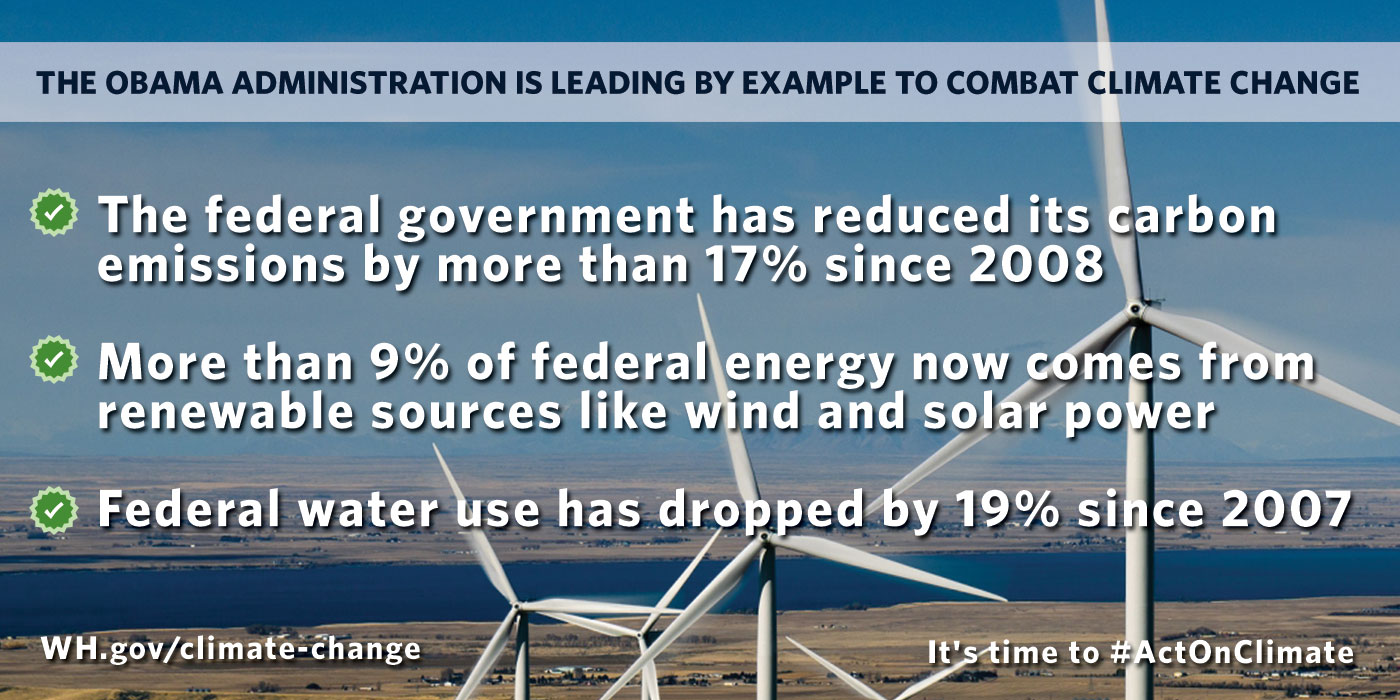
Five years ago this month, President Obama signed his Executive Order on Federal Leadership in Environmental, Energy, and Economic Performance, setting new energy, climate, and environmental targets for federal agencies. The targets are aggressive, but under the President’s leadership, agencies have made significant progress in cutting carbon pollution, improving energy efficiency, and preparing for the impacts of climate change.

Through this initiative, federal agencies have already reduced their greenhouse gas emissions by 17 percent – that’s the equivalent of taking 1.8 million cars off the road. And today, more than 9 percent of our energy comes from renewable sources, on our way to meeting a goal of 20 percent by 2020. We’ve also cut our potable water use by 19 percent, enough water to fill nearly 49,000 Olympic swimming pools.

This progress means we’re on track to meet the President’s goals. But with more than 360,000 buildings, 650,000 fleet vehicles, and $460 billion in annual purchasing power, the federal government is the largest energy consumer in the U.S. economy, so we can’t rest here.

That’s why, today, to coincide with the fifth anniversary of the Executive Order, federal agencies released new plans for reducing their greenhouse gas emissions and preparing for climate change impacts such as flooding, sea level rise, severe weather, and temperature extremes.

ENERGY STAR Day: The Power of the Little Blue Label

Ed. note: This is cross-posted on EPA Connect, the official blog of EPA's leadership. See the original post here.

Watch on YouTube

Let’s start with a few numbers:

$300 billion in savings. That’s how much consumers and businesses have saved on utility bills in the last 22 years because of the ENERGY STAR program.

Two billion metric tons of greenhouse gas emissions avoided, or the equivalent to the annual emissions of more than 420 million cars, over the last 22 years. Thanks to our little blue ENERGY STAR label, folks are doing their part to reduce their greenhouse emissions and combat climate change.

Since President Obama took office, ENERGY STAR has helped American consumers and businesses save over one billion metric tons of greenhouse gas emissions and approximately $110 billion on their utility bills.

That’s one powerful little label.

Gina McCarthy is the Administrator of the U.S. Environmental Protection Agency.