Overcoming Discrimination and Adversity: A Nation Honors Puerto Rico’s Veterans
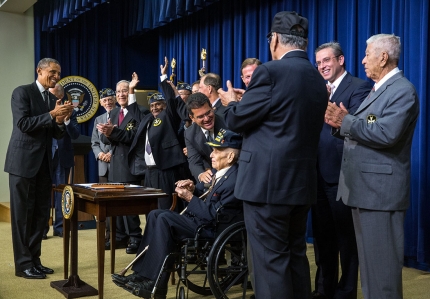
President Barack Obama leads an ovation for the Borinqueneers after he signed H.R. 1726

President Barack Obama leads an ovation for the Borinqueneers after he signed H.R. 1726 to award a Congressional Gold Medal to the 65th Infantry Regiment, known as the Borinqueneers, in the Eisenhower Executive Office Building South Court Auditorium, June 10, 2014. (Official White House Photo by Amanda Lucidon)

President Barack Obama signed into law a bill to award the Congressional Gold Medal to the United States Army’s 65th Infantry Regiment; an Army unit composed mostly of soldiers from the U.S. territory of Puerto Rico called the “Borinqueneers.” They are nicknamed after the native Taino indian name for the island of Puerto Rico - Borinquen. The signing ceremony reminds us all that U.S. citizens from Puerto Rico have built a rich and distinguished record of military service to our country. 

As President Obama highlighted for us:

“Shortly after Puerto Rico became part of the United States in 1898, a regiment of Puerto Rican soldiers was formed, and they served our nation bravely ever since.  In World War I, they defended the homeland and patrolled the Panama Canal Zone.  In World War II, they fought in Europe.  In Korea, they fought in mud and snow.  They are the 65th Infantry Regime, U.S. Army.  They are also known as Borinqueneers”.

The Regiment made its mark for its outstanding combat duty in the Korean War. As one of our nation’s last segregated Army units, it also battled the racially bitter attitudes toward ethnic minorities prevalent in our nation at the time. It wasn’t too long ago in our country that the nation as a whole and the U.S. military in particular, had very different attitudes toward racial and ethnic minorities. The “Borinqueneers” fought the enemy abroad with courage and skill, but also endured and overcame racial discrimination and negative stereotypes at home. This dichotomy- serving proudly while in a segregated Army unit, was the legacy that many soldiers including my Dad and “tío Jose” (uncle Joe) had to bare.

Both Dad and “tío Jose” served in the 65th during World War II.  As a kid, my sister, Dad and I visited “tío Jose” in his home in Bethlehem, PA where after the war, he went to work in the steel mills and settle down. The two brothers would often sit around the kitchen table swapping adventurous, raucous stories about their colorful adventures with the unit and their deployment to Panama and the Philippines. They talked about the endless hours of marching and guard duty in sweltering heat and humidity. And they served and endured proudly.

One of the most poignant anecdotes they shared reflects the social and political realities of a segregated nation at the time. While both brothers enlisted on nearly the same day they were soon to be dissimilarly marked. The way Dad told it, when they shipped out of Puerto Rico for basic training the military did not have a designation for Latino/Hispanic, only colored or white. As it worked out, one brother was designated “colored” while the other was designated “white.” The irony is punctuated by the fact that they resembled each other in a number of ways, nearly identical. 

Dad passed away in the loving hands of the hospice care unit of the Bronx, Veterans Administration Hospital on the Fourth of July, 2013 – knowing dad, he planned it that way.  Dad was a humble man except for two things – his service and his family. 

The Congressional Gold Medal is the highest form of recognition that Congress can bestow on an individual or group for outstanding achievement. Joining the President in the White House were several surviving Borinqueneers, many in their late 80’s and 90’s, and their families but also the Congressional leaders that fought to bestow this high honor to these brave veterans. The Bill, authored by Puerto Rico’s Congressional representative Pedro Pierluisi was shepherded through Congress by a bipartisan effort led by Representative Bill Posey of Florida, a Republican, and Senator Richard Blumenthal of Connecticut, a Democrats. Governor Alejandro García Padilla and several members of the legislative leadership were on hand to congratulate the award recipients.

It was a historic, emotional and uplifting day on so many levels. Seeing our Commander in Chief, flanked by several Borinqueneers in their twilight years, in the White House gathered to sign into law a bill honoring these stalwart heroes was remarkable.  They represented the spirit of tens of thousands of their brothers-in-arms, including my dad and “tío Jose” who have fought for over a century on the battlefields so far from home. 

James Albino is the Executive Director of the President’s Task Force on Puerto Rico

President Obama on Student Loan Debt: “No Hardworking Young Person Should Be Priced Out of a Higher Education”

Ed. note: This is cross-posted on The White House Blog. See the original post here.

More students than ever before are relying on student loans to pay for their college education. 71 percent of students earning a bachelor's degree graduate with debt, averaging $29,400. While most students are able to repay their loans, many feel burdened by debt, especially as they seek to start a family, buy a home, launch a business, or save for retirement.

That's why, as part of his year of action to expand opportunity for all Americans, President Obama is taking steps to make student loan debt more affordable and manageable to repay.

The President signed a memorandum directing the Secretary of Education to propose regulations that would allow nearly 5 million federal direct student loan borrowers the opportunity to cap their student loan payments at 10 percent of their income. The memorandum also outlines new executive actions to support federal student loan borrowers, especially vulnerable borrowers who may be at greater risk of defaulting on their loans.

But in his remarks at the signing, the President made clear that Congress needs to take action as well, saying that today's executive action will “make progress, but not enough.” He brought up the bill written by Sen. Elizabeth Warren that would allow students to refinance their student loans at today's lower interest rates, noting that “it pays for itself by closing loopholes that allow some millionaires to pay a lower tax rate than middle-class families.”

The President then detoured briefly from his prepared remarks, explaining why it's a “no-brainer” for Congress to pass the bill: 

You would think that if somebody like me has done really well in part because the country has invested in them, that they wouldn’t mind at least paying the same rate as a teacher or a nurse.  There’s not a good economic argument for it, that they should pay a lower rate.  It’s just clout, that’s all. So it’s bad enough that that’s already happening. It would be scandalous if we allowed those kinds of tax loopholes for the very, very fortunate to survive while students are having trouble just getting started in their lives. 

So you’ve got a pretty straightforward bill here.  And this week, Congress will vote on that bill.  And I want Americans to pay attention to see where their lawmakers’ priorities lie here:  lower tax bills for millionaires, or lower student loan bills for the middle class.

“This week, [Congress has] a chance to help millions of young people,” President Obama said. “I hope they do. ... And in the meantime, I’m going to take these actions today on behalf of all these young people here, and every striving young American who shares my belief that this is a place where you can still make it if you try.”

Read the President's full remarks from the signing, and learn more about how the President is working to make college more affordable.

You can watch the video here: http://www.youtube.com/watch?v=Mz5prW9iw14

The Changing Role of Fathers in the Workforce and Family

Ed. note: This is cross-posted on the Council of Economic Advisers' blog. See the original post here.

As part of the lead-up to the White House Summit on Working Families, we’ve been exploring policies and best practices that help both families and businesses manage the increasingly complicated interaction between work and family-life. Administration officials hosted a discussion—the first of its kind at the White House—on the state of working dads and how businesses can create a win-win culture to enable these fathers to be more involved parents and better employees.

The need to rethink workplace policies to work better for parents is not just about working moms or women—working fathers are a key piece of the story as well. As the data compiled by the Council of Economic Advisers on “The Economics of Fatherhood and Work” show, the role of fatherhood has been changing with fathers taking a more hands-on approach to raising children. This change is both cultural and economic, with families responding to the reality of women’s increased role in the labor market. Nearly two-thirds of children now have either two working parents or a single parent who is working, contributing to the trend of father’s increasingly caring for children. Today, one in fourteen fathers with kids under 18 are single parents—a striking seven-fold increase since 1970—and dads are increasingly staying at home when their wives work.

Yet most dads, like moms, are trying to balance work and their parenting responsibilities. One in five kids at daycare have a dad identified as the primary caregiver, and most of these dads are employed. Modern dads are spending more time on both childcare and housework while balancing a career. More dads today change diapers, do school pick-up, help with homework, and have to be able to pick up a sick kid from preschool. With more time spent on childcare and housework and little reduction in time spent in the workplace, fathers are increasingly reporting work-life conflict. In a reversal, today's fathers are more likely to report difficulties balancing work and family than mothers.

These changes suggest the need for policies and best practices, such as paid leave and workplace flexibility, which help mothers and fathers better balance the competing demands of work and caregiving. Research has shown that these policies can be good for business by helping to recruit talented workers; lowering worker turnover; and boosting morale, worker productivity, and profits. For example, although some businesses were initially concerned about California’s paid leave law before implementation, in a recent survey , more than 90 percent reported no negative effect or a positive effect of the law on profitability, turnover, productivity, and morale. And other studies have shown that flexibility can lead to improved productivity and is correlated with well managed businesses. Investors also see these policies as good for profitability—stock prices rise when businesses announce new family-friendly policies.

At the event, we heard leading experts, working dads, business leaders, and Administration officials discuss their insights on modern fatherhood and how we can help men balance work and family demands. Our participants—employees and small, medium and large businesses—corroborated the research that shows that flexibility and paid leave policies can be good for business.

In the run-up to the working families summit on June 23rd, we look forward to further engaging with experts, businesses, researchers, and other stakeholders to explore strategies that make full use of America’s talent and increase globally competitiveness while ensuring that both mothers and fathers can also be successful parents.

Jason Furman is Chairman of the Council of Economic Advisers. Betsey Stevenson is a member of the Council of Economic Advisers.

The White House

Office of the Press Secretary

White House Releases Report on the Health Impacts of Climate Change on Americans

Today, the White House released a report on the health impacts of climate change on Americans. The report summarizes the ways that climate change will be felt across the Nation.

In the past three decades, the percentage of Americans with asthma has more than doubled, and climate change is putting those Americans at greater risk of landing in the hospital. And extreme weather events are becoming more frequent across the country – from more rain falling in downpours in many regions, to longer and hotter heat waves in others, to more severe droughts and wildfires in some (notably the West and Southwest).

The effects of climate change impact the most vulnerable Americans – putting the elderly, kids, and people already suffering from burdensome allergies, asthma and other illnesses at greater risk.

The President believes we have a moral obligation to leave our children a planet that’s not irrevocably polluted or damaged. While no single step can reverse the effects of climate change, we must take steady, responsible action to cut carbon pollution, protect our children’s health, and begin to slow the effects of climate change so that we leave behind a cleaner, more stable environment. That’s why the President put forward the Climate Action Plan last year and earlier this week, the Environmental Protection Agency released a vital component of that plan – common-sense carbon pollution standards for existing power plants.

Through common-sense measures to cut carbon pollution we can protect the health of our Nation, while stimulating the economy and helping to prevent the worst impacts of climate change.

Acting on Climate: Asthma in the Latino Community

Ed. Note: This blog was cross posted from the United States Environmental Protection Agency.

Leading up to Asthma awareness month I participated in a #LatinoHealth Twitter chat with League of United Latin American Citizens (LULAC) and Environmental Defense Fund (EDF). We were excited to expand the virtual conversation about air pollution and asthma, issues that seriously affect Latino health. It is scary that so many forms of pollution are hidden in plain sight, such as air pollution and toxic chemicals, which are often part of our everyday lives. But it was also inspiring to be part of such an enthusiastic conversation with concerned community members from Utah to North Carolina, Georgia to New Jersey.

Many of the questions raised in the chat were concerned with the direct link between air quality and asthma. The truth is, lots of chemicals found at home or in the workplace have been linked to the development of asthma. And common outdoor pollutants, like smog and ozone, also contribute to the development of asthma or more severe symptoms. Today, over 3.6 million Latinos in the US are living with this condition, including one in every ten Latino children.

There’s no known cure for asthma, but understanding how indoor and outdoor air pollutants can trigger an asthma attack or episode is an important step in managing this condition. That’s why EDF and LULAC developed bilingual fact sheets to help raise awareness about these issues, and will be launching an education initiative to highlight the serious and underreported environmental threats that disproportionately affect Latino communities around the country.

But we can’t stop there. Tackling hazardous indoor and outdoor air pollution is critical to healthy communities, particularly for Latinos. 39% of Latinos live within 30 miles of a power plant and almost 1 in 2 Latinos in the U.S. live in counties with unhealthy levels of ozone pollution. These pollutants often come from sources that also emit carbon pollution, which contributes to climate change. That warming, in turn, creates longer allergy seasons, higher rates of asthma, and even more smog. In short, unless we limit carbon pollution, our children are going to face more asthma attacks in the future.

Fortunately, President Obama’s Climate Action Plan lays out commonsense steps to cut carbon pollution from power plants and ultimately build climate resilience. If we can begin to reduce this pollution, all Americans will benefit – but the positive impact on Latino health will be especially pronounced.

When organizations like LULAC and EDF build partnerships to battle health threats, and individuals come together to address these challenges in their communities, it is a big step in the right direction. At EPA, we also know it’s our responsibility to play our role in protecting the environment and minimizing these hazards to public health. That’s exactly what we’re doing when we act to support President Obama’s Climate Action Plan. A big thanks to everyone who participated in the #LatinoHealth Twitter chat – here’s looking forward to another productive conversation in the future!

Gina McCarthy is the Administrator for the U.S. Environmental Protection Agency.

The State of Our Climate: A Google+ Hangout with Secretary Moniz and Administrator McCarthy

Climate change is not a distant threat – it's affecting us right now. That's why earlier this month, as part of President Obama's plan to act on climate change, the Administration released the third National Climate Assessment, which breaks down the current and projected impacts of climate change on every region of the country and key sectors of our economy.

On Monday, May 19 at 1:00 p.m. ET, join the website Grist.org, Energy Secretary Ernest Moniz, EPA Administrator Gina McCarthy, and the White House for a Google+ Hangout. We'll be chatting about climate change and the steps we're taking to reduce carbon pollution, prepare for the impacts of climate change, and build a clean energy economy – including an upcoming rule that would cut carbon pollution from existing power plants.

Have questions? Secretary Moniz and Administrator McCarthy will answer them during the event. Ask using the hashtag #WHClimateChat on Twitter, Google+, and Facebook.

Watch the Hangout live at 1:00 p.m. ET on Monday, May 19 on the White House Google+ page.

To learn more, check out the latest on President Obama's Climate Action Plan.

Related Topics: Energy and Environment

White House Office Hours: National Climate Assessment

Climate change is affecting us right now, and the carbon pollution that causes it is a threat to our health and the environment. That’s why last June, President Obama issued a broad-based Climate Action Plan, announcing a series of executive actions to cut carbon pollution, prepare the U.S. for the impacts of climate change, and lead international efforts to address global climate change.

Today, as part of that plan, the Administration released the third National Climate Assessment (NCA), the most comprehensive scientific assessment yet of how climate change is impacting every region of the country and key sectors of our economy.

Have questions about the NCA and President Obama's Climate Action Plan? Tomorrow, Wednesday, May 7 at 2:00 p.m. ET, join us for a session of White House Office Hours with Dan Utech, Special Assistant to the President for Energy and Climate Change. During a live Q&A on Twitter, he'll answer your questions on his handle, @Utech44.

Here are the details:

  • Ask your questions now and during the live event on Twitter with the hashtag #WHClimateChat
  • Follow the Q&A live through the @Utech44
  • If you miss the live Q&A, the full session will be posted on WhiteHouse.gov and Storify.com/whitehouse

Learn more about the President's plan to fight climate change, and then join us for Office Hours on Twitter with Dan Utech on Wednesday, May 7 at 2:00 p.m. ET.

Related Topics: Energy and Environment

How Solar is Powering our Armed Forces and Economy

Editor's Note: This blog introduces readers to Bob Powell, President of SunEdison North America.

As part of President Obama’s commitment to addressing climate change, he has made it a priority to help America’s armed forces double-down on renewable energy and increase federal renewable energy purchases.    In 2012, the Department of Defense announced a goal to deploy three gigawatts of renewable power and meet 25% of its energy needs with renewable energy by 2025.  In December 2013, President Obama called for the government to triple renewable energy use in federal facilities, to 20% by 2020.  These goals are achievable, in part because solar is now close to parity with retail electric rates and wholesale competition from fossil fuels in many states without incentives.   

The Air Force is the largest consumer of energy in the federal government, spending more than $9 billion annually on fuel and electricity.  A prime example of the Air Force and U.S. military’s solar leadership, Davis-Monthan Air Force Base is a 16.4 MW photovoltaic (PV) solar facility in Tucson Arizona that began operation in January 2014 and is the largest of its kind on any U.S. Department of Defense installation.   Davis-Monthan’s solar plant was built in just five months thanks to up to 150 Americans “pounding in place” solar panels.  Moreover, the project will use almost zero water to generate power, which is important to a state facing severe drought. 

Solar is not only an energy cost hedge against future electric cost increases and a water saver, but also a jobs winner for America, creating well-paid, highly-skilled jobs here at home that cannot be outsourced.  Solar is the fastest-growing source of renewable energy in America, pumping billions of dollars into the U.S. economy.   Back in 2008, President Obama had the vision to encourage U.S. solar energy just as the global economy was plunging into recession.  According to the Solar Energy Industries Association and The Solar Foundation, solar jobs have increased from about 24,000 in 2007 to an astounding 143,000 Americans working in the U.S. solar industry today, and a projected 165,000 jobs by the next State of the Union.

Having come from a utility, I know how important it is that these solar energy projects demonstrate real cost savings for the public.  SunEdison was the first to introduce the solar power purchase agreement, now the leading business model in the industry and a smart new finance tool that enables our public agencies to more cost-efficiently procure energy by leveraging private sector tax options.   This new Davis-Monthan solar project will provide approximately 35 percent of the Base’s electricity requirements at an economically beneficial rate for 25 years, reducing the Base’s utility costs by an average of $500,000 annually. 

Leveraging private-public partnerships through long-term power purchase agreements for solar is novel for federal agencies, and federal facilities require particularly strong partnerships to succeed.  The Air Force should be commended for its bold leadership in using this type of solar financing that is providing real savings and value to the government and to taxpayers.

SunEdison is proud to partner with the Obama Administration to keep expanding America’s solar leadership, enabling U.S. energy independence while putting Americans to work every day.  Our company, headquartered in Belmont, California, is a leading American provider of solar from silicon to electrons, with manufacturing in Pasadena, Texas; Portland, Oregon; and St. Peters, Missouri.  We and our partners will keep working to make a safer, more stable world, with renewable sources of energy, as the President urged in the State of the Union.  2014 will be another year of action, helping more Americans turn to solar to go to work, save money, help meet their energy needs, and improve our environment.

Bob Powell is President of SunEdison North America.   

How our Veterans are Securing our Energy Future

Like many of my fellow veterans, I first began to understand the issue of energy security while serving on the battlefield in Iraq.  Each night, after local workers left our base, we needed to move our fuel trucks because the location where those trucks had been would become a mortar target at night.  Over the past several years, the military has made incredible strides to address energy security on the battlefield.  They have learned that being energy efficient and having resilient power supplies not only saves money, but saves lives.

Our veterans, returning from service to their country in Iraq and Afghanistan, have brought their own experiences with energy security home with them.  Now, many are serving on the front lines of clean energy and climate security.  Last November, the White House honored 12 veterans and leaders who are using their skills and knowledge to advance clean energy initiatives and promote greater climate security at the Champions of Change: Veterans Advancing Clean Energy and Climate Security event.

This week, the Solar Foundation and Operation Free released a joint report called Veterans in Solar: Securing America’s Energy Future. This first-of-its-kind report shows that veterans – a group that has faced extraordinarily high unemployment – are employed within the solar industry at higher-than-average rates. The report highlights that America’s solar industry has grown by 500 percent since 2008, providing more than 13,000 veterans with job opportunities as of November 2013.  Strikingly, veterans represent nearly 10 percent of all solar workers at a time when more than 15 percent of veterans aged 18-24 are currently unemployed. The report also discovered that the growth in the industry is continuing: nearly 62 percent of solar companies that employ veterans plan to add more solar workers within the next 12 months.

Our returning service men and women have the skills and training our country needs to ensure continued progress toward a clean economy.  As the President has stated, “No veteran who fought for our nation overseas should have to fight for a job when they return home.”  It’s clear that veterans are finding that the skill sets they obtained through military service are valued by leading solar companies. I am encouraged by the Solar Foundation’s and Operation Free’s commitment to highlighting this opportunity, and by the success of our veterans in continuing to serve the country by advancing our energy security.

Jon Powers is the Federal Environmental Executive at the Council on Environmental Quality.


The White House

Office of the Press Secretary

FACT SHEET: President Obama Leading Administration-wide Drought Response

As communities across California struggle with the impacts of one of the state’s worst droughts in over 100 years, President Obama is committed to ensuring that his Administration is doing everything it can help the farmers, ranchers, small businesses, and communities being impacted.

The U.S. Department of Agriculture (USDA), Department of the Interior (DOI) and other federal agencies are using their existing authorities and working closely with their state and local partners as the state of California responds to and recovers from this historic drought.

New Actions to Help Respond to the Drought

  • $100 million in livestock disaster assistance for California producers. The 2014 Farm Bill contains permanent livestock disaster programs including the Livestock Forage Disaster Program which will help producers in California and other areas recover from the drought.  At President Obama’s direction, USDA is making implementation of the disaster programs a top priority and plans to have the programs available for sign up in 60 days. Producers will be able to sign up for the livestock disaster programs for losses not only for 2014 but for losses they experienced in 2012 and 2013. While these livestock programs took over a year to get assistance out the door under the last Farm Bill– USDA has committed to cut that time by more than 80 percent and begin sign-up in April. California alone could potentially receive up to $100 million for 2014 losses and up to $50 million for previous years.
  • $15 million in targeted conservation assistance for the most extreme and exceptional drought areas. This includes $5 million in additional assistance to California and $10 million for drought-impacted areas in Texas, Oklahoma, Nebraska, Colorado and New Mexico. The funding is available through the Environmental Quality Incentives Program (EQIP) administered by USDA. The assistance helps farmers and ranchers implement conservation practices that conserve scarce water resources, reduce wind erosion on drought-impacted fields and improve livestock access to water.
  • $5 million in targeted Emergency Watershed Protection (EWP) Program assistance to the most drought impacted areas of California to protect vulnerable soils. EWP helps communities address watershed impairments due to drought and other natural occurrences. This funding will help drought-ravaged communities and private landowners address watershed impairments, such as stabilizing stream banks and replanting upland sites stripped of vegetation.
  •  $60 million has been made available to food banks in the State of California to help families that may be economically impacted by the drought. The U.S. Department of Agriculture (USDA) is providing help to food banks through The Emergency Food Assistance Program (TEFAP). 
  • 600 summer meal sites to be established in California’s drought stricken areas. The U.S. Department of Agriculture (USDA) is working with the California Department of Education to target efforts to expand the number of Summer Food Service Program meal sites this summer.  There are expected to be close to 600 summer meal sites throughout the drought stricken areas.
  • $3 million in Emergency Water Assistance Grants for rural communities experiencing water shortages. U.S. Department of Agriculture (USDA) is making $3 million in grants available to help rural communities that are experiencing a significant decline in the quality or quantity of drinking water due to the drought obtain or maintain water sources of sufficient quantity and quality.  These funds will be provided to eligible, qualified communities by application through USDA-Rural Development’s Emergency Community Water Assistance Grants (ECWAG). California state health officials have already identified 17 small community water districts in 10 counties that are at risk of running out of water in 60-120 days. This number is expected to increase if current conditions persist.
  •  Reducing Federal facilities’ water usage: In line with the directive Governor Brown made to state agencies when he declared a drought emergency last month, the President has directed Federal facilities in California to take steps to immediately curb water use, including a moratorium on water usage for new, non-essential landscaping projects and to redouble efforts to fulfill prior commitments to longer-term water use reduction at Federal facilities.  This builds on efforts already underway, including the President’s call to Federal agencies to improve water use efficiency for drinking water at Federal facilities across the country by 26 percent and improve water use efficiency for industrial, landscaping, and agricultural water by 20 percent.  The Administration is already ahead of schedule towards meeting these goals.
  • Operational Flexibilities: The President directed the Department of the Interior to work with water contractors and communities to adjust and speed changes to key water projects, and give water contractors flexibility to meet their obligations, as appropriate and while maintaining important environmental safeguards.  In addition, NOAA, EPA, the Bureau of Reclamation (BOR) and the Fish and Wildlife Service (FWS) are working daily with their state counterparts to examine possible ways to help alleviate water quality and water supply problems caused or exacerbated by the drought.
  •  Investing in climate resilience. In addition to responding to the immediate drought in California, the President believes that we must do more to help communities across the country become more resilient to the effects of climate change.  Recent events have reinforced our knowledge that our communities and economy remain vulnerable to extreme weather and natural hazards.  For that reason, the President’s 2015 Budget that will be released next month will include a new $1 billion Climate Resilience Fund.  Through this Fund, the President proposes that we:
    • Invest in research and unlock data and information to better understand the projected impacts of climate change and how we can better prepare our communities and infrastructure.
    • Help communities plan and prepare for the impacts of climate change and encourage local measures to reduce future risk.
    • Fund breakthrough technologies and resilient infrastructure that will make us more resilient in the face of changing climate.

Today’s Actions Build on Steps Taken by Agencies across the Federal Government to Help Drought-Stricken Counties

NATIONAL OCEANIC AND ATMOSPHERIC ADMINISTRATION (NOAA)

  • Real-time Weather and Hydrologic Information: NOAA’s National Weather Service, through its local Weather Forecast Offices and River Forecast Centers are generating specialized analyses and forecasts to meet California’s needs.  The River Forecast Centers, for example, produce stream flow and runoff forecasts that help inform water supply decisions.

UNITED STATES DEPARTMENT OF AGRICULTURE (USDA)

  • Emergency Agriculture Loans: The U.S. Department of Agriculture declared 54 counties in California as primary natural disaster areas due to drought, making farmers and ranchers in those counties eligible for assistance through emergency loans.
  • Conservation: USDA/NRCS has made $20 million available from its Environmental Quality Incentives Program (EQIP) for agricultural conservation enhancements on key agricultural lands in California. These enhancements include irrigation efficiency, cover crops, orchard pruning, and protection of grazing lands. The funds will be divided into two pools: grazing lands and cropland. Cropland with a reduced water allocation of at least 85% will receive the highest priority.
  • The Natural Resources Conservation Service (NRCS) has also announced up to $15 million in Conservation Innovation Grants (CIG) to state and local governments, Tribes, universities, businesses and agricultural producers. These grants are dedicated to stimulating the development and adoption of innovative conservation approaches and technologies, including those that will help communities adapt to drought and climate change. 
  • Climate Preparedness: USDA announced last week the establishment of climate hubs across the country that will help farmers, ranchers and communities get the information and data they need to make informed decisions around a changing climate. One center was established at the University of California, Davis.

DEPARTMENT OF THE INTERIOR

  • Resources to Upgrade Infrastructure: The Bureau of Reclamation and the Natural Resources Conservation Service recently announced $14 million in grants through Reclamation’s WaterSMART program and USDA’s Agricultural Water Enhancement Program and Environmental Quality Incentive Program to upgrade water delivery infrastructure and on-farm irrigation equipment to conserve water.
  •  Water Resource Management: The Bureau of Reclamation finalized its “2014 Plan for the Central Valley Project.” The plan outlines actions that can be taken in the near-term to manage ongoing water supply challenges such as expanding operational flexibility and streamlining the water transfer process.  The Bureau of Land Management is increasing monitoring of drought sensitive hydrologic resources including springs, streams, and riparian areas. In Northeast California, the BLM has sent livestock grazing permittees drought notification letters warning of potential reductions of use and identifying options available to them.
  • Wildfire Preparedness: The U.S. Forest Service and CAL-FIRE, have boosted fire management resources to 7-day staffing and is engaged in increased coordination. BLM is prepared to submit a fire severity funding request at the instant it is needed.
  • Real-time Water Flow Monitoring: The U.S. Geological Survey is measuring stream flow through the Sacramento – San Joaquin Delta and throughout the state. USGS is re-calibrating stream flow monitors in the Delta during these unprecedented low water levels to assure accurate measurements of water availability. USGS is briefing resource agencies on the latest scientific and technical information regarding water management options and is monitoring groundwater availability and quality and studying the impacts of subsidence due to groundwater withdrawal. USGS continues to monitor hazards that could affect water availability and the effects of drought on plant and animal populations.

U.S. SMALL BUSINESS ADMINISTRATION (SBA)

  • Providing Disaster Loans: To date, the Small Business Administration (SBA) has followed USDA’s 54 disaster declarations in California counties and neighboring counties in Nevada and Oregon, providing a pathway for small businesses, small agricultural cooperatives and non-farm small businesses that are economically affected by the drought in their community to apply for SBA’s Economic Injury Disaster Loan (EIDL).

FEDERAL EMERGNECY MANAGEMENT AGENCY (FEMA)

  • Coordination: FEMA through its California regional office remains in constant contact and coordination with the State of California through the Governor’s Office of Emergency Services (Cal OES).

U.S. ARMY CORPS OF ENGINEERS

  • Operational Readiness: The US Army Corps of Engineers is working with stakeholders and partners to ensure that Corps operated dams in California make best use of available flows for drought management purposes without affecting authorized project purposes, such as flood risk management.