Cooking as a Way of Life

Download Video: mp4 (28MB)

I recently had the privilege of joining the First Lady and hundreds of chefs on the South Lawn of the White House to launch the “Chefs Move to Schools” initiative, a part of the First Lady’s Let’s Move! Campaign. I grew up in the kitchen at an early age cooking alongside my mother. My grandfather grew all the food we ate: leafy greens, fresh fruits and vegetables and more.

To see hundreds of talented chefs all about to embark on a meaningful, very real journey into their community to give back and teach hundreds upon thousands of kids is truly remarkable. Understanding what good nutrition means and the basics of cooking are some of the most important tools kids need for the rest of their lives. Knowing how to put together a good, nutritious meal really improves the quality of one’s life.

I believe that chefs can be real leaders, in their communities, and beyond. Cooking is a way of life I was simply born into. Through this program, I hope that every child in America has the opportunity to experience those same joys of food and cooking that I did – and still do – with that very special chef in their community.


Rachael Ray is a Child Nutrition Advocate and participant in the Chefs Move to Schools Initiative

Ed. Note: As of today, 2,330 chefs and 688 schools have signed up to be a part of the Chef's Move to Schools initiative. See all of the participating chefs and schools across the country on this map and learn more by visiting LetsMove.gov.

Chefs Move to Schools Event with Rachael Ray and Marcus Samuelsson

June 04, 2010 | 2:14 | Public Domain

Hundreds of chefs from all over the country converge on the South Lawn to celebrate the Chefs Move to Schools program with local students. This initiative partners chefs with local schools to help educate kids about food and nutrition. Visit www.LetsMove.gov. to learn more and join the program.

Download mp4 (28MB)

The White House

Office of the First Lady

Remarks by the First Lady to the Camp Pendleton Community

Camp Pendleton, California

4:33 P.M. PDT

MRS. OBAMA:  Yay!  Hello, Pendleton!  Wow, it’s a Sunday, and you’re here.  (Applause.) 
 
First of all, let me thank General Dunford for his kind introduction and for more than 30 years of extraordinary service in uniform.  Let’s give the General -- (applause.)  I also want to thank General Jackson, Colonel Marano, your senior enlisted leaders, especially your base Senior Enlisted Marine -- a remarkable woman who reminds us that our NCOs are the backbone of our military -- Sergeant Major Ramona Cook.  (Applause.)
 
And thank you all for this incredible welcome, and for coming out, as I said, on a Sunday, especially when you could be home getting ready for the big game.  (Applause.)  We will be out of here in time.  (Laughter.)  As you may have heard, my husband, the President, that guy -- (laughter) -- he did pick the Lakers to win.  (Applause.)  It’s close, so we’ll see -- hey, hey, hey, look -- (laughter) -- I'm a neutral party in this battle.  (Laughter.) 
 
It is wonderful to be here at Marine Corps Base -- Camp Pendleton, home of the 1st Marine Expeditionary Force -- “One Mef.”  (Applause.)  One Mef.  (Applause.)  And one of the most decorated military units in American history -- the 1st Marine Division.  (Applause.)  
 
We have folks here from across Marine Corps Installations West -- our Navy-Marine Corps team.  We have a lot of civilian Marines, and a lot of proud Marine spouses and families who are here.  So I also want to acknowledge Ellyn Dunford, Susan Jackson and Tami Marano for giving me such a warm welcome when I landed.  And to all the truly amazing families that I just had a chance to talk to, they are doing just -- as I said, they are intelligent, they are passionate, they’re committed to their issues.  And it was truly an honor for me to spend time with them.  And let’s hear it also for the 3rd Marine Aircraft Wing Band.  (Applause.)  Thank you all. 
 
We’re also joined by your neighbors and partners from three great counties here:  San Diego, Orange and Riverside, and the many elected officials and leaders, local and state, including Senator Boxer and Congresswoman Davis.  They are tireless champions of our men and women in uniform, and also their families and our veterans.  So let’s give them another round of applause.  (Applause.)
 
Now, I’ve been doing this First Lady thing for a little bit, and I’ve had the chance to meet some pretty amazing people -- the Pope, the Queen of England, a couple weeks ago Paul McCartney.  (Laughter.)  But I have to tell you sincerely that some of the most inspiring Americans I’ve ever met are our men and women in uniform.  You all take my breath away every time I’m on a base.  This includes those who are part of our daily lives at the White House -- the United States Marines.  They are just amazing people.  In fact, one of them -- (applause) -- that’s our guys, and gals -- in fact, one of them was your 32nd Commandant, who my husband selected as his National Security Advisor, General Jim Jones, and his wonderful wife Diane.  (Applause.) 
 
And one of the most impressive evenings that the President and I have had since he’s been in office was when we joined General Conway and his wife Annette for the Evening Parade at “the oldest post in the Corps” -- the Marine Barracks Washington.  It was an amazing evening -- the tradition, the discipline, the pride -- the same virtues that you and your families exhibit every day, we got to see it on display that evening.
 
So I wanted to come here today for a simple reason, and it’s become one of my defining missions as First Lady, and that’s to help the rest of our country better understand and appreciate the incredible service of you and your families, and to make sure that your voices are heard back in Washington and that your needs are met, and to make sure that we realize our vision of an America that truly supports and engages our military families.  That’s why I'm here.  And I couldn’t think of a better place to bring this effort than to Camp Pendleton and Southern California.  (Applause.)  It’s beautiful -- this is a beautiful part of the country.  It’s one of America’s biggest and strongest military communities.
 
And many of you have served in Iraq.  Many of you have served in Afghanistan.  Some of you will be shipping out in the coming months.  And I know it is never easy to say goodbye to your loved ones, your spouses, your kids.  It is never easy.  And I know nothing compares to the joy and the relief of those incredible homecomings.  I’ve seen some of them.  And let me join you in saying welcome home to our Marines who returned from Afghanistan just the other day -- the 1st Marine Division Military Police Company.  (Applause.)  Welcome home.
 
But today, our thoughts are also with all our men and women in harm’s way around the world, including our Marines in Afghanistan, so many of whom are from Camp Pendleton.  They’re the “One Mef” Marines in Helmand Province, at Camp Leatherneck, your husbands, your wives, your fellow Marines, including some inspiring women Marines.  Yes for our ladies!  (Applause.)  We send all of them our love and support, and we pray that they come home safe.    
 
Yet as you all know too well, and so painfully, that that’s not always the case.  In the wars in Afghanistan and Iraq, no Marine base -- and few bases anywhere -- has sacrificed more for America, more lives, more wounded warriors, than your families and your colleagues. 
 
And today, we honor all of our fallen heroes, including the Camp Pendleton Marines who gave their lives just this past week:  Sergeant Brandon Bury.  Lance Corporal Derek Hernandez.  Corporal Donald Marler.  Sergeant John Rankel.  Lance Corporal Michael Plank.
 
Our prayers and support are with these fallen Marines and their families, and with all the Gold Star families who are here with us today.  As one Pendleton wife put it so eloquently, she said, “We’re the voices and spirits of the boys -- and girls -- who didn’t come home.”  And as a nation, we join with you in honoring their memory as you and your families find the strength to carry on and to live the lives that would make your loved ones so proud.      
 
So I’m here today to remind America that, as a nation, we can never forget or fail to support you, our incredible military families.  You’re heroes just as much as our men and women in uniform -- the spouses who stay behind, with all the pride of being a military wife or husband, but with also the fears and the anxiety that come when the person you love the most in the world is in harm’s way. 
 
Here on the homefront, you do the job of two or three, juggling play dates and practices and ballet recitals, trying to keep the household together all on your own, making sure that your children get the care and support they need as you move from station to station, maybe trying to hold down a job or pursue your own career, get your own education, all while trying to hide your own worries when the kids look up and ask when daddy or mommy is coming home.
 
And if they come home needing care, you become the caregivers to our wounded warriors, including those with post-traumatic stress and traumatic brain injury.  You put your own lives on hold, working every day around the clock, to make your loved ones whole again.  I just visited your state-of-the-art Wounded Warrior Battalion.  It was amazing, and it was so humbling to be there, to see the Marines there who are fighting so hard to recover.  They are an inspiration, not just to me but the entire country.
 
And through it all, our incredible military kids -- all these beautiful kids serve in their own special way too.  We cannot forget these children.  (Applause.)  They are children who have spent most of their young lives with a parent deployed.  They are older siblings shouldering so much responsibility just like little adults.  And it doesn’t get easier with each deployment -- it only gets harder.  And to the children of the fallen, I know you all are working so hard to be strong and to grow up and to realize your dreams.  So I want every boy and girl here and teenager here to know that America thinks that you guys are doing an amazing job.  We are proud of you all too.  (Applause.) 
 
And then somehow, through it all -- and this always amazes me -- is that no matter what base I visit, anywhere in the country, even as you all serve this nation, you still find time to serve your local communities and your civilian neighborhoods.  That’s amazing.  You’re Little League coaches and soccer moms and volunteers at schools and food banks and churches and hospitals.  You volunteer to build homes for the less fortunate and helped respond during those horrible wildfires here.  And, of course, wherever there are Marines, there’s Toys for Tots, which got started right here in Southern California.  And more than 60 years later, you’re still going strong, all over the country.
 
So I’ve been telling your fellow Americans -- given all that you all and your families do to take care of America, America needs to take care of you.  It is our moral obligation, and every American has a responsibility to do our part.
 
So that’s why I’ve issued a national challenge -- a challenge to every sector of American society to mobilize and take action to support and engage our military families.  And not just now, with our nation at war, but for the decades to come.  We have to build the capacity to support you and your families at every stage of your lives.  But to do this, we need a truly national commitment -- no one can sit on the sidelines.  One percent of Americans may be fighting our wars, but 100 percent of Americans need to be supporting you in that fight. 
 
So this is a challenge -- (applause) -- this is a challenge to the government.  That’s why my husband and his administration have made military families a priority -- increasing funds for military housing, childcare, counseling and career development support for spouses, extending the Family Medical Leave Act to more military families and caregivers, and recently, expanding veterans’ health care and giving unprecedented support to caregivers. 
 
And because we have to bring together the resources across the federal government for this mission, my husband has ordered a government-wide review that urges every department to make supporting your families a high priority, and it will lay the foundation for a coordinated government approach for years to come.
 
This is a challenge across the Department of Defense, including every branch of the military.  And I want to commend General Conway and his wife Annette for making family readiness a top priority.  After all -- (applause) -- it’s true, and people have to understand this, that the readiness of our armed forces depends on the readiness of our military families -- you all know that.   And here at Pendleton, you’re a model of family support -- spouses supporting spouses, and family team building.  It’s a true model.  That includes making sure that our families are healthy, which, as you know, has been one of my big focuses as First Lady.  So I was thrilled to hear about your terrific program -- “Semper Fit.”
 
That’s a good thing.  But as you know, there’s still so much more we need to do to serve your families even better.  And that’s why the Defense Department has launched the Military Family Life Project.  This is a landmark study of spouses and service members to assess your quality of life.  So one thing I’ve been doing is urging every military spouse across America that if you’ve been selected or know someone who’s been participated to participate, please do, because the more we know about your priorities, the more we can do to meet them. 
 
But this can’t be a mission for government alone.  Every American has to play a role.  And that’s the other reason why I wanted to come here to Southern California, because the great civilian communities here really get it. You’re showing the rest of America what it means to truly support and engage our troops and families. 
 
Yes, it’s easier when you have a big base like Pendleton nearby.  But so many of the wonderful ideas and initiatives here can be a model for communities all across the country.  And after all, just like at Pendleton, most military families live off base, as part of the broader community.  Most military children attend public schools somewhere in this country.  Our National Guardsmen and Reservists are in virtually every community across America.  So I want the whole country to be inspired by what is happening here in Southern California.
 
I want local governments to see how San Diego, Orange and Riverside counties and communities have really, truly stepped up; how so many cities have adopted units -- sending care packages to our Marines when you’re deployed, and giving spouses the support and friendship they need back home; how communities like Oceanside come together with “Operation Appreciation Day” -- this is a beautiful effort just to say thank you; and how schools like Mater Dei offer special programs, football and dance, for our military kids.
 
I want the private sector to see how your local businesses have been so creative, like the Fallbrook Chamber of Commerce, which provided all-expenses-paid weddings for lucky Marine couples.  Now, that’s great -- isn’t it?  (Laughter.)  It’s a good thing.  (Applause.)   
 
You can be like businesses all over this area, which have opened up their doors and helped our talented spouses and veterans develop their skills and pursue their careers, because the truth is, the discipline and dedication needed to succeed in the military are the same traits that any business would want in their employees.  And whether your company is big or small, every business leader can speak out against abusive practices like predatory lenders who target military families.  That’s the kind of stuff that needs to stop.
 
And I want organizations across the country to see the incredible difference that community-based groups make here in this area -- often by just doing what they already do but connecting it to the priorities of military families -- the groups all over the region that throw Mother’s Day brunches for Marine moms; the folks in San Onofre who returned the goodwill of Toys for Tots with Christmas Trees for Troops.  There are local museums, like the San Diego Museum of Art, which have joined with Blue Star Families, the National Endowment for the Arts, and hundreds of museums across the country to offer free admission to families -- military families this summer. 
 
And a wonderful program that we were proud to help celebrate at the White House during National Mentoring Month -- that was the Big Brothers Big Sisters of San Diego and their “Operation Bigs,” which provides mentors to so many great military kids here at Pendleton.         
 
So in short, this is a challenge to every American, because everyone can do something to support and engage our military and your families.
 
There are families like the Tuzons.  Norman is a master sergeant with the 1st Marine Division and is currently deployed to Afghanistan.  And I just met his wife Eliza, who is here at Pendleton, with their three beautiful children:  Kiana, who’s here -- she’s nine; and Akina, who’s five; and Akian, who’s the little man with the mohawk, who’s one.  (Laughter.) 
 
And last year, Kiana -- who was then a 3rd grader at Mary Fay Pendleton School -- wrote an essay, which won the national recognition by the Armed Services YMCA.  And her essay -- (applause) -- they’re very proud of her -- her essay was displayed in the halls of Congress, where it could be seen by Americans from across the country.
 
And this is what she wrote.  She said -- and this is a quote -- “We should all have military heroes…[who] do so many things for us that sometimes [are] taken for granted.”  Yes, she’s a 4th grader.  She said, “My military hero…is my dad.”  And she said, “He fights for our country.”  But she added, “When he’s deployed to other countries…my military hero is my mom.”  She said, “She is a strong Marine mom.  She has a very hard duty, just like a Marine.  My mom works 24 hours a day and seven days a week.  And she is always there when I need her.”
 
And by the way, her mom says Kiana is quite a kid too.  Kiana loves math and music, Disney and Mozart.  Her handwriting is excellent, because she wrote me a letter.  She writes better than a lot of my staff.  (Laughter.)  She misses her dad a lot, but she helps her mom around the house and her little sister with her homework.
 
And in her essay, Kiana had a message for every American.  She said -- this is another quote -- “If you do not have a military hero yet, find a Marine and thank him or her for serving our country.”  (Applause.)  Now that’s pretty good advice for a 4th grader.  It’s a simple message.        
 
Kiana, her mom and brother and sister, as I said, are here today, and I got a chance to meet them.  And I’d like to ask them, if they are here, to stand up.  I see them over there.  You guys?  (Applause.)  And they’re gorgeous.  Kiana, sweetie, thank you for helping to inspire us.  Now the whole world knows just how amazing you are.
 
And that’s really the challenge.  That’s what the challenge is all about.  It’s about every American remembering that you and your families, you are the heroes among us.  It’s about every American doing their part.  It’s simple, it’s about making sure that we realize our vision of an America that stands by you at every stage of your lives.
 
An America where every sailor, soldier, airman, Marine, Coast Guardsman and woman can deploy knowing that their family will be taken care of, so instead of worrying about benefits and bureaucracy, they can focus on their mission -- that is, protecting our country.
 
We’re working towards an America where every spouse has the support he or she needs, including a clear understanding of the programs that are available and how to access them.  And this includes the courageous survivors of our fallen heroes, who we must support as they keep alive the legacy of their loved ones and continue to contribute to the life of our country.
 
We’re working towards an America where every military child is recognized as someone who serves too, in their own way, and where they receive the support that they need to pursue their dreams.
 
We’re working to be an America where our troops and our veterans and their spouses are recognized for what they are -- skilled and talented leaders who have so much to offer our country, not only during their military service, but throughout their lives.
 
We’re working to be an American where more people not only understand the service and sacrifice that you and your families make, but where more Americans take action to help lighten your load.
 
That is the future that you all deserve.  And working toward that future is going to remain one of my defining missions as First Lady.  That is my promise to you.
 
So I want to thank you for what you do for our country.  (Applause.)  We are so very proud of you.  You all be safe, be strong, hold together, and God bless.  And Semper Fi!  Thank you all.  (Applause.)

END
4:56 P.M. PDT

The White House

Office of the First Lady

Remarks by the First Lady at Women's Bureau 90th Anniversary Event

Department of Labor, Washington, D.C.

3:23 P.M. EDT

MRS. OBAMA:  Thank you all so much.  (Applause.)  The sit sign.

Well, good afternoon! 

AUDIENCE:  Good afternoon!

MRS. OBAMA:  This is exciting.  It is a pleasure to be with all of you to celebrate the 90th anniversary of the Women’s Bureau here at the Department of Labor.  This is very exciting.  A wonderful turnout.

I want to thank our Secretary of Labor Hilda Solis.  She is not only an outstanding Secretary and a tremendous asset to this administration, but she has become a personal friend of mine.  She is always there, flying around with me, showing up to stuff that I ask her to.  Yeah, she does, all the time.  (Laughter.)  She is a gift to all of us, and she has been just an amazing supporter of this Bureau.  So let’s give Hilda a round of applause.  (Applause.)

And I also want to thank Representative Lynn Woolsey for her terrific work and for joining us here today.  Let’s give her a round of applause.  (Applause.)

I also have to recognize the current director, Sara, for all that you’re doing for this Bureau and for representing women across this country in such a tremendous way. 

But in addition to Sara, we also have the former Women’s Bureau directors who have taken the time to join us today.  And I want those women to stand if they haven’t already done so.  (Applause.)  Sara, you stand, too.  This is for you, as well.  (Applause.)  We have women going back nearly four decades, and we’re thrilled that you all could be here and grateful for your service.  It was an honor for me to get a moment to say hello to each of you backstage.

Now, as you all know, back when this Bureau was founded, women had yet to earn the right to vote.  There wasn’t a single woman serving in Congress or in the Cabinet.  Women were less than one-fifth of our nation’s workforce, and they often worked in dangerous and deplorable conditions. 

And back then, the establishment of this Bureau actually caused a lot of controversy.  And some people even argued that what you all were trying to do here was somehow “un-American.”

Well, for 90 years, whether fighting for workplace safety or equal pay, child care or family leave, the work of this Bureau has been driven by a simple truth.  It’s a sentiment that was articulated in an early bulletin from the bulletin -- from the Bureau which read, simply –- and this is a quote: “America will be as strong as her women.”  (Applause.)

“America will be as strong as her women” –- something that’s true -- just as true today in 2010 as it was back when this Bureau was founded in 1920. 

Today, women make up the majority of students in our colleges.  Women make up roughly half of our workforce, and mothers are the primary or co-breadwinners in nearly two-thirds of American families. 

But despite all the progress that we’ve seen since this Bureau was founded, as you all know, there are still certain stubborn inequalities that still persist. 

Women in this country still earn just 77 cents for every dollar men earn.  There are still only 3 percent of Fortune 500 CEOs that are women. 

And to this day, too many women still face that daily juggling act to manage the needs of their families with the demands of their jobs.  They’re unable to take sick days to care for ailing children or aging parents.  They struggle to find affordable child care.  They feel like they’re burning the candle at both ends –- and in the middle. 

And this reflects a larger problem –- that for too long, policies that help people balance work and family responsibilities have been seen as niceties for women, rather than as the necessity that can benefit all of us, men and women alike.  So we still have our work cut out for us.  We've got a lot to do.

That’s why I am proud that the very first bill that my husband signed into law when he became President of the United States was the Lilly Ledbetter Fair Pay Act -- (applause) -- because as he put it then, here in America, “there are no second-class citizens in our workplaces,” and there is no reason why women shouldn’t get equal pay for equal work. 

And I’m proud of what we’re doing to make the federal government more of a model for the kind of change that we’ve talking about, whether it’s expanding tele-work options to providing emergency child care and affordable day care.  There’s a lot that the federal government can do to model what is good and right in the workplace.

My husband has also proposed helping states that want to set up paid leave funds, and we’ve worked to expand the Family and Medical Leave Act to more of our military families, which is something that should have happened a long time ago -- (applause) -- because the truth is, ultimately, these issues aren’t just women’s issues.  We all know that when women make less than men for the same work, that doesn’t just hurt women; that hurts families who find themselves with less income and have to work harder just to get by. 

When women don’t have the flexibility they need to fulfill their responsibilities as both employees and breadwinners and mothers and daughters, that doesn’t just hurt women; that hurts their children and their parents, it hurts their spouses and their partners, and it puts a strain on the entire household and ultimately on all of our communities.

Ultimately, as the proclamation my husband signed honoring this Bureau said, and this is a quote, “Equal economic opportunity and wage parity are not simply women’s issues –- they are Americans’ issues.”  And even after 90 years of hard work, we’ve still got a way to go. 

But let’s also never lose sight of how far we’ve come.  Just imagine what the first members of this Bureau would think if they could see us all here today.  Just look at this room, look at this country! 

Imagine the faces on their -- the looks on their faces if they could see a Madam speaker in the House of Representatives and so many brilliant women like Secretary Solis serving in our Cabinet.  That's amazing.  (Applause.)

Imagine what those founding members would think of the prospect of three women serving on our nation’s highest court and how proud they would be to see women -- (applause) -- to see women taking their places at the top of so many fields –- from science and business, to politics and the armed forces.

So much has happened in these 90 years –- so many barriers broken, so many glass ceilings cracked and shattered, so many dreams realized and goals fulfilled. 

And it’s really because of people like all of you and the folks who came before you, those folks who organized and mobilized and stood up and spoke out, determined to give their daughters and granddaughters opportunities they never dreamed of themselves.

And I stand before you today not just as a woman who has walked through so many of those doors that have been opened, but as a mother of two beautiful little women -- and they are becoming little women -- (laughter) -- who, because of their efforts, view the world truly as a place with limitless possibilities, who believe that nothing is beyond their reach, nothing is off-limits, and there’s nothing that girls like them can’t do.  And that is beautiful.
 
So I’m here today to thank you, and to honor this Bureau for all it’s done over these past years, not just for women, but for all of us –- and for this country that we love.  This is truly a cause for celebration.  Everyone should be proud.

Thank you so much.  God bless.  And Hilda and I will come down and say hello.  Thank you so much.  (Applause.)

END
3:34 P.M. EDT

"The President of the United States of America believes in you."

First Lady Michelle Obama during the Anacostia Senior High School commencement ceremony

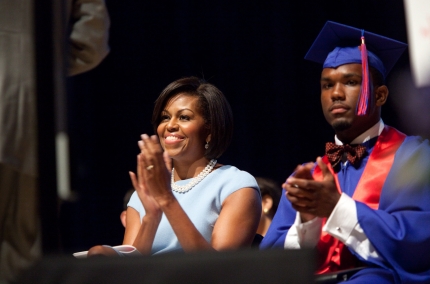
First Lady Michelle Obama sits with class valedictorian Jordan Smiley during the Anacostia Senior High School commencement ceremony at the Daughters of the American Revolution Constitutional Hall in Washington, D.C. June 11, 2010. (Official White House Photo by Samantha Appleton)

First Lady Michelle Obama delivered heartfelt remarks at the Anacostia Senior High School Commencement Ceremony, a school she's visited before with her mentoring activities. Mrs. Obama stressed that no matter what the students are doing next year, they must push themselves, take risks and seize every opportunity.

Her message to family members: offer support. It is only with support from family, teachers and mentors that Mrs. Obama, and the President, are where they are today:

I remember my mom pushing me and my brother to do things she’d never done herself; things she’d been afraid to do herself. What I can remember is my father getting up every day and going to work at the water filtration plant, even after he was diagnosed with MS, even after it got hard for him to button his shirt, and to get up and walk. See, I remember my parents sacrificing for us, pouring everything they had into us, being there for us, encouraging us to reach for a life they never knew.

And it’s because of them and because of the support I got from teachers and mentors that I am standing here today.

And if Barack were here, he’d say the same thing was true for him. He’d tell you it was hard at times growing up without a father. He’d tell you that his family didn’t have a lot of money. He’d tell you he made plenty of mistakes and wasn’t always the best student. But he’d also tell you he turned things around, thanks to his mother, his grandparents, and people who cared about him.

And listen, graduates, the reason that he and I invest so much of our time and energy in young people like you is because we see ourselves in each and every one of you.

We are living proof for you that with the right support, it doesn’t matter what circumstances you were born into, or how much money you have, or what color your skin is, if you’re committed -- if you are committed to doing what it takes, anything is possible. It’s up to you.

In closing, Mrs. Obama set some high expectations for the Class of 2010:

I believe in you. The President of the United States of America believes in you. (Applause.) When times are hard for us, you inspire us. You keep us going. And we are expecting big things from you in the years to come. Big things! We are counting on you to be the very best people that you can be. We’re expecting you to show the same perseverance, the same caring, the same spirit that made it possible for you to be here today.

We’re expecting you to show the same commitment to a better life that has always made this country great. We are expecting you not only to claim your own destiny, but to help others across Anacostia, across D.C., across America claim theirs. And we are confident that what you’ll do is exactly that. We know that you’ll make us proud –- because you already have.

Read the full remarks here.

Related Topics: Education, Mississippi

The White House

Office of the First Lady

Remarks by the First Lady at Anacostia Senior High School Commencement Ceremony

DAR Constitution Hall
Washington, D.C.

10:35 A.M. EDT

MRS. OBAMA:  Thank you, all.  Thank you so much.  And first of all, thank you, Charity.  Charity did a great job on that introduction.  (Applause.)  Love you all, too.  So proud.

I want to thank the Anacostia Senior High School Choir for their amazing performances. (Applause.)  And I also want to thank Brandon, Annie, and of course your valedictorian Jordan for their amazing remarks.  Let’s give them a big hand.  (Applause.)  

I want to acknowledge a couple of other people:  Malik Bazzell, Donald Hense, and all of the community leaders who have joined you all today to celebrate this morning.  Let’s give them a round of applause.  (Applause.) 

I have to tell you that it is a privilege for me to be with you.  I have been looking forward to this day for a long time.  And as you know, this is the second time that I’ve had a chance to come and spend some time with Anacostia High School students. 

AUDIENCE MEMBER:  Thank you!  (Applause.) 

MRS. OBAMA:  During my first visit with you all when I got to come to the school, I came away just impressed and moved by all of you.  That’s why I wanted to be here.  I was impressed by the questions you asked, by your work ethic, by your spirit, your attitude.  I loved hearing about your lives, and your hopes, and your dreams.

I’ve also enjoyed getting to know my girls, the students who are participating in the White House Mentorship Program that we set up this past year.  (Applause.)  So all these opportunities have given me a very meaningful connection to many of the amazing students who are at this school and has given me a real appreciation for this community.  And I just couldn’t wait to be here in person to say congratulations to the Class of 2010!  (Applause.)

I know this has been a long journey to get here, full of warm memories, your friendships and teachers, and maybe not-so-warm memories with rules and papers and tests.  And I know for some of you, there may have been times when you weren’t quite sure you’d make it.

But you are here.  So I want you all to soak it up.  Just soak it up.  You’re here!  You made it to this day.  I want you all graduates to pat yourselves on the back.  Do a little patting.  I want you to be proud of what you’ve accomplished to get here today, because I know your families are proud of you.  Your teachers are proud of you. And I am so proud of you all.  I really am.

And looking out at all of you, I’m reminded that many of you have overcome a lot to be here, much like the community of Anacostia itself.  Founded back in the 1800s for folks who worked at the Navy Yard across the river, Anacostia eventually became a place where people worked hard as clerks and civil servants, and as teachers and tradesmen, where families looked out for one another, where strong churches were the heart and soul of the community.

And yet, we also know that this community has had its share of struggles.  And for a long time, Anacostia was segregated.  In its early years, it was even illegal for African Americans to own land in parts of this community.  And even after those barriers were torn down, others emerged.  Poverty.  Violence.  Inequality.

But, despite these challenges, Anacostia continues to push forward.  And that’s what I admire about this community and what I admire about all of you all.  See, in the face of incredible struggles, you refuse to be defined by the hardships or the adversities.

Instead, what defines you is perseverance.  What defines you is character.  What defines you is the same commitment to education, to hard work, to setting high standards for yourselves that has made this country great.

It’s a commitment reflected in Anacostia alums like Frederick Gregory, who graduated in 1958 from this school, and became the first African American in our history to command a space shuttle.

It’s reflected in the small business owners who’ve opened up furniture stores and theaters in the community, the artists and leaders who have lived in Anacostia throughout the generations, who remain committed to the success of this community.

It’s reflected in a man once called the Sage of Anacostia, lived just a few blocks from this school, in a home called Cedar Hill that I had a chance to take my girls to last summer.  It’s a beautiful home. 

As all of you know, I’m talking about Frederick Douglass.  (Applause.)  We remember him today as one of America’s most eloquent and beloved leaders.  But I want you all to just think for a moment about what it took for Frederick Douglass to become that kind of leader.  Just think about it.  I want you to think about the odds he faced when he was your age.  This is a man who was born into slavery.  His mom died when he was a boy.  He never knew his father.  Because it was illegal to educate slaves, he taught himself how to read and write.

And when he was just a couple of years older than you all are today, he escaped from slavery, traveled all the way to England, and made friends in Britain who eventually bought his freedom.

After he returned to America, Frederick Douglass became a leading abolitionist, an advisor to President Lincoln, and an inspiration to people of every creed and color, fighting for equality not just for African Americans, but for women and others, until his final days.

So I tell you this story because it is one of the best examples in our history of the American spirit.  It’s an example of someone picking themselves up in the face of adversity, persevering through thick and thin, and proving to the world that nothing can stop a person from pursuing their dream.  And that’s the same perseverance, the same character and the spirit that I know we have in so many of you.

I imagine that for some of you all, getting this far hasn’t been easy.  Perhaps there were those who wanted to write you off, maybe because of assumptions they made about you or your school or your community.  But every day you’re proving them wrong.  You're proving that it doesn’t matter what anyone else thinks about you or what you can achieve.  The only thing that matters, rather, is what you think about yourself and what you’re willing to do to achieve your goals.  That's all that matters. (Applause.)  How hard are you willing to work, how big are you willing to dream?

Over this past year, so many of you have shown us exactly what you can do.  I’m told that over 100 of you in this class have college plans this year.  That’s 90 percent of this class.  (Applause.)  And that's up from under 30 last year.  What an achievement.  I’m told that 16 juniors and seniors this year have been awarded Gates Achievers’ Scholarships to college because of their academic excellence.  (Applause.)  

And I understand that student attendance for the entire school is up 20 percent from last year.  (Applause.)  See, now, that’s a tribute to you, to everyone here today.

And yet, despite all you’ve achieved, despite all the obstacles you’ve already overcome with regard to your education, many of you may still be wrestling with your own personal issues and doubts.  Maybe you’re taking care of a younger sibling, or maybe you are responsible for an aging grandparent or a child.  Maybe you’re worried about your family’s financial situation.  Or maybe you’re just feeling crushed by the weight of life’s responsibilities.

Maybe you feel like no one has your back, like you’ve been let down by people so many times that you’ve stopped believing in yourself.  Maybe you feel like your destiny was written the day you were born and you ought to just rein in your hopes and scale back your dreams.

But if any of you are thinking that way, I’m here to tell you, stop it.  Don't do that.  Don’t ever scale back your dreams.  And don’t ever set limits on what you can achieve.  And don’t think for one single moment that your destiny is out of your hands, because no one’s in control of your destiny but you.  And it is never too late.  You can do anything you put your minds to –- and I mean absolutely anything.  It’s important for you all to know this.  (Applause.)  

But what is true is that building a purposeful life for yourself is never easy.  No one achieves success overnight.  You know life doesn’t work that way.  Anything worth having takes time and perseverance.  You’re going to have to push yourselves beyond your limits.  You’re going to have to step outside of those comfort zones.  You’re going to have to ask for help when you need it.

More importantly, part of being a mature and functioning adult in this society is realizing that life is a series of tradeoffs.  If you want a career that pays a good salary, then you have to work hard.  You’ve got to be on time; you’ve got to finish what you start; you have to always keep your word.  If you want a life free from drama, then you can’t hang out with people who thrive on drama.  (Applause.)  You have to pick your friends wisely, pick your friends -- surround yourself with people who share your values and your goals.

But I am confident that if you’re willing to show that kind of commitment and do what it takes, anything is possible for every single one of you.  And you know why I’m so confident?  Because I’m looking at you.  I was watching you all.  (Laughter.)  And I see your strength.  I know what you’re capable of.  I know what kind of young men and women you are, and I want the world to know that.

This class is made up of young women like the remarkable student who introduced me, Charity, whose positive attitude is a model for everyone around her.  She’s beautiful.  (Applause.) 

Charity, she’s an editor of the paper, mentor for 9th graders, and a Gates Achievers’ Scholar, and she’ll be following her own role models –- her sisters –- to college in the fall.

This class is made up of young men like your valedictorian, Jordan Smiley, who grew up -- (applause) -- who grew up surrounded by violence, confronted by daily pressures and daily temptations to fall in with the wrong crowd.

But Jordan was blessed with amazing parents, supportive brothers and sisters.  And because of that will to overcome, he’s been captain of the football team, the track and field team, he’s president of student government.  He’s up here running this graduation.  (Laughter and applause.) 

And today, Jordan becomes the first in his family to go to college -- (applause.) 

And this class is also made up of young men like Rudolph Eastman.  Where’s Rudolph?  (Applause.)  Rudolph, I understand, was raised by a single mother, along with eight brothers and sisters, is that right?  (Applause.)  Whew, where’s Rudolph’s mother?  (Laughter and applause.) 

I understand that Rudolph’s oldest brother was killed in an act of gun violence.  But in the face of tragedy and hardship, Rudolph stayed focused, he worked hard, and today, like Jordan, he becomes the first in his family to go to college.  (Applause.) 

A belief in the importance of education.  Perseverance.  Character.  These are the qualities that Charity, Jordan, Rudolph, and so many of you embody.  And these are the same qualities you’ll need -- and more -- when you leave here and begin the next chapter of your lives.

This is equally true for those of you headed to college as it is for those of you with other plans.

To those of you who are college bound in the fall, I just hope that you make the most of that experience.  Take advantage of every opportunity that comes your way.  Make new friends; get to know your classmates.  Take classes that’ll challenge the way you think about the world.  Build relationships with professors that inspire you.  Don’t sit in your room, get involved in activities that spark your passions and service organizations that touch your hearts.  And the thing that I’ve been telling graduates all over this country is study abroad if you can.  Find a way to travel the world.  Above all, never stop finding new ways to push yourselves.  Never stop finding new ways to learn and to grow.

And the same goes for those of you who aren’t headed to college, because you don’t have to be on a college campus to educate yourself -- (applause) -- or to create new opportunities to grow, or to push yourself to think differently about the world.  There are opportunities all over D.C. for you to enrich your lives and your minds.

But we also know that in this difficult economy, it’s going to be tough to find a job.  That means you’re going to have to be creative with your approach.

So here’s some advice:  Be persistent.  Start with your immediate network of people -- folks like the folks up here.  Reach out to people you admire in your community -- teachers, pastors, business owners.  Talk to them about how they got started in their careers.  Ask them for advice and guidance.  And most of all, stay positive.  Believe in yourselves and in what you have to offer.

And if there aren’t immediate prospects for a paid job, then do what you can to make yourself more competitive and more marketable.  Take a class at a community college.  See what types of training programs are available at a community center.  Explore the option of community service with AmeriCorps.  Even consider an unpaid opportunity that might give you a foot in the door. 

And don’t forget, even if you’re not going to college right now, you can always apply later.  It’s never too late.
    
The point is, no matter what you’re doing next year, you have to be aggressive.  You have to seize every opportunity that’s available to you.  You can’t wait.  You can’t just sit around.  Don’t expect anybody to come and hand you anything; it doesn’t work that way.  (Applause.)  If you want your own destinies and you want to control those destinies tomorrow, you’ve got to start practicing who you want to be today, because if you’re afraid to step beyond your comfort zone today and reach for the things you want today, you’ll always be afraid.  If you’re afraid to speak up and ask for what you need today, you will always be afraid. 

Don’t (inaudible) fear, but if you begin to take control of your destiny today, graduates, if you push yourself today, if you practice taking risks today, that’s what you’ll continue to do for the rest of your lives.

And then once you do that -- once you grab hold of your future and pull yourselves up -- there’s just one more thing you have to do, and that is reach back and pull someone else up after you -- (applause) -- because the truth is none of us can succeed on our own.  We all need help along the way.

Even Frederick Douglass couldn’t succeed on his own.  He needed the help of others to learn how to educate himself.  He needed the help of others to learn how to educate himself.  He needed the help of others to gain his freedom.  He needed support to claim his own destiny.  And, graduates, so do you.

And that support will come from teachers like the ones you have at Anacostia.  It’ll come from friends, but real friends who have your best interests at heart, friends who bring out the best in you, friends who have your back and keep you focused on your dreams.  (Applause.)  And it’s all going to come from your families.  And again, we got to take a moment again to recognize the family members and to remember that many of you are here because of what they have done.  So today, to all the family members, this is your day, too.  So we got to give the family members a round of applause.  (Applause.)  

And if you’re anything like my parents were when I graduated from high school, I can imagine how you must be feeling today.  I know you’re proud.  I know you’re a little relieved.  (Laughter.)

But I suspect that some of you may also be feeling a little nervous.  Maybe you’re worried about the tough job market, and how your child will find a job in this economy.  Maybe you’re anxious about how you’re going to pay tuition.  Maybe you’re hesitant about having your child move away from home to attend college.  Or, if your kids are the first in your family to go to college, you may be wondering how you’re supposed to help them navigate experiences you’ve never had.

I understand those worries, because my parents had similar worries.  See, my parents didn’t have the money to cover college tuition for me and my brother.  Neither of my parents went to college or had any idea how to support us.

But, family members, know this:  You don’t have to have lived the kind of life you want your kids to live to help them excel.  Your kids don’t need you to be a doctor or a lawyer.  Your kids don’t need you to be rich and famous.  What they need from you is your wisdom.  What they need from you is your support.  What they need from you is love, that unconditional love -- (applause) -- the kind of love that lets them know that you will be there for them, no matter what.  That’s all your kids need.  

And trust me, I know, because when I was in their shoes, that’s all I needed.  Growing up, there were plenty of times that I doubted my capabilities, and those doubts were fueled by a lot of people around me.  Kids teasing me when I studied hard.  Teachers telling me not to reach too high because my test scores weren’t good enough.  Folks making it clear with what they said –- or didn’t say -– that success wasn’t meant for a little girl like me from the South Side of Chicago.

But let me tell you something, something else I can remember.  I remember my mom pushing me and my brother to do things she’d never done herself; things she’d been afraid to do herself.  What I can remember is my father getting up every day and going to work at the water filtration plant, even after he was diagnosed with MS, even after it got hard for him to button his shirt, and to get up and walk.  See, I remember my parents sacrificing for us, pouring everything they had into us, being there for us, encouraging us to reach for a life they never knew.

And it’s because of them and because of the support I got from teachers and mentors that I am standing here today.  (Applause.)

And if Barack were here, he’d say the same thing was true for him.  He’d tell you it was hard at times growing up without a father.  He’d tell you that his family didn’t have a lot of money.  He’d tell you he made plenty of mistakes and wasn’t always the best student.  But he’d also tell you he turned things around, thanks to his mother, his grandparents, and people who cared about him.

And listen, graduates, the reason that he and I invest so much of our time and energy in young people like you is because we see ourselves in each and every one of you.  (Applause.)

We are living proof for you that with the right support, it doesn’t matter what circumstances you were born into, or how much money you have, or what color your skin is, if you’re committed -- if you are committed to doing what it takes, anything is possible.  It’s up to you.  (Applause.) 

So, I know the journey you’ve traveled may not have been easy. I know many of you have faced more than your fair share of hardships and adversities.  I know you may be worried about what the future holds.  But you have to understand that there are a lot of people out there who believe in you.

I believe in you.  The President of the United States of America believes in you.  (Applause.)  When times are hard for us, you inspire us.  You keep us going.  And we are expecting big things from you in the years to come.  Big things!  We are counting on you to be the very best people that you can be.  We’re expecting you to show the same perseverance, the same caring, the same spirit that made it possible for you to be here today.  We’re expecting you to show the same commitment to a better life that has always made this country great.

We are expecting you not only to claim your own destiny, but to help others across Anacostia, across D.C., across America claim theirs.  And we are confident that what you’ll do is exactly that.  We know that you’ll make us proud –- because you already have.

Congratulations, Class of 2010, we love you.  (Applause.) 

END
11:02 A.M. EDT

United We Serve: Let’s Read. Let’s Move.

Ed Note: Food banks across the country are facing severe shortages, just as summer leaves more children without school nutrition programs. As part of the second annual Summer Service Initiative, Federal employees are stepping up to meet the challenge. Learn more about Feds Feed Families.

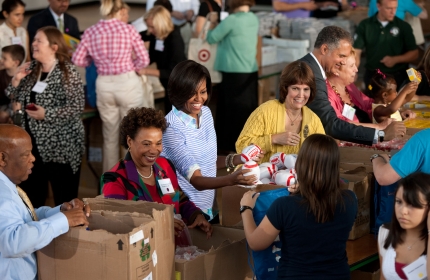
First Lady Michelle Obama helps fill care packages during a Congressional Service

First Lady Michelle Obama helps fill care packages during a Congressional Service event at the Kennedy Recreation Center in Washington, D.C. June 8, 2010. (by Lawrence Jackson)

All across America children are excitedly counting down the days to summer vacation; summer is a time each year when children and families can relax, play, and explore their creative interests together. We are, however, keenly aware that summer is also the time when the healthy habits and knowledge that our children developed during the school year are most likely to stall.

Research shows that many of our young people suffer learning set-backs and develop unhealthy eating habits during the summer break. Children can lose more than two months’ progress in reading achievement over the summer, and inactivity during the summer months can cause children to gain weight three times faster than during the school year.

This summer, the Corporation for National and Community Service is launching the United We Serve: Let’s Read, Let’s Move. initiative to change that – we’re focused on strengthening our kids’ minds and bodies.

The goal of Let’s Read. Let’s Move. is simple, yet transformative. With partners including the Departments of Education, Agriculture, Interior, and Health and Human Services, as well as the Institute of Museum and Library Sciences, we are expanding opportunities to engage young people in summer reading and physical activities, as well as providing access to healthy, affordable food.

Yesterday afternoon, First Lady Michelle Obama kicked off Let’s Read. Let’s Move. during a service event with over a dozen Members of Congress and their families. Watch a video of the First Lady’s call to action and read the remarks.

United We Serve: Let’s Read. Let’s Move. needs your help. Keeping our kids fit for school and fit for life requires us all to work together, and there are plenty of ways to make a difference. We’re already hearing about people across the country cleaning up walking trails and playgrounds, tending to communities gardens, organizing book drives, and reading to young children. I encourage each of you to consider how you could make an enduring difference in your own community.

Visit Serve.gov to find a volunteer activity in your community.

Patrick Corvington is CEO of the Corporation for National and Community Service

The White House

Office of the First Lady

Remarks by the First Lady at Congressional Service Event

Kennedy Recreation Center
Washington, D.C.

1:32 P.M. EDT

MRS. OBAMA:  Hey, everybody.  Forgive me.  I am done with my cold, but it’s still there.  It’s good to see everybody.  First let me thank Patrick for the kind introduction and the work that he’s doing with the corporation.  He is a fabulous addition to the team and he’s hitting the ground running.  And we are just thrilled to have him.  So let’s give him a round of applause.  (Applause.)   

I want to thank all the AmeriCorps volunteers who are here today.  You guys, raise your hands.  You're doing some great work.  (Applause.)  I understand this group has just come back from Louisiana and all along the Mississippi and the Gulf Coast, so they’ve just come back and already they’re hitting this project.  So we are just so appreciative and proud of the work that you all are doing.  Keep it up -- and recruit more people all the time.

And I have to thank our congressional families, all of you here, for bringing your families.  They’re so cute!  Everyone is just looking very spring-like.  And I know you all are busy, and it’s just wonderful that you take the time from juggling all the many responsibilities that you have, to come and do even more for the community. 

Many of you already are leading service initiatives back in your home states and in your districts.  And I think it’s great that you show your passion and commitment again by supporting efforts here in Washington, D.C.  So it’s just really terrific, this day, spending time with you all.   

You all know the difference that a few passionate, committed individuals can make in the life of a family, a school, a neighborhood and a community.  And we all want to encourage folks to make that kind of difference every day all across the country.

That’s why today, I’m proud to officially launch our second annual United We Serve Summer Service Initiative.  This is a nationwide effort calling on Americans to make service a part of their daily lives.  And when we say all, we truly mean all.  That's everybody.  That's grownups; that's you little, bitty people.  That's everyone, from every background, from every corner of every community in this country.  We’re going to be asking individuals and community organizations, corporations, foundations and the  government to come together and devote their time and energy to helping our fellow Americans in need.

United We Serve is going to be led by the Corporation for National and Community Service, and this year’s theme is “Let’s Read.  Let’s Move.”  Right?  “Let’s Read.  Let’s Move.”  (Applause.)  The idea this summer is simple and it sort of piggybacks off of the work that I've been doing with childhood obesity, but we want to do everything we can to help our kids stay active and healthy -– and to keep them learning –- all throughout the summer.

And we always have our work cut out for us in these areas.  As I’ve said many times, it comes to -- when it comes to the health of our children, the statistics are always staggering.  One in three kids in this nation are either overweight or obese.  And a recent study by the Centers for Disease Control found that only 17 percent of high school students reported getting the 60 minutes a day of physical activity that experts recommend that they get  -- only 17 percent.

We also know that during the summer, when our kids take a break from school, too many of them experience what they call summer learning loss.  And I know kids you don't like to hear this, but we think about this all the time -- will you retain anything that you learned during the year?  See, your moms know.  And a lot of kids sometimes find that they forget some of the things that they learned throughout the school years, and as a result, if they stop learning through the summer, they can fall behind and then they’re struggling throughout the year.

This summer, though, through United We Serve, we plan to address these problems head on by getting our kids, number one, to exercise -- to move, right?  And not just to exercise their bodies, but we want you guys to exercise your minds.  That's right.  You’re helping me out.  You know.  I don't know what your name is.  I’m going to find your name.  (Laughter.)  But you know what I’m talking about, right?  Exercising your mind and to improve what you eat, as well.  That's also part of it.

But we’ll need help from folks all across the country to get this done.  We’re going to need people to step up and volunteer to build and renovate playgrounds, and clear walking trails, and create community gardens, and organize book drives, and to take the time to serve as tutors and as mentors and to read to children of all ages. 

Even if you have just a few hours -- I mean, that's the thing -- it doesn’t take a lot of time -- a few hours a week can really make the difference.  You don’t need to be a specialist.  You don't need to be a math tutor.  You don't need to be a physical fitness expert.  You don't even need to really be in shape yourself.  You can use this to get in shape, to get focused.  So you don't have to come to this with special skills, because no matter what you bring to the table or reasons for being involved in the community, what this event I think shows is that we can come together as a nation around some really critical issues that affect our kids.

It doesn’t matter whether we agree every day -- because I know sometimes folks in this room, we don't always agree.  But we all agree that we care about our kids, and we care about their health and we care about what’s going on in their heads.  And this new initiative I think is one way this summer that we can all continue to come together to keep moving our communities and our kids forward. 

And as our dear friend, Senator Kennedy, used to say, all we have to do is ask.  And he was talking about Americans when it comes to service -- all we have to do is ask, and then provide the opportunity, because, as he said, most Americans are already willing to give.  They're willing to be a part.  They just need the opportunity.  So we’re giving folks that opportunity through this initiative.  We are asking.  We are asking in a very big way. 

So I want to thank you all again for the time that you put out for communities in your own home states.  The fact that you’ve taken the time to come here again -- once again, this year before the Congressional Picnic, means a great deal to us.  We are truly grateful for your leadership.  And we’re looking forward to having a fun picnic when this is all said and done.  Right?  It’s going to be good food.  So let’s get to work and then we can have some fun.  (Applause.) 

Thank you all so much for coming out.

END
1:39 P.M. EDT

Chefs Move to Raise a Healthier Generation of Kids

First Lady Michelle Obama addresses hundreds of chefs

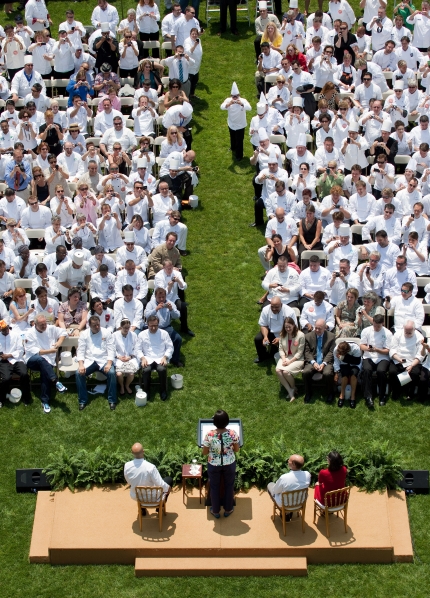
First Lady Michelle Obama addresses hundreds of chefs from around the country during a “Let’s Move!” event on the South Lawn of the White House, June 4, 2010. The First Lady called on chefs to get involved by adopting a school and working with teachers, parents, school nutritionists and administrators to help educate kids about food and nutrition. June 4, 2010. (Official White House Photo by Chuck Kennedy)

What an amazing day! Today, hundreds of chefs from over 37 states gathered on the South Lawn of the White House in support of the "Chefs Move to Schools" program, a part of the First Lady's Let's Move! Campaign to end the epidemic of childhood obesity. I had the pleasure of introducing Mrs. Obama who reinforced what this program is all about in her remarks:

That's why we created the “Chefs Move to Schools” program, to pair chefs like you with interested schools in your local communities. And together, you’ll be helping students learn where food comes from, and develop healthy habits. You’ll be elevating the role of food in our schools, and working to create healthy meals on a budget…

But each of you has so much to offer when it comes to helping our children make healthy choices. You know more about food than almost anyone -- other than the grandmas --and you’ve got the visibility and the enthusiasm to match that knowledge. That's really what’s key. Just watching you guys in action will -- it excites me, let alone my little girls who can’t stay out of the kitchen when Sam is cooking.

You can make a salad bar fun -- now, that’s something -- and delicious. You can teach kids to cook something that tastes good and is good for them; and share your passion for food in a way that’s truly contagious.

Our kids face a serious health challenges, and a major component of that is what they eat. The more the chef community focuses our hours of service on the issues we know best -- and the issues were we are best positioned to help -- the greater the chance that our efforts can have a lasting impact.

Small lessons like helping to teach a child how broccoli or cauliflower grows, or how to make a salad, or demonstrate a basic cooking skill that results in a delicious sweet potato can help put young people on the path of making healthy choices for years to come.

As of this morning, 990 Chefs and 488 Schools have signed up to be part of the Chef's Move to Schools initiative. See all of the participating chefs and schools across the country on this map. And it’s not too late for chefs and schools to sign up – today is just the beginning and so much can grow from this day.

Related Topics: Healthy Kids

The White House

Office of the First Lady

Remarks by the First Lady at "Let's Move!" Chefs Event

South Lawn

12:40 P.M. EDT

MRS. OBAMA:  Thank you, everyone.  Good afternoon.  So is it hot enough?  (Laughter.)  We planned this especially.  Lots of sun, no breeze, got you in your whites and hats.  We’re going to bring you out scarves and mittens and boots soon to make it really comfortable.  (Laughter.)

But I -- we are just thrilled.  I mean, I don't know if you can see yourselves, but I was looking out from the Residence and looking down at you all as you were spread over the South Lawn, and it was just a sight to behold.  I have to say I wasn’t sure when I heard the goal of having nearly a thousand chefs on the South Lawn.  I said, right, Sam, sure, whatever.  (Laughter.)  But you all pulled it off.  And I am just so proud and honored to have you here at the White House.

I want to start by thanking Todd and Norah for sharing their stories, for the work that they’re doing at the Murch School.  It’s just, you know, a wonderful example of the partnership that can be created.  This is our hope for all of you -- to just spread out around the country and replicate what they have done.  And we are just thrilled with the level of broad thinking and creativity that they’ve put into this work.  And we want to see more of it happen.

And I also have to thank my partner in crime, Sam Kass, who has just been such an important part of promoting healthy eating, not just here at the White House, but helping to shape this initiative.  And Sam has worked closely with so many staff members on the East Wing and in our kitchen, but we wouldn’t be here and we wouldn’t have the knowledge and the passion if it weren’t for people like Sam who really understand your world; they understand and appreciate the value of cooking.

This has been a long conversation that Sam and I have had over the years, and I think it’s just pretty powerful to see what started out as a few conversations in our kitchen on the South Side of Chicago turn into a major initiative that hopefully will change the way we think as a country, not just about the health of our kids but about our health as a nation.  (Applause.)

Well, you’re all here for the same reason -- because you appreciate the power that food can have in our lives.  And who would have thought food having power, other than just making us full?  But it’s got a lot of power.  You all know the enormous amount of care and the sense of pride that our farmers put into growing the food that nourishes the world.  You have those relationships.  You’ve seen it in action.

You know the joy of cooking for others, that passion that you get, the sense of camaraderie, the understanding and fulfillment that comes with seeing folks gathering around a dinner table, not just enjoying a meal, but enjoying fellowship.  That is power. 

You know the central role that food plays in the moments that make us happiest.  Food is always there, whether it’s at a birthday party, or Thanksgiving dinner, or quiet moments with friends.  Food is at the core of what makes life wonderful. 

And you all know how the ingredients we put in our bodies can affect the way we feel, the way we think, and how we grow.  This is especially true when we’re talking about our nation’s kids.

And you all know the statistics when it comes to the health of our kids -- and they're staggering, every time we talk about it -- how nearly one-third of children in this country are now overweight or obese.  That's one in three.  Just think about that.  That means that these kids are at greater risk of obesity-related diseases -- you name them, cancer, heart disease, stroke.   

And last year as a nation, we spent nearly $150 billion treating conditions like these.  And if we don’t do something now, that number is just going to continue to increase as we see these children reach adulthood at an unhealthy weight.  But what we do know is that none of us wants this kind of future for our kids.  No one does.  This is not what we had in mind.  And we don't want this kind of future for our countries. 

That’s why, earlier this year, we started “Let’s Move!”  As you know, it’s been a national campaign with a very ambitious goal, which is to solve the problem of childhood obesity in a generation so that kids born today grow up with a totally different approach to eating and their health, and they grow up at a healthy weight with a wonderful appreciation for food and how to use it to tap into their power.

“Let’s Move!” is about making the changes that we need in several key ways.  Number one, we’re working to get more information to parents so that they can make good choices for their kids.  That's something that's always confusing as a mom:  What do you feed your kids?  How do you do it?

We need to do a better job at making sure that our parents know what’s best for their kids. 

We’re working to make sure that families and communities across this country have access to quality affordable foods.  You all know this.  Millions of Americans are living in food deserts.  They don’t have access to the kind of food that they need to live a healthy life.  And we can’t begin to have this conversation about healthier living for our kids if their families don’t have access and can’t afford the foods that they need.  (Applause.)

     And we’re also working on the other end of the spectrum.  There’s food, and there’s movement.  That’s what the “Let’s Move!” piece is about.  We need to make sure that our kids are getting the physical activity that they need to stay healthy.  The recommendation is that kids get 60 minutes of active play every single day.  And when we were growing up, that was just hanging out.  (Laughter.)  Now, it’s to save their lives.

     But even as parents work to help their kids eat right and exercise at home, we also need to make sure that they have access to healthy meals at school.  For many kids, that’s where they’re getting the vast majority of their calendars -- calories. 

     And I know that sometimes there’s a tendency to see money being spent on school nutrition as somehow taking away from what people think are the more important aspects of education like the curriculum or teacher salaries or school supplies.  And with the average school being allotted about $2.68 for each meal they prepare -- $2.68, that’s it -- and of that, only $1.00, $1.25 of that money actually goes to the food itself -- I mean, you can imagine just how creative you have to be to make food interesting in the schools.

But the truth is that the food that our kids eat does have a direct effect on how they learn.  That’s just the truth.  So this isn’t a luxury.  This isn’t a set-aside.  This isn’t a sidebar.  One recent study showed that kids who ate breakfast were more attentive.  They had faster response times than kids who don’t.  That’s learning. 

And with more than 31 million children participating in the national school lunch and breakfast programs, good nutrition at school is more important than ever. 

A major key to giving our children a healthy future will be to pass a strong child nutrition bill.  (Applause.)  And right now, the reauthorization bill is moving its way through Congress, and fortunately it has bipartisan support.  Yay!  (Applause.)  

     The Senate Agriculture Committee’s action on the bill this spring marks historic progress on this bill, and it’s vitally important that the Senate continues this effort and passes a bill in the coming weeks. 

A majority of Senators and House Members from both parties have publicly called for swift passage of a robust proposal, and I urge Congress to provide the resources that we need to support these important programs.  (Applause.)  

It’s important that we keep the momentum going and we pass this bill this year.  So we need all of your help.  Everyone out there needs to focus on this.  This is doable.  It’s right there.  But we’ve got to make it happen.   

But if there’s one thing that we know for sure -- and that is that the solution to childhood obesity is not going to come from Washington alone.  There is not one single expert that we’ve talked to that said that the solution to this problem is for government to tell people what to do.  That just doesn’t work.

Instead, as we’ve said all this time, it’s going to take all of us -- it’s going to take all of us -- parents and teachers, community leaders, food manufacturers, all of us doing our part to give our children the healthy future they deserve. 

And it’s going to take all of you, our nation’s chefs.  That’s why I am so moved to see you all here.  You all are at the heart of this initiative, because if anyone understands nutrition and food, it’s the folks sitting here in their whites today.  I know what they’re called -- “whites.”  (Laughter.)  We tease Sam.  We call them “blouses” just to make him mad.  (Laughter.)

     But each of you has so much to offer when it comes to helping our children make healthy choices.  You know more about food than almost anyone -- other than the grandmas --and you’ve got the visibility and the enthusiasm to match that knowledge.  That's really what’s key.  Just watching you guys in action will -- it excites me, let alone my little girls who can’t stay out of the kitchen when Sam is cooking.
 
You can make a salad bar fun -- now, that’s something -- and delicious.  You can teach kids to cook something that tastes good and is good for them; and share your passion for food in a way that’s truly contagious.

Let me tell you something.  My mother didn’t know how to cook broccoli.  It was watery and mushy, and that's what we thought broccoli was.  We thought you could eat it with a spoon and cut it with a knife.  (Laughter.)  And I know a lot of parents out there cooking broccoli like that.  It makes it hard to like broccoli if that’s how you’re cooking it.

But you guys can help change that.  That's why we created the “Chefs Move to Schools” program, to pair chefs like you with interested schools in your local communities.  And together, you’ll be helping students learn where food comes from, and develop healthy habits.  You’ll be elevating the role of food in our schools, and working to create healthy meals on a budget. 

Now, just like you wouldn’t be thrilled if someone came in your restaurant and told you what to do, we’re not asking you guys to go into school kitchens and take over.  And that's an important point to make.

Our school food service professionals who are out there, they have dedicated their careers to helping our children grow up healthy and happy.  They work long hours and they stretch budgets to the limit, often with no recognition at all.  And their advice has been so invaluable as we’ve tried to identify areas where schools can improve and become more efficient.  So they deserve our respect and our admiration, and I want to take the time now to thank them for their service and for their -- (applause) -- for their hard work. 

That’s why we’re asking you, when you go into the schools, to work closely with our food service professionals to support the work that they do every day, in and out, long hours.  They’re looking forward to getting
some extra help -- they need it -- doing everything from teaching basic cooking skills in the cafeteria to encouraging healthy choices in the lunch line.  So they're going to need your support, but it’s got to be a collaboration.  And we strongly encourage you all to go in with that spirit.

Now I know that none of this is going to be easy.  Nothing we do is.  I think the very nature of living in this house means that the Easy Button has been taken away forever.  (Laughter.)  And it won’t happen overnight.  That's for sure.  You’re going to need to figure out what you’re up against.  You’re going to need to take time to learn your communities, to understand your schools, to figure out how the school kitchen operates, to finding out what equipment is available -- because there are equipment limitations that have been an issue at some many schools -- and what kind of changes the school and the community can actually sustain.  So it’s going -- there’s going to be a learning curve.  So you’ve got to be patient and help people become patient with you.

But making our schools healthier isn’t just about what happens in the kitchen.  As Norah said, it’s also about what kids learn in the classroom.  And that’s why we’re also encouraging you to do things like put on cooking demonstrations; teach kids how to prepare meals at home.  You can help start a cooking club, work with the teacher to integrate food into the lesson plan, like they’ve done at Murch, or help students plant a garden, if possible.  All that stuff is a part of it.  It’s not just about the work in the kitchen.

And with your help, our hope is that we’ll be able to double the number of schools in the Healthier US School Challenge.  This is an innovative program that recognizes schools that are providing healthy foods and opportunities for kids to stay active.  So there are just so many ways to get involved.  And I know that many of you are already ahead of the game because you’re doing that right now.  You’re here because you’re already doing it. 

There are folks like Chef Toni Robertson, who, for the last three years, has helped students from the Mott Hall School in New York plant a vegetable garden and learn healthy eating habits -– even throwing salad parties for parents.  That's a good thing.

There’s also Chef Seth Bixby Daugherty from Minnesota who has worked with -- yes, let’s give him a hand --(applause) -- who has worked with several schools across the country to design easy, healthy recipes that taste good and can be made with the equipment that schools already have.

Or there’s someone like Fernando Olea from Santa Fe, who teaches popular cooking classes for local students -- yay, Fernando -- (applause) -- showing them how to prepare healthy meals from his native Mexico.

In the end, it’s all about helping kids build healthy habits that are going to last a lifetime.

And many of you guys know about the White House Kitchen Garden.  We’re going to go down there and harvest with our kids in a few minutes.  But I still remember last year when we started the whole process, and we involved kids from local schools from the very beginning.  They helped us till the soil.  They helped us plant.  They helped us weed.  They helped us harvest.  They ate.  It was pretty powerful. 

And several of the schools asked the kids to reflect in writing on their experience.  And this is what helped us to know that we were onto something here.  One of the students described herself as “a pretty regular fifth-grader who loves sweets.”  And afterwards, she wrote that her time in the garden -- and this is a quote -- “has made me think about the choices I have with what I put in my mouth.”   Hey -- winner!  (Applause.)

Another child wrote that “It has inspired us to eat better and work harder.”

And one young man wrote, and this is a direct quote, “I think about the garden project as a model for being gentle:  gentle with nature, gentle to your body, and gentle with each other.  Now we need to remember and follow that model.”  Isn’t that beautiful?  (Applause.) 

So ultimately, this is what we’re trying to do.  And as you know, kids are so hungry.  They will take it all in.  They can change their habits, their taste buds, their approaches overnight.  All they need is your encouragement, your enthusiasm, your passion, and your patience.  And if we do this together -- and I know you guys are ready because you wouldn’t be sitting out here in those hats in the hot sun if you weren’t -- (laughter) -- we can change the future for our children and for this nation. 

We are so grateful to you, so proud of the work that you’ve done, and we’re asking you to do more to recruit others.  There are about a thousand of you here.  We can triple that number.  And that’s also part of your goal.  We want you to reach out, find those who are less hesitant, who are a little afraid of kids, who are not sure about schools, and help bring them in.  We’ve got to make these numbers grow because we want you all in every school in the nation.  We want every school in the nation to have a chef partner, a set of kids who call you theirs, who believe that you care about nothing more than how they grow up and how they feel.  The more grownups who are working on behalf of our kids, the stronger they’ll be.

So let’s move, let’s get this done.  Thank you all for the work you’ve done.  (Applause.)  And I look forward to seeing you all in the months to come.  Thanks so much.  (Applause.) 

END
1:01 P.M. EDT