Let's Move Outside! at Red Rock Canyon

First Lady Michelle Obama launches at Red Rock Canyon with Senator Harry Reid

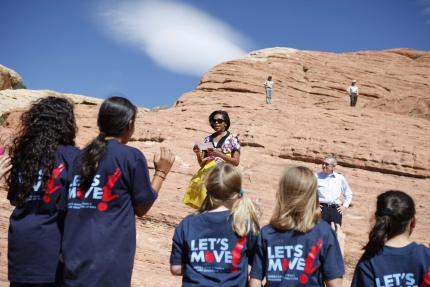
First Lady Michelle Obama launches her "Let's Move Outside" component of her "Let's Move" initiative at Red Rock Canyon with Senator Harry Reid in Las Vegas, Nevada. June 1, 2010. (Official White House Photo by Samantha Appleton)

Yesterday, I was fortunate to join First Lady Michelle Obama, Representative Dina Titus and Senator Harry Reid at the launch of Let’s Move Outside! in the spectacular Red Rock Canyon National Conservation Area of Southern Nevada. The Canyon is just a short drive from the bustle of the Las Vegas Strip; this 197,000 acre property takes you to another time and with its solitude, wide open vistas and soaring red sandstone cliffs. Red Rock Canyon is one of only sixteen National Landscape Conservation Areas in the country, managed by the Bureau of Land Management.

This amazing backdrop was the perfect setting for the First Lady's to announce a new component of her Let’s Move! campaign -- Let's Move Outside! As the first lady said in her remarks:

Our overall goal for “Let’s Move Outside” is to really get our kids active so that they make it a habit of moving around and seeing the activity they need not as a chore but as a fun way to explore our country and to do some things they haven’t done.

Doctors, teachers, and other professionals  agree that outdoor activity is one of the easiest and most fun ways to get – and stay – fit. And boy, did we have fun!

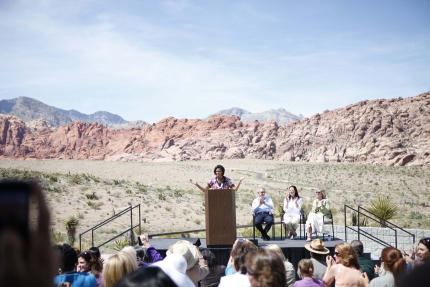
First Lady Michelle Obama launches "Let's Move Outside" at Red Rock Canyon

First Lady Michelle Obama launches her "Let's Move Outside" component of her "Let's Move" initiative at Red Rock Canyon with Senator Harry Reid in Las Vegas, Nevada. June 1, 2010. (Official White House Photo by Samantha Appleton)

Twenty energetic kids from nearby elementary schools joined us for the afternoon’s activities. The First Lady and Senator Reid led the group in a series of geology stretches. Then, we all hiked over to a sandstone slope, where we watched some able rangers guide kids on a “rock scramble.” Even though it was a steep climb, the pay-off at the top was terrific — a panoramic view of the canyon as far as the eye could see. Finally, children were sworn in by First Lady Michelle Obama as official Let’s Move Outside! Junior Rangers, capping off an afternoon of adventure, exercise, and good cheer.

There are no better places for America’s children to get moving than in the parks, trails, and waters in all of our communities. Whether you are walking, hiking, swimming, horseback riding, or mountain biking --America’s public lands have a wide range of affordable activities and adventures for every family. These lands are America’s backyard—they are owned by everyone in this country and provide opportunities to get outside in every state, county, and city in the country.

The Department of Interior and the U.S. Forest Service will be hosting Let’s Move Outside! events across the country during the summer months. We will engage partners across the public and private sectors to expand access to these places and connect American families to our great big collective backyard. Check out the Let's Move! website to find opportunities to get outside and have fun today!

Rhea Suh is Department of the Interior Assistant Secretary for Policy, Management & Budget

Related Topics: Healthy Kids, Nevada

The White House

Office of the First Lady

Remarks by the First Lady at "Let's Move Outside" event with Senator Harry Reid

Red Rock Canyon
Las Vegas, Nevada

2:45 P.M. PDT
 
MRS. OBAMA:  Thank you.  Thank you so much.  (Applause.)  Woohoo!  (Laughter and applause.)  Oh, my goodness, I am just delighted to be here.  This is beautiful.  And you notice, kids, how quiet it can be outside?  We’re outside!  I live in the city.  It is never this quiet outside. 
 
It is beautiful.  This is just a perfect place for the launch of this new initiative. 
 
But let me begin by thanking -- doing my thank you:  First, to Senator Reid, not just for his kind introduction but all of the wonderful work he’s done to move this country forward.  He’s just been a tremendous asset, not just to my husband, but to the country and to all of you kids.  You know, everybody hears about what the President does, but Presidents can’t do anything if they don't have a good team.  And Senator Reid is a member of that good team.  So we’re just grateful to have him onboard. (Applause.)
 
And I have to thank Representative Titus for her tireless advocacy for the people of Nevada in Congress.  She’s a member of the team and is doing a terrific job.
 
Assistant Secretary Suh, for everything that she’s doing along, with the folks in her agency to really preserve and protect places like this -- Red Rock Canyon here in Nevada and all across the country.
 
I also want to thank Nevada State -- Nevada State Controller Kim Wallin and State Senate Majority Leader Steven Horsford as well for their leadership.  (Applause.)  Where are they?  Where are you?  There you are.  (Applause.)  Thank you all.  Thank you for being here.  Thank you for your support and your work.
 
And I want to particularly acknowledge the young people in the back -- (applause) -- because we’re really here for you guys today.  All of this is for you, just like all these parks are for you today.  We’re here for you.  And we’re going to be doing a little fun stuff together in a little bit -- a little hiking, a little something.  I’ve got cold, so you have to bear with me today.  And I hear we’re going to learn a little something about how to do a “rock scramble.”  I don't know what that is.  Sounds scary.  (Laughter.)  But I’m looking forward to it.
 
And then all of them are going to be sworn in as official “Let’s Move Outside” Junior Rangers, which I think is pretty exciting.  (Applause.)  So you guys in the back hold the great honor of being the first to launch this program all across the country!  (Applause.)  Yes!  (Applause.)
 
We are here because of you.  We want every child in this country to have opportunities like this -- to get outdoors and to get fit and to lead active lives right from the beginning.  And you guys are lucky to have access to places like these -- and not every kid does. 
 
Experts, as others have said, recommend that kids get 60 minutes of physical activity every day to stay healthy.  That's 60 minutes, an hour, every day. 
 
And while today that may seem like a lot, if adults here can just think back to when we were growing up, back then an hour of just vigorous activity was nothing, because we didn’t call it “activity.”  It wasn’t required.  We called it “play.”  (Laughter.)  We had recess, we had gym class at school, and when we got home in the afternoons, our parents didn’t want to be bothered with us so they kicked us outside.  In fact, they told us not to come back inside.  (Laughter.)  So we could run around for another hour before dinner.  They were really just trying to make us sleepy.  (Laughter.)  But all of that was really good for us. 
 
But today, at a time of a lot of belt-tightening and budget cuts, unfortunately it’s gym class and recess and after-school sports that often are the first things to go.  And too many of our kids end up spending way too much time inside in front of the TV, playing video games.  Can I get -- do you hear from the parents?  It’s too much!  It’s too much.
 
In fact, a study just released by the Centers for Disease Control found that -- and this is amazing -- only 17 percent of high school students reported meeting the recommended hour-a-day requirement.  That's only 17 percent of high school students in our country today.
 
So it shouldn’t come as a surprise to us that today nearly one third of our children in this country are overweight or obese.  You know, we’re just not giving them the chance.  And that's one in three.  And that's a lot.  That's way too many.  It’s more than what it was when all of us were growing up.  Things just weren’t like that.  That means that these kids are at greater risk for obesity-related conditions like heart disease and diabetes and cancer.  I mean, this is the fate that we’re handing over to our kids. 
 
And it’s not just a health crisis, as Senator Reid said.  It’s an economic crisis.  We are spending nearly $150 billion a year to treat obesity-related illnesses.  And if we don't act now, if these kids now grow up to be adults, then that number is just going to continue to go up. 
 
And none of us wants that kind of future for our kids.  We don't.  And we definitely don't want that kind of future for our country. 
 
So instead of just talking about the problem, which we -- a lot of -- we can do a lot of talking, and worrying and wringing our hands, we really need to get moving.  And that's why about a year or so ago -- I’m losing track of time because we’ve been doing this -- but we launched “Let’s Move,” which is the big nationwide campaign with the single goal of ending childhood obesity in a generation so that kids born today would grow up at a healthy weight.  It sounds so simple, but this goal has to be generational and it has to be big. 
 
And we’ve spent the last year or so working on a number of different fronts.  We need to get more information to parents so that they can make the right choices for their kids.  They have to have the information. They have to have access to affordable healthy foods.  We have to work on that.  We have to work closely with our schools to make sure that there are healthy choices in the classroom, because many of our kids are getting most of their calories at school, which is why we need to get the Child Nutrition Reauthorization bill passed, because that piece of legislation is going to go a long way to changing and improving the quality of foods in our -- that our kids are getting at school.
 
But more importantly and something that we focused on a lot, now that it’s summer time, is that we need to substantially increase the amount of physical activity that our kids are getting not just in school but outside of school, as well, and that's why I am very excited about the launch of this program, “Let’s Move Outside.”  Very clever, right?  “Let’s Move Outside” -- I love it.  (Laughter.)
 
And it’s a collaborative effort with the Bureau of Land Management, with National Park Service, Forest Service, Fish and Wildlife Service, and others.  And as you’ve heard, we just want to encourage kids to use the resources that are available to them.  I mean, that's part of the point of this, is that activity doesn’t have to cost a thing. 
 
We have access in this country to some of the greatest parks and recreation facilities in the country, and it’s all free.  And as Rhea said, it’s all yours, guys.  This stuff belongs to you.  And my family and I, we’ve tried to go every summer to some of the parks.  We went to Yellowstone, we went to Asheville, we did some hiking, and I think -- I’m hoping, if they treat us right, they’ll let us go somewhere else this summer.  (Laughter.)  But you never know.  (Laughter.)
 
And it’s really a lot of fun.  And it’s not just a great way to get exercise.  It’s also a phenomenal way to come together as a family and spend some time together without spending a whole lot of money.
 
So in addition to this part of this program, we’re upgrading the Junior Ranger Program, because there’s always been Junior Rangers.  I’ve met several of them all over the country, but we’re upgrading it to encourage more of our kids to be more physically active.  Our wildlife refuges and conservation areas, our national parks and forests, and historic sites -- these are ours, and we have to make use of them.  And our agencies have just been phenomenal, rallying around to make this possible. 
 
I want to thank everyone, particularly our not-so-junior rangers who have played a really important part.  And my kids have had direct experience with the grown-up rangers.  They are knowledgeable.  Many of them are doing this as their second or third career.  Their stories are phenomenal in so many ways.  These are people who love this country.  They love these parks.  They want to make sure that our kids learn and they pass on these traditions.  And we’re grateful for all of you, because we couldn’t do this on the ground without your enthusiasm and your knowledge.  So I want us to give our not-so-junior rangers a hand, as well.  (Applause.)
 
But in the end, our overall goal for “Let’s Move Outside” is to really get our kids active so that they make it a habit of moving around and seeing the activity they need not as a chore but as a fun way to explore our country and to do some things they haven’t done. 
 
So with that, I'll stop talking, because this program is called “Let’s Move,” right?  (Laughter.)  So we need to get moving.  All right?  You guys ready?  You ready to scramble up a rock?  All right!  Thank you, guys.  Thanks so much.  (Applause.)
 
END
2:55 P.M. PDT

2010 Women’s Summit

First Lady Michelle Obama greets the crowd after making remarks at the Women's Summit

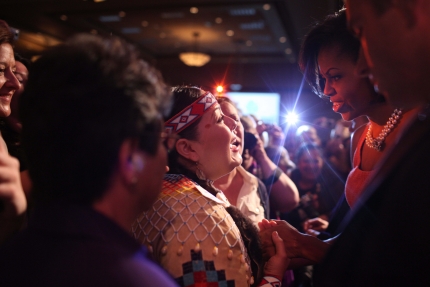
First Lady Michelle Obama greets the crowd after making remarks at the Women's Summit with Senator Harry Reid in Reno, Nevada. June 1, 2010. (Official White House Photo by Samantha Appleton)

Today First Lady Michelle Obama traveled to Reno, Nevada where she delivered the keynote address to the 2010 Women’s Summit. The Summit, hosted by Senator Harry Reid, brought together a diverse group of women from across the country to talk about the issues that impact their lives as women and as Americans.

In her remarks, Mrs. Obama used the example of health care to illustrate women’s unique and increasingly significant role when it comes to keeping families healthy:

Eight in 10 mothers report that they’re the ones responsible for choosing their children’s doctors, taking them to the appointments, managing follow-up care. And many women are making the same decisions for their spouses. And more than 10 percent of women in this country are currently taking care of a sick or elderly relative, often a parent, and making critical health care decisions for them as well.

But women aren’t just disproportionately affected because of the role we play in our family, we’re also affected because the jobs we do are more likely to be part-time or in small businesses, jobs that are -- less likely provide health insurance. Women are more likely to be denied coverage because of so called preexisting conditions like having a C-section or a previous pregnancy. In some cases, insurance plans don’t cover basis women’s health services like maternity care or preventative care for mammograms and Pap smears. And a recent study showed that 25-year-old women are charged up to 84 percent more than 25-year-old men for the same coverage. And at age 40, it’s 40 percent more -- for the exact same coverage.

Now, we know this is unacceptable. It is unacceptable for women. It’s unacceptable for families. And it is unacceptable for our country.

And that's part of the reason why so many people fought so hard to pass health reform this year. Under the new law, starting this year, insurance companies will never again be allowed to deny children coverage because of preexisting conditions.

The White House

Office of the First Lady

Remarks by the First Lady at Women's Summit with Senator Harry Reid

Reno Ballroom, Reno, Nevada

11:47 A.M. PDT

MRS. OBAMA:  Thank you.  Thank you all so much.  Thank you.  That’s so sweet of you all -- please.  Thank you so much.

First, let me begin by apologizing because I have a cold that I caught from this wonderful husband of mine.  (Laughter.)  So forgive my voice and my dryness and all that good stuff.  And when I come around to shake hands, there will be somebody following with Purell.  (Laughter.)  Because you all have a lot of work to do and we can’t afford for any of you to be sick.  (Laughter.)

But I am so thrilled to be here with all of you today.  It is an honor to be a part of this summit and to be with so many wonderful women who are doing such amazing things here in Nevada and across the country.  So I am thrilled -- and it’s really pretty nice here, too.  (Laughter.)

I want to start by thanking a few people.  First of all, Attorney General Frankie Sue Del Papa -- (applause) -- as well as State Treasurer Kate Marshall.  (Applause.)  And your Speaker of the Assembly Barbara Buckley.  (Applause.)  I want to thank them for their service, for their dedication to the people of this state.  (Applause.)  They are terrific.  I got a chance to see them in the back.

And of course I have to thank one of my favorite people in the world -- Senator Reid.  (Applause.)  That was such a kind introduction and so generous, and all I can say is the same thing to him -- the same thing.  Over the years, he has been a tireless advocate on behalf of women -- from helping pass health care reform, to supporting legislation to help prevent domestic violence, to helping women get equal pay for equal work.  (Applause.)  This state is -- and this country -- is lucky to have Harry Reid and Landra working on our behalf in Washington.  And I want to thank him for everything -- both of them -- for their friendship, for their hard work, for their kindness.  And let’s give him one more round of applause.  (Applause.)

So I have to tell you, as much as I love living in Washington, it is always nice to get out of town every once in a while.  (Laughter.)  Especially when that means spending time with so many terrific women.

This summit is about bringing a diverse group of women together from different cities and different towns, different generations and backgrounds and walks of life, to talk about the issues that impact our lives as women and as Americans.  And I think it’s especially fitting that we’re here in Nevada, a state that has always been home to so many strong, pioneering women.

As you all know, this state started out as a pretty forbidding place to live.  It was part of the vast, unexplored West -- a land of sweeping deserts and dense wilderness and mountains so high that they’ll just take your breath away.

The nearest town was sometimes hundreds of miles away, but those who were brave enough to venture out here often had to struggle just to survive.  Many of these women worked as prospectors and teachers and nurses and entrepreneurs.  They ran cattle ranches and they worked long days in the mines and they started their own businesses, braving coyotes and rattlesnakes along the way.  (Laughter.)

They were fiercely independent -- many of them with a wonderful stubborn streak a mile wide, and a strong sense of their place in the world.  In fact, due to their tireless activism and leadership, these women here in Nevada gained themselves the right to vote in 1914 -- a full six years before the 19th Amendment was passed.  And that’s pretty incredible.  (Applause.)

So today, all of you are really heirs to that legacy of those tough, trailblazing, visionary women leaders, because you know the same thing that they knew:  that in the end, the success of our communities, of our country, depends on the success of our women.

Now, obviously the challenges that we face today are a little different from the ones Nevadans faced 150 years ago.  And I’m pretty sure none of you had to deal with an angry rattlesnake on your way here.  (Laughter.)  But the -- maybe you did.  (Laughter.)  But the problems are no less daunting today and no less important for the success of our nation.  You know that.  They’re issues that touch the lives of every single American.

And health care is a perfect example.  Today, as you all know, women play a unique and increasingly significant role when it comes to keeping our families healthy.

Eight in 10 mothers report that they’re the ones responsible for choosing their children’s doctors, taking them to the appointments, managing follow-up care.  And many women are making the same decisions for their spouses.  And more than 10 percent of women in this country are currently taking care of a sick or elderly relative, often a parent, and making critical health care decisions for them as well.

But women aren’t just disproportionately affected because of the role we play in our family, we’re also affected because the jobs we do are more likely to be part-time or in small businesses, jobs that are -- less likely provide health insurance.  Women are more likely to be denied coverage because of so called preexisting conditions like having a C-section or a previous pregnancy.  In some cases, insurance plans don’t cover basis women’s health services like maternity care or preventative care for mammograms and Pap smears.  And a recent study showed that 25-year-old women are charged up to 84 percent more than 25-year-old men for the same coverage.  And at age 40, it’s 40 percent more -- for the exact same coverage.

Now, we know this is unacceptable.  It is unacceptable for women.  It’s unacceptable for families.  And it is unacceptable for our country.  (Applause.)

And that's part of the reason why so many people fought so hard to pass health reform this year.  Under the new law, starting this year, insurance companies will never again be allowed to deny children coverage because of preexisting conditions.  (Applause.)

And in the coming years, no one with a preexisting condition will be banned from coverage.  (Applause.)  Insurance companies won’t be able to drop your coverage when you get sick, deny you the care you need because you’ve reached your annual or lifetime limit, or charge you more because you’re a woman.

And soon, if you don't have insurance or are looking for a more affordable option, you’ll be able to compare prices and purchase coverage through an insurance exchange, which is the same way members of Congress will get their insurance.  (Applause.)

So we’ve done some great things, but as much progress as we’ve made, health care is really only one of the issues affecting women in this country, which brings us to a second challenge that we face, and that's securing an equal place in today’s economy.

Right now women make up nearly half of our workforce, and mothers are the primary or co-breadwinners in nearly two-thirds of American families.  The majority of our students in our colleges are female.  So we play an increasingly important role in setting the family’s budget, keeping food on the table.  And across the country, women are breaking barriers in every field -- from science and business, to politics and the armed forces.  So there’s no question that we have come a long way.  But the fact remains that women still earn 77 cents for every dollar men earn.

And only 3 percent of Fortune 500 CEOs are female.  And inequality, as many of you know, still exists in small and very stubborn ways in the lives of too many women.  That’s why the first bill that my husband signed into law after taking office was the Lilly Ledbetter Fair Pay Act.  (Applause.)

As he put it, he said, here in America, “There are no second-class citizens in our workplaces,” and there is no reason why women shouldn’t get equal pay for equal work.

But as you all know, the success of women in the workplace isn’t just about a paycheck.  It’s also about being able to juggle the needs of our families with the demands of our jobs.  You all know that constant struggle to meet our responsibilities both as employees and breadwinners and as mothers and daughters and wives and everything else we do.

And as the mother of two beautiful girls -- and they're not little any more, they’re getting big.  Malia is here, so don't be shocked.  It’s still her.  (Laughter.)  This is an issue that is particularly close to my heart as I know it is for so many of you.  Now, as I’ve said before, in our current life in the White House, we are incredibly blessed.  We have more resources and support than I could have ever imagined that I would have, including a grandmother who lives upstairs.  And let me tell you that is priceless.  (Applause.)

But the truth is, we didn’t always live in the White House.  And for many years, before coming to Washington, I was a working mom, doing my best to juggle soccer and ballet with meetings and conference calls.  And when I was at work, I was feeling like I was shortchanging my kids.  And when I was with my girls, I worried that I was falling behind at work.  And there was just a lot of stress and a lot of guilt.  And I was one of the lucky ones.  I had understanding bosses and accommodating jobs.

In fact, I remember being on maternity leave with Sasha.  She was about four months old, and I was still trying to figure out my next career move.  And I got a call to do an interview for a senior position at the University of Chicago hospitals.  So I frantically called every babysitter I knew and none of them were available.  So guess what I did.  (Laughter.)  I packed her up -- still nursing -- put her in the stroller, and I took her with me.  And I prayed that she wouldn’t need to do anything -- (laughter) -- while we were there, and that would automatically disqualify me.  But, fortunately, she slept through the entire interview.  And it was fortunate, because the man I was interviewing with, he and his wife had just had a baby.  So he knew what I was going through, and I ended up getting the job.    
But I know most folks are nowhere near as lucky as I was, especially in this economy.  So many people struggle every day to find affordable childcare or to take time off to care for a child or an aging parent.  Often they have to scramble to figure out that backup plan when the usual arrangements fall through.  And that is the most destabilizing thing that can happen in the course of your day. 

Our military families have it even tougher than most, with women serving in uniform themselves or struggling to provide a stable home while facing long deployments and loved ones who are stationed in harm’s way.  To me, this reflects a larger problem -- that for too long, policies that help people balance work and family responsibilities have been viewed as niceties for women rather than as a necessity that can benefit all of us, men and women.
There is still this perception out there that employees who want more flexible schedules, so that they can pick up a child after school or take care of an elderly parent, are somehow less committed, and that businesses who accommodate them are destined to be less profitable.  But we all know that that’s simply not true.  We know that these kinds of policies that support family balance can actually make employees more productive, because they allow them to focus on work rather than worrying about what’s going on at home.

And that’s one of the reasons why my husband has proposed helping states that want to set up paid leave funds, and recognized companies that are adopting innovative polices that focus on work output rather than hours and face time.  And that’s why we’re working to make the federal government a model for the kind of change that we’re talking about -- things like expanding telework options and providing emergency childcare and affordable day care.
That’s why we’ve worked to expand the Family and Medical Leave Act to have it go to more of our military families.  And that’s also why Jill Biden and I are encouraging everyone in this country, including employers, to do everything in their power to support our men and women in uniform and their loved ones.  (Applause.)

But in the end, whether we’re talking about health care or the economy or caring for our families, we need to remember that while these issues may affect women in particular, they aren’t just women’s issues.  When insurance companies deny coverage to women for preexisting conditions or refuse to cover treatment, it can devastate an entire family.  When women make less than men for the same work, that hurts families who find themselves with less income and have to work harder just to get by.  And when employers don’t allow employees the flexibility to care for their family, that hurts children, it hurts grandparents, it hurts husbands, and it puts a strain on an entire household.

But the good news is that thanks to so many extraordinary women who came before us, we’ve really come a long way.  We know that all of us are here today because of all those generations who put in that time, who packed up their things, and staked their claims in places here, and who cracked and shattered those glass ceilings so that we could have opportunities that they never dreamed of.

And we know that it will be up to all of you -- the leaders, the activists, the visionaries, the organizers, the everyday women, to carry that work forward, because what we’re working towards -- all of us -- is to ensure that our daughters and our granddaughters can dream just a little bigger and reach just a little higher than we did.  That’s really why I’m here.  (Applause.)

So what I can promise is that if you keep the discussion going, and if all of you keep fighting and organizing and standing up for the causes that we all share, then I know that together -- together -- we will keep moving forward, not just as women, but as Americans.

So I really, truly, can’t express to you how grateful we are for your leadership.  We look to you for that energy, so don’t ever stop.  Keep it up.  And thank you.  Thank you for all your support and your hard work.
Thank you so much.  (Applause.)

END
12:05 P.M. PDT
 

"Our Next Chapter"


Download Video: mp4 (260MB) | mp3 (26MB)

Yesterday Mrs. Obama took the White House youth leadership and mentoring efforts on the road to Detroit, Michigan. The First Lady’s visit, in partnership with Michigan’s First Gentleman Daniel Mulhern, was designed to engage, encourage, and inspire the city’s young people. Leaders from across the country came along to encourage kids to dream big – mentors included: Governor Granholm; Cathie Black, CEO of Hearst Magazines; Susan Taylor, Editor-in-Chief Emeritus, Essence Magazine and Founder, National CARES Mentoring Movement; Spike Lee, Actor and Director; and Magic Johnson, Basketball Player, to name a few.

In her remarks at Wayne State University, Mrs. Obama discussed the potential of the city's youth:

So our next chapter –- Detroit’s next chapter, Michigan’s next chapter, America’s next chapter –- is waiting to be written.

And it will be written by each and every one of you, because your future, your city’s future, this country’s future will look exactly like what each of you wants it to look like. And that’s what I believe. And that’s why I am here. Young people, I am asking you to embrace that responsibility to be our future.

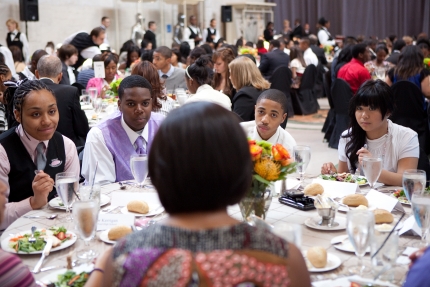
Students listen to First Lady Michelle Obama during a mentoring luncheon in Detroit, Mich.

Students listen to First Lady Michelle Obama during a mentoring luncheon at the Detroit Institute of Art in Detroit, Mich. May 26, 2010. (Official White House Photo by Samantha Appleton)

Later that day, at a mentoring luncheon, the First Lady emphasized the importance of hardwork and support:

What we all know in our lives and through our experiences is that there’s no magic dust that is sprinkled on us that gives us success. There’s no magic to this. There are no shortcuts, there are no quick fixes. None of us was born with the knowledge that we have today, the skills or the talents that we have today. Some, maybe. You’ve got your special people that were just born crazy talented or crazy smart, but it wasn’t me, or the President, for that matter. All these folks here developed those things through hard work.

Governor Granholm wasn’t born knowing how to run a state; probably never thought she’d be doing it. Magic Johnson didn’t know how to always -- did you always know how to dribble? (Laughter.) Maybe you did. Maybe you were one of the ones. But you didn’t always know how to run your own business, right? So, Susan Taylor’s magazine didn’t just publish itself -- Essence, one of my favorites. These achievements took effort and struggle, late nights and long hours. And all these folks practiced and practiced, and then practiced a little more, to get those promotions, to win those elections, and to hit those notes just right.

When people doubted them, or told them they couldn’t do something, they worked a little harder. When they were scared or worried -- and let me tell you, we all have been worried that we just wouldn’t measure up -- they all found a way to keep going. When they fell short or failed -- and failure is a part of success, it’s a necessary part of success -- they didn’t let that defeat them. They let it teach them.

And all along, they found people in their lives to guide them: parents, and grandparents, teachers, coaches, friends who believed in them, who encouraged them and refused to give up on them even when they wanted to give up on themselves.

To have a more concrete impact on local students, the First Lady launched the White House leadership and mentoring initiative in the fall and visited Denver, Colorado in an effort to take the message nationwide. The idea isn’t just to create a once-in-a-lifetime opportunity for just a few, but to encourage more adults to step up, volunteer their time, and make mentoring a lifelong habit.

Related Topics: Service, Women, Colorado, Michigan

The First Lady Announces Social Innovation Fund Matching Grants

May 27, 2010 | 25:25 | Public Domain

First Lady Michelle Obama highlights the initial round of commitments from philanthropists to match the Social Innovation Fund and make other investments in innovative community solutions.

Download mp4 (243MB) | mp3 (23MB)

The First Lady on Leadership & Mentoring in Detroit

May 26, 2010 | 22:40 | Public Domain

The First Lady takes the White House youth leadership and mentoring effort on the road to Detroit, Michigan.

Download mp4 (260MB) | mp3 (26MB)

Stepping up to Support the Social Innovation Fund and Other Community Solutions

Download Video: mp4 (243MB) | mp3 (23MB)

As we continue to tackle our nation’s great challenges, we know that many of the best, most lasting solutions are already being developed in communities across the country.  Local answers to our national challenges originate everywhere.
 
The best solutions are often driven by everyday Americans who are having an impact but need capital to improve their results, grow, and replicate their solutions so that they can serve more communities.  Solutions like, for example, the Latin American Youth Center (LAYC).  LAYC has grown from a small grassroots recreation center to a nationally recognized organization serving low-income youth and families across the District of Columbia and in Maryland.   Every day LAYC works with vulnerable young people and their families to improve academic achievement and build stronger, healthier lives.    We know that government must partner with philanthropists and the private sector to support – not supplant – solutions like LAYC and others that are being developed in communities across the nation. 

One year ago, at the Time 100 Awards, the First Lady announced the creation of a new $50 million Social Innovation Fund (SIF), which is part of the President’s commitment to invest in results-oriented solutions around the country.  On June 30th, 2009, at an event at the White House, the President also called on our nation's foundations to partner with the Administration to invest in solutions that have the potential to grow and address the needs of more communities across the country.

Today, we highlighted the initial round of commitments from philanthropists to match the Social Innovation Fund and make other investments in innovative community solutions.  In addition, an independent coalition of more than 20 of the nation’s leading national and regional funders have created the “Scaling What Works” initiative, a complementary set of investments led by Grantmakers for Effective Organizations (GEO) to extend the reach and impact of the Social Innovation Fund and similar efforts to help high-impact nonprofits succeed. The Council on Foundations also released a letter signed by more than 130 heads of community foundations from across the country that signaled their support for the Social Innovation Fund and the Administration’s agenda to investment in community solutions.
   
Today’s event shows how the government is doing business differently: finding solutions outside of Washington, DC; investing in innovations that can have a big impact and have the potential to grow; and partnering with the private, philanthropic and nonprofit sectors to address the toughest problems we face. 

These efforts are just the beginning of how we seek to turn community solutions into national solutions.

First Lady at Social Innovation Event

First Lady Michelle Obama and Corporation for National and Community Service CEO Patrick Corvington announce the initial phase of philanthropic commitments to match Social Innovation Fund (SIF) grants at an event in the South Court Auditorium of the White House, May 27, 2010. (Official White House Photo by Samantha Appleton)

Melody Barnes is Assistant to the President and Director of the Domestic Policy Council


The White House

Office of the First Lady

Remarks by the First Lady at Detroit Mentoring Luncheon

Detroit Institute of Art, Detroit, Michigan

12:54 P.M. EDT

MRS. OBAMA:  It’s good to see you.  You all please sit down.   So, how does it feel?  Pretty good, huh?  Are you hungry, you anxious?  Well, don't be.  We’re excited to be here.

First of all, I want to thank the First Gentleman of Michigan, Dan Mulhern, who is my friend.  I want us to give him another round of applause, because he and the governor -- (applause) -- they’ve been doing such a fantastic job promoting mentoring all around the state.

But it is a pleasure for me to be here with you all today to bring together some of the most extraordinary men and women in our country with some of the most promising young people in this city so that you all could really get a chance to talk, and learn from each other, and hopefully inspire one other.

As you see, because everyone was introduced, we’ve got just some amazing people who have flown here just to be with you.  Many have had to come from all over the place to be here, not just me.  We’ve got a Cabinet Secretary, we’ve got a governor, a mayor.  We’ve got CEOs here, we’ve got members of Congress, we have one of the great filmmakers of our time.  We’ve got an NBA legend and entrepreneur, and we have the head of the United States Secret Service presidential detail.  And just so you know how important this man is to me, he protects my husband.  He makes sure that everywhere he goes -- (applause) -- the Secret Service to us are like family, and we love them dearly, and we’re just honored to have one of them among us today. 

All of these folks have broken barriers in some way or another.  They’ve transformed lives, and they’ve changed the way that we look at the world.  And they’re all here today for one simple reason -- and that's to share the lessons that they’ve learned from their remarkable lives and experiences with all of you young people, all of whom have your own hopes and dreams and ambitions, all your own.  We hope that you do.  We hope that you’re dreaming really big. 

They’re here because -- we’re all here because we believe in you.  It is as simple as that.  We are believing in you so deeply.  We believe that you all have something really special to offer, and because we all see a little bit of ourselves in you.  That's why I do this, because when I look at you, I see me.  I was the same kid you all were.  I won’t give you numbers or ages or anything, but it was a little while ago.

The important thing to know is that these folks weren’t always the leaders that you see today.  They weren’t born this way.  They didn’t always have fame, and accomplishments, or fancy titles to their name.  Many of them come from pretty humble backgrounds, and they’ve never imagined that they’d be where they are today.  And again, many of them started out just like you, and it’s important to know that.

What we all know in our lives and through our experiences is that there’s no magic dust that is sprinkled on us that gives us success.  There’s no magic to this.  There are no shortcuts, there are no quick fixes.  None of us was born with the knowledge that we have today, the skills or the talents that we have today.  Some, maybe.  You’ve got your special people that were just born crazy talented or crazy smart, but it wasn’t me, or the President, for that matter.  All these folks here developed those things through hard work.

Governor Granholm wasn’t born knowing how to run a state; probably never thought she’d be doing it.  Magic Johnson didn’t know how to always -- did you always know how to dribble?  (Laughter.)  Maybe you did.  Maybe you were one of the ones.  But you didn’t always know how to run your own business, right?  So, Susan Taylor’s magazine didn’t just publish itself -- Essence, one of my favorites.  These achievements took effort and struggle, late nights and long hours.  And all these folks practiced and practiced, and then practiced a little more, to get those promotions, to win those elections, and to hit those notes just right.

When people doubted them, or told them they couldn’t do something, they worked a little harder.  When they were scared or worried -- and let me tell you, we all have been worried that we just wouldn’t measure up -- they all found a way to keep going.  When they fell short or failed -- and failure is a part of success, it’s a necessary part of success -- they didn’t let that defeat them.  They let it teach them.

And all along, they found people in their lives to guide them:  parents, and grandparents, teachers, coaches, friends who believed in them, who encouraged them and refused to give up on them even when they wanted to give up on themselves.

Cathie Black, who is the CEO of Hearst Magazine, she told us she had a boss who looked after her every step of the way and gave her the good advice that helped her career take off.  And then Mayor Bing, your mayor, had a basketball coach, we understand, who was like a second father to him, encouraging him to play even when everyone else said he was too small.  You were serious about that, Mayor Bing.  Have you seen your mayor?  There’s nothing too small about him.  And there’s Spike Lee who had a film professor in college who pushed his students as hard as he could, insisting that they shoot their films in just three days and then edit them in two, and he was the one that encouraged Spike to make his first movie.

Unfortunately, too many young people today don’t have that kind of support.  They’ve got big dreams and the talent and the drive to fulfill those dreams, but they’ve never been given the chance.  They never find someone to guide their path.  And the more opportunities they miss out on early in their lives, the harder it becomes to catch up later.

And as First Lady, one of the things I am determined to do -- I’m determined to do everything in my power to try to bridge that gap.  And I have to tell you, I am incredibly impressed with the work that's going on right here in Michigan through the Mentor Michigan program that your governor and First Gentleman have worked so hard to promote.  By promoting and supporting mentoring organizations and creating partnerships with businesses, schools, non-profits and government, this initiative has more than doubled the number of mentors in Michigan in just five years.  That's astounding.

That’s a trend that I’d like to see all across this country.  And that’s why I’ve reached out to young people in our new hometown in D.C.  One of the initiatives I’ve worked on since I’ve been First Lady that I’m most proud of is that we've created a White House Leadership and Mentoring initiative, matching up White House staffers with young people in Washington, where they get to come to the White House and do special events and following me around on some of my trips in D.C.  And I’m working to host mentoring events just like the one we’re doing here today, just like the big rally we did at Wayne State.  We want to see this going on around the country where folks like all of you can come together, and share a meal and share your stories.

The idea here is just to -- isn’t just to create a once-in-a-lifetime opportunity for just a few of you who get to be here.  But it’s -- the big goal is to encourage more caring adults to step up, and volunteer their time, and to make mentoring a lifelong habit.

And it’s to encourage the mentees, all of you all -- and this is important for me, this is what I’m asking back from you -- is to take the initiative in seeking out mentors in your own lives.  It doesn’t always happen automatically, because the truth is, you can’t hang out with famous folks like these every day, right?  This lunch doesn’t happen every day.  It may not happen again in your lifetime.  But you don’t need it to.  Every day of your lives, you’re surrounded by potential mentors.  And the best mentors in my life weren’t anybody famous.  They were folks that I knew:  teachers, parents, neighbors, coaches, you name it.  They’re all around.  And you have to be willing to reach out to them, and be brave enough to step up to somebody and say, you know what, can I come and see you in your office, can I call you, can I e-mail you?

I know I had to do that.  I had to find, snatch my mentors up, and you all need to do the same thing.  So I want you to remember, don’t be afraid to ask for help.  Don't think that there’s someone too important or too out of reach to ask for help, because there are so many of us adults, no matter what our titles are, whether we’re living in the White House or living next door, who want to help.  And that's something that I didn’t really know when I was growing up.  I was lucky enough to have parents who cared about me, but I was never strong enough to step up to somebody big and say, can I just sit down and meet with you?

So I want you all to practice that today at your tables.  Your challenge is to speak up, all right; to talk about yourselves proudly.  The toughest thing for you to do -- and one of the things I tell my mentees at the White House is that if you can walk into the State Room of the White House and look the First Lady in the eye and say, hello, my name is X and this is who I am, then you can do anything, because nothing will be more scary than that, right?

So practice it.  And the more you practice it, the more you’ll get comfortable with it.  And it’s that first impression that makes a difference.  If you can talk about yourself with confidence, you’re going to turn that light off in somebody’s head, and they’re going to say, whoa, I want to know more about that young person.
    
And the last thing I want to ask you all to do is to take this experience and use it to bring somebody else along.  You know, in every phase of my life, whether I was in high school or Princeton or Harvard or working for the city or working at the hospital, I was always looking for somebody to mentor.  I was looking for a way to reach out into my neighborhood and my community and pull somebody else along with me, because I thought, there but for the grace of God go I.  I know I could be in a different situation from somebody else.  So my job is to bring other people along. 

That's your job, too.  It’s not enough that you’re lucky, right?  You all are mentors today.  You’ve got a cousin, a niece, a neighbor, a nephew.  You’ve got somebody in your lives that are watching you today.  So start practicing being a mentor, because the one thing it’ll do is it’ll make you act better if you’ve got somebody looking at you, right?

So that's my ask for you today.  I want you all to speak up.  I want you to make sure you’re talking about yourselves today at your tables, asking questions.  Don’t be shy.  And when you leave here, take this experience with you and find your mentors and find the person that you’re going to mentor.  Can you all promise me that?

And other than that, just have fun.  Breathe.  Everyone, breathe, okay.  Is there breathing going on?  All the mentors, is there breathing at your tables?  Okay, let’s shake it off, and we’re ready to have some fun, have some conversation. 

All right, you all, thank you for being here.  And I am so proud of you all.  Thanks so much.  (Applause.)

END
1:06 P.M. EDT

The Social Innovation Fund: Driving Solutions and Rewarding Results

Every day, in communities across America, promising non-profit organizations direct heroic efforts to implement innovative, effective solutions to our nation’s most daunting social challenges. Tackling a wide variety of issues, from poverty to failing schools, non-profits are at the forefront of what I call the “solutions business.”  The impact of their good work is only hampered by a lack of resources and insufficient capacity to gauge their programs’ impact, improve on them, and grow them to serve more people in more communities.

What if non-profit funding could be better focused on the best solutions?  And what if we could share what works more broadly, so leaders in any community could tackle these challenges with ideas and approaches that have demonstrated success?  The benefits would be enormous. 

A new program called the Social Innovation Fund (SIF) will do just that.  Run by the Corporation for National and Community Service, this fund represents an extraordinary opportunity to drive results-oriented responses to critical social challenges, stimulate innovation in the non-profit sector, and support community-led approaches.

The SIF will drive the best solutions and reward results. Instead of providing resources directly to non-profits, the SIF channels funding through foundations and other grantmakers who will competitively select, fund, and support promising non-profit organizations working in low-income communities over a period of years. Through evaluation and knowledge-sharing, the SIF has the potential to transform how our nation tackles social challenges. 

It’s an approach that has clear benefits. 

  • The Best Ideas.  The SIF provides investments to multiple non-profits in an issue area or a geographic area, allowing the best innovations to rise to the top. 
  • Capacity Building.  It provides non-profits with critical support for management, staffing, data collection, fundraising and other challenges that they will need to overcome as they grow.
  • Accountability.  The SIF provides funding and incentives for non-profits to evaluate their effectiveness.  Grantmakers will be true partners in these evaluation efforts and will be jointly held accountable for results.  This focus on evaluation is a critical part of expanding non-profit capabilities.
  • Matching Funds.  The SIF leverages private funding from grantmakers and others.  Each federal dollar will be matched with private funding, enhancing the government’s investment to result in greater impact.. 

First Lady Michelle Obama said: "By focusing on high-impact, results-oriented non-profits, we will ensure that government dollars are spent in a way that is effective, accountable and worthy of public trust.” 

Tomorrow at the White House, the First Lady, Melody Barnes, and I will join over 100 philanthropists, foundations, and innovators for an exciting announcement about progress on the SIF.  We hope you’ll watch it live here at 11:45 AM EDT.

Patrick Corvington is the CEO of the Corporation for National and Community Service