Announcing "Chefs Move to Schools"

Since the groundbreaking of the White House Kitchen Garden more than a year ago, local students have spent time on the South Lawn of the White House planting seeds, harvesting vegetables and learning about health and nutrition along the way. Through the garden, the First Lady started a discussion on the role food plays in living a healthy life. The discussion grew into the Let’s Move! campaign and like the garden – we just keep on growing.

Today, I’m excited to announce the “Chefs Move to Schools” program – an opportunity for chefs around the country to adopt a local school to help solve the childhood obesity epidemic within a generation. In the words of the Mrs. Obama:

We are going to need everyone’s time and talent to solve the childhood obesity epidemic and our Nation’s chefs have tremendous power as leaders on this issue because of their deep knowledge of food and nutrition and their standing in the community. I want to thank them for joining the Let’s Move! Campaign.

“Chefs Move to Schools” will pair chefs with schools in their communities to bring fun to fruits and vegetables, and teach kids about food, nutrition and cooking in an engaging way. And by working with school food service employees, administrators and teachers -- chefs can help deliver these messages from the cafeteria to the classroom. After hearing fifth graders cheer for broccoli, I know firsthand that chefs can have a huge impact on kid’s health and well being.

Chefs and schools that are interested in participating can sign up here or through www.LetsMove.gov.

Sam Kass is the White House Assistant Chef and the Food Initiative Coordinator

Related Topics: Healthy Kids

The White House

Office of the First Lady

First Lady Michelle Obama Launches "Chefs Move to Schools" Program

THE WHITE HOUSE – As communities and organizations get behind the First Lady’s Let’s Move! campaign to solve the childhood obesity epidemic within a generation, one group that could have a tremendous impact on the health and well being of children is the Nation’s chefs. As part of her effort to turn policies into practical solutions for America’s families, Mrs. Obama is calling on chefs to get involved by adopting a school and working with teachers, parents, school nutritionists and administrators to help educate kids about food and nutrition.  By creating healthy dishes that taste good, chefs have a unique ability to deliver these messages in a fun and appealing way to the larger audience, particularly children.

The “Chefs Move to Schools” program, run through the U.S. Department of Agriculture, will pair chefs with interested schools in their communities so together they can create healthy meals that meet the schools’ dietary guidelines and budgets, while teaching young people about nutrition and making balanced and healthy choices.  With more than 31 million children participating in the National School Lunch Program and more than 11 million participating in the National School Breakfast Program, good nutrition at school is more important than ever. 

“Many children consume as many as half of their daily calories at school and as families work to ensure that kids eat right and have active play at home, we also need to ensure our kids have access to healthy meals in their schools,” said First Lady Michelle Obama. “We are going to need everyone’s time and talent to solve the childhood obesity epidemic and our Nation’s chefs have tremendous power as leaders on this issue because of their deep knowledge of food and nutrition and their standing in the community.  I want to thank them for joining the Let’s Move! campaign.”

“Chefs and nutrition experts can play a critical role in addressing the childhood obesity crisis, and they are welcome partners as we work together to improve the overall health and nutrition of America’s children,” said Agriculture Secretary Tom Vilsack. “By passing a strong reauthorization of the Child Nutrition Act, Congress can provide important resources to improve school cafeteria equipment and expand training opportunities for chefs, school food service personnel, and nutrition experts in our schools, because they will be on the front lines of improving school meals for our kids.”

“School cafeterias are the frontline for fostering a healthy lifestyle for children,” said Secretary of Education Arne Duncan. “This initiative is a creative and vital opportunity for children to learn and practice healthy habits. When partnerships between schools and the broader community are created, everyone wins.”

Chefs interested in signing up can do so by going to www.letsmove.gov and clicking on the “Chefs Move to Schools” button. In coming weeks, chefs will be paired with a school in their community that is interested in using them as a resource.

"The Future That Our Military Families Deserve"

Earlier today, First Lady Michelle Obama spoke at a summit hosted by the National Military Family Association and called it the country's "moral obligation" to recognize the state of military families today. She commended families for their resilience and dedication to service and called for the “vision of a nation that truly supports our military families.”

The First Lady discussed hardships that military spouses endure, including struggling to access benefits and assistance and mental health counseling for the stress of separation. She called for the nation to support and engage military families not only during their time of military service, but at every stage of their lives.

And although I think it would pain most Americans to hear this, we have to be honest.  Too many of our military families still think a lot of Americans don’t fully appreciate what they’re going through, how they sacrifice for us.  As one military mom appealed to me in a letter, she said, “Please don’t let Americans forget or ignore what we live with.”  She said, “We are at war.”

And finally, we know that the needs of our military families are only going to grow.  Our forces and their families face more deployments.  That means more veterans needing care, especially those with post-traumatic stress and traumatic brain injury.  It means more caregivers needing support.  It means more survivors who can never be forgotten.

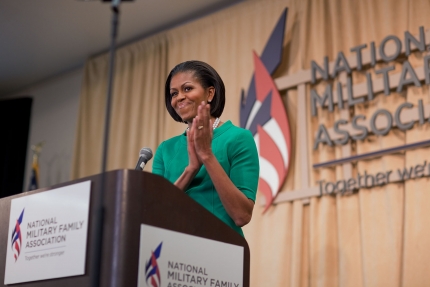
First Lady Speaks to National Military Family Association

First Lady Michelle Obama delivers remarks to the National Military Family Association Military Child Summit at Georgetown University in Washington, D.C. May 12, 2010. (Official White House Photo by Chuck Kennedy)

The First Lady explained that the Administration has made military families an important priority by increasing benefits and funds for military housing, childcare, counseling and career development, and also expanding health care for veterans and support for caretakers.  She praised the Department of Defense for launching the Military Family Life Project, a study of over 100,000 spouses and service members to assess their quality of life for a better understanding of how families are affected by deployments. She also talked about the Department of Agriculture’s 4-H program, which forged partnerships with the armed services to help military children when their parents are deployed.

The First Lady announced that the President has directed the national security staff to lead a government-wide review to identify new priorities and partnerships to support military families. She explained that the initiative will lay the foundation for a coordinated government approach to supporting and engaging military families.

And it won’t be easy.  It’s going to take many years.  It’s going to require a great deal of patience, as you all know.  But if Americans respond to this challenge; if we mobilize every segment of society; if we work together; if we hold ourselves to the same high standard of excellence that our military families live by every day, then I know we can succeed.  I know we can realize our vision of an America that truly supports and engages our military families not just now, but for decades to come.  

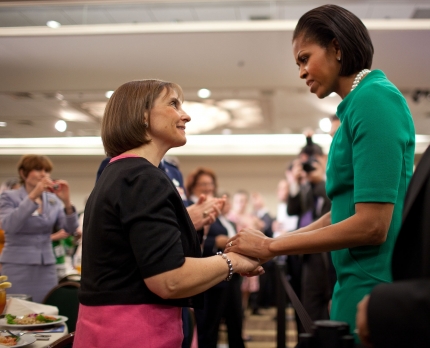
First Lady at National Military Family Association Summit

First Lady Michelle Obama talks with National Military Family Association Board Chair Mary Scott after speaking at the National Military Family Association Military Child Summit at Georgetown University in Washington, D.C., May 12, 2010. (Official White House Photo by Chuck Kennedy)


Related Topics: Veterans

The White House

Office of the First Lady

Remarks by the First Lady at National Military Family Association Summit

Georgetown University Conference Center, Washington, D.C.

12:36 P.M. EDT

MRS. OBAMA:  Thank you.  Thank you, everyone.  Thank you all so much.  (Applause.) Please, thank you.  You know I get embarrassed by too much clapping.  (Laughter.) 

Thank you.  I am thrilled to be here.  And I want to start by thanking Mary for that very kind introduction and for her life of service, more than 30 years as an Army spouse, proud mother to six children -- you would never know -- (laughter) -- and all six of whom serve in the Armed Services, and now, your leadership as chair of the National Military Family Association.  We are just grateful for your work.  And thank you and your entire family for your outstanding service to this country.  Let’s give Mary a round of applause.  (Applause.)

And to everyone here at NMFA -- that's a tongue twister for me; isn't it for you? -- (laughter) -- thank you so much for bringing us all together for this very important summit.  And I hear things have been going really well. 

I want us to give a big round of applause to the person who I understand put this all together, Executive Director Joyce Raezer.  And I know she’s out there.  Where is Joyce?  There you are.  (Applause.)  Thank you.  Thank you for everything.  (Applause.)

As Mary said, as First Lady I’ve had the extraordinary opportunity to help shine a spotlight on the amazing service of our military families -- all of your families. 

And I’m so grateful to be joined in this effort by a truly wonderful partner in this work.  She’s a Blue Star mom and a champion of our National Guard and Reserve families, my friend, Dr. Jill Biden.

As many of you heard, Jill couldn’t be here because her son Beau was admitted to the hospital yesterday, but he is expected to make a full recovery, and our thoughts and prayers are with the entire Biden family.

So together, Jill and I have tried to help make sure that the voices of military families -- your voices -- make sure that they are heard here in Washington, to help make sure that your priorities are America’s priorities. 

And I say that we’ve tried “to help” because, of course, this is really what all of you do every single day. So, I’d like to thank you all, all the organizations joining us today from across the country -- military families representing military families, spouses and leaders in your own right, including Deborah Mullen who is here and to whom Jill and I are so grateful for her thoughtful advice and friendship along the way, as well as all of the spouses of the Joint Chiefs and senior enlisted advisors.  Let’s give Deborah a round of applause.  (Applause.)  I know she’s very embarrassed about that, but -- (applause.)

I'd also like to thank our partners inside and outside of government who have joined us here, including researchers whose pioneering work is guiding this summit.  And I look forward to seeing your Blueprint for Action, which can help guide our national efforts as we work to serve our military families even better.

As organizations, as individuals, each of you has made a profound difference in the lives of so many families.  But we’re here today because we know that, like the NMFA says, “Together we’re stronger.”  Together we’re stronger.

So I couldn’t think of a better time and place to come together and discuss a subject that we all know needs to assume its rightful place in America’s agenda -- and that is the state of our military families -- where we are today; where we’re going -- our vision of a nation that truly supports our military families, not just now, but over the long term; and finally, how, as a country, we can turn our vision into reality.

The first part of our task is to recognize the state of our military families today. 

And I want every American to understand what you all see every day.  We know that our military families are some of the most patriotic, some of the most dedicated, the most service-oriented Americans you will ever meet.  They are spouses who somehow manage to do it all -- like the woman from Michigan who wrote to me saying -- she said, “I wear many hats -- career woman, mother of three daughters, and a soldier’s wife.”  She described the everyday challenges of holding the family together during her husband’s deployment.  But she added, “I am proud of my husband and so very proud to be a soldier’s wife.”

They are families that, even as they serve the nation, they still find time to serve their own communities -- like the Gordons, who I met during the Toys for Tots drive at the Marine base at Quantico.  They spent so much time collecting toys for other children that they had to bring their family’s Christmas tree into the collection center so they could actually enjoy it.  (Laughter.)

But we also know that after more than eight years of war, with just 1 percent of our population -- our troops --doing 100 percent of the fighting, that these strong families are being tested like never before. 

They are resilient, so they don’t always show it.  And they are proud, so they don’t always talk about it.  So a lot of Americans don’t always see it.  But these are the hard realities that you know.

These families have served through multiple deployments, year after year -- like the inspiring mother and daughter that I just got to meet, you heard from this morning:  Christian and Emryse Geye, whose husband and father, Martin, is now in Iraq on his fourth tour of duty, his fourth deployment.

For these deployed parents, they miss out on the birthdays and the anniversaries and special moments that every family treasures -- like the father who I recently met during my visit to Walter Reed.  It was there, laying in his bed, recovering from his wounds, that he finally held his newborn son for the first time.

And we can never forget our incredible military kids -- little children who’ve spent most of their lives with a parent deployed, and older siblings who shoulder more responsibility than even most adults can imagine. 

They’re kids like Brittany Wallace, Operation Homefront’s 2009 Military Child of the Year, who I got to meet last year.  When her father was wounded, her mother had to leave home to help him recover.  Brittany went from being a teenager to a mom for her siblings.  She explained, in her own words, she said, “My priorities changed.  My family came first.”

So I want to commend the NMFA and RAND for your pioneering research, which has highlighted the resilience of our military children, but also how today’s war can be so very hard for them, and how it doesn’t get easier with each deployment -- it actually gets harder.  And I want to thank you for using this summit to develop actions we can take as a nation to support these amazing children.

And our military families -- they’re caregivers, pulling their own lives together and putting them on hold, working every day, around the clock, to care for our wounded warriors. 

They are families who live every day knowing that a loved one is in harm’s way -- like the mother who wrote to me saying, “A good day is when a chaplain doesn’t knock on my door.” 

They are the family and the friends of the fallen who the President and I met in Arlington as they spent a few moments among those marble headstones, remembering the honor and honoring their loved ones.  

We know that over these past eight years, we’ve seen an outpouring of support for our troops and their families.  Congress and government have responded with new programs and funding.  Our military is more family-friendly than ever before.  Organizations like yours have been a godsend to so many families.  The American people have volunteered their time, they’ve contributed money, sent care packages, they’ve lined up at airports to welcome our troops home. 

Entire towns and cities have come to a standstill as Americans have paid their respects as flag-draped caskets carry our fallen heroes to their final resting place.

And yet we all know something else -- that even with all this generosity and goodwill, many families are still not receiving all the support that they need.  And that’s another hard reality.  And it’s the reason that we’re here today -- because too many families still struggle to access the benefits and the assistance that they need. 

We know that too many spouses still aren’t receiving the support to deal with the stress of separation, and that includes mental health counseling.  And we want to thank Deborah Mullen for bringing this issue to the nation’s attention. 

Too many spouses still find it hard to pursue their own education and their own careers.  Too many military kids are still struggling, with a higher risk of anxiety and depression.  Too many veterans will find it hard to translate their military experience into jobs in the private sector or civilian service to their communities. 

And although I think it would pain most Americans to hear this, we have to be honest.  Too many of our military families still think a lot of Americans don’t fully appreciate what they’re going through, how they sacrifice for us.  As one military mom appealed to me in a letter, she said, “Please don’t let Americans forget or ignore what we live with.”  She said, “We are at war.”

And finally, we know that the needs of our military families are only going to grow.  Our forces and their families face more deployments.  That means more veterans needing care, especially those with post-traumatic stress and traumatic brain injury.  It means more caregivers needing support.  It means more survivors who can never be forgotten. 

As America asks more of these families, they have a right to expect more of us.  This is our moral obligation. 

It’s also a matter of national security.  The readiness of our armed forces depends on the readiness of our military families.

So that’s the second part of our task -- ensuring that, as a nation, we have the capacity to support and engage our military families at every stage of their lives, over the long term.  That requires going forward, together, with a shared vision of the future that our military families deserve. 

Here today, we know what that future can look like.  I know all of you do.  We see an America where every soldier, sailor, airman, Marine and Coast Guardsman -- and woman -- can deploy knowing that their family will be taken care of.  So instead of worrying about benefits and bureaucracy, our troops can focus on their mission, which is protecting our country.

We see an America where every spouse has the support he or she needs, including a clear understanding of the programs that are available and how to access them.

We see an America where every military child is recognized as someone who serves too, in their own way; and where they receive the support they need to pursue their dreams.

We see an America where our troops and veterans and their spouses are recognized for what they are -- and that is skilled and talented leaders who have so much to offer our country, not only during their military service, but throughout their lives.

And we see an America where more Americans not only understand the service and sacrifices of our troops and their families, but where more Americans take action to help lighten that load.

This is the future that our military families deserve. 

So the question is:  How do we get there?  And that’s the final part of our task -- turning that vision into reality. 

Now, there was a time, like in World War II, when the whole nation went to war.  Everyone contributed in some way, even on the home front -- planting Victory Gardens and buying War Bonds. 

But the truth is, with the amazing capabilities of our all-volunteer force and the nature of today’s wars, most Americans haven’t really had to sacrifice in the current conflicts. 

Well, that may be a luxury of our time, but it’s no excuse not to be engaged.  And we’re fortunate to have organizations like all of yours, and the infrastructure in government -— especially the Department of Defense and the Veterans Affairs -— leading our efforts on behalf of our troops and our families. 

But that’s no excuse not to fulfill the responsibility that each of us have as citizens.   So today I’m issuing a national challenge -— a challenge to every sector of American society to mobilize and take action to support and engage our military families.  We need a truly national commitment here.

One percent of Americans may be fighting our wars, but we need 100 percent of Americans to support them and their families.  This has to be all hands on deck.  This is a challenge to government. 

 As President, my husband and his administration have made military families a priority.  They’ve increased pay and benefits and increased funds for military housing and childcare and counseling and career development for spouses.  And the budget for next year would continue to strengthen military family support programs.  They’ve extended the Family and Medical Leave Act to more military families and caregivers.  And last week, my husband signed into law legislation that many of you fought for -- expanding veterans’ health care and giving unprecedented support to caretakers.

At the Department of Defense, which is responsible for so many of our military family programs, Secretary Gates’ and Admiral Mullen’s leadership has resulted in a great deal of progress. 

But as they will tell you, there’s still much more we need to know to serve these families better.  So I want to commend the department for launching the Military Family Life Project.  This is going to be a landmark study of more than 100,000 spouses and servicemembers to assess their quality of life and to better understand how families experience deployments. 

It’s starting this month, so I want to encourage all the spouses who were selected to fully participate in this project, because the more that this nation knows about your priorities, the more we can do to meet them.  

This is also a challenge across the federal government, where there are so many programs and policies and potential partnerships that could benefit military families. 

For instance, at the Department of Agriculture, the 4-H program, which can be found in every county in America -- from cities to rural communities -- has forged partnerships with the armed services to help military kids when their parents are deployed. 

And today, I’m proud to announce that my husband has directed a new effort to bring together the resources of the federal government for this mission.  The President has directed the national security staff to lead a government-wide review that will identify new priorities across the federal government, including new partnerships, to support military families.  And it’s going to urge every department to make supporting these families a very high priority.  And it will begin to lay the foundation for a more coordinated government approach to supporting and engaging military families for years to come.

But this is also a challenge to state and local governments, whose services touch military families in so many ways.  For example, as you know, the Interstate Compact that makes it easier for military children to transfer to new schools and keep up with their classmates has been adopted by 30 states.  And we are going to need the other 20 states to help by adopting it, too.  This is a challenge to the private sector. 

Last Veterans Day, Jill Biden and I went to Yankee Stadium to join an Iraq veteran who lost an arm in combat, and he threw out the first pitch.  We were with Yogi Berra.  It was very cool.  (Laughter.) 

It was part of Major League Baseball’s “Welcome Back Veterans” program to support wounded veterans and to encourage baseball fans to learn how they can help, too.
 
So every business, large or small, can play a role.  Maybe it’s offering services, pro bono, to a military family or veteran.  Maybe it’s helping a military spouse or a veteran develop their job skills and find a job.  Maybe it’s hiring them -- because you know the discipline and dedication needed to succeed in the military are the same traits that any business would want in their employees.  Or maybe it’s speaking out against abusive practices, like the predatory lenders who target military families -- and we know that needs to stop.

This is a challenge to community-based organizations. 

One of the great lessons of recent years is that you don’t need to be a military expert to help.  You don’t necessarily need to build something new to help.  You can keep doing what you’re already doing and connect your work to the priorities of military families.
 
Consider the Sierra Club, which partnered with the NMFA to create Operation Purple -- summer camps that have made a difference in the lives of tens of thousands of military kids.  Or my favorite, Sesame Street, which has partnered with the USO to reach more than 100,000 military families and helped kids cope with some very challenging situations. 

There are so many organizations with skills and interests that can be shared with military families, and we need to get them involved.

This is a challenge to every community in America. 

Yes, it’s easier when you live near a military base.  In Fayetteville, North Carolina, for example, near Fort Bragg, I learned about a baby shower that the community threw for 1,000 expectant military moms.  Now, that’s a lot of diapers, we know.  (Laughter.) 

But even in communities without a base, there are so many ways to reach out.  After all, most military families, as you know, live off base.  They’re our neighbors.  The vast majority of military children attend public schools.  They’re our children’s classmates.  And many of our National Guardsmen and Reservists don’t live anywhere near a base.  They’re teachers and doctors and police officers in virtually every community across our country. 

That’s why, last Veteran’s Day, Jill and I also helped launch Mission Serve, the national network that brings civilian and military service groups together not only to help support troops and veterans and their families, but to encourage communities to tap the talents and skills of our military families and veterans.

There are just so many partnerships waiting to be forged. 

So ultimately, this is a challenge to every American, because everyone can do something, whether it’s reaching out to a local family or supporting an organization serving families or sharing your skills or being a voice in your community or just saying, “Thank you.”  Even small things send a big message.  They send our answer to that military mom who wrote me asking that we never forget or ignore our military families.

And how can we forget families like the Banks and their young son Willie?  A few years ago, when Willie was just four, his father, who was a major in the Army, died of cancer.  And then just a year later, his mom, also a soldier, deployed to Iraq.  And Willie and his baby sister, Talana, went to live with relatives.  It hasn’t been easy. 

But one of the things that helps Willie get through the hard times are the gifts his father left for him.  Knowing that he would not be there to raise his son, Willie’s father wrote him a series of letters, to be opened on his birthdays as he grew up. 

They include life messages and lessons, and words of encouragement like, “Be a man of your word and never break a promise.  Put your family first.  You can do all the things you set your mind to.  I’m proud of you.”  And you’re wonderful -- going to be a wonderful young man. 

And today, Willie is 10.  And when Operation Homefront named him this year’s Military Child of the Year, I was honored to welcome him to the White House.  And let me tell you, his father would be proud.  Willie is such a wonderful little man.  He helps take care of his sister.  He loves math and science and he helps other students in his classes.  He’s helped his mom prepare for her next change of station.  He’s a little guy, but he’s got big dreams.  And he wants to go to West Point and become a general in the Army.  And he also wants to play in the NFL.  (Laughter.)

Willie’s story and all the stories I’ve shared today are in the end a challenge to all Americans.  After all their sacrifices, after all they’ve done for us, will we keep faith with these families?  Will we stand by these spouses?  Will we help these children realize their dreams?  As individuals, as a nation, I believe we must.  And I certainly believe that we can. 

And it won’t be easy.  It’s going to take many years.  It’s going to require a great deal of patience, as you all know.  But if Americans respond to this challenge; if we mobilize every segment of society; if we work together; if we hold ourselves to the same high standard of excellence that our military families live by every day, then I know we can succeed.  I know we can realize our vision of an America that truly supports and engages our military families not just now, but for decades to come.   

And I can promise you this today, this will remain one of my defining missions as First Lady. 

And I thank you all for the work that you do every day to turn our vision into reality.  Thank you all so much.  (Applause.)

END
1:01 P.M. EDT

The White House

Office of the Press Secretary

First Lady Michelle Obama Announces Presidential Directive on Military Families

WASHINGTON, DC – First Lady Michelle Obama today announced that President Obama has directed the National Security Staff to lead a new 90-day review to develop a coordinated Federal government-wide approach to supporting and engaging military families.  Building on work and expertise by the Departments of Defense, Homeland Security, and Veterans Affairs, the review will involve nearly twenty federal agencies as well as the White House Domestic Policy and National Economic Councils and the Offices of the Vice President, the First Lady, and Dr. Biden.

Specifically, the review will:

  • Set strategic military family priorities for the next ten years and identify key military family concerns and challenges;
  • Review a cross section of public and private programs to identify the most promising ideas and programs that positively support military families;
  • Develop options for departments to integrate military family matters into their strategic and budgetary priorities;
  • Examine opportunities for Federal policies and programs to stimulate new and support existing state and local efforts achieving military family readiness goals and meeting military family priorities;
  • Identify opportunities to leverage the skills and experience of military family members in national and community life; and
  • Strengthen existing feedback mechanisms for military families to voice their concerns and views on the effectiveness and future direction of relevant Federal programs and policies.

The review builds on the Obama administration’s efforts to forge an enduring national commitment to support and engage military families.  These combined national efforts will help ensure that:

  • The United States military continues to recruit and retain the highest-caliber volunteers contributing to the Nation’s security;
  • Service members can have strong family lives while maintaining the highest state of readiness and focus on their military responsibilities;
  • Civilian family members can fulfill their own potential while supporting service members; and
  • The general population better understands military families and seeks more opportunities to support military families.

“With just one percent of our population—our troops—doing 100 percent of the fighting our military families are being tested like never before,” said First Lady Michelle Obama.  “This government wide review will bring together the resources of the federal government, identify new opportunities across the public and private sectors, and lay the foundation for a coordinated approach to supporting and engaging military families for years to come.”

The First Lady made the announcement during an address to the National Military Family Association’s summit – When Parents Deploy:  Understanding the Experiences of Military Children and Spouses.  Mrs. Obama addressed the state of America’s military families today, outlined a vision of the nation supporting them over the long-term, and how, as a country, all segments of society can work together to turn that vision into a reality.  The First Lady, along with Dr. Jill Biden, uses their platform to support military families by:

  • Championing a national call to action that both addresses the unique challenges facing military families and recognizes and taps their skills, strength and commitment to service;
  • Building stronger civilian-military community ties; and
  • Engaging and highlighting the service and sacrifice of military families to ensure their voices are heard inside the administration.

The White House

Office of the Press Secretary

Primera Dama Michelle Obama anuncia directiva presidencial sobre familias militares

WASHINGTON, DC – La Primera Dama Michelle Obama anunció hoy que el Presidente Obama ha dado instrucciones al personal de Seguridad Nacional para que dirija un nuevo estudio de 90 días a fin de formular una estrategia coordinada a nivel de gobierno federal para apoyar y propiciar la participación de familias militares. En base al trabajo y experiencia de los departamentos de Defensa, Seguridad Nacional y Asuntos de Veteranos, se realizará un análisis de casi veinte agencias federales, como también el Consejo de Política Nacional (Domestic Policy Council) y el Consejo Económico Nacional (National Economic Council) de la Casa Blanca  y las oficinas del Vicepresidente, la Primera Dama y la Dra. Biden.

Específicamente, el estudio:

• Designará prioridades estratégicas para las familias militares dentro de los próximos diez años e identificará las principales inquietudes y desafíos de las familias militares;
• Examinará una variedad de programas públicos y privados para identificar las ideas más prometedoras y los programas que apoyan de manera positiva a las familias militares;
• Desarrollará opciones para que los departamentos integren asuntos relacionados con las familias militares a sus prioridades estratégicas y presupuestales;
• Examinará oportunidades de medidas y programas federales para propiciar nuevos esfuerzos estatales y locales, como también apoyar los existentes que están logrando los objetivos de preparación de familias militares  y contribuyendo a las prioridades de las familias militares;
• Identificar oportunidades para aprovechar las aptitudes y experiencia de los miembros de familias militares en la vida nacional y comunitaria, y
• Reforzar los mecanismos existentes para ofrecer comentarios a fin de que las familias militares expresen sus inquietudes y opiniones sobre la eficacia y dirección futura de programas y medidas federales pertinentes.

El estudio contribuirá a los esfuerzos del gobierno del Presidente Obama por forjar un compromiso nacional duradero y propiciar la participación de las familias militares. Estos esfuerzos nacionales conjuntos ayudarán a asegurar que:

• Las Fuerzas Armadas de Estados Unidos continúen reclutando y reteniendo a voluntarios del más alto nivel que contribuyan a la seguridad nacional;
• Los miembros de las Fuerzas Armadas mantengan fuertes lazos familiares y a la vez un alto grado de preparación y disposición para el servicio y puedan enfocarse en sus responsabilidades militares;
• Los familiares civiles puedan alcanzar su pleno potencial mientras apoyan a los miembros de las Fuerzas Armadas, y
• La población en general comprenda más a las familias militares y busque más oportunidades para apoyar a las familias militares.
 
“Como sólo uno por ciento de nuestra población, nuestras tropas, hace el cien por ciento de la lucha, nuestras familias militares están bajo presión como nunca antes”, afirmó la Primera Dama Michelle Obama.  “El estudio a nivel de todo el gobierno, organizará los recursos del gobierno federal, identificará nuevas oportunidades en los sectores privados y públicos y sentará las bases de un enfoque coordinado para apoyar y propiciar la participación de familias militares en los años venideros”.
 
La Primera Dama hizo el anuncio durante una presentación con ocasión de la cumbre de la Asociación Nacional de Familias Militares (National Military Family Association) cuyo tema fue Movilización internacional de padres: las experiencias de esposas e hijos de militares (When Parents Deploy:  Understanding the Experiences of Military Children and Spouses).  La Sra. Obama habló de la situación actual de las familias militares en Estados Unidos, describió su visión de una nación respaldándolos a largo plazo y la manera en que todas las esferas de la sociedad pueden trabajar juntas para hacer realidad esa visión. La Primera Dama, junto con la Dra. Jill Biden, usa su cargo para apoyar a las familias militares de la siguiente manera:
 
• Auspicia un llamado nacional que tenga en cuenta las características singulares de los desafíos que enfrentan las familias militares y que reconozca y aproveche sus habilidades, fortaleza y compromiso con el servicio;
• Reafirma los lazos entre la comunidad civil y militar; y
• Busca la participación de las familias militares y destaca su servicio y sacrificio para asegurar que se escuche su voz dentro del gobierno.
 

The First Lady Unveils Childhood Obesity Task Force Action Plan

May 11, 2010 | 46:07 | Public Domain

First Lady Michelle Obama joins Domestic Policy Council Director Melody Barnes and members of the Childhood Obesity Task Force to unveil the Task Force action plan: Solving the Problem of Childhood Obesity Within a Generation.

Download mp4 (578MB) | mp3 (42MB)

Read the Transcript

Remarks by the First Lady at "Let's Move" Action Plan Announcement with Cabinet Secretaries

10:40 A.M. EDT

MRS. OBAMA:  Thanks, everyone, and thanks, Melody, for that kind introduction, that wonderful summary.

I want to thank Melody in particular for her work with this administration, especially her leadership on this Task Force.

As I said when we announced the Task Force effort, this is going to have to be an administration-wide effort.  And I am proud of the way that so many people from so many different areas of the federal government have come together and embraced this challenge, stepped up with a level of commitment and passion that’s really made a difference.

If we -- just take a step back for a moment and think about just how much this group has been able to accomplish in such a short period of time.  In just a few months, the folks behind me have worked together to put forward a comprehensive plan that draws on everything that we’ve done up to this point and shows us that clear way forward.

That cooperation, enthusiasm and initiative is really what has made this entire effort so successful.  And again that’s why we’re here today –- to talk about the action plan they’ve put together to help reverse the epidemic of childhood obesity in this country.  We all know that it’s possible.  We know we have the tools, we know we have the resources to make this happen.  And now, thanks to the work of the Task Force, we have a road map for implementing our plan across our government and across the country.

I have talked about the statistics.  We have all heard about them.  But they always bear repeating.  How nearly one in three children in this country are overweight and obese.  How one in three kids will suffer from diabetes at some point in their lifetime as a result.  And how we’re spending $150 billion a year to treat obesity-related conditions like heart disease and cancer.

That is why, three months ago, we started “Let’s Move” and we set a very ambitious goal -- and that is to end the epidemic of childhood obesity in a generation, so that children born today grow up at a healthy weight.

And since we’ve made that announcement, we’ve already begun the work.  It’s revolved around four main pillars.  We’ve been working to give parents the information that they need to make healthy decisions for their families.  We’ve been working to make our schools healthier.  We’ve been working to increase the amount of physical activity that our kids are getting, not just during the day at school but also at home.  And we’re working to eliminate “food deserts” so that folks have easy and affordable access to the foods they need right in their own neighborhoods.

But all that we've done over the past few months has really just been the beginning.  We also want to make sure we’re using every resource that we have -- not just in our federal government -- but throughout the public and private sector, as well.  We are calling upon mayors and governors; and parents and educators; business owners and health care providers -- anyone who has a stake in giving our children the healthy, happy future that we all know they deserve.

And as I’ve said before, we don’t need new discoveries or new inventions to reverse this trend.  Again, we have the tools at our disposal to reverse it.  All we need is the motivation, the opportunity and the willpower to do what needs to be done.

That’s why, shortly after we started “Let’s Move,” we asked the Task Force to collect ideas and to put together a road map for what we need to do moving forward. 

But we’ve also known, as Melody pointed out, from the very beginning that the solution to this epidemic isn’t going to come from just Washington alone.  Not a single expert that we’ve consulted has said that having the federal government tell people what to do is the way to solve this.

That’s why the Task Force has done such a great job in reaching out to people all across the country for their ideas, as Melody has pointed out, and we’ve got terrific responses and input which has really helped to shape this report.

Today, the Task Force has submitted their report outlining important steps that federal agencies and their partners -– including businesses and the private sector -– will take in the months and years ahead to help keep our children healthy.  For the first time -- this is the key -- we’re setting really clear goals and benchmarks and measurable outcomes that will help tackle this challenge one step, one family and one child at a time.

The effort starts with using the resources across the federal government in the most effective ways possible -– not just talking about making a difference, but actually doing it.  And that’s why I am so proud of the folks behind me because they’ve really taken the lead and stepped up in their agencies.

At the Department of Agriculture, Secretary Vilsack -- who couldn’t be here today, but Kathleen is -- is leading the way to first reauthorize the Child Nutrition Act, to get healthier foods in our schools, and to make sure that everyone in this country has access to healthy, affordable foods in their neighborhoods.

At the Department of Health and Human Services, Secretary Sebelius is working to provide mothers with better prenatal care, and to give parents and caregivers the information they need to make healthy decisions for their families.

At the Department of Education, Secretary Duncan is working to expand opportunities for physical activity in schools, and helping our children learn how to make healthy choices for themselves.

And at the White House, Nancy-Ann DeParle worked with Secretary Sebelius and so many others to help pass health reform, the bill that is a groundbreaking piece of legislation that includes really important provisions like requiring chain restaurants to post the calories in their food, and businesses to provide opportunities for working mothers to continue to breastfeed.

This report also contains these steps, but many others -– more than 70, as Melody pointed out -- including measurable benchmarks for tracking the progress.  So if we do our jobs, and if we meet the goals we’ve set, we will reverse a 30-year trend and solve the problem of childhood obesity in America.

In order to make our kids maintain a healthy weight from the very beginning, we’re going to increase prenatal counseling, help pregnant mothers maintain a healthy weight.  We’re also setting a goal to increase breastfeeding rates to help children get a healthy start on life.

To encourage children to eat healthier, we’re setting a goal to increase the amount of fruits that children consume to 75 percent of the recommended level by 2015.  We want to increase that again to 85 percent by the year 2020, and then by the year 2030 we hope to be at 100 percent.  We’re using a similar scale to increase the percentage of vegetables that our kids are eating as well.  We’re also working to decrease the amount of added sugar that our kids consume from a whole range of products.

And to make sure that parents and kids are getting the right information that they need to make healthy decisions, we’re setting a goal that all primary care physicians should be assessing BMI at all well-child and adolescent visits by the year 2012.  And we’re also working to increase the portion of healthy food and beverages that are advertised and targeted to our children so that within three years the majority of food and beverage ads aimed at kids will promote healthy choices. 

We’re also setting benchmarks for our schools as well.  We’ll be working, as I’ve said many times over the months, to double the number of schools that meet the HealthierUS School Challenge by the year 2011, and we want to add another thousand schools each year for the following two years.  We’re also aiming to add an additional 2 million children to the National School Lunch Program by 2015. 

And to help our kids stay active, we’re going to increase the number of high school students who participate in daily P.E. classes by 50 percent by the year 2030.  And we’ll aim to increase the percentage of elementary schools that offer recess to 95 percent by the year 2015.  Both these steps are aimed at boosting the number of kids of all ages who meet current physical activity guidelines.
To make it easier for parents to put healthy food on the table, we’re going to keep track of the low-income areas where residents live more than a mile from a supermarket or large grocery store, and for rural areas we’re tracking those that are more than 10 miles away.  And we’ll set a goal of eliminating all those “food deserts” within seven years.

And to make it easier for kids to walk to school, we’re aiming to increase the percentage of school-age children who take safe walking and biking trips to school by 50 percent in the next five years.

In the end, that’s why this report, and this Task Force, are so important.  We all know the dangers of childhood obesity, and the toll that it takes on our children, our families, and our country.  We know the steps that we need to take to reverse the trend.  Through “Let’s Move,” we’ve already started making some progress.  We’ve gotten wonderful support from all sectors of our country.

And now, with this report, we have a very solid road map that we need to make these goals real, to solve this problem within a generation.  Now we just need to follow through with the plan.  We just need everyone to do their part -- and it’s going to take everyone.  No one gets off the hook on this one -- from governments to schools, corporations to nonprofits, all the way down to families sitting around their dinner table.

And the one thing that I can promise is that as First Lady I’m going to continue to do everything that I can to focus my energy to keep this issue at the forefront of the discussion in this society so that we ensure that our children can have the healthy lives and the bright futures that they deserve. 

So I am grateful to everyone here -- not just members on stage, but people in the media who have really done an outstanding job to continue to keep this issue at the forefront.  We’re going to keep needing to have this conversation.  Our work has just begun.  This road map is just the beginning.  But we’re going to continue to need your help in monitoring, tracking, having the important discussions that we need to inform families about what’s going on, how to make the changes that they need.  It’s not going to be easy, but we’ll do our part to stick with families and communities and reach our goals.

So I want to thank you all for the support you’ve lended this effort.  I’m very proud of our federal agencies, all our secretaries and our agency heads.  Every single one of them has shown a passion.  They’ve seen around the country that we’re poised to make a difference in this country, that people are ready for this change.

So with that, I’ll again thank Melody for her work in leading this very efficient and effective effort, and then we’ll open it up.  These secretaries will answer questions.  I will leave -- (laughter) -- but they’re very competent to get that done. 

So thank you, all.  Thank you, guys.  Thank you.  (Applause.)

END
10:54 A.M. EDT 

Close Transcript

The White House

Office of the First Lady

Remarks by the First Lady at "Let's Move" Action Plan Announcement with Cabinet Secretaries

South Court Auditorium

10:40 A.M. EDT

MRS. OBAMA:  Thanks, everyone, and thanks, Melody, for that kind introduction, that wonderful summary.

I want to thank Melody in particular for her work with this administration, especially her leadership on this Task Force.

As I said when we announced the Task Force effort, this is going to have to be an administration-wide effort.  And I am proud of the way that so many people from so many different areas of the federal government have come together and embraced this challenge, stepped up with a level of commitment and passion that’s really made a difference.

If we -- just take a step back for a moment and think about just how much this group has been able to accomplish in such a short period of time.  In just a few months, the folks behind me have worked together to put forward a comprehensive plan that draws on everything that we’ve done up to this point and shows us that clear way forward.

That cooperation, enthusiasm and initiative is really what has made this entire effort so successful.  And again that’s why we’re here today –- to talk about the action plan they’ve put together to help reverse the epidemic of childhood obesity in this country.  We all know that it’s possible.  We know we have the tools, we know we have the resources to make this happen.  And now, thanks to the work of the Task Force, we have a road map for implementing our plan across our government and across the country.

I have talked about the statistics.  We have all heard about them.  But they always bear repeating.  How nearly one in three children in this country are overweight and obese.  How one in three kids will suffer from diabetes at some point in their lifetime as a result.  And how we’re spending $150 billion a year to treat obesity-related conditions like heart disease and cancer.

That is why, three months ago, we started “Let’s Move” and we set a very ambitious goal -- and that is to end the epidemic of childhood obesity in a generation, so that children born today grow up at a healthy weight.

And since we’ve made that announcement, we’ve already begun the work.  It’s revolved around four main pillars.  We’ve been working to give parents the information that they need to make healthy decisions for their families.  We’ve been working to make our schools healthier.  We’ve been working to increase the amount of physical activity that our kids are getting, not just during the day at school but also at home.  And we’re working to eliminate “food deserts” so that folks have easy and affordable access to the foods they need right in their own neighborhoods.

But all that we've done over the past few months has really just been the beginning.  We also want to make sure we’re using every resource that we have -- not just in our federal government -- but throughout the public and private sector, as well.  We are calling upon mayors and governors; and parents and educators; business owners and health care providers -- anyone who has a stake in giving our children the healthy, happy future that we all know they deserve.

And as I’ve said before, we don’t need new discoveries or new inventions to reverse this trend.  Again, we have the tools at our disposal to reverse it.  All we need is the motivation, the opportunity and the willpower to do what needs to be done.

That’s why, shortly after we started “Let’s Move,” we asked the Task Force to collect ideas and to put together a road map for what we need to do moving forward. 

But we’ve also known, as Melody pointed out, from the very beginning that the solution to this epidemic isn’t going to come from just Washington alone.  Not a single expert that we’ve consulted has said that having the federal government tell people what to do is the way to solve this.

That’s why the Task Force has done such a great job in reaching out to people all across the country for their ideas, as Melody has pointed out, and we’ve got terrific responses and input which has really helped to shape this report.

Today, the Task Force has submitted their report outlining important steps that federal agencies and their partners -– including businesses and the private sector -– will take in the months and years ahead to help keep our children healthy.  For the first time -- this is the key -- we’re setting really clear goals and benchmarks and measurable outcomes that will help tackle this challenge one step, one family and one child at a time.

The effort starts with using the resources across the federal government in the most effective ways possible -– not just talking about making a difference, but actually doing it.  And that’s why I am so proud of the folks behind me because they’ve really taken the lead and stepped up in their agencies.

At the Department of Agriculture, Secretary Vilsack -- who couldn’t be here today, but Kathleen is -- is leading the way to first reauthorize the Child Nutrition Act, to get healthier foods in our schools, and to make sure that everyone in this country has access to healthy, affordable foods in their neighborhoods.

At the Department of Health and Human Services, Secretary Sebelius is working to provide mothers with better prenatal care, and to give parents and caregivers the information they need to make healthy decisions for their families.

At the Department of Education, Secretary Duncan is working to expand opportunities for physical activity in schools, and helping our children learn how to make healthy choices for themselves.

And at the White House, Nancy-Ann DeParle worked with Secretary Sebelius and so many others to help pass health reform, the bill that is a groundbreaking piece of legislation that includes really important provisions like requiring chain restaurants to post the calories in their food, and businesses to provide opportunities for working mothers to continue to breastfeed.

This report also contains these steps, but many others -– more than 70, as Melody pointed out -- including measurable benchmarks for tracking the progress.  So if we do our jobs, and if we meet the goals we’ve set, we will reverse a 30-year trend and solve the problem of childhood obesity in America.

In order to make our kids maintain a healthy weight from the very beginning, we’re going to increase prenatal counseling, help pregnant mothers maintain a healthy weight.  We’re also setting a goal to increase breastfeeding rates to help children get a healthy start on life.

To encourage children to eat healthier, we’re setting a goal to increase the amount of fruits that children consume to 75 percent of the recommended level by 2015.  We want to increase that again to 85 percent by the year 2020, and then by the year 2030 we hope to be at 100 percent.  We’re using a similar scale to increase the percentage of vegetables that our kids are eating as well.  We’re also working to decrease the amount of added sugar that our kids consume from a whole range of products.

And to make sure that parents and kids are getting the right information that they need to make healthy decisions, we’re setting a goal that all primary care physicians should be assessing BMI at all well-child and adolescent visits by the year 2012.  And we’re also working to increase the portion of healthy food and beverages that are advertised and targeted to our children so that within three years the majority of food and beverage ads aimed at kids will promote healthy choices. 

We’re also setting benchmarks for our schools as well.  We’ll be working, as I’ve said many times over the months, to double the number of schools that meet the HealthierUS School Challenge by the year 2011, and we want to add another thousand schools each year for the following two years.  We’re also aiming to add an additional 2 million children to the National School Lunch Program by 2015. 

And to help our kids stay active, we’re going to increase the number of high school students who participate in daily P.E. classes by 50 percent by the year 2030.  And we’ll aim to increase the percentage of elementary schools that offer recess to 95 percent by the year 2015.  Both these steps are aimed at boosting the number of kids of all ages who meet current physical activity guidelines.
To make it easier for parents to put healthy food on the table, we’re going to keep track of the low-income areas where residents live more than a mile from a supermarket or large grocery store, and for rural areas we’re tracking those that are more than 10 miles away.  And we’ll set a goal of eliminating all those “food deserts” within seven years.

And to make it easier for kids to walk to school, we’re aiming to increase the percentage of school-age children who take safe walking and biking trips to school by 50 percent in the next five years.

In the end, that’s why this report, and this Task Force, are so important.  We all know the dangers of childhood obesity, and the toll that it takes on our children, our families, and our country.  We know the steps that we need to take to reverse the trend.  Through “Let’s Move,” we’ve already started making some progress.  We’ve gotten wonderful support from all sectors of our country.

And now, with this report, we have a very solid road map that we need to make these goals real, to solve this problem within a generation.  Now we just need to follow through with the plan.  We just need everyone to do their part -- and it’s going to take everyone.  No one gets off the hook on this one -- from governments to schools, corporations to nonprofits, all the way down to families sitting around their dinner table.

And the one thing that I can promise is that as First Lady I’m going to continue to do everything that I can to focus my energy to keep this issue at the forefront of the discussion in this society so that we ensure that our children can have the healthy lives and the bright futures that they deserve. 

So I am grateful to everyone here -- not just members on stage, but people in the media who have really done an outstanding job to continue to keep this issue at the forefront.  We’re going to keep needing to have this conversation.  Our work has just begun.  This road map is just the beginning.  But we’re going to continue to need your help in monitoring, tracking, having the important discussions that we need to inform families about what’s going on, how to make the changes that they need.  It’s not going to be easy, but we’ll do our part to stick with families and communities and reach our goals.

So I want to thank you all for the support you’ve lended this effort.  I’m very proud of our federal agencies, all our secretaries and our agency heads.  Every single one of them has shown a passion.  They’ve seen around the country that we’re poised to make a difference in this country, that people are ready for this change.

So with that, I’ll again thank Melody for her work in leading this very efficient and effective effort, and then we’ll open it up.  These secretaries will answer questions.  I will leave -- (laughter) -- but they’re very competent to get that done. 

So thank you, all.  Thank you, guys.  Thank you.  (Applause.)

END
10:54 A.M. EDT 

Take a Look at Our Action Plan to Solve the Problem of Childhood Obesity

Today, the Childhood Obesity Task Force is excited to release our action plan to solve the problem of childhood obesity within a generation. The First Lady will be holding a press conference this morning to talk about the report, and you can tune in and watch it live at 10:30AM EDT at www.WhiteHouse.gov/live. And make sure to take a look at the report HERE! It will serve as a roadmap for the work we need to do together to make sure that our kids grow up healthy and have the opportunity to live active lives.

The report reflects input from 12 federal agencies as well as the 2,500 submissions we got from parents, teachers, doctors, nurses and others. It includes 70 recommendations for public and private sector action, as well as concrete metrics and benchmarks to measure our progress towards our goal. Very broadly, the report makes recommendations in 5 key areas:

  1. Getting children a healthy start on life, with good prenatal care for their parents; support for breastfeeding; limits on “screen time”; and quality child care settings with nutritious food and ample opportunity for young children to be physically active.
  2. Empowering parents and caregivers with simpler, more actionable messages about nutritional choices based on the latest Dietary Guidelines for Americans; improved labels on food and menus that provide clear information to help make healthy choices for children; reduced marketing of unhealthy products to children; and improved health care services, including BMI measurement for all children.
  3. Providing healthy food in schools, through improvements in federally-supported school lunches and breakfasts; upgrading the nutritional quality of other foods sold in schools; and improving nutrition education and the overall school environment.
  4. Improving access to healthy, affordable food, by eliminating “food deserts” in urban and rural America; lowering the relative prices of healthier foods; developing or reformulating food products to be healthier; and reducing the incidence of hunger, which has been linked to obesity.
  5. Getting children more physically active, through quality physical education, recess, and other opportunities in and after school; addressing aspects of the “built environment” that make it difficult for children to walk or bike safely in their communities; and improving access to safe parks, playgrounds, and indoor and outdoor recreational facilities.

Many of our ideas can be implemented right away, at little or no cost. With the First Lady’s leadership and working in strong partnership with states, local communities, and the private sector, we look forward to moving without delay to get this plan into action. Let’s Move!

Related Topics: Healthy Kids

"All of the Extraordinary Women in Our Lives"

Read the Transcript  |  Download Video: mp4 (254MB) | mp3 (12MB)

In honor of Mother’s Day, the First Lady hosted an event at the White House this afternoon, joined by Dr. Jill Biden and Former First Lady Rosalyn Carter. She also recognized that today is Military Spouses Appreciation Day and told the spouses and mothers of service members that “we are forever grateful for your service and inspired by your strength.”

Talking about the love and care that mother figures give every day, she said that there is no way to quantify how important mothers are in our lives, asking, “Do 15 or 20 sleepless nights during high school equal a bouquet of flowers?” The First Lady was joined by her own mother, who she described as her “rock.”

She has pulled me up when I’ve stumbled.  She’s pulled me back when I’ve run out of line, talking a little too much.  She’ll snap me up.  She really does push me to be the best woman that I can be, truly, as a professional, and as a mother, and as a friend.  And she has always, always, always been there for me.  And as our family have grown, she’s managed to expand her love for all of us. 

And raising our girls in the White House with my mom -- oh, not going to do this -- (laughter) -- is a beautiful experience.  And the opportunity to have three generations living in the White House, it’s beautiful.  And I’m pretty sure the President is happy about it, too.  In this world there is so much going on, we know that we’re blessed, the Obamas.

The First Lady Hugs Her Mother at the Mother's Day Tea

First Lady Michelle Obama leans over to kiss her mother, Marian Robinson, while hosting a Mother's Day Tea with White House Mentees, their mothers, and former First Family guests in the State Dining Room of the White House, May 7, 2010. (Official White House Photo by Samantha Appleton)

The First Lady also discussed the White House Leadership and Mentoring Initiative, which she said was created because she believes “in the importance of giving our young mentees a piece of ourselves.”  She explained that the program is about helping women realize that they can be leaders and create their own opportunities, recognizing that the room was filled by women who had done just that. “[T]here are so many of these stories right here in this room.  Now, they may have different characters and soundtracks, right, but whether you grew up on Bing Crosby, Aretha Franklin or Beyonce, each story here is important,” she said.

She described Mother's Day as “a day to enjoy one another,” and closed by telling her mother, “Thank you, Mommy. I love you.”

The First Lady Greets Mentees at the Mother's Day Tea

First Lady Michelle Obama talks with guests while hosting a Mother's Day Tea with White House Mentees, their mothers, and former First Family guests in the State Dining Room of the White House, May 7, 2010. (Official White House Photo by Samantha Appleton)

Wide Shot of the Mother's Day Tea

First Lady Michelle Obama hosts a Mothers Day Tea in the State Dining Room of the White House, May 7, 2010. (Official White House Photo by Chuck Kennedy)

Related Topics: Women