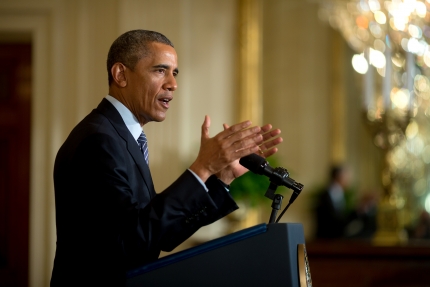
Inside the White House: Solar Panels
May 09, 2014 | 2:48 | Public Domain
Go inside the White House and learn about the installation of solar panels on the roof of the residence. http://obamawhitehouse.archives.gov
Download mp4 (114.7MB) | ()
May 09, 2014 | 2:48 | Public Domain
Go inside the White House and learn about the installation of solar panels on the roof of the residence. http://obamawhitehouse.archives.gov
September 30, 2015 | 2:51 | Public Domain
Climate change is a global challenge, but its effects are felt locally. Alice Hill, Senior Director for Resilience Policy under President Obama, explains how you can prepare your family for the natural disasters that we'll see as climate change continues to impact our communities and our nation.
Today, President Obama announced the Administration’s biggest step yet in the fight against global climate change – the Clean Power Plan, which sets the first-ever carbon pollution standards for power plants.
There is consensus across a broad swath of supports – from business to mayors, medical professionals to faith leader, and environmentalists to civil rights groups, that this landmark action will protect public health, reduce energy bills for households and businesses, create American jobs, and bring clean power to communities across the country.
Below are just some of the reactions:
American Lung Association, Harold P. Wimmer, National President and CEO:
Today, President Obama honored his commitment to act on climate change, a public health emergency. The Clean Power Plan is a tremendous step forward in the United States’ fight against carbon pollution and climate change that will also bring immediate health benefits to the American people. EPA estimates that the Clean Power Plan will prevent up to 3,600 premature deaths and 90,000 asthma attacks in 2030, as well as prevent 300,000 missed days of work and school.
Today, as part of the President’s plan to cut carbon pollution, the Environmental Protection Agency (EPA) finalized the first-ever national limits on carbon pollution from existing power plants, the single-largest source of carbon pollution in the United States. The Clean Power Plan is an historic step in the fight against climate change. It sets flexible and achievable standards to reduce carbon dioxide emissions by 32 percent from 2005 levels by 2030, while creating tens of thousands of jobs.
But just because this common-sense proposal will have huge benefits for hard-working Americans across the country, doesn’t mean some people won’t spread misinformation and launch false attacks. There will be critics of what we’re trying to do, and cynics who say it can’t be done. Long before the details of this plan were even decided, the special interests and their allies in Congress were already mobilizing to oppose it with everything they’ve got. In fact, we are likely to see the same tired arguments naysayers raised last year — and in 1990, when the United States tackled acid rain; and in the 1970s, when the Clean Air Act was passed.
Before we get into the details, we want to remind everyone, throughout our history, when America has taken steps to cut pollution and protect public health, opponents have made dire predictions about destroying jobs and harming the economy — and throughout our history they've been wrong.
This time will be no different. As the polluting interests and their allies come up with new and creative myths, we’ll dispel them on Twitter at @Rohan44.
Over the years, this has been the polluters' favorite myth. When Republican President Richard Nixon signed the Clean Air Act to combat smog, he talked about the promise of tackling pollution and our responsibility to future generations. Polluting interests and their allies said new pollution standards would decimate the auto industry. That was false. In 1990, when Republican President George H.W. Bush took steps to stop acid rain, polluting interests and their allies claimed the lights would go out and businesses around the country would suffer. That was false.
EPA has been protecting air quality for more than 40 years, and in that time we've cut pollution by 70 percent while the economy has more than tripled.
So Americans know we don't have to choose between cutting carbon pollution to protect the health of our kids and creating jobs.
In fact – they go hand in hand. Cutting carbon pollution from power plants will spark innovation and drive investment in clean energy technologies and energy efficiency that will create jobs and save families money. It will also result in significant health benefits, which will yield medical savings.
EPA’s detailed economic analysis shows that this proposal will create tens of thousands of jobs all over the country. And they aren’t the only ones. Two independent studies show even larger job gains of around 300,000 jobs when the Clean Power Plan is fully implemented. And if we look at carbon reduction programs that are already in place, we find that from 2014-2016, the Regional Green House Gas Initiative trading program, is expected to create 14,000 new jobs across nine states.
BREAKING: On Monday, President Obama will release the final version of America's Clean Power Plan—the biggest, most...
Posted by The White House on Saturday, August 1, 2015
On Monday, August 3, President Obama is announcing the finalization of America's Clean Power Plan, the biggest step we've ever taken to combat climate change. This plan sets the first-ever carbon pollution standards for power plants, while providing states and utilities with the flexibility they need to meet those standards.
Watch the President's remarks:
It was the afternoon of Saturday, April 24th, 2004, and as usual it was a breathtakingly hot day in the Northern Arabian Gulf—easily over 90 degrees. I was standing watch in the Combat Information Center onboard the USS BULKELEY (DDG-84), a U.S. Navy guided-missile destroyer, and we were steaming south on a new mission.
We had recently completed our weeks-long tasking of guarding the two offshore oil terminals that sit off the coast of Iraq. We knew these terminals were targets for insurgent attack, so it had been a stressful few weeks of round-the-clock operations, monitoring everything that moved on the water or in the skies; and intercepting anything that got a little too close for comfort.
As we sailed south, the call came we had all been dreading. The terminals were under attack. Although we had trained for it countless times, it was still surreal to hear it come across the radio. We turned the ship around and sped north at flank speed. We put the ship at high alert and launched our helicopters to take a first look, but it was too late. Terrorists had already launched an attack on the Al Basra terminal. In the end, the coalition forces on-site would foil their attack, but it ultimately cost the lives of two U.S. sailors and a Coastguardsmen.
I tell this story because at the heart of that fight was the issue of energy. Now, more than ever, the United States faces global challenges as we respond to threats born from instability in energy-rich regions, and a changing environment impacted by climate change.
Today, the Department of Defense is delivering a report to Congress entitled the “National Security Implications of Climate-Related Risks and a Changing Climate.” It states in no uncertain terms what our men and women in uniform are seeing every single day—that it “is clear that climate change is an urgent and growing threat to our national security.”
The report identifies the most serious and likely climate-related security risks and discusses the ways that DoD is navigating these risks as part of its planning processes. It also describes the resources that will be required to adequately and effectively respond to them.
The report builds upon the risks DoD identified in its 2014 Quadrennial Defense Review, when it made the following case: “the pressures caused by climate change will influence resource competition while placing additional burdens on economies, societies, and governance institutions around the world. These effects are threat multipliers that will aggravate stressors abroad such as poverty, environmental degradation, political instability, and social tensions – conditions that can enable terrorist activity and other forms of violence.”
The good news is, we are taking aggressive action to combat these threats. President Obama’s diversified energy strategy is making America more energy independent, and since the President took office, domestic energy-related emissions have fallen to their lowest level in 20 years. For the first time in nearly three decades, we're importing less foreign oil than we're producing domestically -- and we're using less overall. That's a really big deal.
America is producing more oil, gas, and renewable energy, and the U.S. is becoming more energy efficient overall. These trends are increasing our energy security, cutting our carbon pollution, and enhancing our economic growth.
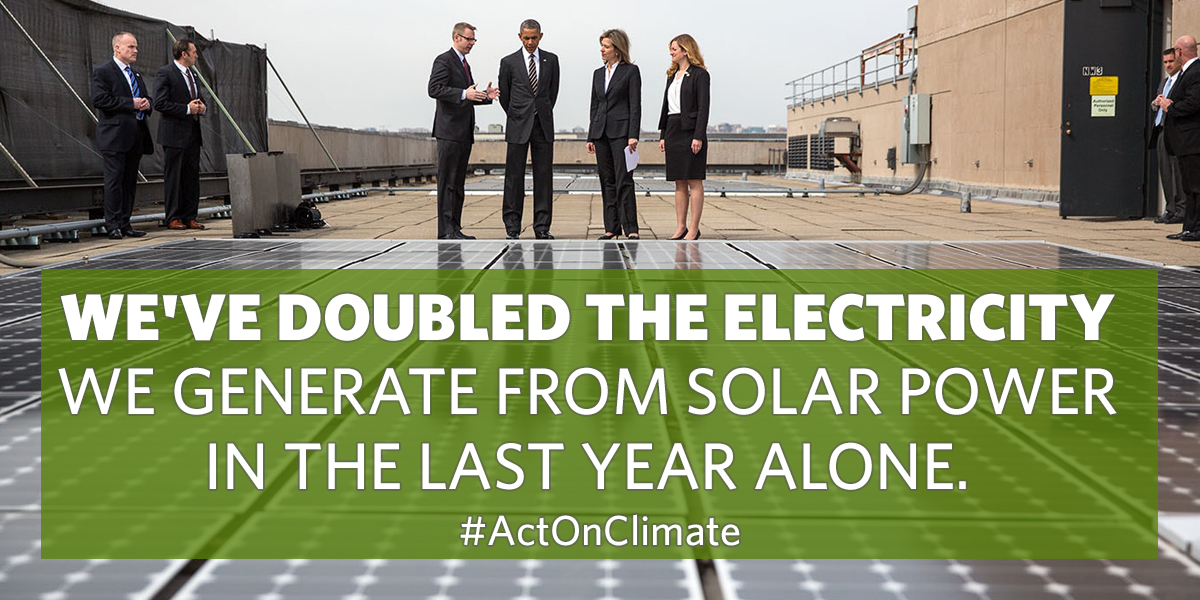
The United States is leading global efforts to address the threat of climate change. Since 2005, the United States has reduced its total carbon pollution more than any other nation on Earth. Wind power has tripled, and solar energy has increased twenty times. President Obama has taken a series of common-sense steps to curb carbon pollution and other greenhouse gases through initiatives that drive energy efficiency, promote clean energy, and put in place the first-ever carbon pollution standards for power plants.
While we are leading in these efforts at home, we know no country is immune from the impacts of climate change. And no country can meet this challenge alone. America continues to lead the international community in driving action to reduce carbon pollution and prepare for climate impacts, and we are helping to forge a truly global solution to this global challenge.
My time in service in the US Navy, my time in service here at the White House, and my time as a father of two young girls reminds me constantly of President Obama’s challenge:
“Someday, our children, and our children’s children, will look at us in the eye and they’ll ask us, did we do all that we could when we had the chance to deal with this problem and leave them a cleaner, safe, more stable world?”
I want that answer to simply be yes.
On Monday, I was pleased to be able to welcome twelve people of faith as they were honored as White House “Champions of Change” for their efforts in protecting our environment and communities from the effects of climate change. These Champions have demonstrated clear leadership across the United States and around the world through their grassroots efforts to green their communities and educate others on the moral and social justice implications of climate change.

The Champions shared personal reflections on their efforts in advance of the event:
President Obama is committed to improving the nation’s electric grid and spurring the development of renewable energy. Since the President took office, the United States has increased electricity generation from solar energy 20 fold and tripled the amount of electricity we generate from wind. To further build on this progress, the Obama Administration remains committed to modernizing and improving our transmission grid. Improving our transmission grid will make electricity more reliable, save consumers money, catalyze the transition to a clean energy economy, and reduce the carbon pollution that is leading to climate change.

That is why, today, the Administration is announcing new investments in the next generation of power transmission and smart grid technology in 13 states and executive actions that will make it easier and faster to permit transmission lines, including:
Last week, the Obama Administration announced a new set of actions to support low-income and other vulnerable communities in preparing for the impacts of climate change. Included in this set of actions are new steps to increase the role of community service in helping these communities prepare through the creation of a Resilience AmeriCorps pilot program.
On Wednesday afternoon, senior White House officials and key resilience partners will be hosting a White House Google+ Climate Hangout to discuss President Obama's commitment to protecting vulnerable communities from climate change and the Administration's launch of the Resilience AmeriCorps pilot program. We invite you to join the Hangout and participate in the conversation by tweeting your questions and comments using #ActonClimate. This conversation will be moderated by Christy Goldfuss, Managing Director of the White House Council on Environmental Quality.
Watch the Google+ Hangout on Wednesday, July 15, 2015, at 2:00pm ET.
Participants include:
FOR IMMEDIATE RELEASE: Contact: press@ceq.eop.gov
July 9, 2015
FACT SHEET: Actions to Build Resilience to Climate Change Impacts in Vulnerable Communities
With cities, states and tribes already confronting the costly impacts of climate change, the Obama Administration is committed to ensuring that communities develop smart strategies and partnerships for building climate resilience. As part of his Climate Action Plan, the President established the State, Local, and Tribal Leaders Task Force on Climate Preparedness and Resilience (Task Force) in 2013 to help the Federal Government respond to the needs of communities nationwide that are dealing with the impacts of climate change. The Task Force recommendations emphasized the importance of supporting communities that are likely to be disproportionately affected, including those that already face economic- or health-related challenges. The Third U.S. National Climate Assessment also noted that socioeconomic disparities can exacerbate the vulnerability of certain populations, including low-income, tribal, and some communities of color, due to in part to limited capacity and resources necessary to prepare and adapt.
Today, the White House is releasing a progress report highlighting some of the key actions taken by the Administration that support the Task Force’s recommendations, which were compiled and delivered to the President in November 2014. Building on this progress, the White House is also announcing a series of new actions focused on enhancing resilience in the communities most vulnerable to the impacts of climate change that includes over $25 million in private and public investments.
NEW ACTIONS AND INVESTMENTS TO BUILD RESILIENCE
TO CLIMATE CHANGE IMPACTS
Launching a Resilience AmeriCorps Pilot Program. The Corporation for National and Community Service (CNCS), the Department of Energy (DOE), the Environmental Protection Agency (EPA), and the National Oceanic and Atmospheric Administration (NOAA) are partnering with The Rockefeller Foundation and Cities of Service to launch Resilience AmeriCorps, a pilot program that will recruit, train, and embed AmeriCorps VISTA members in up to 12 communities in 2015. The 2-year pilot program responds to a recommendation made by the Task Force to assist vulnerable communities that lack the capacity to address climate-resilience planning and implementation. The AmeriCorps VISTA members will increase civic engagement and community resilience in low-income areas, and help those communities develop plans for becoming more resilient to any number of shocks and stresses, including better preparations for extreme weather events. On July 15 at 2pm EDT, the White House will hold a Google+ Hangout to discuss the important role that community service can play in helping vulnerable communities become more resilient in the face of a changing climate. The event will feature speakers from the Administration, The Rockefeller Foundation, Cities of Service, and community leaders engaged in building on-the-ground resilience. Members of the public are encouraged to ask the participants questions during the livestreamed conversation using the Twitter handle #ActOnClimate.
Helping Tribes Prepare for Climate Impacts. The Department of the Interior’s Bureau of Indian Affairs is announcing $11.8 million in Tribal Climate Preparedness Grants to support tribes in planning for the impacts of climate change. This funding will support over 104 awards that address tribal efforts for training, technical assistance, and capacity building needs. In addition, today at the White House Tribal Youth Gathering, more than 90 tribal youth leaders will have an opportunity to have a dialogue with federal officials on issues of importance to tribal youth at a session, entitled “Our Natural Resources and Climate Change.” Also today, the EPA is announcing that it will expand the Local Environmental Observers (LEO) network to tribal colleges and universities and engage hundreds of Alaska Native and American Indian students in sharing observations about the impacts of climate change in their communities.
Expanding Investment in the National Disaster Resilience Competition. Today, in support of Housing and Urban Development’s (HUD) $1 billion National Disaster Resilience Competition (NDRC), The Rockefeller Foundation is committing $3.2 million in additional support to build capacity in jurisdictions across the country that are working to increase their resilience to future shocks and stresses. In June, HUD announced 40 states and local communities that will compete for funds awarded under the NDRC, which seeks to ensure that disaster recovery investments reflect the needs of low-income residents, contribute to stronger local economies, and provide amenities that improve the quality of life for all. The Rockefeller assistance is expected to include expertise from a range of technical experts, participation in Resilience Academies, and a Resilience Summit for funders and Federal agencies in the fall, which will be open to all NDRC-eligible communities. In addition, HUD will be offering a series of topical webinars, beginning July 30, for a broad audience of communities that will describe best practices and innovative tools that further investments in resilience. The full schedule can be found here.
Expanding Opportunities in America’s Cities. The Kresge Foundation is announcing an independent commitment to invest $10 million dollars over the next three years to support climate-resilience efforts in low-income communities through its Climate Resilience and Urban Opportunity Initiative. The foundation already has awarded over $2 million dollars in grants through this effort. Launched in 2014, the initiative is focused on strengthening the capacity of community-based nonprofit organizations to influence local and regional climate-resilience planning, policy development, and implementation to better reflect the priorities and needs of low-income people in U.S. cities.
Conducting a Climate Adaptation, Preparedness, and Resilience Seminar. The Federal Emergency Management Agency (FEMA) National Exercise Division (NED) is working with the White House and federal agencies to design and conduct a seminar series focused on providing the knowledge and tools needed for communities to address local climate impacts and to develop locally relevant exercises supporting community resilience. The first pilot seminar will be conducted in coordination with Florida International University and community representatives in the Miami area in mid- August.
Developing Regional Sea-Level Rise and Climate Information. In response to the growing need for authoritative, place-based climate information to support preparedness planning and safeguard vulnerable communities, Federal agencies will work with the U.S. Global Change Research Program (USGCRP) and the National Ocean Council (NOC) to develop, for the first time ever, a set of sea-level rise scenarios out to 2100 that combine national coverage with regional specificity, and that address not just sea-level rise itself, but also the associated coastal flood hazards that create risks for communities. This effort will launch in 2016, with an initial focus on the Atlantic and Gulf Coasts, and a commitment to engage coastal stakeholders in the scenario-development process. In addition, Federal agencies and the USGCRP will use locally-relevant climate-model projections to develop products that help decision makers better understand how temperature, precipitation, and other factors could change through the rest of this century. Tools resulting from these efforts will be made publicly available through the Climate Resilience Toolkit at toolkit.climate.gov.
Regional Energy Vulnerabilities & Resilience Solutions: DOE will soon release a report, “Climate Change and the U.S. Energy Sector: Regional Vulnerabilities and Resilience Solutions,” that will assist decision makers in their efforts to enhance energy-sector resilience to climate change by assessing vulnerabilities by region and providing illustrative examples of approaches for addressing these vulnerabilities. DOE is also developing a report on tribal energy-system vulnerabilities to climate change and extreme weather, which will be released later this year.
Increasing Energy Security in Native American Tribes. DOE is announcing that five Native American Tribes are receiving on-the-ground support from the Department’s Strategic Technical Assistance Response Team (START) Program. START is aimed at moving community- and commercial-scale energy projects closer to implementation by overcoming project development challenges and barriers, helping the tribes improve their energy security, combat climate change, and build a sustainable energy future. The 2015 projects include validating the economics of a proposed microgrid, helping to determine the best way to transport renewable energy to tribal consumers, and better understanding the economics of expanding the use of renewable energy on tribal lands. These projects would enable the Tribes to generate and store their own electricity while also enhancing community resilience by maintaining power in the event of a storm.
ADDITIONAL ACTIONS TO PRIORITIZE RESILIENCE IN FEDERAL PROGRAMS
Focusing on Environmental Justice. On June 23, The White House announced the Interagency Working Group on Environmental Justice’s (IWG EJ) new Educate, Motivate and Innovate (EMI) Climate Justice Initiative. This initiative will focus on the next generation of climate-justice leaders and will expand collaborations with Minority-Serving Institutions, including Historically Black Colleges and Universities, Tribal Colleges and Universities, Hispanic Serving Institutions, and Asian American and Native American Pacific Islander Serving Institutions. The inaugural EMI Climate Justice Leadership Training Workshop will be held in March 2016, focusing on the effects of climate change on communities, including those with minority, low-income, and/or tribal populations, and on understanding the relationships among climate change, human health, economic development, and environmental justice. The training workshop will also discuss how EJSCREEN - EPA’s new environmental justice screening tool - can help identify and better understand potential community vulnerabilities. EJSCREEN was recently released to the public and gives users powerful data and mapping capabilities to access environmental and demographic information at a high geographic resolution.
Launching a Regional Climate-Change Impact Webinar Series. As announced on July 7, DOE is launching an eight-part webinar series today through its Minorities in Energy Initiative to discuss the regional impacts of climate change on minority and tribal communities. Through this series, experts will: explain relevant findings from the Third U.S. National Climate Assessment and recently released Quadrennial Energy Review, outline Federal energy-policy objectives as they relate to climate resilience for underserved communities, and discuss opportunities in renewable-energy and energy-efficiency sectors to foster a growing, next-generation workforce. This effort supports the White House Office of Science & Technology Policy’s Climate Education and Literacy Initiative, with the goal of ensuring that all students and citizens are climate-literate.
Making Climate-Smart Federal Investments. Through its “Circular A-11” guidance document, the White House Office of Management and Budget is directing all Federal agencies to consider climate preparedness and resilience objectives as part of their Fiscal Year 2017 budget requests for construction and maintenance of Federal facilities. For the first time, all funding requests in support of Federal facilities – from office buildings and hospitals to laboratories and warehouses – must align with climate preparedness and resilience goals.
Mainstreaming Resilience into Federal Programs. Federal agencies continue making progress in integrating climate change considerations throughout their programs and operations. Recent examples include:
Providing Data and Tools for Climate Preparedness. The Administration’s Climate Data Initiative (CDI) and Climate Resilience Toolkit (CRT), launched in 2014, have made hundreds of high-values datasets, tools, and case studies freely available to the public and decision makers. The recent releases of the “Energy” and “Transportation and Supply Chain” themes in June 2015 mark the completion of the initial focus areas of the CDI and CRT. Building on these early successes, content, tools, and functionalities will continue to be added as new themes – such as “Tribal Nations”– are developed. By the end of 2015, the CRT will include a new and improved “Climate Explorer,” new topical map layers that are relevant to decision makers and planners, and a mobile app. These efforts will be supported by an increase in targeted stakeholder-engagement opportunities.
###