The White House

Office of the Vice President

Readout of The President and Vice President's Meeting with Ambassador Hill and General Odierno

The President and Vice President met today with Ambassador Chris Hill and General Ray Odierno, Commanding General of the United States Forces-Iraq (USF-I), to review political, economic, and security developments in Iraq.  They discussed the importance of broad participation in the upcoming Parliamentary elections and reaffirmed U.S. support for Iraqi efforts to promote national unity.  They also discussed how to develop U.S. partnership with Iraq in sectors such as the economy and education. The Ambassador and General Odierno will also participate in a meeting on Iraq which the Vice President will chair with Principals on Friday.

The White House

Office of the Vice President

Informe sobre la Reunión del Presidente y el Vicepresidente con el Embajador Hill y el General Odierno

El Presidente y el Vicepresidente se reunieron hoy con el embajador Chris Hill y el General Ray Odierno, el Comandante General de las Tropas de Estados Unidos en Irak (USF-I), para analizar la situación política, económica y de seguridad en Irak. Hablaron de la importancia de una amplia participación en las próximas elecciones parlamentarias y reafirmaron el respaldo de Estados Unidos para los esfuerzos iraquíes por promover la unidad nacional. Asimismo, conversaron sobre cómo ampliar la colaboración entre Estados Unidos e Irak en materia de temas como la economía y la educación. El embajador y el General Odierno también participarán en la reunión del viernes sobre Irak organizada por el Vicepresidente y a la que asistirán importantes funcionarios.

The Recovery Act – Year One

February 17, 2010 | 24:19 | Public Domain

President Obama and Vice President Biden mark the one year anniversary of the American Recovery and Reinvestment Act, legislation that is working to cushion the greatest economic crisis since the Great Depression and lay a new foundation for economic growth.

Download mp4 (306MB) | mp3 (22MB)

Read the Transcript

Remarks by the President and the Vice President on the One-Year Anniversary of the Signing of the Recovery Act

10:26 A.M. EST

THE VICE PRESIDENT:  Good morning, folks.  Thank you all for being here.  It's been one year today since the President signed the Recovery Act into law, and I'm probably preaching to the choir here as to how beneficial it's been.  I stand before you, as I said, actually one day -- actually the exact day to a year that we signed this act.  And what I want to talk about is what we've accomplished, where we were back then, where I think we are now, and where we're going. 

And you and I know without any question the Recovery Act is working.  It's working well, and maybe even most importantly, it's working towards something.  It's not only helping American workers get back on their feet today but it's laying a foundation for long-term growth for tomorrow -- a little bit what we were talking about in the anteroom.  And you're the living proof of just what the Recovery Act is capable of.

But the President and I, we realize that there's still a great deal more to do.  We know that every success story that you could talk about there's another story about a man or woman who just lost a job, just been laid off, a plant that's been closed down, a mortgage that's been foreclosed on.  We know times are tough for too many people and -- throughout the country.  I don't find -- I've traveled now to I think it's 60-some cities talking about the Recovery Act, and every day, every community I go to, you can see the pain that some of the communities are going through -- communities that were battered by the economy.

I was just in Saginaw, Michigan.  Through no fault of their own -- I've looked into the eyes of those out-of-work teachers, out-of-work businessmen and women, small business owners, construction workers who've been laid off.  But I've seen something else as I've gone through those cities and towns.  I've seen a sense of hope and optimism as well. 

Just yesterday, as I said, in Saginaw, Michigan, I was with a gentleman who has his B.A. -- his name is Gonzalez -- Mr. Gonzalez.  He worked for an automobile company and he got laid off.  His wife and two kids were there at this event.  But because of the Recovery Act and the job training program at a community college in his town, he went back and took a 16-hour course in being able to begin to deal with -- 16-week course -- in being able to deal with chemicals related to how they produced solar panels.  And DOW Corning has a plant nearby.  They added a thousand people over the last year because of some help they got as well, and in their great reach, he's now working.  He's working at a decent salary.  And that community college is going to train this year -- another hundred people are going to go right from that training program directly to a job. 

The other thing I've noticed is -- and I notice particularly from you all -- and I use "you" in an editorial sense -- is this emphatic, unrelenting belief that there is no reason why America has to be number two.  None whatsoever.  I find even that laid-off worker refuses to believe America is going to be number two in the world -- whether it's in ultimately the construction of wind turbines, or whether it's in any other renewable energy form, or new automobiles and battery technology.  I mean, there is this sense, there is this sense among Americans, even in these tough times, there's no reason we're not going to come out of this stronger than when we went into it.

     And so that's what we've been having -- we've been able to deal with.  And the Recovery Act has just provided some significant degree of optimism.  Rebuilding our crumbling infrastructure, sparking a clean energy revolution, transforming American health care, creating the best education system in the world -- that's our future.

     I always say to my friends who think -- in politics who voted against this act -- I say, any of you tell me how we can possibly lead in the 21st century with the same education system, with the same health care system, and the same energy policy we've had the last 35 years?  Everyone knows the truth.  The truth is that without a transformation in health care, without a transformation in education, without a transformation in energy, we're not going to succeed; we will not lead the 21st century -- which is an unacceptable proposition to the American people.

     But sadly, some of my friends who were willing to acknowledge we need to lead in all those areas and make transformational changes, they're unwilling to take what I admit are difficult steps to make this transformation.  They're unwilling to step up. 

     Well, not us.  The President and I know we can do better.  You know we can do better.  We know this is a new economy, and there's no reason why we won't lead it.  That's why we think we have to usher in a new era of innovation and global leadership for America, and we owe much of the Recovery Act -- behind the Recovery Act, which we don't talk much about, is those elements of innovation and change we're looking for.  And we also owe it to the clear-eyed leadership of not only the President but many of you. 

I'll conclude by saying that many of you have taken advantage of the sort of spark that the Recovery Act provides in some of the tax incentives and others.  But we don't think the government is the one that's going to ignite this revolution we need.  You all take a little bit of help and you go out and you risk a lot.  You go out and you get some help from the government, and then you go out to capital markets and you've been out there and you go on the line for a whole lot more -- a whole lot more risk.  And we admire you for it.  That's the way we're going to get through this. 

That, along with the President's leadership -- he's the reason, in my view, why we stand here today with so much hope for tomorrow.  His leadership has taken us very far from where we were last year.  It's easy to forget, the first quarter of last year, this economy shrunk over 6 percent.  The last quarter of this year it grew over 6 percent.  Something's happening.  Something positive is happening.

     So, ladies and gentlemen, I think the main reason it's happening, at least in terms of government guidance, is because of the man I'm about to introduce:  the President of the United States of America, President Barack Obama.  (Applause.)

     THE PRESIDENT:  Thank you, everybody.  Thank you.  Please, have a seat.  Thank you very much.  Thank you to Blake and Chuck, and thank you to my outstanding Vice President and his extraordinary team that have done just a great job managing this program.

     I want to begin by recalling where we were one year ago.  Millions of jobs had already been lost to the recession before I was sworn into office.  Another 800,000 would be lost in the month of January.  We'd later learn that our economy had shrunk by an astounding 6.4 percent in the first quarter of 2009.  And economists from across the political spectrum warned that if dramatic action was not taken to break the back of the recession, the United States could spiral into another depression. 

That was the backdrop against which I signed the American Recovery and Reinvestment Act in Denver with Blake alongside.  It certainly wasn't a politically easy decision to make for me or for the members of Congress who supported it -- because, let's face it, no large expenditure is ever that popular, particularly at a time when we're also facing a massive deficit.  But we acted because failure to do so would have led to catastrophe.  We acted because we had a larger responsibility than simply winning the next election.  We had a responsibility to do what was right for the U.S. economy and for the American people.

One year later, it is largely thanks to the Recovery Act that a second depression is no longer a possibility.  It's one of the main reasons the economy has gone from shrinking by 6 percent to growing at about 6 percent.  And this morning we learned that manufacturing production posted a strong gain.  So far, the Recovery Act is responsible for the jobs of about 2 million Americans who would otherwise be unemployed.  These aren't just our numbers; these are the estimates of independent, nonpartisan economists across the spectrum.

Now, despite all this, the bill still generates some controversy.  And part of that is because there are those, let's face it, across the aisle who have tried to score political points by attacking what we did, even as many of them show up at ribbon-cutting ceremonies for projects in their districts.  (Laughter and applause.)  But if we're honest, part of the controversy also is, is that despite the extraordinary work that has been done through the Recovery Act, millions of Americans are still without jobs.  Millions more are struggling to make ends meet.  So it doesn't yet feel like much of a recovery.  And I understand that.  It's why we're going to continue to do everything in our power to turn this economy around.

Now the truth is the Recovery Act was never intended to save every job or restore our economy to full strength.  No bill or government program can do that.  Businesses are the true engines of growth; businesses are the engines of job creation in this country.  They always will be.  But during a recession, when businesses pull back and people stop spending, what government can do is provide a temporary boost that puts money in people's pockets, and keeps workers on the job, cuts taxes for small businesses, generates more demand; gives confidence to entrepreneurs that maybe they don’t have to cut back right now, maybe they can hold steady in their plans and in their dreams.  That's exactly what we've been able to do with the Recovery Act.

And I just want to point this out -- there has never been a program of this scale, moved at this speed, that has been enacted as effectively and as transparently as the Recovery Act.  I’m grateful that Congress agreed to my request that the bill include no earmarks, that all projects receive funding based solely on their merits.  And despite that, I was still concerned -- Joe and I were just talking in the back -- when this thing passed we said $787 billion -- somewhere there’s going to be some story of some money that ended up being misspent; $787 billion spent out over 18 months, that's a lot -- that's a lot of money.  And it is a testimony to Vice President Biden and his team that, as Joe puts it, the dog, so far at least, hasn't barked.  (Laughter.)

This team has done an outstanding job overseeing the Recovery Act.  It doesn't mean that everything has been perfect, but when you think about the scope, the magnitude of this thing, this program has run cleanly, smoothly, transparently.  We brought in one of the toughest inspector generals in Washington as well as professionals from private industry to help run the implementation.  And every American can see how and where this money has been spent just by going on www.recovery.gov.
 
Now, just to review:  One-third of the money in this bill -- one-third -- was made up of tax cuts.  I talked about this at the State of the Union.  Tax cuts for 95 percent of working Americans.  I just want to say to the American people, because we see some polling where about twice as many people think we've raised taxes as lowered taxes -- 95 percent of you got a tax cut. (Applause.)  Tax cuts for 95 percent of working Americans.  Tax cuts for small businesses.  Tax cuts for first-time homebuyers.  Tax cuts for parents trying to -- trying to care for their kids. Tax cuts for 8 million Americans paying for college.  So far, we've provided $120 billion in tax relief to families and small businesses. 

Now, up until this point I've never met a Republican who didn't like a good tax cut -- (laughter) -- but you remember when I mentioned this at the State of the Union, Joe, they were all kind of squirming in their seats.  They weren't sure whether to clap or -- (laughter) -- or not because most of them had voted against all these tax cuts, which I thought was -- it was interesting to watch.  (Laughter.)

The second third of this bill was made up of relief for those who have been most affected by this recession.  We've extended or increased unemployment benefits for more than 19 million Americans.  We made health insurance 65 percent cheaper for families who lost their jobs and had to get temporary coverage through COBRA.  And we gave relief to states that were struggling to balance their budgets -– relief that has allowed 300,000 teachers and education workers to keep their jobs, as well as tens of thousands of cops and firefighters and first responders and correctional officers.  And Joe Biden will tell you that not one of the 50 governors we've spoken to -– Democrat or Republican -– has failed to show appreciation for this relief. 
     And I also have to tell you that I am concerned because state budgets have not yet recovered, and you're now seeing a whole bunch of state and local governments who were able to put off layoffs last year, as the recovery money is running out, having to make some very tough decisions.  And we could potentially see layoffs taking place this year because we haven't re-upped in terms of providing some help to those states and local governments.  That's something that we're watching and we're concerned about.

Now, the last third of the Recovery Act is what I want to talk a little bit about more today.  It's the reason Blake and Doug are here.  That third is about rebuilding our economy on a new and stronger foundation for growth over the long term.  See, we knew when we came into office that it wasn't enough simply to solve the immediate crisis before us.  We knew that even before the crisis hit, we had come through what some people are calling the "lost decade" -– a period where there was barely any job growth, and where the income of the average American household declined.  This is before the recession, over the course of the decade, the average American household, they saw their incomes decline even as the cost of health care and college tuition were skyrocketing, had reached record highs.  The prosperity was built on little more than a housing bubble and on financial speculation -- people maxing out on their credit cards, taking out home equity loans.

We can't go back to that kind of economy.  That's not where the jobs are.  The jobs of the 21st century are in areas like clean energy and technology, advanced manufacturing, new infrastructure.  That kind of economy requires us to consume less and produce more; to import less and export more.  Instead of sending jobs overseas, we need to send more products overseas that are made by American workers and American business.  And we need to train our workers for those jobs with new skills and a world-class education.

Other countries already realize this.  They're putting more emphasis on math and science.  They're building high-speed railroads and expanding broadband.  They're making serious investments in clean energy because they want those jobs. 

And America cannot stand still in the face of this challenge.  We can't afford to put our future on hold.  So that's why a big part of the Recovery Act has been about investing in that future.  Yes, it created jobs now.  Yes, it created business opportunities now.  But more importantly, it's laying the foundation for where we need to go.

So instead of just pouring more money into America's schools, regardless of their performance, we launched a national competition between states that only rewards success and reform  -- reform that raises student achievement, and inspires students to excel in math and science, and turns around failing schools -- failing schools that steal the future of too many young Americans. 

We're also making sure that our nation has an infrastructure that's built to compete in the 21st century.  So we now have projects in 31 states that are laying the ground for the first high-speed rail network in the United States of America.  I mean, for years, Japan and Europe have had high-speed rail.  China has got about 40 times as many projects that have been going on, on this front.  We're playing catch-up; we shouldn't be. 

The Recovery Act has made possible over 12,500 transportation construction projects, from rebuilding highways to improving our airports.  And today we announced funding for over 50 innovative transportation projects across America –- everything from railroads in Appalachia to a new passenger terminal in New Orleans. 

These projects will put hundreds of thousands of Americans to work.  And in many cases, they already have.  That's part of the reason that Chuck is here today -- he's the president of a construction company in Pennsylvania, and the Recovery Act will fund about a third of the work his paving company will do this year.  That's allowed him to hire two engineers and about a hundred employees.  So in case people are wondering whether or not the Recovery Act has created jobs and opportunity for businesses, talk to Chuck.  (Laughter.)  The new equipment he's ordered to help pave these roads will save an additional 40 jobs on an assembly line out in California.  These are well-paying, long-lasting, private sector jobs that wouldn't be possible without the Recovery Act.  They’ll be doing the work that America needs done to stay competitive in a global economy.

In no area is this more important than in energy.  Because of the Recovery Act, we have finally jumpstarted the clean energy industry in America, and made possible 200,000 jobs in the clean energy and construction sectors. 

Just take one example:  Consider the investment that we've made in the kind of batteries used in hybrid and electric cars.  You've heard about these, right?  Before the Recovery Act was signed, 98 percent of the world's advanced battery production was done in Asian countries. The United States did less than 2 percent of this advanced battery manufacturing that's going to be the key to these high-mileage, low-emission cars. 

Then we invested in new research and battery technologies, and supported the construction of 20 battery factories that will employ tens of thousands of Americans -– batteries that can make enough -- factories that can make enough batteries each year to power half a million plug-in hybrid vehicles.  So as a result, next year -- next year, two years after the Recovery Act -- the United States will have the capacity to produce nearly 20 percent of the world's advanced batteries -- from less than 2 percent to 20 percent.  And we’ll be able to make 40 percent of these advanced batteries by 2015 -- an entire new industry because of the Recovery Act. 

This kind of progress is happening throughout our clean energy sector.  Yesterday I announced loan guarantees to break ground on America's first new nuclear power plant in nearly three decades -– a plant that will create thousands of construction jobs and 800 permanent jobs in years to come.  There's the manufacturer in Philadelphia who makes energy-efficient windows. He used to be skeptical about the Recovery Act until he had to add two more shifts just to keep up with the new business it's created. 

And Blake at Namaste Solar -- it's based in Boulder, Colorado.  One year ago, Blake gave us a tour of one of his company's solar installations, on top of a museum in Denver, right before I signed the Recovery Act into law.  And at the time, Blake was pretty sure that the recession would force him to lay off about half of his staff.  One year later, because of the clean energy investments in the Recovery Act, he has instead added about a dozen new workers, and expects to hire about a dozen more by year's end.  His company continues to install solar panels all over Colorado, from the Governor's Mansion to the Denver Museum of Natural -- Nature and Science. 

So that's our future.  That's what's possible in America.  You can argue, rightly, that we haven't made as much progress as we need to make when it comes to spurring job creation.  That's part of the reason why the Recovery Act is on track to save or create another 1.5 million jobs in 2010.  That's part of the reason why I expect Congress to pass additional measures as quickly as possible that will help our small business owners create new jobs; give them more of an incentive to hire.

But for those skeptics who refuse to believe the Recovery Act has done any good, who continue to insist that the bill didn't work, I'd ask you to take that argument up with Blake and his employees.  Take that argument up with Chuck and his construction workers.  Take it up with the Americans who are working in those battery plants, or building those new highways, or teaching our children new skills -- all because the Recovery Act made it possible.

     So our work is far from over, but we have rescued this economy from the worst of this crisis.  And slowly, in new factories and research facilities and small businesses, the American people are rebuilding a better future.  And we will continue to support their efforts.  We will leave our children an economy that is stronger and more prosperous than it was before.

     Thank you very much, everybody.  (Applause.)

END
10:50 A.M. EST

Close Transcript

On the Road to Recovery - Saginaw, MI

As a White House Fellow in the Office of the Vice President, part of my job is monitoring how the Recovery Act is helping put communities across the county on a path toward economic recovery.  Yesterday I had the opportunity to see the Recovery Act in action when I traveled to Saginaw, Michigan with Vice President Biden ahead of the program's one-year anniversary.

Saginaw has been hard hit by the economic downturn and changes in the automotive industry, but it is quickly reinventing itself to be competitive in the 21st century economy with investments in the renewable energy industry.

We started the day at Delta College where students, with support from the Recovery Act, are getting trained for jobs in manufacturing in the solar industry. The Vice President received a heartfelt introduction from Justo Gonzalez, a recent graduate of the job training program.  Justo began by explaining how almost one year ago, he was laid off from his job in the automotive industry. But after going through training at Delta College, he was recently hired at Hemlock Semiconductor as a Reactor Care Operator.  Justo looked to his wife and two daughters in the crowd and nodded as the Vice President later spoke about how a job is more than just a pay check, it’s about dignity and knowing you can care for your family.

Vice President Biden at a Factory in Saginaw, Michigan

Vice President Joe Biden talks about the Recovery Act at Delta College where students are being trained for jobs in the solar industry, outside Saginaw, Michigan February 16, 2010. (Official White House Photo by David Lienemann)

Then we were off to Fuzzy's Diner in downtown Saginaw for a discussion with local business leaders and community members over lunch. Paul Furlo, the CEO of Morley Companies Inc., spoke about how a recent loan that was backed by the Small Business Administration through the Recovery Act, has allowed him to expand his company’s capacity and hire another 650 associates.

Vice President Biden Has Lunch in Saginaw, Michigan

Vice President Joe Biden meets with local business leaders over lunch at Fuzzy's Diner in Saginaw, Michigan February 16, 2010. (Official White House Photo by David Lienemann)

And it all came full circle when we ended the day at Hemlock Semiconductor, Justo’s new employer and a recipient of an energy manufacturing tax credit.  Justo's words from that morning came alive, "This is a new era.  Like when the automotive industry took over the lumber industry here in the Saginaw Bay Region, the solar industry is now taking us forward into the future. We are just at the early stages and with the sky not just being the limit, it's another source of energy.  With solar and wind energies our growth is unlimited. Michigan has a vast knowledge of manufacturing products. We need to stay positive."

Vice President Biden Shakes Hands in Saginaw, Michigan

Vice President Joe Biden and SBA Administrator Karen Mills meet Justo Gonzalez who introduced the Vice President at Delta College where he was a student, outside Saginaw, Michigan February 16, 2010. (Official White House Photo by David Lienemann)

We're only part-way through the Recovery Act and there is still much work to do – but it’s clear it’s making a difference for people like Paul and Justo all over the country.

Annie Maxwell is a White House Fellow in the Office of the Vice President

Related Topics: Economy, Michigan

One Year, Two Million People Working, a New Foundation

In order to fully understand the scope of the Recovery Act, there are three levels to consider: the national, the local, and the individual.

Recovery Act: The National Level

This morning the Vice President – who has overseen the implementation of the Recovery Act as one of his primary responsibilities – marked the one-year anniversary with his first annual report to the President on progress (pdf). A White House release, "Recovery by the Numbers," breaks out some key bullet points – here are just a few:

Jobs

  • CBO: According to the nonpartisan CBO, the Recovery Act is already responsible for as many as 2.4 million jobs through the end of 2009.
  • CEA, Other Private Forecasters: Analysis by the Council of Economic Advisers also found that the Recovery Act is responsible for about 2 million jobs – a figure in line with estimates from private forecasters like IHS Global, Moody’s Economy and even the conservative American Enterprise Institute.

The Economy

  • GDP/Economic Growth: In the fourth quarter of 2009, the economy grew 5.7 percent – – the largest gain in six years and something many economists say is largely due to the Recovery Act.  Before the Recovery Act, the economy was shrinking by about 6 percent.
  • Job Losses: Job losses for the fourth quarter of 2009 were one-seventh what they were in the first quarter of 2009 when the Recovery Act was passed.

There's plenty more in there, including breakdowns on infrastructure, technology and innovation, immediate relief, and aid to state and local governments. The Vice President also penned an op-ed in USA Today where he discussed the job creation estimates and the role the Recovery Act played in bringing us back from the brink of outright depression, but also what lies ahead:

And yet, to me, the most exciting thing about the Recovery Act is not what we've done, but what lies ahead. Many Recovery Act programs that will build the groundwork for the economy of the 21st century will be implemented in the next few months. Broadband access for small and rural communities. New factories where electric cars and clean fuel cells will be made. Wind farms, solar panels — and the facilities to construct them. New health technologies and smarter electrical power grids will be creating jobs this year thanks to the Recovery Act. Truly, the best is yet to come.

In remarks this morning, the President touched on another top level guiding principle of the Recovery Act – creating a new foundation for the American economy. From building a clean energy economy and creating a smarter energy grid, to revitalizing America’s infrastructure and transportation, to making our health records electronic and efficient, to rewarding excellence in teaching our children, people were put to work building a better future for America.

Recovery Act: The Local Level

Here at WhiteHouse.gov/Recovery, we looked at a more local level, with an interactive map looking at a sample of key projects, and the video below featuring the Mayors of Charleston, SC, Philadelphia, PA, Des Moines, IA, Columbus, OH, and Fresno, CA, all telling the story of how the Recovery Act affected cities and towns across the country:

Download Video: mp4 (50MB)

Recovery Act: The Individual Level

With job losses, it always feels like missing the point to talk about numbers and figures, when every job lost can mean almost infinite pain and struggle for a given family. And in the same way that the President and Vice President understand the tough times Americans are going through with that lens, that is also the most meaningful way to look at what the Recovery Act has accomplished.  Joining the President this morning, the Vice President took a moment to talk about just one person:

Just yesterday, as I said, in Saginaw, Michigan, I was with a gentleman who has his B.A. -- his name is Gonzalez -- Mr. Gonzalez.  He worked for an automobile company and he got laid off.  His wife and two kids were there at this event.  But because of the Recovery Act and the job training program at a community college in his town, he went back and took a 16-hour course in being able to begin to deal with -- 16-week course -- in being able to deal with chemicals related to how they produced solar panels.  And DOW Corning has a plant nearby.  They added a thousand people over the last year because of some help they got as well, and in their great reach, he's now working.  He's working at a decent salary.  And that community college is going to train this year -- another hundred people are going to go right from that training program directly to a job. 

The President closed out his remarks referring critics to two other individuals: Blake Jones, Co-Founder of Namaste Solar in Boulder, and Charles Niederriter of Golden Triangle Construction Co. in Imperial, PA, who joined him and the Vice President today:

But for those skeptics who refuse to believe the Recovery Act has done any good, who continue to insist that the bill didn't work, I'd ask you to take that argument up with Blake and his employees. Take that argument up with Chuck and his construction workers. Take it up with the Americans who are working in those battery plants, or building those new highways, or teaching our children new skills -- all because the Recovery Act made it possible.

There's Blake:

The President, Vice President, and Small Business Owners Mark the First Anniversary of the Recovery Act

President Barack Obama makes a statement to business owners on the anniversary of the Recovery Act signing in the South Court Auditorium of the Eisenhower Executive Office Building February 17, 2010. (Official White House Photo by Samantha Appleton)

The White House

Office of the Press Secretary

Remarks by the President and the Vice President on the One-Year Anniversary of the Signing of the Recovery Act

South Court Auditorium, Eisenhower Executive Office Building

10:26 A.M. EST

THE VICE PRESIDENT:  Good morning, folks.  Thank you all for being here.  It's been one year today since the President signed the Recovery Act into law, and I'm probably preaching to the choir here as to how beneficial it's been.  I stand before you, as I said, actually one day -- actually the exact day to a year that we signed this act.  And what I want to talk about is what we've accomplished, where we were back then, where I think we are now, and where we're going. 

And you and I know without any question the Recovery Act is working.  It's working well, and maybe even most importantly, it's working towards something.  It's not only helping American workers get back on their feet today but it's laying a foundation for long-term growth for tomorrow -- a little bit what we were talking about in the anteroom.  And you're the living proof of just what the Recovery Act is capable of.

But the President and I, we realize that there's still a great deal more to do.  We know that every success story that you could talk about there's another story about a man or woman who just lost a job, just been laid off, a plant that's been closed down, a mortgage that's been foreclosed on.  We know times are tough for too many people and -- throughout the country.  I don't find -- I've traveled now to I think it's 60-some cities talking about the Recovery Act, and every day, every community I go to, you can see the pain that some of the communities are going through -- communities that were battered by the economy.

I was just in Saginaw, Michigan.  Through no fault of their own -- I've looked into the eyes of those out-of-work teachers, out-of-work businessmen and women, small business owners, construction workers who've been laid off.  But I've seen something else as I've gone through those cities and towns.  I've seen a sense of hope and optimism as well. 

Just yesterday, as I said, in Saginaw, Michigan, I was with a gentleman who has his B.A. -- his name is Gonzalez -- Mr. Gonzalez.  He worked for an automobile company and he got laid off.  His wife and two kids were there at this event.  But because of the Recovery Act and the job training program at a community college in his town, he went back and took a 16-hour course in being able to begin to deal with -- 16-week course -- in being able to deal with chemicals related to how they produced solar panels.  And DOW Corning has a plant nearby.  They added a thousand people over the last year because of some help they got as well, and in their great reach, he's now working.  He's working at a decent salary.  And that community college is going to train this year -- another hundred people are going to go right from that training program directly to a job. 

The other thing I've noticed is -- and I notice particularly from you all -- and I use "you" in an editorial sense -- is this emphatic, unrelenting belief that there is no reason why America has to be number two.  None whatsoever.  I find even that laid-off worker refuses to believe America is going to be number two in the world -- whether it's in ultimately the construction of wind turbines, or whether it's in any other renewable energy form, or new automobiles and battery technology.  I mean, there is this sense, there is this sense among Americans, even in these tough times, there's no reason we're not going to come out of this stronger than when we went into it.

     And so that's what we've been having -- we've been able to deal with.  And the Recovery Act has just provided some significant degree of optimism.  Rebuilding our crumbling infrastructure, sparking a clean energy revolution, transforming American health care, creating the best education system in the world -- that's our future.

     I always say to my friends who think -- in politics who voted against this act -- I say, any of you tell me how we can possibly lead in the 21st century with the same education system, with the same health care system, and the same energy policy we've had the last 35 years?  Everyone knows the truth.  The truth is that without a transformation in health care, without a transformation in education, without a transformation in energy, we're not going to succeed; we will not lead the 21st century -- which is an unacceptable proposition to the American people.

     But sadly, some of my friends who were willing to acknowledge we need to lead in all those areas and make transformational changes, they're unwilling to take what I admit are difficult steps to make this transformation.  They're unwilling to step up. 

     Well, not us.  The President and I know we can do better.  You know we can do better.  We know this is a new economy, and there's no reason why we won't lead it.  That's why we think we have to usher in a new era of innovation and global leadership for America, and we owe much of the Recovery Act -- behind the Recovery Act, which we don't talk much about, is those elements of innovation and change we're looking for.  And we also owe it to the clear-eyed leadership of not only the President but many of you. 

I'll conclude by saying that many of you have taken advantage of the sort of spark that the Recovery Act provides in some of the tax incentives and others.  But we don't think the government is the one that's going to ignite this revolution we need.  You all take a little bit of help and you go out and you risk a lot.  You go out and you get some help from the government, and then you go out to capital markets and you've been out there and you go on the line for a whole lot more -- a whole lot more risk.  And we admire you for it.  That's the way we're going to get through this. 

That, along with the President's leadership -- he's the reason, in my view, why we stand here today with so much hope for tomorrow.  His leadership has taken us very far from where we were last year.  It's easy to forget, the first quarter of last year, this economy shrunk over 6 percent.  The last quarter of this year it grew over 6 percent.  Something's happening.  Something positive is happening.

     So, ladies and gentlemen, I think the main reason it's happening, at least in terms of government guidance, is because of the man I'm about to introduce:  the President of the United States of America, President Barack Obama.  (Applause.)

     THE PRESIDENT:  Thank you, everybody.  Thank you.  Please, have a seat.  Thank you very much.  Thank you to Blake and Chuck, and thank you to my outstanding Vice President and his extraordinary team that have done just a great job managing this program.

     I want to begin by recalling where we were one year ago.  Millions of jobs had already been lost to the recession before I was sworn into office.  Another 800,000 would be lost in the month of January.  We'd later learn that our economy had shrunk by an astounding 6.4 percent in the first quarter of 2009.  And economists from across the political spectrum warned that if dramatic action was not taken to break the back of the recession, the United States could spiral into another depression. 

That was the backdrop against which I signed the American Recovery and Reinvestment Act in Denver with Blake alongside.  It certainly wasn't a politically easy decision to make for me or for the members of Congress who supported it -- because, let's face it, no large expenditure is ever that popular, particularly at a time when we're also facing a massive deficit.  But we acted because failure to do so would have led to catastrophe.  We acted because we had a larger responsibility than simply winning the next election.  We had a responsibility to do what was right for the U.S. economy and for the American people.

One year later, it is largely thanks to the Recovery Act that a second depression is no longer a possibility.  It's one of the main reasons the economy has gone from shrinking by 6 percent to growing at about 6 percent.  And this morning we learned that manufacturing production posted a strong gain.  So far, the Recovery Act is responsible for the jobs of about 2 million Americans who would otherwise be unemployed.  These aren't just our numbers; these are the estimates of independent, nonpartisan economists across the spectrum.

Now, despite all this, the bill still generates some controversy.  And part of that is because there are those, let's face it, across the aisle who have tried to score political points by attacking what we did, even as many of them show up at ribbon-cutting ceremonies for projects in their districts.  (Laughter and applause.)  But if we're honest, part of the controversy also is, is that despite the extraordinary work that has been done through the Recovery Act, millions of Americans are still without jobs.  Millions more are struggling to make ends meet.  So it doesn't yet feel like much of a recovery.  And I understand that.  It's why we're going to continue to do everything in our power to turn this economy around.

Now the truth is the Recovery Act was never intended to save every job or restore our economy to full strength.  No bill or government program can do that.  Businesses are the true engines of growth; businesses are the engines of job creation in this country.  They always will be.  But during a recession, when businesses pull back and people stop spending, what government can do is provide a temporary boost that puts money in people's pockets, and keeps workers on the job, cuts taxes for small businesses, generates more demand; gives confidence to entrepreneurs that maybe they don’t have to cut back right now, maybe they can hold steady in their plans and in their dreams.  That's exactly what we've been able to do with the Recovery Act.

And I just want to point this out -- there has never been a program of this scale, moved at this speed, that has been enacted as effectively and as transparently as the Recovery Act.  I’m grateful that Congress agreed to my request that the bill include no earmarks, that all projects receive funding based solely on their merits.  And despite that, I was still concerned -- Joe and I were just talking in the back -- when this thing passed we said $787 billion -- somewhere there’s going to be some story of some money that ended up being misspent; $787 billion spent out over 18 months, that's a lot -- that's a lot of money.  And it is a testimony to Vice President Biden and his team that, as Joe puts it, the dog, so far at least, hasn't barked.  (Laughter.)

This team has done an outstanding job overseeing the Recovery Act.  It doesn't mean that everything has been perfect, but when you think about the scope, the magnitude of this thing, this program has run cleanly, smoothly, transparently.  We brought in one of the toughest inspector generals in Washington as well as professionals from private industry to help run the implementation.  And every American can see how and where this money has been spent just by going on www.recovery.gov.
 
Now, just to review:  One-third of the money in this bill -- one-third -- was made up of tax cuts.  I talked about this at the State of the Union.  Tax cuts for 95 percent of working Americans.  I just want to say to the American people, because we see some polling where about twice as many people think we've raised taxes as lowered taxes -- 95 percent of you got a tax cut. (Applause.)  Tax cuts for 95 percent of working Americans.  Tax cuts for small businesses.  Tax cuts for first-time homebuyers.  Tax cuts for parents trying to -- trying to care for their kids. Tax cuts for 8 million Americans paying for college.  So far, we've provided $120 billion in tax relief to families and small businesses. 

Now, up until this point I've never met a Republican who didn't like a good tax cut -- (laughter) -- but you remember when I mentioned this at the State of the Union, Joe, they were all kind of squirming in their seats.  They weren't sure whether to clap or -- (laughter) -- or not because most of them had voted against all these tax cuts, which I thought was -- it was interesting to watch.  (Laughter.)

The second third of this bill was made up of relief for those who have been most affected by this recession.  We've extended or increased unemployment benefits for more than 19 million Americans.  We made health insurance 65 percent cheaper for families who lost their jobs and had to get temporary coverage through COBRA.  And we gave relief to states that were struggling to balance their budgets -– relief that has allowed 300,000 teachers and education workers to keep their jobs, as well as tens of thousands of cops and firefighters and first responders and correctional officers.  And Joe Biden will tell you that not one of the 50 governors we've spoken to -– Democrat or Republican -– has failed to show appreciation for this relief. 
     And I also have to tell you that I am concerned because state budgets have not yet recovered, and you're now seeing a whole bunch of state and local governments who were able to put off layoffs last year, as the recovery money is running out, having to make some very tough decisions.  And we could potentially see layoffs taking place this year because we haven't re-upped in terms of providing some help to those states and local governments.  That's something that we're watching and we're concerned about.

Now, the last third of the Recovery Act is what I want to talk a little bit about more today.  It's the reason Blake and Doug are here.  That third is about rebuilding our economy on a new and stronger foundation for growth over the long term.  See, we knew when we came into office that it wasn't enough simply to solve the immediate crisis before us.  We knew that even before the crisis hit, we had come through what some people are calling the "lost decade" -– a period where there was barely any job growth, and where the income of the average American household declined.  This is before the recession, over the course of the decade, the average American household, they saw their incomes decline even as the cost of health care and college tuition were skyrocketing, had reached record highs.  The prosperity was built on little more than a housing bubble and on financial speculation -- people maxing out on their credit cards, taking out home equity loans.

We can't go back to that kind of economy.  That's not where the jobs are.  The jobs of the 21st century are in areas like clean energy and technology, advanced manufacturing, new infrastructure.  That kind of economy requires us to consume less and produce more; to import less and export more.  Instead of sending jobs overseas, we need to send more products overseas that are made by American workers and American business.  And we need to train our workers for those jobs with new skills and a world-class education.

Other countries already realize this.  They're putting more emphasis on math and science.  They're building high-speed railroads and expanding broadband.  They're making serious investments in clean energy because they want those jobs. 

And America cannot stand still in the face of this challenge.  We can't afford to put our future on hold.  So that's why a big part of the Recovery Act has been about investing in that future.  Yes, it created jobs now.  Yes, it created business opportunities now.  But more importantly, it's laying the foundation for where we need to go.

So instead of just pouring more money into America's schools, regardless of their performance, we launched a national competition between states that only rewards success and reform  -- reform that raises student achievement, and inspires students to excel in math and science, and turns around failing schools -- failing schools that steal the future of too many young Americans. 

We're also making sure that our nation has an infrastructure that's built to compete in the 21st century.  So we now have projects in 31 states that are laying the ground for the first high-speed rail network in the United States of America.  I mean, for years, Japan and Europe have had high-speed rail.  China has got about 40 times as many projects that have been going on, on this front.  We're playing catch-up; we shouldn't be. 

The Recovery Act has made possible over 12,500 transportation construction projects, from rebuilding highways to improving our airports.  And today we announced funding for over 50 innovative transportation projects across America –- everything from railroads in Appalachia to a new passenger terminal in New Orleans. 

These projects will put hundreds of thousands of Americans to work.  And in many cases, they already have.  That's part of the reason that Chuck is here today -- he's the president of a construction company in Pennsylvania, and the Recovery Act will fund about a third of the work his paving company will do this year.  That's allowed him to hire two engineers and about a hundred employees.  So in case people are wondering whether or not the Recovery Act has created jobs and opportunity for businesses, talk to Chuck.  (Laughter.)  The new equipment he's ordered to help pave these roads will save an additional 40 jobs on an assembly line out in California.  These are well-paying, long-lasting, private sector jobs that wouldn't be possible without the Recovery Act.  They’ll be doing the work that America needs done to stay competitive in a global economy.

In no area is this more important than in energy.  Because of the Recovery Act, we have finally jumpstarted the clean energy industry in America, and made possible 200,000 jobs in the clean energy and construction sectors. 

Just take one example:  Consider the investment that we've made in the kind of batteries used in hybrid and electric cars.  You've heard about these, right?  Before the Recovery Act was signed, 98 percent of the world's advanced battery production was done in Asian countries. The United States did less than 2 percent of this advanced battery manufacturing that's going to be the key to these high-mileage, low-emission cars. 

Then we invested in new research and battery technologies, and supported the construction of 20 battery factories that will employ tens of thousands of Americans -– batteries that can make enough -- factories that can make enough batteries each year to power half a million plug-in hybrid vehicles.  So as a result, next year -- next year, two years after the Recovery Act -- the United States will have the capacity to produce nearly 20 percent of the world's advanced batteries -- from less than 2 percent to 20 percent.  And we’ll be able to make 40 percent of these advanced batteries by 2015 -- an entire new industry because of the Recovery Act. 

This kind of progress is happening throughout our clean energy sector.  Yesterday I announced loan guarantees to break ground on America's first new nuclear power plant in nearly three decades -– a plant that will create thousands of construction jobs and 800 permanent jobs in years to come.  There's the manufacturer in Philadelphia who makes energy-efficient windows. He used to be skeptical about the Recovery Act until he had to add two more shifts just to keep up with the new business it's created. 

And Blake at Namaste Solar -- it's based in Boulder, Colorado.  One year ago, Blake gave us a tour of one of his company's solar installations, on top of a museum in Denver, right before I signed the Recovery Act into law.  And at the time, Blake was pretty sure that the recession would force him to lay off about half of his staff.  One year later, because of the clean energy investments in the Recovery Act, he has instead added about a dozen new workers, and expects to hire about a dozen more by year's end.  His company continues to install solar panels all over Colorado, from the Governor's Mansion to the Denver Museum of Natural -- Nature and Science. 

So that's our future.  That's what's possible in America.  You can argue, rightly, that we haven't made as much progress as we need to make when it comes to spurring job creation.  That's part of the reason why the Recovery Act is on track to save or create another 1.5 million jobs in 2010.  That's part of the reason why I expect Congress to pass additional measures as quickly as possible that will help our small business owners create new jobs; give them more of an incentive to hire.

But for those skeptics who refuse to believe the Recovery Act has done any good, who continue to insist that the bill didn't work, I'd ask you to take that argument up with Blake and his employees.  Take that argument up with Chuck and his construction workers.  Take it up with the Americans who are working in those battery plants, or building those new highways, or teaching our children new skills -- all because the Recovery Act made it possible.

     So our work is far from over, but we have rescued this economy from the worst of this crisis.  And slowly, in new factories and research facilities and small businesses, the American people are rebuilding a better future.  And we will continue to support their efforts.  We will leave our children an economy that is stronger and more prosperous than it was before.

     Thank you very much, everybody.  (Applause.)

END
10:50 A.M. EST

The White House

Office of the Vice President

OP-ED by Vice President Joe Biden in Today's USA Today

The following op-ed, written by Vice President Joe Biden, was published in today’s USA Today:

USA TODAY
Assessing the Recovery Act: 'The best is yet to come'
By Joe Biden
February 17, 2010

A year ago today, President Obama signed the Recovery Act into law. Time and again I am asked, "How can you say that the Recovery Act has worked when the unemployment rate is so much higher today than it was when the act was signed?" It's a fair question — and one worth answering on this anniversary day.

First, we think the Recovery Act is working because of the progress we've made in slowing job loss. In the three months before the act took effect, America lost 750,000 jobs a month. In the last three months, we've lost about 35,000 jobs a month. That's progress — not good enough, not where we need to be, but progress. And most economists agree that that progress is thanks in a very large part to the Recovery Act.

Independent economists believe that, thanks to the Recovery Act, about 2 million people are on the job today who would not have work otherwise. Is that good enough in an economy that has lost more than 8 million jobs? Of course not. But it is a lot better than the alternative.

Second, the Recovery Act is working because it is helping hard-hit families get through tough economic times. If you get a paycheck, you got a tax cut from the Recovery Act, which lowered the amount of withholding for over 95% of working Americans. If you are a senior citizen, or a veteran, you got a $250 check to help pay your bills. If you are unemployed, your benefits were extended thanks to the Recovery Act. In fact, these tax cuts and direct aid to individuals are the largest parts of the Recovery Act — more than half of all Recovery Act spending has gone to cut taxes or provide relief to seniors, veterans and the unemployed.

Look around for results

Third, we know that the Recovery Act is working because we can see the results all around us. Thousands of road projects are not only creating jobs — they are making for faster, safer transportation. Superfund sites are being cleaned up and commuter rail tracks are being repaired. Work is underway on water, weatherization and construction projects — creating jobs now, and making critical improvements in our nation's infrastructure for the future.

And yet, to me, the most exciting thing about the Recovery Act is not what we've done, but what lies ahead. Many Recovery Act programs that will build the groundwork for the economy of the 21st century will be implemented in the next few months. Broadband access for small and rural communities. New factories where electric cars and clean fuel cells will be made. Wind farms, solar panels — and the facilities to construct them. New health technologies and smarter electrical power grids will be creating jobs this year thanks to the Recovery Act. Truly, the best is yet to come.

'A long way to go'

We've gotten the act moving ahead of schedule, and most projects are coming in under budget. A tough, independent group of inspectors general is on the lookout for fraud, and we've killed scores of projects that don't pass muster. Your tax dollars are being used wisely and quickly to turn the economy around.

We're on track to meet or beat our goal of saving or creating 3.5 million jobs by the end of this year. Work on road, rail, bridge, airport and other infrastructure projects will expand dramatically as warm weather returns. Projects that needed final planning in 2009 will see construction in 2010.

Americans know this downturn isn't over yet — we have a long way to go before we are over the economic chasm left by the Great Recession. Year Two of the Recovery Act will build on the successes of Year One, continuing to generate jobs while seeding the transformative investments needed to ensure that our economy remains the world's strongest.

Joe Biden is vice president of the United States.

The White House

Office of the Press Secretary

The Vice President's Annual Report to the President on Progress Implementing the American Recovery and Reinvestment Act of 2009

WASHINGTON – At tomorrow’s Economic Daily Briefing, Vice President Joe Biden will deliver to President Barack Obama his “Annual Report to the President on Progress Implementing the American Recovery and Reinvestment Act of 2009.”  The report, which summarizes Recovery Act progress to-date and lays out projections for the program in the coming months, can be viewed in full HERE.  Key excerpts from the report are below.

KEY EXCERPTS

GDP IMPACT
As ARRA funds have begun to work their way through the economy, several key indicators show that they have clearly halted an economic freefall.  In their recently released quarterly report, the Council of Economic Advisers (CEA) found that GDP had been positively impacted by ARRA:

“ARRA added between 2 to 3 percentage points to real GDP growth in the second quarter of 2009; between 3 and 4 percentage points in the third quarter, and between 1.5 and 3 percentage points in the fourth quarter.  This is broadly similar to those of a wide range of other analysts.”

Figure 1 shows the progression of GDP over the past five quarters.

Figure 1.  GDP Progression over the Past Five Quarters

Figure 1.  GDP Progression over the Past Five Quarters

EMPLOYMENT IMPACT
GDP is not the only indicator that shows a boost from ARRA funds.   Payroll job losses are also lessening and, ever since a peak in March of 2009, unemployment insurance claims have been generally declining.  Both these trends can be seen in Figures 2 and 3:

Figure 2 Payroll Job Losses December 2008 – Present

Figure 2 Payroll Job Losses December 2008 – Present

Figure 3 Initial Unemployment Insurance Claims, 2007 – Present
 
Figure 3 Initial Unemployment Insurance Claims, 2007 – Present
It is no accident that we have seen the labor market improve dramatically since the passage of ARRA – abundant evidence and many different experts say it is creating millions of jobs.
***
At the end of September 2009, CEA released their first quarterly report, finding that ARRA had created or saved over 1 million jobs.  In their second quarterly report, CEA found that this positive trend continues, with ARRA having created or saved 1.5 to 2 million jobs  in the fourth quarter of 2009, as shown in Figure 4.  The Congressional Budget Office (CBO), in their latest report on the status of ARRA implementation, also found that ARRA funding has supported a comparable number of jobs – with their estimate being up to 2.4 million jobs supported.

ARRA Jobs Created or Saved by Quarter, per CEA

Figure 4.  ARRA Jobs Created or Saved by Quarter, per CEA[1]
These jobs not only span sectors, but also span the entire country as is seen in Figure 5.

Figure 5.  Cumulative ARRA Jobs Created or Saved by State per CEA
 
Figure 5.  Cumulative ARRA Jobs Created or Saved by State per CEA

PACE OF SPENDING
Though each part of the Act was designed to spend at different rates, the Act overall represents one of the largest and fastest infusions of direct funding into the economy.  Just as the Congress understood the urgency of passing the Recovery Act, so too did the Federal agencies and their partners in charge of implementing it.  In fact, Recovery Act funds have not only moved into the economy quickly, but the pace has also exceeded the Congressional Budget Office’s (CBO) original ambitious projection, as shown in Figure 8.
Part of keeping up the pace of moving funds out into the economy is tied directly to the oversight and management capabilities of the Federal agencies.  Agencies have worked diligently to move funds out the door as fast as possible, while not sacrificing the careful selection processes, monitoring, and oversight necessary to make sure that Recovery Act funds are being used in a prudent manner.  Understanding that speed in getting funds into the economy is crucial to achieving the goals of the Act, agencies, such as the Department of Defense, have reallocated funds from projects that, while worthy, are not able to execute in a timely fashion.  In other cases, agencies have realized bid savings on project costs – and have quickly reallocated those “excess” funds to new projects, allowing more projects to be started than originally projected.  For example, in August, the Department of Homeland Security was able to quickly reallocate $240 million in bid savings on current projects to new in-line baggage screening projects at ten additional airports across the country.

Figure 8 Recovery Act Spending vs. CBO Spending Projection as of September 30, 2009
 
Figure 8 Recovery Act Spending vs. CBO Spending Projection as of September 30, 2009
WHAT’S NEXT
Looking forward, we have a clear goal to disburse (outlays + taxes) 70 percent of Recovery Act funds, or $551 billion, by September 30, 2010. We are on track to achieve this goal.

We have disbursed to date nearly $300 billion in outlays and taxes for an average monthly rate of about $27 billion. Of that $27 billion, $11 billion has been in the form of tax relief and $16 billion in spending. 

To achieve our goal for a $551 billion in disbursements by the end of September, we will need to disburse $32 billion per month going forward, a pace which we will meet or exceed. From February onwards, monthly tax relief should increase from $11 billion to $18 billion.

***

Mix of Outlays Changes in 2010, With Projects Spending Accounting for a Larger Share
Just as tax relief will play a major part in 2010 disbursements, so will spending, as outlays comprise the second and critical part to meeting the goal of disbursing 70 percent of the Act by September 30.  In the months ahead, there will be a modest uptick in the monthly outlay rate of the Act.  More importantly however, the mix in spending will shift significantly from being primarily payment driven to being more evenly matched between payments and projects.  In fact, monthly project outlays are expected to more than double compared to the 2009 average.  Since payments were the portion of the Act most quickly disbursed in 2009 to rescue the economy from freefall, 2010 payment outlays may see a slight drop off in pace.  Nevertheless, total monthly outlays will see a modest uptick which will be driven by projects.

Figure 13 Projected Outlays through June 2010
 
Figure 13 Projected Outlays through June 2010
***
Building on the Successes of the First Year
The increase expected in overall outlay pace going forward, as well as in the change in mix, can be directly traced to a groundwork that was laid in the first year of the Act’s implementation.  Through the end of January, a total of $334 billion in spending had been obligated, of which $179 billion had been outlayed.  The portion of obligations made up by payments was greater than the portion made up by projects, but by less than 15 percent.  However, the split within the portion outlayed is dramatically different, with over four times as much going towards payments v. projects.  In other words, less than one fifth of outlays through January were project related outlays.  Thus, project related dollars that are already obligated and working in today’s economy will transition into significant corresponding outlays.  By the numbers, in addition to the money that is left to be obligated, there remains $112 billion in obligated project dollars that have yet to be outlayed, while by contrast, there remains only $43 billion in obligated payment dollars that have yet to be outlayed.


Figure 15.  Obligated and Outlayed Dollars to Projects and Payments, February 2009 through January 2010


Figure 15.  Obligated and Outlayed Dollars to Projects and Payments, February 2009 through January 2010
 
Figure 16.  Obligations and Outlays in Projects and Payments, February 2009 through January 2010
Therefore, fueled largely by a strong first year performance of getting dollars awarded and projects obligated and started, the year ahead will see a capitalizing on an inventory of work that is awarded and “ready to go”.  This capitalizing explains much of the increase in outlay pace as well as the change in outlay mix that will be seen in the months ahead.
Further evidence of this lies in reports filed by a portion of Recovery Act funding recipients who, by law, report on the use of their funds every quarter.  These recipients filed reports in January detailing the status and progress made on their awards through December 31, 2009.  Despite the sizeable activity that these recipients depict, their reports tell us that the vast majority of their projects are less than half complete.  This assessment remains the same whether made in terms of project numbers or in terms of dollars as is seen in Figure 17.
 Figure 17.  Projects and Dollars by Level of Completeness

Figure 17.  Projects and Dollars by Level of Completeness
With a strong and increasing base of awards that have been made, and with large numbers of awards that still have more than half of their work remaining to be done, the level of on-the-ground work being done by the Recovery Act will remain strong and the pace of outlays will accelerate during Fiscal Year 2010.
Signature Projects Come Online
In addition to the increase from standard infrastructure related projects, 2010 will also see work getting underway on several of the longer-term signature investments in the Recovery Act, including the recently awarded High Speed Rail, Health IT and Broadband related grants.  The table below provides some highlights on signature programs – part of the Reinvestment phase of ARRA – that are scheduled to spend out over 2010 and beyond, keeping the Recovery moving forward.

Figure 18.  Signature ARRA Project Status

Figure 18.  Signature ARRA Project Status
###

Patriotism and Pride at the Olympics

Before leaving Vancouver, the U.S. Delegation attended our final Olympic competition at the Pairs Figure Skating Short Program. I’ve always loved figure skating – it’s about not only the lifts, jumps and twists, but also the artistry, form and style. Watching Peggy Fleming compete in 1968 almost made me feel that I too could skate because of the grace and ease with which she skated. Last night, we watched both American pairs – Caydee Denney and Jeremy Barrett, and Amanda Evora and Mark Ladwig – skate with speed, power and beauty.

U.S. champions Caydee Denney and Jeremy Barrett were the first American pair to perform. Skating to a powerful piece of music, these teammates were dazzling and made each lift look easy – and this is their first Olympics. Just a few minutes later, Amanda Evora and Mark Ladwig took the ice for a dazzling and heartfelt performance that was meant for the Olympics. Both couples smiled from ear to ear, as the audience cheering enthusiastically. The passion they feel for ice skating came across with each glide and turn.

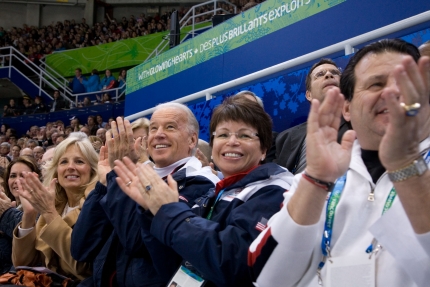
Vice President Biden, Dr. Jill Biden and Valerie Jarrett Applaud the U.S. Olympic Pairs Figure Skaters

Dr. Jill Biden, Vice President Joe Biden, Valerie Jarrett and Mike Eruzione cheer on Team USA during the Pairs Figure Skating Short Program competition at the 2010 Winter Olympics in Vancouver, Canada February 14, 2010. (Official White House Photo by David Lienemann)

There’s no question that all of our athletes train to perform at their peak at the Olympics, but I was especially taken by the energy and chemistry that our team members displayed as they executed challenging routines with poise and strength. Last night's performances were breathtaking.

At the end of the day, Ambassador David Jacobson and his wife Julie, joined Olympic champions Peggy Fleming, Vonetta Flowers and Mike Eruzione, and I for a closing dinner at Lok's Chinese restaurant to help celebrate the Chinese New Year and an incredible visit to the Olympic Games.

As we head back to Washington, it's a little hard to leave. We've met some of the most talented athletes over the last few days. I feel a deep sense of patriotism and pride because of our extraordinary Team USA who go all out, fearlessly competing to do their very best.

Valerie Jarrett is a senior advisor to the President, and heads the White House Office of Olympic, Paralympic, and Youth Sport

Related Topics:

Relief from Crushing Student Loan Payments

On January 25th, the Middle Class Task Force unveiled several initiatives designed to relieve the strain on family budgets, including a cap on student loan payments.  A few days later, the President talked about this student loan proposal during his State of the Union address.  The President’s words generated a lot of interest and excitement, so we wanted to tell you a little more about our plan.

Over the past three decades, college tuition has grown ten times faster than real median incomes for families with children. So it’s no surprise that about two-thirds of graduates take out loans to pay for college and their average debt is over $23,000.  But we didn’t need statistics to understand how challenging it can be to pay for college; the Vice President and other members of the Task Force heard about it directly from students, parents, faculty and administrators when we held meetings at Syracuse University and the University of Missouri-St. Louis.

We are proposing to make federal student loans more affordable by limiting a borrower’s payments to 10 percent of the income he or she has left over after covering basic expenses. Here is an example:  The monthly payment for a single borrower earning $30,000 who owes $20,000 in loans would be $115 a month, compared to $228 a month under the standard 10-year repayment plan. 

Our proposal has been praised by a number of student aid experts. According to Dr. Michael Lomax, the President and CEO of UNCF, this change “will decrease the loan payments of hundreds of thousands of low-income borrowers with significant student loan debt, lightening the load of many Americans and enabling them to get the education they need, and our nation needs them to have.”

Debt can be especially difficult to manage for borrowers in low-paying public service careers, as well as those who have lost their jobs.  Lauren Asher, the President of the Institute for College Access and Success (TICAS) noted that “this is a well-targeted and well-timed change that would help people who are struggling to stay afloat financially.”

In addition to lowering monthly payments, we are proposing to keep the total cost of loan repayment manageable by forgiving all remaining debt after 20 years of payments, or 10 years of payments for those in public service work.  As Mark Kantrowitz, the publisher of finaid.org said, the “acceleration of the loan forgiveness will ensure that borrowers are not still paying back their own federal student loans when their children enroll in college.”

These changes build on the Income-Based Repayment (IBR) plan for student loans that was implemented last summer.   Lauren Asher of TICAS explained that IBR “was supported by a broad coalition of student, parent, loan industry, and higher education groups to make college more affordable and accessible,” and our proposal is “a way to make the program even more helpful to responsible borrowers.”

This initiative complements other key pieces of the Administration’s agenda, like extending the American Opportunity Tax Credit for college expenses and passing legislation, which is currently before the Senate, to reform student lending to eliminate tens of billions of dollars in wasteful subsidies to banks. The savings will be used to expand Pell Grants and invest in community colleges.  Together, these proposals will make it easier for millions of Americans to pursue their college dreams. 

Brian Levine is the Deputy Domestic Policy Advisor to the Vice President