

Latest News
Building a Fair and Stable Economy for Indian Country
Posted by on February 13, 2012 at 4:24 PM ESTIn his State of the Union address, President Obama laid out a blueprint for an economy that’s built to last – an economy built on American manufacturing, American energy, skills for American workers, and a renewal of American values. Today, the President released a budget that illustrates how we put that blueprint to work.
The President has been clear that we need to do more to create jobs and help economic growth. While the current economic crisis has challenged all Americans, we know this to be especially true for Indian Country where some reservations face unemployment rates of up to 80 percent. Though the economic challenges of Indian Country are significant, President Obama is committed to building strong, prosperous Native American economies.
Learn more aboutEmpowering Children to Explore the Internet--Safely
Posted by on February 13, 2012 at 3:06 PM ESTIt is an honor that while we have been focused on building Zui.com to deliver the best Internet experiences for kids, we have been recognized on a national level. At the end of 2011 I was presented with an extraordinary honor – to be honored as a 2011 Champion of Change by the White House. Part of President Obama’s Winning the Future initiative, the Champions of Change program highlights Americans who are making an impact in their communities and helping our country rise to meet the many challenges of the 21st century.
I am, simply, honored and humbled to receive this recognition, and to have the opportunity to reach out to other recipients and White House representatives to continue to discuss amplifying best practices in both the private and public sectors.
The team at Zui.com works tirelessly to make the Internet big, fun and safe for kids, and has done so since 2008, when we launched our first KidZui Browser. The browser empowers children to safely and independently explore and enjoy over 5 million parent-and-teacher reviewed websites, games, images and YouTube videos.
We are very proud that our recently launched ZUI.COM search and exploration engine has been hailed as the "Google for kids." We are proud that the administration feels we are a good example of President Obama’s vision to “out-innovate, out-educate and out-build the rest of the world, and we are excited to share our learning with the administration and help further innovation in the United States.”
Cliff Boro is Co-Founder and CEO of Zui.com
GC Classrom: Online Training Courses on Small Business Government Contracting
Posted by on February 11, 2012 at 3:01 PM ESTEd. Note: The following is a cross-post that originally appeared on the Small Business Administration's blog.
As a former government contractor, I know how hard it can be to succeed in federal government procurement. You face challenges every day as a business owner, an employer, and a service provider.
That’s why as the Acting Associate Administrator of Government Contracting and Business Development at the SBA it is a priority of mine to make sure that we provide as much information to you as possible about our efforts to support small business government contracting. We want to provide you, the small business owner, pertinent and relevant information in an understandable format. That’s why today, SBA is pleased to spotlight three new online training courses meant to help small businesses interested in government contracting learn about the process - the Government Contracting Classroom.
The GC Classroom is an online training destination where small businesses can acquire the confidence and know-how to participate in the federal contracting space. The new online contracting series is called Government Contracting 101, Parts 1-3. Part 1 provides an overview of the small business contracting programs so you know what is available to you as a small business owner. Part 2 is designed to help small firms understand how the government buys goods and services. Part 3 is about how to sell to the government. All three modules include a “resources and tools” section with links, materials and more that could be useful.
These three new modules add to the five existing, free self-paced training modules, all designed to help small firms benefit from the more than $500 billion in federal contracts that are awarded each year. We have big plans to add more information in the coming months, so keep checking the GC Classroom, and www.sba.gov, for more updates and information.
John Shoraka is the Acting Associate Administrator for Government Contracting and Business Development.
Learn more about TechnologyLatino Business Leaders Agree that Broadband is Key to a Strong Future
Posted by on February 10, 2012 at 3:18 PM ESTYesterday I attended a meeting of Latino business leaders, convened by the White House, to discuss how the broadband industry can grow the jobs of the future in the Latino community.
We often hear about an emerging skills gap in America and the urgent need for more graduates in the science, technology, engineering, and math (STEM) fields. Business leaders recognize that to help address this challenge, particularly in the technology sector, broadband Internet access is a priority. Another key to growing a technology-skilled workforce is tackling the broadband adoption gap in the Latino community. NTIA’s research shows that only 57 percent of Hispanic households had broadband service in 2010, which significantly lags behind the national rate. Even when adjusting for socioeconomic factors, like income and education, Hispanic households still trail White households in broadband adoption by 11 percentage points.
Learn more about TechnologySBA Continues to Help Strengthen Small Businesses in Indian Country
Posted by on February 10, 2012 at 1:56 PM ESTThis post originally appeared on the Small Business Administration's blog
Recently, SBA kicked off the 2012 Emerging Leaders (known as the e200) executive-level training initiative for small business owners in 27 cities, including 10 Native American communities.
The e200 is an intensive training program for small companies that have the potential for quick growth and job creation. I’m excited that e200 continues to reach our Native small business communities with training, mentorship and resources to help them take their businesses to the next level. Native American small businesses are an important part of creating a blueprint for an economy built to last.
Learn more about EconomyCelebrating Black Women in American Culture and History
Posted by on February 10, 2012 at 7:00 AM ESTLast week, President Obama signed a proclamation, declaring February National African American History Month. This year's theme, "Black Women in American Culture and History," specifically recognizes the numerous, unique contributions that African-American women have made to the advancement of the Nation.
Today, the White House released a video message from the First Lady in honor of African-American History Month. In the video, the First Lady said, “You don’t have to be in a history book to make a contribution to our country.”
Mrs. Obama urges others to not only celebrate African-American heroes such as Sojourner Truth and Harriet Tubman, whose contributions to the improvement of the country are depicted in many history books; but to also honor the women of today, “our aunts … our best friends … all those women who live each day with a spirit that is uniquely their own, and who continue to write our country’s story every single day.”
The First Lady’s message includes a challenge, for others to, “reinvest in those around us…and pledge to continue their story by contributing our own gifts for the good of our families, our communities, and our country.” Together, we can be the difference we search for while recognizing there are those around us who have continued to positively contribute to our community.
Learn more about WomenCelebrating the Two Year Anniversary of Let’s Move! and work in Indian Country
Posted by on February 9, 2012 at 11:15 AM EST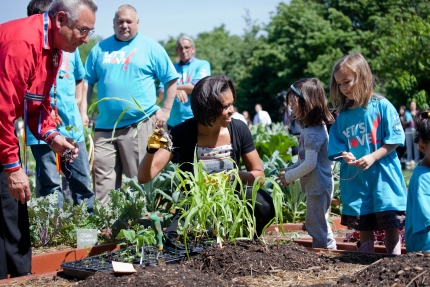
First Lady Michelle Obama participates in a Garden Harvest Event with children and members of the American Indian community, in the White House Kitchen Garden on the South Lawn of the White House, June 3, 2011. (Official White House Photo by Samantha Appleton)
Today, First Lady Michelle Obama is hitting the road to kick off a three day, nation-wide tour celebrating the second anniversary of Let’s Move!. Since launching Let’s Move! on February 9, 2010, significant progress has been made to solve the problem of childhood obesity.
Over the past three decades, rates of childhood obesity in this country have tripled. Today, nearly one in every three children in the U.S. are overweight or obese. An integral part of the Let’s Move! initiative includes addressing the needs of populations where childhood obesity rates are particularly high, including American Indian and Alaska Native communities, who experience obesity and other related diseases atdisproportionately high rates and are twice as likely as the general population to be overweight. In May 2011, First Lady Michelle Obama launched Let’s Move! in Indian Country (LMIC), bringing together federal agencies, local communities, nonprofits, corporate partners, and tribes to end the epidemic of childhood obesity in Indian Country within a generation by creating a healthy start on life for children; ensuring families access to healthy, affordable, traditional foods; and increasing opportunities for physical activity.
The First Lady’s Let’s Move! tour will highlight examples of people making changes across the country. In Indian Country, parents, businesses, educators, elected officials, members of the military, chefs, physicians, athletes, childcare providers, schools, community and faith leaders and youth themselves have made substantial commitments to improve the health of our nation’s children. For example, Dallas Duplessis is a youth advocate for healthier eating and started a gardening club on her reservation in Tulalip, Washington. After witnessing the effects of unhealthy eating habits, Dallas and her family got involved with the Hilbulb Cultural Center program “Growing Together as Families,” which teaches families healthy eating habits. Dallas then started the Tulalip Youth Gardeners Club to inspire other kids to garden together with their families. President Obama recognized Dallas’ leadership as a White House Champion of Change in his remarks at the White House Tribal Nations Conference in December, noting that the First Lady would appreciate the goal of the club, which, in Dallas’ words, is “not to be couch potatoes, but to grow some potatoes.”
Dallas is just one of the many “champions” of the Let’s Move! initiative in Indian Country.
LMIC has worked with many stakeholders in Indian Country to create a comprehensive toolkit to connect communities, schools and tribal leaders to resources, funding, trainings and programs that will help improve the health of the next generation. The LMIC interagency partners have also worked towards four specific goals, informed by the work of the Childhood Obesity Task Force and the feedback received through meetings with tribal leaders and organizations. These goals include:
- Creating a Healthy Start on Life: The Indian Health Service (IHS) launched the Baby-Friendly Hospital campaign to promote breast-feeding in IHS facilities and has committed to achieving baby friendly certification for all of their 14 federally-run obstetrics units.
- Creating Healthy Learning Communities: The USDA Food and Nutrition Services delivered six trainings to Bureau of Indian Education (BIE) schools in 2011, to provide information on how schools can participate in the Healthier U.S. School Challenge – Fuel Up to Play 60, obtain funding for infrastructure development, and access programs and resources to serve healthier meals and snacks year-round to school age children. Because of the President’s commitment to the Healthy, Hunger-Free Kids Act, which reauthorized the Child Nutrition Act, the BIE began the process of updating agency standards to create a healthier school environment through a Bureau-wide Health and Wellness Policy for schools that will be implemented throughout the BIE school system this year.
- Fostering Healthy, Comprehensive Food Systems Policies: USDA has worked to develop over twenty Food Policy Councils (FPC) across Indian Country to improve food production opportunities and access to healthy, affordable, and traditional foods.
- Increasing Opportunities for Physical Activity: Last year the BIE launched the Presidential Active Lifestyle Award (PALA) Challenge in Indian Country with the help of the Chicago Bears’ and Nike N7 athlete Levi Horn. Many of the BIE schools have made this challenge their own by incorporating culturally relevant and traditional activities. With the help of partners like Coach-Across-America (CAA), Just Move It, and many others, LMIC is bringing coaches and Physical Education programming to communities previously lacking access to these opportunities.
Learn more aboutUSDA commemorates the “New Year of the Trees”
Posted by on February 8, 2012 at 5:25 PM EST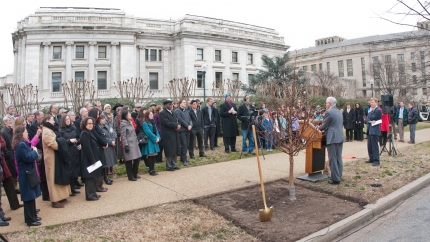
United States Department of Agriculture Under Secretary Natural Resources and Environment Harris Sherman next to the freshly planted Dawn Redwood for the Celebration of Tu B’Shevat “The New Year of the Trees” event at the USDA Headquarters, Wednesday, February 8, 2012. (Photo by Lance Cheung, USDA)
This post originally appeared on the US Department of Agriculture blog.
It is written in the Talmud – a central text of Judaism – that ‘just as my parents planted for me, so I will plant for my children.’ Here at USDA, we’re planting trees across the country and in Israel to bring the wide-ranging benefits of trees, both ecological and spiritual, to future generations.
Today, USDA Natural Resources and Environment Under Secretary Harris Sherman planted a tree next to the USDA’s Washington DC headquarters in commemoration of Tu B’Shevat, “The New Year of the Trees.” This event brought together the local Jewish community and government leaders alike to share their common bond of conserving our natural resources and leaving a healthier world for the next generation.
Learn more about Additional Issues
- &lsaquo previous
- …
- 165
- 166
- 167
- 168
- 169
- 170
- 171
- 172
- 173
- …
- next &rsaquo
Twitter