

Latest News
Rural Educator Bringing Change
Posted by on January 30, 2012 at 10:58 AM ESTIn 2005 when I first began working with the Alamance-Burlington School System in North Carolina to start a college access and career awareness program, “What’s After High School?,” this quote in the office at Eastern Alamance High School caught my attention and I wrote it down:
Perhaps the most valuable result of all education is the ability to make yourself do the thing you have to do, when it ought to be done, whether you like it or not. This is the first lesson to be learned. –Thomas Huxley
Later I thought to myself, “that’s really what college access is…teaching young people about the world and opportunities beyond where they live, showing them how a college education can help them realize those opportunities and equipping them with the tools and resources to do what they ‘have to do, when it ought to be done, whether (they) like it or not’…”
Prior to working with the local school system, in 2004 I organized a group of friends to start “YES I CAN,” a one-time, faith-based college access program at Children’s Chapel United Church of Christ. Our goal was to serve 25 African American children in grades 6-12 and their parents to help them understand how to be successful in school, prepare for college and pay for it. By the end of the summer we had served more than 100 students and parents. Seven years later the YES I CAN Program is now Youth Enrichment Series, Inc., a 501c3, serving students in grades 3-12. Parents, friends, family and colleagues play a major role in this all volunteer operation. Our graduates and former student advisors are enrolled in or graduates of more than twenty 2- year and 4- year colleges and universities in North Carolina and other states. I was encouraged to contact the Alamance-Burlington School System about opportunities to develop college access programming to impact all students and families in our community. That’s how the “What’s After High School?” Program was conceived.
Learn more aboutWhite House Blog Post: Advance Estimate of GDP for the Fourth Quarter of 2011
Posted by on January 27, 2012 at 7:09 PM ESTYou can view the blog postHERE.
Today’s report shows that the economy posted its tenth straight quarter of positive growth, as real GDP (the total amount of goods and services produced in the country) grew at a 2.8 percent annual rate in the fourth quarter of last year. For 2011 as a whole, GDP rose by 1.7 percent, raising the level of real GDP 0.7 percent above where it was at the start of the recession in the fourth quarter of 2007. While the continued expansion is encouraging, faster growth is needed to replace the jobs lost in the recent downturn and to reduce long-term unemployment.
Positive contributions to real GDP growth in the fourth quarter included consumer spending (1.5 percentage points) and fixed investment (0.4 percentage point). Overall government purchases fell (4.6 percent), with substantial declines in Federal defense spending (12.5 percent) and State and local spending (2.6 percent).
As President Obama has said, this is a make-or-break moment for the middle class, and those who are struggling to get into the middle class. That is why the President announced on Tuesday his Blueprint for an America Built to Last – an economy built on American manufacturing, American energy, skills for American workers, and a renewal of American values.
 Learn more about Economy
Blueprint for an America Built to Last and Indian Country
Posted by on January 25, 2012 at 5:14 PM ESTIn yesterday’s State of the Union address, the President laid out a blueprint for an economy that’s built to last – an economy built on American manufacturing, American energy, skills for American workers, and a renewal of American values. The President has been clear that we need to do more to create jobs and help economic growth. But under his leadership and thanks to action taken by the President, the economy is growing again. The economy has added a total of nearly 3.2 million private sector jobs over the last 22 months.
Last night, the President outlined a series of ideas to build an economy that works for everyone, one that will bring about a new era of American manufacturing, and promote homegrown and alternative energy sources. The President’s Blueprint for an America Built to Last includes the following initiatives that will benefit Indian Country:
- Prevent tax increases for Native American families by extending the payroll tax cut: The President challenged Congress to strengthen the economic recovery by extending the payroll tax cut for the rest of the year so that taxes don’t go up on American workers. About 1.5 million Native American workers – throughout urban, rural, reservation and village communities – will benefit from the extension and expansion of the payroll tax cut, giving them and their families more money to keep our local economies strong at this critical time. Today, one of the most important ways we can continue to support economic growth in Indian Country is through the extension of the payroll tax cut.
- Forge new partnerships between community colleges – including tribal colleges – and businesses to train and place 2 million skilled workers: Many industries have difficulty filling jobs requiring specific technical skills, even with many Americans still looking for work. In coming years, America will need to fill millions of mid- and high-level skilled positions in industries from healthcare to advanced manufacturing, clean energy to information technology. The President proposed a new initiative to train and place two million Americans in good jobs through partnerships between businesses and community colleges that give workers the skills employers explicitly need. The program is modeled on efforts by employers and community colleges from Charlotte and Chicago to Orlando and Louisville. To address future workforce needs, the President will support partnerships between high schools and industry to create more career academies, which combine instruction in academic subjects and industry skills.
- Help start-ups and small businesses in Indian Country succeed and create jobs by reforming regulations and expanding tax relief: Start-ups and small businesses create most of the new net jobs in this country. The President is proposing to build on measures he has already taken to enact 17 small business tax cuts through additional tax relief to start-ups and small businesses that are creating jobs and increasing wages and by calling for further measures to expand access to capital for small businesses by simplifying and streamlining regulations.
The State of LGBT Health in Colorado
Posted by on January 25, 2012 at 4:35 PM ESTEd. Note: Cross-posted from the HealthCare.gov blog.
All of us hope and expect to be provided care and treated well by the health care professionals we rely on every day to keep us healthy. Unfortunately, far too often, lesbian, gay, bisexual and transgender (LGBT) Americans are denied care or treated discriminatorily simply because of their sexual orientation or gender identity.
Last week, I had the opportunity to host a Conversation on LGBT Health in Denver, Colorado, in partnership with the One Colorado Education Fund. One Colorado recently completed a comprehensive study to discover and document the state of LGBT health and wellness in Colorado. The study surveyed nearly 1,300 LGBT Coloradans who shared their personal health care stories and experiences.
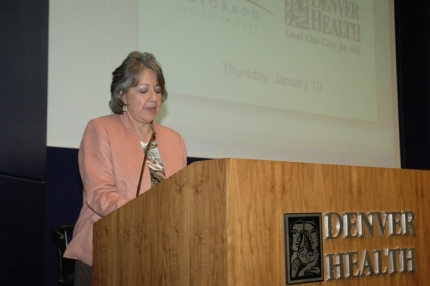
Marguerite Salazar, HHS Regional Director (Region VIII), speaks at “A Conversation on LGBT Health”, January 19, 2012 in Denver, CO (photo courtesy of Jess Woodrum/ONE Colorado). January 19, 2012. (by Jess Woodrum/ONE Colorado)
One participant stated, “A lot of people might not come out to their doctor because it’s very scary. You don’t know how people will react.” Another respondent stated, “You can’t be healthy if you have to hide who you are. Or if you think you have to hide who you are because you don’t know if it’s safe.”
According to the study:
- 21 percent of the LGBT respondents and 53 percent of the transgender community were refused care by doctors or other health workers
- 27 percent of transgender respondents do not have health insurance
- 74 percent of respondents reported a lack of or limited health insurance
- 83 percent of transgender respondents reported healthcare expenses to be a barrier to seeking services
Increasing Access and Supporting Catholic Education
Posted by on January 25, 2012 at 1:30 PM ESTI believe the success of the great American experiment is inseparably intertwined with a commitment to opportunity for everyone—that every person will have an opportunity for happiness, an opportunity to fulfill their potential, an opportunity to be safe, gainfully employed, prosperous in the most important ways. I believe that outside of the role of family in an Americans’ lives, the role education plays in achieving these goals of equal opportunity is paramount. Without the foundation of a first rate education, few people would have many opportunities at all. Put another way, when America succeeds at education, we succeed at being America. When we fail at providing the best education for even a single child, in that moment we fail as America because for that child we know there is little opportunity.
For this reason, I am grateful to the White House for choosing to honor individuals in the field of Catholic education this week as “Champions of Change,” for I believe Catholic schools are an essential component of a successful American education system, and therefore a successful America. We know Catholic schools have a history of succeeding with marginalized populations. After all, Catholic schools began in America hundreds of years ago with the very purpose of serving poor immigrant populations, whole groups of new Americans that generations later have risen up in this land of opportunity. Yesterday’s poor Catholic immigrants sat in the desks of rigorous, values-based, Catholic school classrooms, and today the descendants of those first Catholic school students are more often than not actualizing the American dream.
Youth Community Initiatives: Staying Active and Giving Back
Posted by on January 25, 2012 at 1:30 PM EST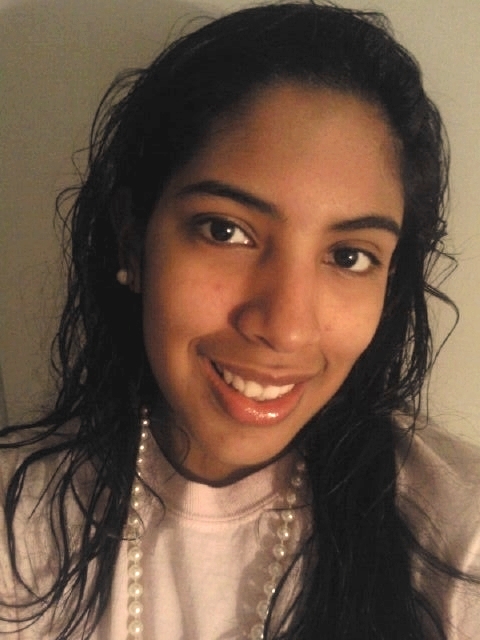
Being involved in activities, sports and taking the initiative in being a leader in my community were things I just did because I felt I should do something productive with my time. Whenever I get involved in my community I try to convince other people to join me because it is so much more fun when community service is done in groups. I would have never thought I would receive an award for all of the little things I do in my community. Mother Teresa said “What we are doing is just a drop in the ocean. But if that drop was not in the ocean, I think the ocean would be less because of that missing drop.” Mother Teresa does have a point; every little thing we do to better our community does make a big difference in the future.
Ever since I was little I always wanted to do something for the betterment of my community. I did not know how to start until an opportunity arose during the summer before my sophomore year. I attended a program called AMYLA, and the manager of the program gave me the idea of starting a day camp for children in the community. If the program was going to happen, it would have to be my responsibility to start it and organize it. I was frightened at first, because how could a 14-year-old start a day camp all by herself? But after doing a little bit more thinking about it, I was convinced to take on this challenge and make the community better with this day camp. After taking the initiative to organize and the responsibility of being camp manager, the day camp was a dream come true. The day camp had 10 children, a good number for the first year.
When that summer had passed, I realized I had the capacity to do whatever I wanted to if I put my mind to it. After the day camp, I felt like I should get more involved in my school community. I started signing up for extracurricular activities. My sophomore year, I applied to the International Baccalaureate Diploma Program and participated in volleyball and stage crew. Being involved in my school community felt great because I felt like I was a part of something bigger than myself.
Entering my junior year, I wanted to participate in more activities and be productive after school. I was involved in Carroll Food Drive, volleyball, basketball, Augustinian Scholars, Peer Ministry, National Honor Society, lacrosse, the International Baccalaureate Diploma Program, mentoring and stage crew. I was juggling all these extracurricular activities during the year. During my senior year, I am still involved in these extracurricular activities. I always invite friends to do activities with me. We as students can make small changes that can better our community.
I hope I can inspire other teenagers to take the initiative to be leaders in their community and go above and beyond. It is never too early to start making a change in your community. Do not let negative ideas such as 'you’re too young' affect what you want to do in your community. We as teenagers are responsible for the future, and we can make a difference.
Bertha Castenda serves is a senior at Archbishop Carroll High School in Washington, D.C., where she maintains a 4.0+ GPA in the International Baccalaureate Diploma Programme, one of the toughest college prep curriculums available world-wide. .
Promoting Comtemporary Jesuit Education Locally, Internationally and Globally
Posted by on January 25, 2012 at 1:30 PM EST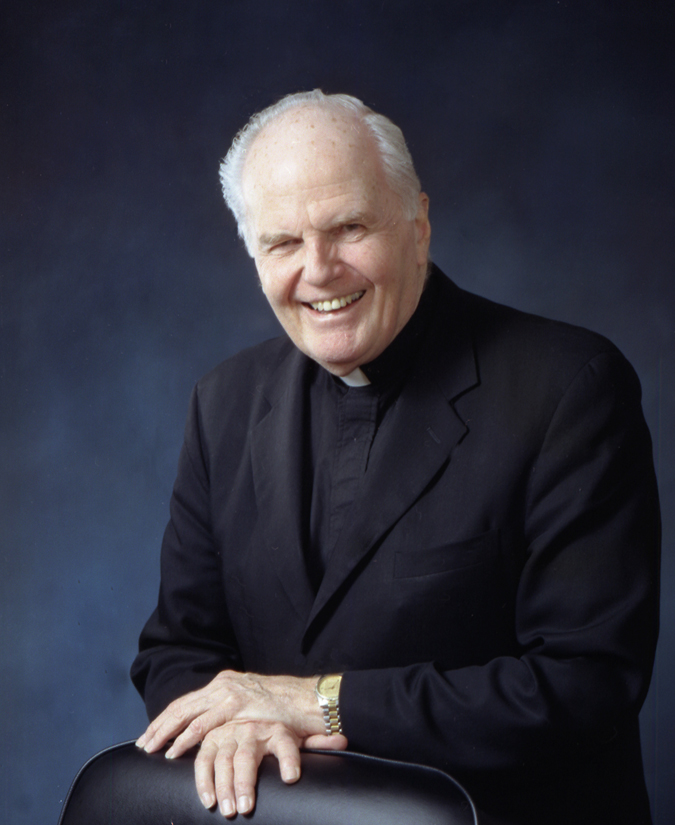 Jesuits are committed to two ideals that make for a heady agenda on college and university campuses: seeking God in all things and pursuing the magis, the greater and more effective good in whatever they do. The contemporary Jesuit campus is busy with living those ideals with a freedom to pursue to new ideas, work on new frontiers, and to be continually restless to be more effective and generous in pursing important issues and projects. Add to that a current emphasis on realizing a global perspective in and out of the classroom.
It has been my privilege for the past 14 years to lead the Association of Jesuit Colleges and Universities (AJCU), which serves the 28 Jesuit schools by representing them, supporting them in every way possible and promoting national and international collaborative efforts that make these institutions at once local, national and global. My role has led me to interact with the talented women and men on our very dynamic campuses by following, encouraging, and facilitating their good work.
My role has taken me to: El Salvador with our students engaged in a transformative immersion experience on a campus where Jesuits and their co-workers were killed over 20 years ago (one of many immersion experiences developed by our schools); to a refugee camp in Kenya, where our faculty are now offering on-line courses to refugees; to Latin America to work with our sister Jesuit universities there; and to China where U.S. Jesuit universities have collaborated to offer both an international MBA and an undergraduate immersion experience.
The Cristo Rey Network: Graduating Scholars and Granting Dreams
Posted by on January 25, 2012 at 1:30 PM EST Millions have been educated in parochial schools through the 1960s and these graduates have grown up to make vital contributions to American productivity and culture. Since then thousands of Catholic schools have closed, particularity in inner-cities. The remaining traditional Catholic schools often charge a high tuition that low-income families cannot afford; meanwhile, students most in need of a good education today are being failed by the public education system. An African American male in America today is more likely to land in prison than in college; a young Latina enrolled as a freshman in college has about a one in 10 chance of earning a degree.
The Cristo Rey Network has taken up the challenge to exclusively serve young people who come from families with economic need and do not have access to a quality education. With 24 Catholic, college preparatory high schools across the country, Cristo Rey has been cited by Time Magazine as “an island of success in the Catholic ocean.” Each of the 6,900 students enrolled this year will graduate high school with the knowledge and 21st century skills to be successful in college and the workplace. Our schools implement a rigorous, college preparatory curriculum and every student participates in the Corporate Work Study Program. This program employs all students in a professional job one day a week to earn up to 70% of their tuition as well as gain hands-on work experience.
- &lsaquo previous
- …
- 169
- 170
- 171
- 172
- 173
- 174
- 175
- 176
- 177
- …
- next &rsaquo
Twitter