

Latest News
From Civil Rights to Silver Rights
Posted by on January 12, 2012 at 1:00 PM EST
There are more people in the United States today without a bank account -- 17 millions to be exact -- than there were without the right to vote in the early 60's. Think about that for a minute. Dr. Martin Luther King Jr.’s final action and unfinished dream was launching a Poor People’s Campaign that attacked unfair housing practices and sought to root out economic injustice and disparity for the underserved. Now here we are some 40+ years later and we still struggle with tragic statistics like these pulled from a recent study conducted by the FDIC.
The proportion of U.S. households that are unbanked varies considerably among different racial and ethnic groups, with certain racial and ethnic minorities more likely to be unbanked than the population as a whole. Minorities more likely to be unbanked include blacks (an estimated 21.7 percent of black households are unbanked), Hispanics (19.3 percent), and American Indian/Alaskans (15.6p ercent). Racial groups less likely to be unbanked are Asians (3.5 percent) and whites (3.3 percent).
Bottom line -- without basic access to mainstream financial services and a fundamental understanding of the language of money, when nearly 20% of Latinos and nearly 22% of Black households remain unbanked, we usher in a new form of social injustice and disparity, an age of what should be considered economic slavery.
In the face of these sobering statistics our mission must be to ensure and fight for, “Silver Rights” and “Financial Dignity” for all — or in other words, finding ways to make free enterprise and capitalism work for the poor and underserved. To make financial dignity, and the tool of financial literacy, the new civil rights issue for a generation. That process starts with acquiring a basic understanding of the language of money, the teaching of financial literacy, and the practice of Economic Empowerment.
Learn more about Civil Rights, ServiceNot Just Another National Holiday
Posted by on January 12, 2012 at 1:00 PM EST
In 1988, two years after Martin Luther King Day was first observed as a national holiday, I was working late into the evening with then Pennsylvania Secretary of Labor and Industry, Harris Wofford. Harris had been a close friend and colleague of Dr. King during the civil rights movement. He and I began discussing the irony of how despite Dr. King’s legacy as a champion of action and social justice, in the two years since the national holiday began, it was becoming just another day off for millions of Americans. Harris thought that Dr. King would have been appalled had he known that young people were using his holiday to sleep late, go to the mall and watch television, rather than being engaged in efforts to improve communities.
Harris and I envisioned a different kind of holiday, fitting of Dr. King’s legacy of social change. We imagined diverse groups of people throughout the nation celebrating Dr. King’s legacy by serving others. This service would bring together people of all ages and backgrounds to identify pressing community challenges, turn concerns into citizen action, and build partnerships that would act as a springboard to sustainable civic engagement.
By 1994, Harris was a U.S. Senator from Pennsylvania and I was his state office Chief of Staff. While six years had passed since our 1988 late night conversation, we would often ruminate that the Martin Luther King holiday needed to include honoring Dr. King in other ways fitting of his legacy. Then, Harris, along with Atlanta Congressman John Lewis, championed this call to citizen action by co-authoring the King Holiday and Service Act. President Clinton signed this legislation into law later that year on August 23, creating the national Martin Luther King Day of Service.
Learn more about ServiceFaith Moves Mentoring
Posted by on January 12, 2012 at 1:00 PM EST
We all have a choice in life to define our legacy and assess our true divine calling. As we approach the time of year of reflection on the tremendous contributions made to our society by the Rev. Dr. Martin Luther King, Jr, I am reminded of his simple request wanting to be remembered as someone who simply tried to love. Dr. King’s spirit moves through me, daily, as I have made a conscious decision, moving by faith, that I want my legacy to be defined by the love for my community in my role as the Executive Director of Mentoring USA.
Mentoring USA, an affiliate of HELP USA, was founded in 1995 by New York State former first lady Matilda Raffa Cuomo. As a structured site-based mentoring organization, we provide comprehensive mentoring services and activities for youth, ages 7-21, through partnerships with schools, corporations, faith-based institutions, foster care agencies, community centers, and housing facilities nationwide. Once mentors are screened and trained, they play a vital role in teaching essential life skills such as: financial and media literacy; cultural awareness and respect; anti-bullying; self-esteem improvement; and living healthy lifestyles to the mentees in our program for a minimum of four hours per month. Essentially, our mentors are ‘positive opportunity brokers’ who serve selflessly to provide access to information, education, and opportunity to our mentees, and in some cases, the mentee’s family.
In the role as a mentoring executive, I am required to wear multiple hats in order to fulfill the goal of inspiring individuals—youth and adults, corporations, community partners, etc. to become agents of change. Some days I feel like I am a faith coach developing spiritual athletes and teaching youth and adults to: press on when life throws a curve ball, lift up in prayer challenging circumstances, and hurdle the temptation to engage in activities that will hurt their families and communities. Other days, I feel like a banker, investing in our communities and youth by using asset-driven language that deposits hope without withdrawing faith. My thought is that things can improve if we exercise an all 'hands on deck' approach in our respective communities.
Learn more about , ServiceFor the Win: Simply Irresistible
Posted by on January 9, 2012 at 1:41 PM ESTFor the Win is a guest blog series featuring the remarkable initiatives that young Americans are advancing to win the future for their communities. Each week we highlight a new young person and learn about their inspiring work through their own words. Submit your story to appear in the For the Win guest blog series.
Grace Li is a junior at Glenda Dawson High School in Pearson, Texas. She is a writer as well as the founder of We Care Act, which helps school children recover from disasters and engages youth around the world to help others in need. Grace is a member of the 2011 PARADE All-America High School Service Team, an award recognizing outstanding young service leaders presented by Parade Magazine in partnership with generationOn, the global youth enterprise of Points of Light.
I think May 15 was the first time I went outside since the end of winter. The temperature was well past 100 degrees, and even a massive amount of sunscreen didn’t keep my skin from burning. To most people, May was considered part of the spring, but in Texas, we only have two seasons—summer and not-summer. Maybe it was because of the heat that I saw the news before most of my friends in other states. While they were out having fun, I was suffering from heat stroke. On the afternoon of May 13, 2008, I was at home attempting to complete my homework when I decided to take a break and watch TV, but when I turned it on, the screen lit up with images of carnage and destruction, in Sichuan, China. My plans for Disney Channel were crushed as I stared, riveted, at the TV, the reporter’s words painting a scene of sorrow and loss just as effectively as the images.
It was at that point that I knew I had to do something, and so that very weekend, my siblings (all between 13 and 17 years old) and I drew up a newsletter to the best of our ability. We went outside with our decorated shoebox-turned-donation box and traveled door-to-door asking for donations. Our main motive was to get the word out that a disaster, a massive earthquake, had struck Sichuan, China, because in our small town what happened outside our little bubble usually went unnoticed. I hesitate to say it was a success in terms of money raised, but this first mission sparked something in me, and strengthened my resolve that I needed to go out there and do something to change the world.

Grace Li. (Photo from Points of Light)
Since then, my organization, We Care Act, has gone from a small, backyard charity of five people (that’s the number in our family!) to more than 100 team leaders from five countries. The span of what we’ve done still astonishes me, because I never would’ve believed that I, a child of now 16 years of age, would be able to do any more than get good grades or hang out with friends.
Weekly Address: Continuing to Grow the Economy in the New Year
Posted by on January 7, 2012 at 5:30 AM ESTPresident Obama shares his New Year's resolution: doing whatever it takes to move the economy forward and ensure that middle class families regain the security they've lost in the last decade.
Transcript | Download mp4 | Download mp3
Learn more about Economy,USCIS Proposes Regulatory Change to Decrease the Time U.S. Citizens are Separated from Family Members who are Legally Immigrating to the U.S.
Posted by on January 6, 2012 at 1:53 PM ESTEditorial Note: This was originally published on USCIS’ blog
Underscoring the Obama Administration’s commitment to family unity and administrative efficiency, this morning U.S. Citizenship and Immigration Services posted a Notice of Intent in the Federal Register to begin a regulatory change that would reduce the amount of time that U.S. citizens are separated from their families while their family members go through the process of becoming legal residents of the United States.
Currently, children and spouses of U.S. citizens who have accrued a certain period of unlawful presence in the U.S., and have to leave the country in order to become a legal permanent resident of the U.S., are barred from returning to their families for as long as 3 or 10 years. They can receive a waiver to allow them to return to their families before that period by showing that their U.S. citizen family member would face extreme hardship as a result of the separation. But under current procedures, in order to obtain the waiver, these individuals must apply from outside the United States after they have been found inadmissible by a Department of State consular officer. This process can be lengthy and discourages individuals who are currently eligible for this waiver from applying. To address this problem, the USCIS proposal would allow eligible immediate relatives of U.S. citizens to apply for and receive "provisional waivers" of unlawful presence before they leave the United States for consular processing of their immigrant visa applications, significantly reducing the time U.S. citizens are separated from their spouses, or children.
Not only will this proposal further the Administration’s commitment to family unity, but the change would improve government efficiency by increasing the predictability and consistency of the application process.
Learn more about ImmigrationNew Online Business Primer to Help with Job Creation in Indian Country
Posted by on January 5, 2012 at 2:21 PM ESTEd. note: This is cross-posted from Open for Business, the blog of the U.S. Small Business Administration
The U.S. Small Business Administration yesterday launched a new online tool that helps Native American entrepreneurs prepare for business ownership. The Native American Small Business Primer: Strategies for Success is a free online business course developed for Native American entrepreneurs that gives an overview of basic business principles and of the SBA’s programs and services that help business owners get started.
The new primer is an important tool for American Indians, Alaska Native and Native Hawaiian business owners that can lend in our nation’s overall economic health through business ownership and creating new jobs. Our ultimate goal is to help spur job creation and to stimulate economic and business development in our Native American communities.
The new course is the ideal business development tool for the entrepreneur’s toolbox that emphasizes business planning and market research as essential steps to take before going into business. The course gives useful first steps to take, and includes a section on how to estimate business start-up costs that help assess the financial needs of starting a business.
SBA’s Office of Native American Affairs works to ensure that American Indian, Alaska Natives and Native Hawaiian communities have full access to all SBA programs and services. Each year, more than 200,000 American Indian and Alaska Native and 29,000 Native Hawaiian-owned businesses add billions to the American economy. We stand at the ready to help even more Native American entrepreneurs with business ownership.
Learn more about EconomyChampions of Change: A Latina in STEM
Posted by on January 5, 2012 at 1:52 PM EST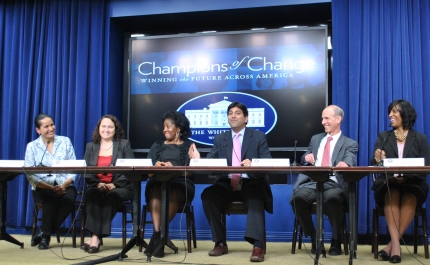
On December 9th, 2011 twelve local leaders in the effort to recruit and retain girls and women in science, technology, engineering, and math (STEM) fields were honored as White House Champions of Change. December 9, 2011. (by White House, Office of Public Engagement)
A dear friend of mine watched the live webcast of the “Champions for Change” panel. Afterwards she said to me, “Judit, you seemed so happy during the discussion. You smiled often. Were you looking at someone in the audience?”
I actually was. I was looking at two women who have inspired me for many years: Dr. Lydia Villa-Komaroff, a founding member of SACNAS and Dr. Yvonne Rodriguez, our Director of Programs. Having Lydia and Yvonne at the “Champions of Change” event was incredible—a way to honor both those who have come before and those who are leading the way.
The “Champions for Change” event was the first time that I have been recognized for my work as a woman working on behalf of women of color in STEM and an important step in my life as a woman, activist, leader, and mother. It also created a space at the national level for the continued and pressing dialogue about women in the STEM workforce. We are still a long way from parity in terms of representation of women in all fields of science, science leadership positions, salary equity, and in developing a healthy work/life balance. (I commend the National Science Foundation’s efforts in this direction with their Career-Life Balance Initiative.)
- &lsaquo previous
- …
- 174
- 175
- 176
- 177
- 178
- 179
- 180
- 181
- 182
- …
- next &rsaquo
Twitter