

Latest News
Investing in Women
Posted by on January 4, 2012 at 2:55 PM ESTHappy New Year everyone! We kick off 2012 with a brand new “Women Working to Do Good” blog from HelloGiggles. This week’s profile features Alexa von Tobel, the founder of a start-up focused on offering personal finance advice to women. In the profile the author writes, “It’s a role she was born to play. Alexa says she has known she wanted to be an entrepreneur since she was a little girl, filling notebooks with all her plans for future projects.”

Alexa Von Tobel. (Photo from HelloGiggles)
With the announcement of President Obama’s appointment of Richard Cordray to head the new Consumer Financial Protection Bureau, information and resources to prevent people from financial tricks and traps are becoming more abundant. For Alexa, her focus has been on educating women and arming them with “money skills” to improve their lives and help achieve their goals. “Alexa says she recognized a huge gap in the market. “Women control approximately eighty percent of household spending. It seemed like a no-brainer.”
With so many people making New Year’s resolutions to get their fiscal house in order, Alexa’s vision and passion to help women save money simply makes a lot of sense.
Read more about Women Working to Do Good:
- "Women Working to Do Good" Visits the White House
- A Girl's Best Friend
- Giving Thanks
- Showing Up in a Big Way
- Art Cart in the Big Apple
- An “Eco-Renaissance” Woman
- Teachers We Love
- Growing Community in Chicago
- Wonder Woman in the Los Angeles Volunteer World
Ronnie Cho is an Associate Director in the White House Office of Public Engagement.
Be Ready When Disaster Strikes
Posted by on January 1, 2012 at 1:00 PM EST
It has been my pleasure to serve as the Executive Director of the Be Ready Alliance Coordinating for Emergencies (BRACE) since its founding in 2006. Thirty-two years of service with the American Red Cross and then as the Escambia Long Term Recovery Coordinator following Hurricanes Ivan & Dennis provided great preparation for supporting 450 Partners as we strive to make our community the most disaster resilient in America. We provided survivors of Hurricanes Ivan & Dennis with over $1.3 Million in housing assistance after the end of the FEMA temporary housing mission. BRACE donated modular housing to 88 pre-disaster renters allowing them to realize the American Dream of home ownership.
In the anxiety provoking hours prior to landfall of Hurricane Ivan in 2004 over 85 first responder employees of Escambia County, the City of Pensacola and Escambia Sheriff’s Office learned that their plans for the care of their children had failed. They faced the terrible choice between caring for their children and probably losing their jobs or reporting to their emergency duty station and deserting their children. We are working with over a dozen BRACE Childcare for First Responder Partners to ensure first responders in our community never face that choice again. The BRACE coordinated Childcare for First Responders shelter ensures that emergency workers may give their full attention to disaster duties knowing that their children are in a safe environment, supported by experienced childcare professionals, well fed and secure.
We have been supporting efforts by government at all levels to establish a culture of preparedness. BRACE has conducted two Youth Emergency Preparedness (YEP!) expos during National Preparedness Month (September). Those expos have allowed BRACE to reach an audience of over 90,000 residents with disaster and emergency preparedness messaging thanks to the support of BRACE’s many media partners. The expos engaged over 800 youth in interactive, educational activities designed as service learning opportunities. In March 2011 BRACE introduced the Teen Community Emergency Response Team (CERT) curriculum at Escambia County High School, training 43 youth in emergency preparedness, fire safety, first aid, light search & rescue and other skills that will allow them to be support safety efforts at their school. We have met with principals of every public high school in the County to make the Teen CERT curriculum available throughout the entire county.
Don't Ask, Don't Tell Repeal One Year Later: “Out of Many, We Are One”
Posted by on December 22, 2011 at 12:33 PM EST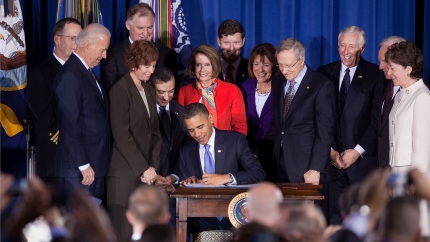
President Barack Obama signs the Don't Ask, Don't Tell Repeal Act of 2010 during a ceremony at the Interior Department in Washington, D.C., Dec. 22, 2010. (Official White House Photo by Chuck Kennedy)
For we are not a nation that says, “don’t ask, don’t tell.” We are a nation that says, “Out of many, we are one.” We are a nation that welcomes the service of every patriot. We are a nation that believes that all men and women are created equal. Those are the ideals that generations have fought for. Those are the ideals that we uphold today. And now, it is my honor to sign this bill into law.
-- President Barack Obama, December 22, 2010.
One year ago, President Obama signed into law the Don’t Ask Don’t Tell Repeal Act, bringing to an end a discriminatory policy that forced patriotic Americans to serve under a cloud of anxiety and isolation and stood in stark contrast to our shared values of unity and equality.
One year later, gay and lesbian service members can serve the country they love without hiding who they love – and both our military and country are stronger for it.
To commemorate the one year anniversary of President Obama signing the Don’t Ask Don’t Tell Repeal Act, we asked a few former service members to reflect on the long journey toward repeal and what it was like to watch President Obama sign the Repeal Act into law:
Zoe Dunning
Until her retirement in 2007, Retired Navy Commander Zoe Dunning was one of the only openly gay service members in the country, having successfully fought an attempted discharge in 1993. For many of those years, she served on the board of Servicemembers Legal Defense Network as an advocate for the repeal of DADT.
Watch Retired Navy Commander Zoe Dunning's story here.
Learn more about Civil Rights"Women Working to Do Good" Visits the White House
Posted by on December 22, 2011 at 10:00 AM ESTOver the past few months, I have had the pleasure of working with the website HelloGiggles to highlight incredible women that are making a difference in communities across the country. This project began with the goal of showcasing the women that President Obama has said are “the quiet heroes” in our lives, making our country stronger and prosperous. This series has now become one of the most read blogs on whitehouse.gov, and each week we look forward to getting to know another woman working to do good. This week’s blog features a look back at the blog series and a recap on a recent visit to the White House by HelloGiggles editor Julia Gazdag.
We all know someone like the women featured in this series, someone who quietly inspires us with their actions, their passion and generosity. They’re not doing it because it’s glamorous or because it pays incredibly well or because they’re seeking acclaim. No, these folks take care of our communities and improve people’s lives because it’s simply the right thing to do. This is exactly what makes America so great - that so many rise to the challenge issued by President Kennedy that we ask not what our country can do for us, but what we can do for our country.
As a son to a mother, a brother to a sister and, perhaps one day, a husband to a wife and a father to daughters, I am proud to highlight such amazing women that serve as role models to us all. So during this holiday season, as these heroes continue to educate our children, protect our communities, break down barriers and overcome challenges quietly, let our gratitude and admiration for their work be anything but.
Building Welcoming Communities for All
Posted by on December 21, 2011 at 4:45 PM ESTAchieving full economic recovery and maintaining America’s competitive edge globally now and into the future will require communities to fully embrace their strongest resource –their people. This is why communities around the country are taking a new approach to integrating newly arrived immigrants, refugees, and other newcomers into their community and creating more welcoming environments for all community members.
Through the New Americans Citizenship and Integration Initiative, officials from throughout the Administration have met with hundreds of leaders in communities across the nation to learn about successful models for integrating immigrants civically, economically, and linguistically. Recently, White House staff from the Domestic Policy Council and Office of Public Engagement sat down to learn more about Welcoming America, a national organization working to create a welcoming atmosphere – community by community –which helps immigrants integrate into the social fabric of their adopted hometowns. Welcoming America is a part of the “receiving communities movement,” which focuses on building 21st century communities that attract and retain global investment.
Learn more about ImmigrationWatch the White House Kitchen Get "Kosherized" for Hanukkah
Posted by on December 20, 2011 at 10:35 AM ESTPresident Obama and the First Lady today sent their warmest wishes to everyone celebrating Hanukkah around the world. Earlier this month the First Couple hosted a Hanukkah celebration at the White House, an event that involved making over the kitchen according to the highest standard of kosher observance. Watch the video below for a look at the White House kitchen as it has never been seen before:
Jarrod Bernstein is the Director of Jewish Outreach in the Office of Public Engagement.
Thinking Outside of the Box to Engage Individuals in Community Service
Posted by on December 20, 2011 at 9:30 AM EST I have always been inspired by leaders of our great nation and thus I am honored to be a White House Champion of Change. Upon reflecting about what service means to me for this event, I began to realize that service has struck my life in a multitude of ways. Community service is one of the most powerful tools we have because the resources one can provide their fellow human are infinite.
The ways in which we participate in community service must transcend the traditional forms of how we serve others. Soup kitchens and food banks are incredibly important to providing emergency services to people in need and could not operate without the support of volunteers. However, we also must highlight other forms of service that play an integral role in overcoming the reasons people resort to emergency resources. Mentoring or speaking to at-risk youth, providing IT support to non-profits, and educating ourselves about why challenges like food insecurity and social injustice exist are examples of uncomplicated approaches that support our communities. Encouraging a proactive, outside the box approach to service is critical to aiding communities in need, and in turn, combating many of the challenges our nation faces today.
My own story of service began in January 2007, when I traveled with a group of 11 people from St. Michael’s College to New Orleans to assist in the post-Hurricane Katrina relief efforts. At the onset of the trip, I was excited for the opportunity to travel to a new part of the country to do community service, but completely unaware of the impact this weeklong service trip would have on my life. During the week I served in New Orleans, I worked alongside others to clean the homes of two elderly people who had relocated after the storm. I was left with a daunting visual of the challenges our nation faces, but also met with a new found energy and interest in service.
Learn more about Service'Giving a Hand Up Not a Hand Out:' Helping People Get Back on Their Feet
Posted by on December 19, 2011 at 5:15 PM EST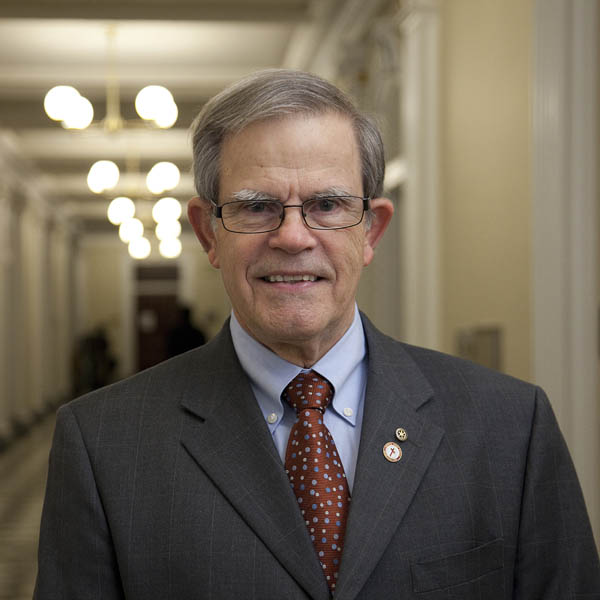
I am honored to be considered a “Champion of Change,” representing Central Union Mission in Washington, DC. Help for homeless and poor people has not changed much since the privately funded Mission began 127 years ago—clean beds, nutritious meals and hot showers will always be required. We continue to provide a clean, safe and polite overnight facility for men, as well as food, clothes and other necessities for families and children. What is changing, however, is the scope of our guests’ needs and how we address them. I can best explain our efforts toward wholesome change at our historic institution by introducing some of my partners in change.
I invited Dr. Jorge De Casanova to join the Mission staff in 1998 to open our services to the rapidly growing Hispanic community. We studied the community and began by offering a Bible study and sharing food and clothing. Word spread, and the Hispanic Family Ministries has grown to include over 300 families. Pastor Jorge challenged some preconceptions: classes in English literacy often need to begin with Spanish literacy. We need citizenship classes, but some need emotional and career counseling first. To offer vocational training, we incorporate testing and partner with other agencies for job experience. Free clothing, food and furniture ease the financial burden on under-employed families. Through this Ministry, hundreds of children receive school supplies so they can succeed, summer camp experiences that help them mature and Christmas and Easter presents that show them how much they are loved.
- &lsaquo previous
- …
- 175
- 176
- 177
- 178
- 179
- 180
- 181
- 182
- 183
- …
- next &rsaquo
Twitter