

Latest News
President Obama Meets with Tribal Leaders
Posted by on December 5, 2011 at 5:46 PM ESTOn December 2, 2011, following the 2011 White House Tribal Nations Conference, President Obama met with a small and regionally diverse group of tribal leaders from across Indian Country. Also participating in the meeting were Secretary of the Interior Ken Salazar, Secretary of Health and Human Services Kathleen Sebelius, Secretary of Education Arne Duncan, and Associate Attorney General Thomas Perrelli.
The tribal leaders in attendance had the opportunity to directly engage with the President on a leader-to-leader, government-to-government basis. They spoke about economic issues affecting their reservations and proposed some innovative solutions for developing sustainable economies focusing on building solar and wind projects, reducing regulatory burdens, expanding broadband and leveraging private sector investment, among others. Also discussed was the Executive Order on Improving American Indian and Alaska Native Educational Opportunities and Strengthening Tribal Colleges and Universities, which the President signed earlier in the day to improve education opportunities for Native American youth across the country.
The twelve tribal leaders that participated in the meeting were Fawn Sharpe, President, Quinault Indian Nation; Diane Enos, President, Salt River Pima-Maricopa Indian Community; Steve Ortiz, Chairman, Prairie Band Potawatomi Nation; Jefferson Keel, Lt. Governor, Chickasaw Nation; Nelson Cordova, Governor, Pueblo of Taos; George Edwardson, President, Inupiat Community of Arctic Slope; Ben Shelly, President, Navajo Nation; Richard Milanovich, Chairman, Agua Caliente Band of Cahuilla Indians; Colley Billie, Chairman, Miccosukee Indian Tribe; Tracy “Ching” King, President, Fort Belknap Indian Community; Rodney Bordeaux, President, Rosebud Sioux Tribe; and Erma Vizenor, Chairwoman, White Earth Band of Chippewa.
This meeting took place after a week of White House events that focused on strengthening the government-to-government relationship between the United States and Tribal Nations and building on the progress made during the 2009 and 2010 White House Tribal Nations Conferences. In addition to the President’s meeting, the White House hosted a series of Regional briefings and listening sessions for tribal leaders, highlighted 11 Native American youth as Champions of Change, released a White House Tribal Nations Conference Progress Report and at the Tribal Nations Conference the President spoke to representatives from the 565 federally recognized Indian tribes.
Learn more about , Economy, Education, Energy and Environment, Health Care, Taxes, Additional IssuesObama Administration Investment Promotes Job Growth and Mitigates Environmental Risk in Tribal Communities
Posted by on December 5, 2011 at 11:57 AM ESTThis year, President Obama hosted the third White House Tribal Nations Conference to hear directly from tribal leaders about their priorities. I had the opportunity to address some of the representatives of federally recognized tribes during a series of briefings and listening sessions hosted by the White House.
The President is committed to strengthening the government-to-government relationship with Indian Country and partnering and investing to find solutions to complex issues and to win the future for Indian Country.
Environmental challenges are affecting tribal economies. The Obama Administration has taken significant steps to mitigate environmental risks and strengthen the capacity of reservations to meet the training and economic needs of their communities.
Native Americans living on reservations experience higher incidences of environmentally-related health issues than other groups, including in the upper Missouri River basin. This includes 19 reservations in Montana, North Dakota and South Dakota, along the Missouri River system and its tributaries where minerals and wildlife are abundant both in water and on land. Unfortunately, as concerns about the environment have plagued these communities, the response has not been timely or meaningful. These are areas of the country where the norm is economic depression and generational unemployment. In some cases unemployment rates approach 90 percent. The impacts of environmental degradation have contributed to stagnant business growth in these rural communities and severely limited opportunities for workers.
One major problem is the lack of qualified technicians to tackle these environmental issues. According to data from the 2005 Bureau of Indian Affairs Labor Report, approximately 240,000 residents inhabit these tribal areas but only about 140,000 of them are available for the workforce.
Recently, a $1.6 million Jobs and Innovation Accelerator Challenge award was presented to United Tribes Technical College, Bismarck, North Dakota, for the Upper Missouri Tribal Environmental Risk Mitigation (UM‐TERM) cluster to help accelerate jobs and business development in natural resources and reduce unemployment in economically distressed tribal areas. The cluster leverages existing resources of Tribal Colleges, the Native American Business Enterprise Center funded by Commerce's Minority Business Development Agency (MBDA), and tribal Planners. The project is expected to provide training and education for 1,045 participants, creating a sustainable network of approximately 120 regional environmental technicians, and 15 new minority‐owned businesses.
The Importance of Education for the Success of America’s Latino Community
Posted by on December 1, 2011 at 12:14 PM ESTToday at 2pm EST, I will be participating in LATINO Magazine’s 2011 Latino Youth Forumin Washington, DC. As a part of a panel made up of educators and community leaders, and moderated by CNN commentator Maria Cardona, we will be discussing a very real crisis plaguing the Latino community - the number of Latino students dropping out of school.
As a greater share of our young people compete with their peers across the globe for the jobs and industries for our time, President Obama has called us to be engaged in a race to the top. America needs a workforce that is smart, skilled, creative and equipped to succeed in today’s global economy. Our ability to meet that demand is being decided every day, in schools and classrooms across our nation. The future of our economy is inextricably linked to the strength of our education system; we will not win this global contest until we secure the educational advancement and success of America’s Latino community.
As the nation’s largest minority group, Latinos number more than 11 million students in America’s public elementary and secondary schools and constitute more than 22 percent of all pre-K-12 students. More than one in five students enrolled in America’s schools is Latino. Yet, only about half of all Latino students earn their high school diploma on time; those who do complete high school are only half as likely as their peers to be prepared for college.
Our Administration is working to reform America’s schools and to build a world-class education system that will deliver the complete and competitive education needed to prepare every child for college and a career. As the Obama Administration works to re-shape K-12 education, to invest in innovation, and to develop new solutions for closing the achievement gap, the work of education reform can have a profound effect on America’s Latino communities – fulfilling our commitment to equality and unlocking the doors of opportunity for millions of Latino students and their families.
I look forward to the opportunity to hear directly from Latino students about their personal experiences and concerns, andI encourage you to watch the live webcast, as well as join our discussion, by visiting latinomagazine.com from 2-4pm EST.
Roberto Rodriguez is the Special Assistant to the President for Education Policy.
Over 200 Leaders Attend White House Hispanic Community Action Summit in Albuquerque
Posted by on November 30, 2011 at 3:28 PM ESTEd. Note: Cross-posted from the Department of Education.
The wellbeing of Hispanics in America is inextricably tied to the nation’s overall success.
This message was heard loud and clear throughout the day on Saturday, November 12th at the White House Hispanic Community Action Summit held at the National Hispanic Cultural Center in Albuquerque, New Mexico. Over 200 community grassroots and institutional leaders gathered to voice their hopes around addressing the most pressing issues affecting New Mexicans, which included educational improvement, quality health care access, job growth and economic development, and comprehensive immigration reform.
This was not your average federal government meeting. Over a dozen White House Administration officials made themselves available to engage and listen to participants in dynamic community-led open space discussions. After a morning briefing by the federal officials, the microphone was handed over to participants as they proposed over 20 sessions on the topics most important to the people of New Mexico. From early childhood education to land grants-to the federal workforce, all topics were on the table as White House officials listened and offered resources around the issues.
Report From The Field: A Broadband Bridge To Puerto Rico
Posted by on November 30, 2011 at 3:00 PM ESTAccording to NTIA’s National Broadband Map, less than half of Puerto Ricans have access to basic broadband service, which consumers increasingly need to apply for and get a job, access valuable education and healthcare information, and participate in today’s digital economy.
To help fill this gap, NTIA awarded Puerto Rico two Recovery Act grants to expand and enhance broadband infrastructure. While I was in San Juan earlier this month at the Puerto Rico Chamber of Commerce’s Annual Telecom Conference, I had the opportunity to visit one of these projects.
I joined members of Critical Hub staff and Puerto Rico Chief Information Officer Juan Eugenio Rodriguez on a tour of Critical Hub’s data center facilities in San Juan, part of its Puerto Rico Bridge Initiative (PRBI) BTOP project.
Critical Hub Networks, which received a $25.6 million grant, is expanding high-speed Internet access in underserved areas of Puerto Rico by establishing a broadband “bridge” to the United States mainland and deploying a high-capacity middle-mile network on the islands. Additionally, Critical Hub will also offer a 25 percent broadband discount to K-12 schools to help improve education and distance learning.

Critical Hub Networks Vice President Karen Larson, Deputy Asst. Secretary Anna Gómez, and Puerto Rico Bridge Initiative Community Outreach Coordinator Leslie Ortíz at the Puerto Rico Bridge Initiative’s facilities in San Juan. November 29, 2011. (by National Telecommunications and Information Administration)
Learn more about TechnologyRegional Planning – Key to Rural Economic Strength
Posted by on November 28, 2011 at 11:08 AM ESTEd. note: This blog is cross-posted from USDA.gov.
Both of us grew up in small towns, Kathleen in Greenfield, MA and Bob in Ancram, NY. From our own experiences, we understand the challenges and the importance of a strong rural economy.
We recently visited Brevard, a town of about 6,000 people in North Carolina’s Transylvania County. While there we held a White House Rural Council meeting at the Transylvania County Library with leadership from the Land-of-Sky Regional Council, the regional economic development commission AdvantageWest, business leaders from Asheville and Brevard, and several local elected officials. We released a report from the Partnership for Sustainable Communities, Supporting Sustainable Rural Communities, at Brevard College, which focuses on how the federal government can help rural areas to be economically vibrant and environmentally sustainable.
One theme that was discussed at the Rural Council roundtable was the need for communities to be solution oriented by setting priorities and realistic goals for the direction they want their region to head. In Transylvania County, about 1/6th of the residents used to work in the paper mill business, an industry that is no longer there. So the county is working within the region to figure out how they can build a sustainable community for the future, one that recognizes the great economic value of the water, farmland and forests in Western North Carolina.
Participants asked about how communities can continue economic growth with declining Federal, state and local resources. We spoke about the need for regional planners to get the right people around the table in order to create a clear vision in the community so that they can make the best use of Federal funding to form partnerships and leverage private sector development. Because ultimately, the economy in Brevard, like the small towns we grew up in, is linked to the rest of the region.
Learn more about RuralGiving Thanks
Posted by on November 23, 2011 at 3:22 PM ESTI love Thanksgiving. I love everything about it -the crunchy leaves beneath our feet, the sound and smells of a kitchen at work, making a list of the things I’m thankful for (baseball, the men and women in military service, my parents, America), the company of friends and family while retelling old stories, and of course the food!
A great writer once called Thanksgiving the “one day that is ours … the one day that is purely American.” On this day we gather around to enjoy a feast to end all feasts, surrounded by those we love to share our gratitude for all that we have.
As President Obama said in his remarks during the annual turkey pardoning ceremony, we also need “to be mindful of those who have less. Let’s appreciate those who hold a special place in our lives, and make sure that they know it.” It’s that very sentiment that inspired a young woman to create a solution that gives back to those in need.

Eva Radke. (Photo from HelloGiggles)
Progress and Persistence in Pursuit of Workplace Equality
Posted by on November 21, 2011 at 6:55 PM ESTEd. Note: This piece also appears on the U.S. Department of Labor's official blog.
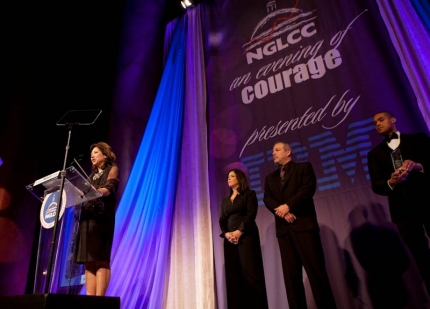
Labor Secretary Hilda Solis speaks at the National Gay and Lesbian Chamber of Commerce’s (NGLCC) annual dinner (photo courtesy of the Department of Labor). November 18, 2011. (by U.S. Department of Labor)
On Friday, I was proud to attend the National Gay and Lesbian Chamber of Commerce’s (NGLCC) annual dinner to talk about this Administration’s commitment to support LGBT entrepreneurs and workers.
I’ve spent the last two decades fighting for equal opportunity for LGBT Americans, so I was honored to receive the NGLCC’s Extra Mile Award. But as I made clear in my speech, it’s our LGBT job creators who should be thanked and supported.
It’s hard to overstate the contributions of the lesbian, gay, bisexual and transgender community to our national economy. Across America, an estimated 1.4 million LGBT-owned businesses are making products, delivering vital services, exporting goods and creating jobs. And LGBT purchasing power is expected to top $800 billion this year.
These numbers demonstrate the LGBT community’s critical role in advancing our economic recovery—and our government’s obligation to promote policies that value their contributions.
Learn more about Civil Rights
- &lsaquo previous
- …
- 180
- 181
- 182
- 183
- 184
- 185
- 186
- 187
- 188
- …
- next &rsaquo
Twitter